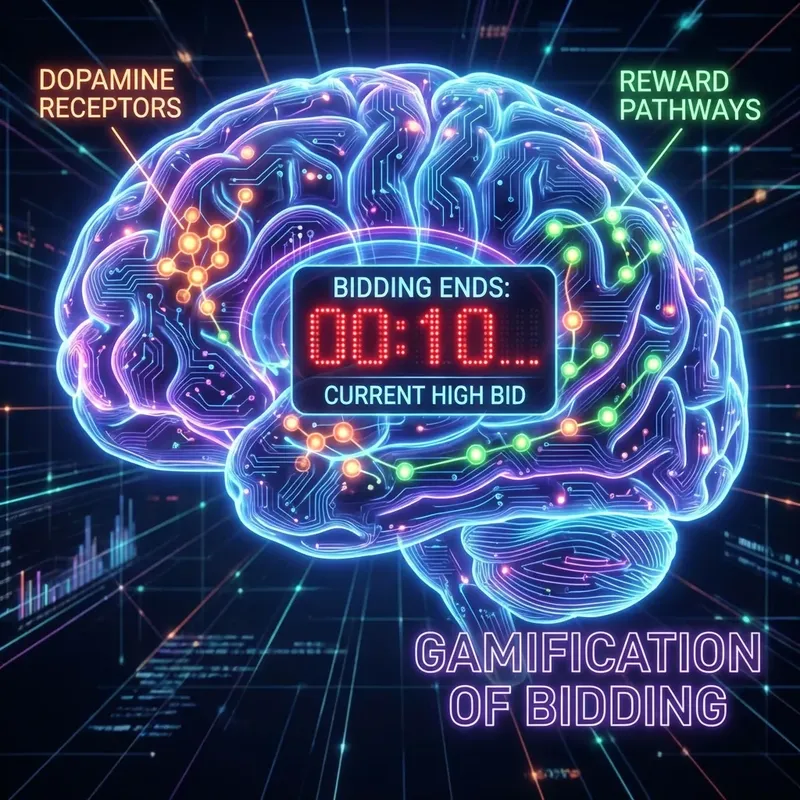
We've all been there. You set a hard limit of $100. Then the timer hits 0:10. Someone bids $105. Your heart rate spikes. Your palms sweat. Before your logical brain can intervene, your thumb hits "$110". Why?
1. The Endowment Effect
Behavioral economists call this the "Endowment Effect". Once you occupy the "Winning Bidder" slot for more than 30 seconds, your brain psychologically registers the item as yours. When someone outbids you, it doesn't feel like a missed opportunity; it feels like theft.
You aren't bidding to gain the card anymore. You are bidding to avoid losing what you already believe you own.
2. The Dopamine Loop
Auction platforms are designed like slot machines. The bright red countdown timers, the flashing "OUTBID" notifications—these are triggering a dopamine release. The anticipation of the win is actually more chemically potent than the win itself.
The "Winner's Curse"
In competitive auctions with common information (like card grading), the winner is mathematically the person who most overestimated the item's value.
3. Escaping the Trap
The only way to beat Auction Fever is to remove the "Real Time" element.
- Use Snipe Tools: Set your max bid 2 days early and walk away.
- Never Live-Bid: If you are watching the timer, you have already lost.
- Calculate Fees First: Remember that $100 bid is actually $122 after tax/shipping.