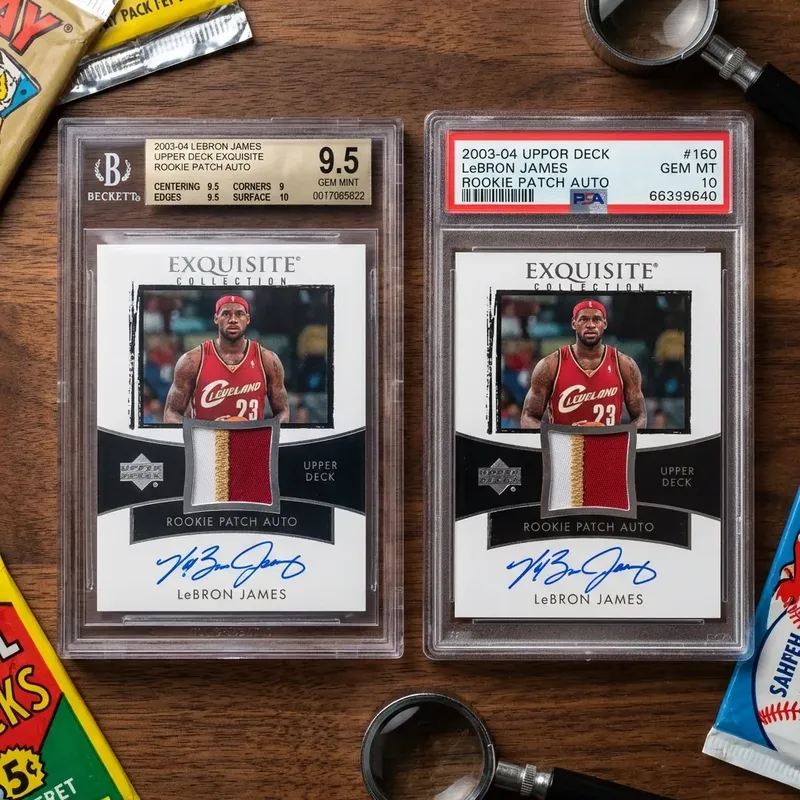
For nearly two decades, the Beckett Grading Services (BGS) 9.5 "Gem Mint" and the Professional Sports Authenticator (PSA) 10 "Gem Mint" were viewed as rough equivalents. That era is definitively over.
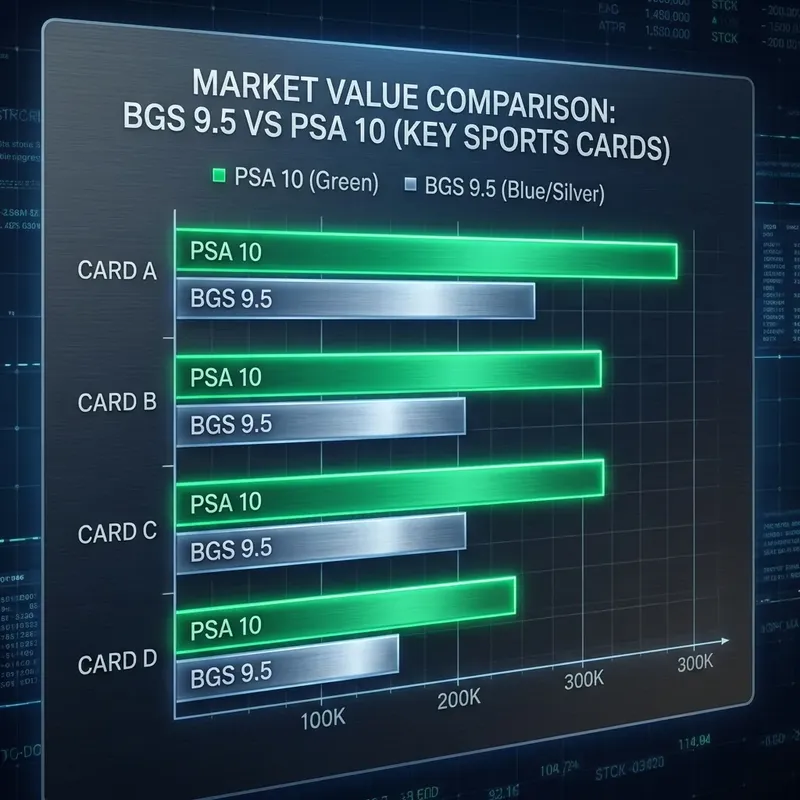
In today's market, the PSA 10 Gem Mint commands a premium that defies simple logic. It has become the de-facto currency of the hobby. While purists may argue about BGS subgrades and the strictness of Beckett's scale, the market has spoken with its wallet: PSA 10s consistently outsell BGS 9.5s by 30% to 50% (and sometimes more on vintage or low-pop cards).
This price disparity creates one of the few true arbitrage opportunities left in the sports card market: buying "strong" BGS 9.5s, cracking them out of their cases, and resubmitting them to PSA for that coveted 10 grade. But be warned: this is not a game of chance. It is a game of skill, eye appeal, and understanding the distinct grading philosophies of Newport Beach (PSA) vs. Dallas (Beckett).
Both graders have changed this year. PSA's cheapest open tier is now Standard at $59.99 (Priority $79.99 for a $1,500 cap — a $450-850 crossover target fits Standard's $1,000 cap only if the graded value stays under $1,000; declare carefully or expect an upcharge). On the BGS side, Beckett paused Base/Standard submissions in August and reopened Sept 15 through a temporary form while beckett.com is under maintenance — buying BGS 9.5 inventory on the secondary market is unaffected, but factor the new PSA tier math into your spread.
The Math: Why We Crack
Let's look at the numbers. The "Spread" is what makes this strategy viable. You aren't just looking for a slight bump; you are looking for a multiplier event.
Consider a 2018 Luka Doncic Prizm Base Rookie:
- BGS 9.5 Value: ~$450 - $500
- PSA 10 Value: ~$750 - $850
After factoring in grading fees (~$60-80 per card at PSA's current Standard/Priority tiers — the Value tiers are paused since June 2026 — plus shipping) and selling fees (13%), the profit margin on a successful cross is roughly $150-$250 per card. Do this ten times, and you've funded a major purchase. But if you fail? A PSA 9 often sells for less than a BGS 9.5 (~$350). The risk is real.
Decoding the Subgrades: The "True Gem" Theory
The secret to high conversion rates lies in the BGS subgrades. Beckett provides four specific scores: Centering, Corners, Edges, Surface. PSA, on the other hand, gives one composite grade. To succeed, you must reverse-engineer how a BGS subgrade translates to PSA's eyes.
PSA is notoriously strict on specific flaws (corners and surface) while being slightly more lenient on others (centering, especially on the back). BGS is a rigid mathematical formula.
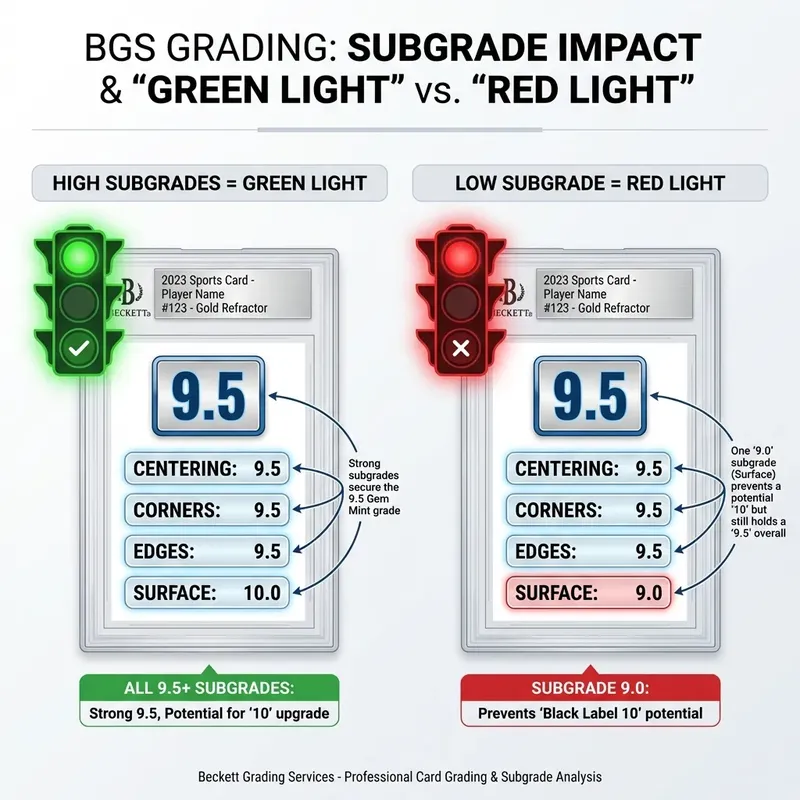
1. The "Quad 9.5" (The Safe Bet)
A BGS slab with 9.5s across the board is a prime candidate. It implies no single attribute is weak. PSA loves balanced cards. These have a 60-70% crossover rate if vetted properly.
2. The "Min Gem" (The Trap)
This is a BGS 9.5 with subgrades like: 9.5, 9.5, 9.5, 9.0.
DANGER ZONE. The 9.0 is the weak link.
- If the 9.0 is Corners: DO NOT CRACK. PSA is brutal on corners. 9.0 corners at BGS is a PSA 9 (or 8) instantly.
- If the 9.0 is Surface: Proceed with Caution. Use a loupe. Is it a print line? A scratch? PSA hates scratches but might forgive a faint print line on the back.
- If the 9.0 is Centering: GOLD MINE. PSA allows up to 60/40 centering for a PSA 10. BGS is stricter (50/50). A BGS 9.0 centering grade often fits comfortably inside PSA 10 standards.
3. The 10.0 Subgrade (The Offset)
Buying a card with a "Pristine 10" subgrade (like 10 Centering, 9.5 Corners, 9.5 Edges, 9.0 Surface) is often a great play. The 10 shows that one aspect of the card is flawless, which creates immense eye appeal. Eye appeal wins at PSA.
Strategy: Crack Out vs. Cross-Over Service
This is the most debated topic in the conversion community. You have two options:
Option A: The Cross-Over (In Slab)
You send the card to PSA inside the BGS slab. You set a "Minimum Grade" of 10. If they think it's a 10, they crack it and slab it. If not, they return it in the BGS slab.
Success Rate: < 10%
Why: PSA is biased. Grading a card through plastic is harder. They will default to "Did Not Meet Minimum Grade" to be safe.
Option B: Crack and sub (Raw)
You physically break the BGS slab yourself, remove the card, and send it to PSA as a "Raw" card. PSA has no idea it was ever a BGS 9.5.
Success Rate: ~50-60%
Why: Unbiased grading. The card stands on its own merits without the BGS label influencing the grader.
Verdict: If you are serious, you crack. The Cross-Over service is a donation to PSA.
The Final Checklist Before You Crack
Before you take pliers to plastic, run through this 5-point inspection.
- Wipe the slab clean: Scratches on the BGS case can look like scratches on the card. Polish it first.
- Check the corners under 10x magnification: Any whitening? Any soft tips? If yes, stop.
- Surface scan in raking light: Tilt the card under a bright LED. Look for the "spider web" scratches BGS might have missed (or graded as a 9.5). PSA will crush you for these.
- Measure the centering: Use a digital centering tool. Is it better than 60/40? If it's 55/45, you are golden.
- Check the Pop Report: Does PSA control the population of this card? Some sets (like 2012 Prizm) are famously hard to get 10s on now. Know the "grader mood" for that set.
Don't guess. Use our AI Pre-Grade Calculator to scan your BGS slab visuals and get a probability score for a PSA 10 conversion.