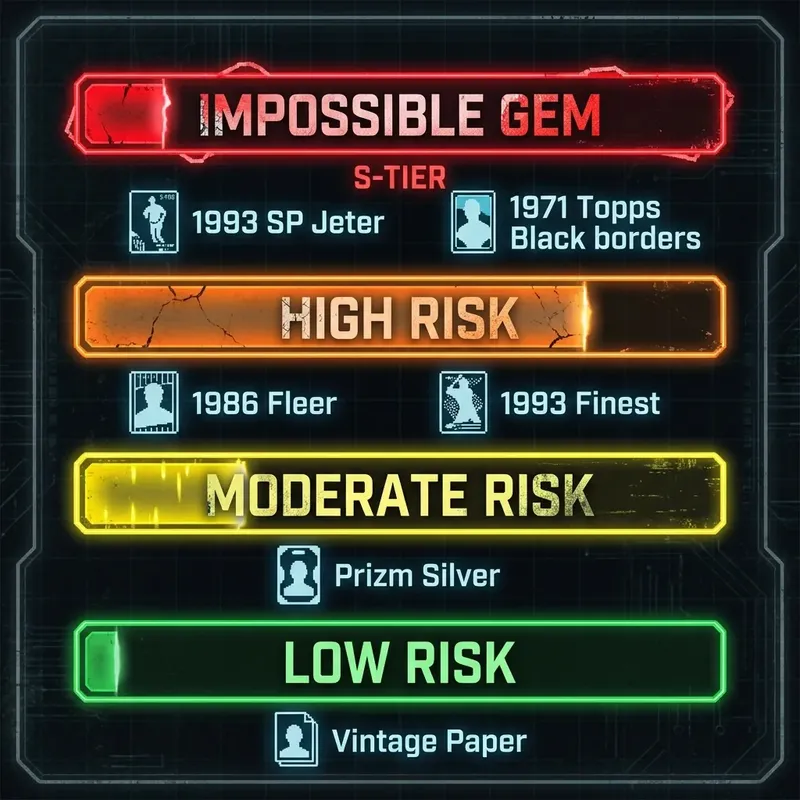
When investing in a card, you are betting on its condition surviving time, humidity, and gravity. The "Fragility Index" measures how likely a card is to downgrade itself simply by existing.
The Chemistry of Failure
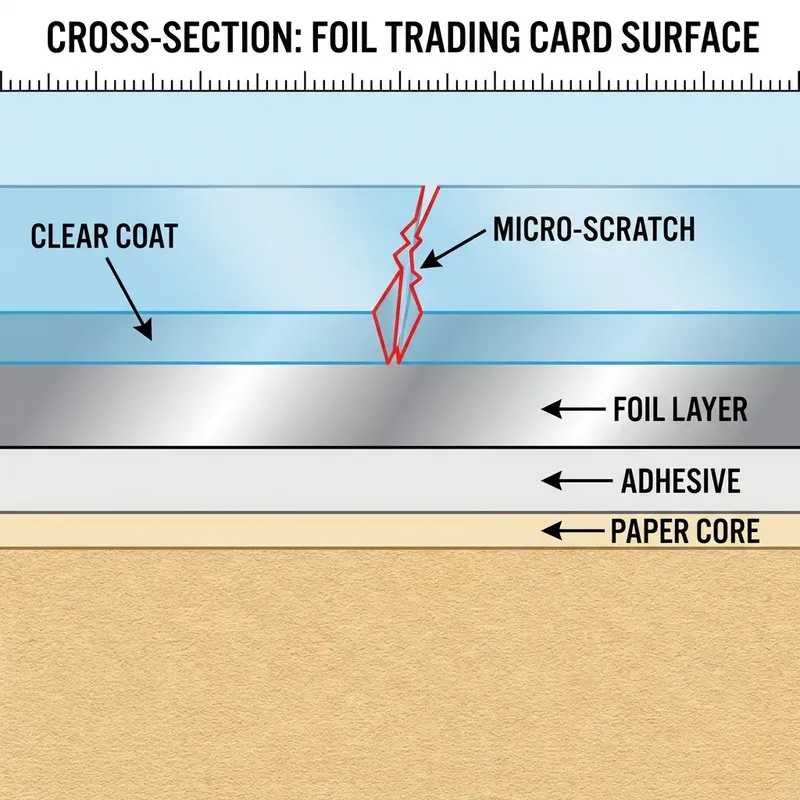
Why do some cards fail? It's usually a conflict of materials. Foil layers expand at different rates than paper cores. Glossy coatings crack when flexed.
The Ranking (2026 Edition)
1993 SP Foil (Jeter)
The undisputed king of fragility. The entire surface is a delicate foil sheet glued to flimsy paper. If you breathe on it, it scratches. If you look at it wrong, the corner peels.
1971 Topps (Black Borders)
The midnight black ink on the edges chips if the card moves inside a toploader. Simply shipping a raw copy usually downgrades it from an 8 to a 6.
Chrome / Prizm (Hulking)
Modern chrome cards have a "bowing" or "hulking" issue due to humidity. While they don't chip easily, surface clouding (polymer degradation) is a silent killer.
The "Hulk" Effect
Chrome cards curve because the plastic layer does not absorb moisture, but the paper back does. In humid environments (Florida, SE Asia), the back creates tension, bowing the card. A "hulked" card can be fixed with a humility chamber, but if forced flat quickly, it will crease.
The Verdict
If you own an S-Tier fragile card in high grade, do not touch it. Do not crack it out. Do not reholder it unless necessary. You are holding a chemical miracle that is trying to destroy itself.