When a human grader holds your card, they are looking for "Silvering"—the white flash of inner card stock showing through a dark border. But when a computer looks at your card, it sees a Histogram of Intensity Gradients.
Modern grading companies like PSA, CGC, and TAG are increasingly integrating Computer Vision (CV) into their workflow. To understand why your card got a 9, you need to understand the algorithm that likely flagged it.
The Algorithm: Canny Edge Detection
The industry standard for detecting edges in digital image processing is the Canny Edge Detector. Developed by John F. Canny in 1986, this algorithm uses a multi-stage process to detect a wide range of edges in images.
Translation: The AI looks for sudden changes in brightness. On a Pokemon card, the yellow border should transition to the background smoothly. If there is a "micro-fracture" (tiny chip), the brightness spikes instantly. The Canny algorithm flags this spike as an edge defect.
The "Sub-Pixel" Problem
Here is the scary part: AI can see between the pixels. By calculating the intensity of adjacent pixels, algorithms can infer edge location to an accuracy of 0.1 pixels. This means detecting "Soft Corners" that look perfectly sharp to the naked eye.

Human View
"Looks Clean. Maybe a 10?"
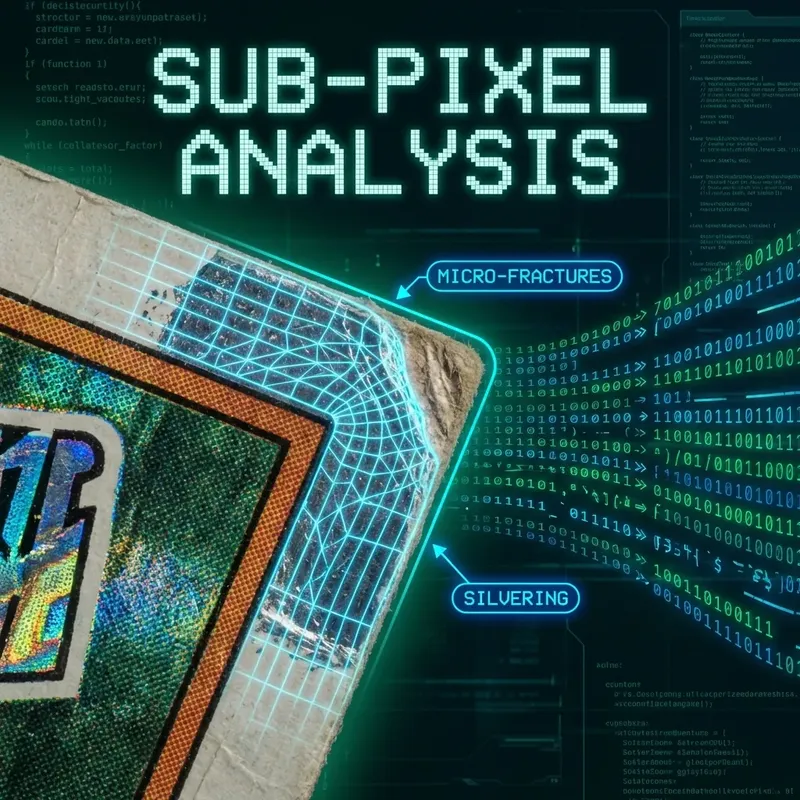
Machine View
"Fracture detected. Sector 4. Grade: 8.5"
How to Beat the Machine
You cannot trick the algorithm, but you can "Pre-Filter" your submissions. The goal is to stop sending cards that have High-Frequency Noise on the edges.
1. The 60x Loupe Rule
If you can see a divot at 60x magnification, the AI will see a canyon. Do not submit 60x flaws expecting a 10.
2. Clean Your Edges (Safely)
Sometimes "whitening" is just dust or paper fiber from the factory cut (common in 2023-24 Topps). A gentle brush with a pantyhose cloth can remove this "noise" before the scanner sees it.
The Future is Automated
Companies like TAG are already grading 100% digitally. PSA bought Genamint to integrate this tech. The days of "opinion based" grading are ending. The days of "pixel based" grading are here.