The Short Answer
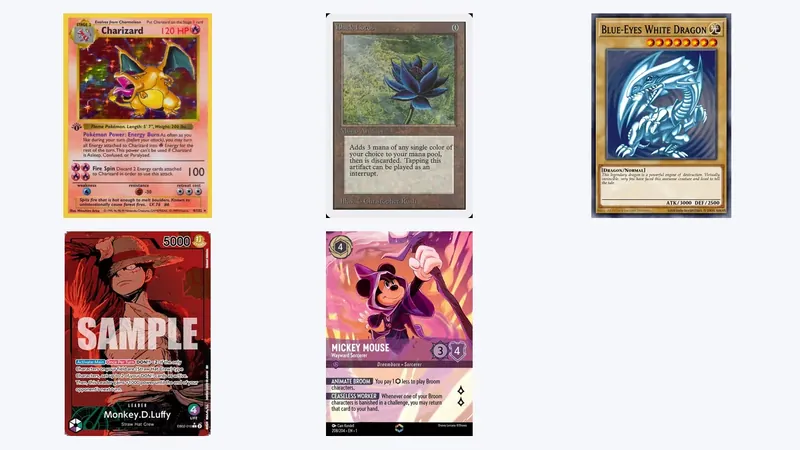
- AI TCG grading supports 15+ trading card games including Pokémon, Magic, Yu-Gi-Oh!, One Piece, and Lorcana.
- The AI identifies card set, number, rarity, language, and foil type from a single photo.
- TCG cards are graded on the same four pillars as sports cards: centering, corners, edges, and surface.
- Foil, holo, and textured cards require special surface detection for scratches and print lines.
- AI TCG grading is 85-92% accurate within one grade point of professional graders.
- Pre-screening improves ROI by filtering out low-grade candidates before paying professional grading fees.
What Is AI TCG Grading?
AI TCG grading uses computer vision and deep learning to identify a trading card game card and estimate its professional condition grade. The AI recognizes the game, set, card number, rarity, language, and foil type from a photograph. It then analyzes centering, corners, edges, and surface to predict the grade a professional service like PSA, CGC, or BGS would assign.
Trading card games have unique grading challenges that make AI especially useful. TCG cards come in many languages, with different foil treatments, different border styles, and different rarity symbols. A human collector needs to be an expert in each game to evaluate cards accurately. The AI is trained on millions of cards across all major games and can identify and grade them consistently.
The purpose of AI TCG grading is pre-screening. Professional grading costs $20-$300 per card, and many TCG cards are not worth grading in low grades. AI pre-screening costs under $1 per card and helps collectors decide which cards to submit. This is especially valuable for modern TCG cards, where the PSA 10 premium can be 5-20x the PSA 9 price.
How AI TCG Grading Works
The AI TCG grading pipeline follows a structured process that combines identification, alignment, and condition analysis. Here is the step-by-step workflow.
| Step | What AI Does | Output |
|---|---|---|
| 1. Capture | User photographs front and back under good lighting | High-resolution card image |
| 2. Detect Game | AI identifies Pokémon, Magic, Yu-Gi-Oh!, etc. | Game classification |
| 3. Identify Card | AI reads set symbol, card number, name, rarity | Card metadata |
| 4. Align | AI corrects perspective and crops the card | Straight card image |
| 5. Grade | AI analyzes centering, corners, edges, surface | Predicted grade |
| 6. Report | AI delivers grade, sub-scores, and defect map | Grading report |
The identification step is unique to TCG grading. Sports cards are usually identified by player, but TCG cards are identified by game, set, number, and rarity. The AI must be trained to read the set symbol, card number, and rarity indicator for each game. This is a complex task because different games use different visual languages for the same information.
Supported Trading Card Games
AI TCG grading supports the major trading card games and many niche games. The following table lists the most important supported games and their grading characteristics.
| TCG | Most Graded Cards | Key Grading Challenges |
|---|---|---|
| Pokémon | Base Set Charizard, Shadowless, 1st Edition | Holo scratches, centering, counterfeit detection |
| Magic: The Gathering | Alpha, Beta, Reserved List, Modern staples | Edge wear, print quality, old card stock |
| Yu-Gi-Oh! | First Edition, Ghost Rares, Starlight Rares | Holo surface, corner whitening, print lines |
| One Piece | Alt-art leaders, Manga panels, OP-01 | Alt-art surface, centering, embossing |
| Disney Lorcana | Enchanted foils, first chapter | Enchanted foil surface, corner issues |
| Flesh and Blood | Cold foils, Marvels, legendary equipment | Cold foil surface, cold foil pattern |
| Digimon / Dragon Ball | Secret rares, alt arts, special foils | Foil texture, centering, holo scratches |
The AI models are trained on cards from all these games and more. As new games are released, the models can be updated to recognize them. The most valuable cards to grade are usually the earliest chase cards from each game, because they have the strongest collector demand and the highest PSA 10 premiums.
The Four Grading Pillars for TCG Cards
TCG cards are graded on the same four pillars as sports cards: centering, corners, edges, and surface. Each pillar has game-specific considerations that the AI must account for.
Centering is the most common reason TCG cards lose a grade point. PSA 10 requires 55/45 front centering and 75/25 back centering. Many TCG cards have narrow borders, and even small misalignment is visible. Pokémon cards are particularly known for centering issues, especially from the Base Set era. Yu-Gi-Oh! cards have a more complex layout with multiple text boxes and artwork frames, making centering harder to evaluate visually.
Corners are evaluated for sharpness, whitening, and fraying. TCG cards are often played with, which causes corner damage. Even unplayed cards can have soft corners from factory handling. Magic cards from the early years have rounded corners by design, which are not graded as damage. Modern Magic cards have sharper corners and are graded more strictly.
Edges are evaluated for chipping, whitening, and fraying. Edge wear is common on TCG cards because they are often stored in boxes and binders. The edges of Magic Alpha and Beta cards are particularly prone to whitening because of the card stock used in the early 1990s. Yu-Gi-Oh! cards have thin borders that show edge wear easily.
Surface is the most complex pillar for TCG cards. Foil, holo, and textured cards have reflective surfaces that show every defect. The AI must distinguish between the intended foil pattern and actual scratches or print lines. This is particularly challenging for Pokémon holo cards, Yu-Gi-Oh! Ghost Rares, and Magic foil cards.
Card Identification and Authentication
Beyond grading, AI TCG systems provide powerful identification and authentication features. The AI can identify the game, set, card name, card number, rarity, year, language, and printing. This is useful for cataloging collections, pricing cards, and detecting mislabeled listings. It can also help detect counterfeit cards by flagging inconsistencies in design, borders, and holograms.
Counterfeit detection is especially important for high-value TCG cards. Fake Pokémon Charizards, Magic Black Lotuses, and Yu-Gi-Oh! Blue-Eyes White Dragons are common in the market. The AI can detect counterfeit cards by comparing them to known authentic examples. It checks the border color, font, set symbol, hologram pattern, and card texture. However, AI authentication should be paired with manual verification for the most valuable cards.
The identification feature is also useful for foreign language cards. The AI can recognize Japanese, Chinese, Korean, German, French, Spanish, and other language variants. This is important because foreign language cards can have different values than their English counterparts. A Japanese Pokémon card is often more valuable than the English version, while a German Magic card may be less valuable.
Foil, Holo, and Textured TCG Cards
Foil and holo cards are the most valuable and the most difficult to grade in TCGs. The reflective surface makes scratches, print lines, and surface residue highly visible. Different games use different foil technologies, and the AI must be trained on each type.
Pokémon holo cards use a classic star pattern foil. The foil layer is embedded in the card and is prone to scratching. A holo scratch is a permanent defect that usually prevents PSA 10. The Base Set Charizard is the most famous example of a card where the holo surface is heavily scrutinized. Shadowless cards and 1st Edition cards are even more valuable and are graded more strictly.
Magic: The Gathering foil cards use a rainbow foil pattern. The foil can be applied to the entire card or just the illustration. Old foils from the 1990s and early 2000s have a different texture than modern foils. The most common surface issues are clouding, scratching, and curling. Curling is a known issue with Magic foils and can affect the grade.
Yu-Gi-Oh! cards have several foil types including Secret Rare, Ultra Rare, Ghost Rare, and Starlight Rare. Ghost Rares are particularly difficult to grade because the artwork is partially transparent and the foil extends across the entire card. Starlight Rares have a unique pattern that can hide scratches or make them more obvious depending on the angle.
One Piece and Lorcana cards have textured and embossed finishes. The texture is part of the design, but real defects can still occur on the raised surfaces. The AI learns to distinguish between the intended texture and actual damage.
Foreign Language and Regional Cards
TCG markets are global, and foreign language cards are a significant part of the grading market. Japanese Pokémon cards are often more valuable than English cards because they are the first printing and have better print quality. Japanese Yu-Gi-Oh! cards have different rarities and set structures than English cards. Korean and Chinese cards are also collected, though they generally have lower liquidity than English and Japanese cards.
European Magic: The Gathering cards are printed in English, French, German, Italian, Spanish, Portuguese, and Japanese. Russian and Chinese printings are less common. The language can affect the value significantly. English cards are usually the most valuable, followed by Japanese and sometimes German for older sets. The AI must recognize the language from the text and font style.
Foreign language cards also have different centering standards in practice. Japanese cards are often printed with tighter tolerances than English cards. European cards sometimes have wider borders. The AI accounts for these regional differences when making grading predictions.
Accuracy vs PSA, CGC, and BGS
AI TCG grading accuracy is typically 85-92% within one grade point of professional graders. The accuracy is highest for modern cards with good images and lowest for vintage cards with poor images or unusual defects. The accuracy also varies by game, because different games have different card stocks, foil types, and border styles.
PSA is the dominant brand for Pokémon and many other TCGs. CGC has become the second-most popular brand and is sometimes preferred for Magic and Yu-Gi-Oh! because of its strict standards. BGS is less common for TCGs but still used for high-value cards. The AI predicts grades for all three services based on their known standards.
The accuracy breakdown by pillar is similar to sports cards: centering 95%+, corners 90%+, edges 85%+, and surface 80%+. Surface is the most difficult because of foil reflections and the subtle nature of TCG holo scratches. The AI is continuously improving as it is trained on more graded card images.
The chart above shows approximate AI accuracy by game. Newer games like One Piece and Lorcana have lower accuracy because there is less training data available. As more graded cards are added to the training set, accuracy will improve.
ROI of Pre-Screening TCG Cards with AI
The financial case for AI TCG grading is strong. Professional grading costs $20-$300 per card, while AI pre-screening costs under $1 per card. TCG cards have some of the highest PSA 10 premiums in the collectibles market, making grade prediction extremely valuable.
Consider a Pokémon collector with 50 raw Base Set Charizards. Without pre-screening, the collector might submit all 50 cards to PSA at $100 each for a total cost of $5,000. If 15 come back PSA 8, 25 come back PSA 9, and 10 come back PSA 10, and the values are $500, $2,000, and $10,000 respectively, the total value is $7,500 + $50,000 + $100,000 = $157,500. After subtracting grading costs, the net is $152,500.
With AI pre-screening, the collector might identify only the 20 strongest candidates. The AI cost is $20. If 8 come back PSA 10 and 12 come back PSA 9, the value is $80,000 + $24,000 = $104,000. The grading cost is $2,000. The net is $101,980. The remaining 30 cards can be sold raw for $300 each, adding $9,000. The total with AI is $110,980. The collector saved $3,000 in grading fees and reduced the risk of low grades. For cards with lower values, the AI filtering is even more important because low-grade cards can lose money after grading.
The PreGradeCards AI TCG Grading Workflow
PreGradeCards makes AI TCG grading accessible to every collector. The workflow is designed to be simple, fast, and accurate.
- Upload: Take a clear photo of the front and back of your card under good lighting. Place the card on a dark, flat surface for best results.
- Identify: The AI recognizes the game, set, card number, rarity, language, and foil type automatically.
- Inspect: The AI analyzes centering, corners, edges, and surface in seconds. It flags specific defects and provides a defect map.
- Score: The AI provides predicted grades for PSA, CGC, and BGS, along with sub-scores for each pillar.
- Decide: Based on the prediction, you decide whether to submit the card, sell it raw, or hold it ungraded.
The entire process takes less than a minute per card. You can analyze entire collections in a single session and build a submission list of only the strongest candidates. This is the modern approach to TCG card grading.
Frequently Asked Questions
Which TCGs can AI grade?
Can AI detect fake TCG cards?
Does AI TCG grading work on foreign language cards?
What is the most common reason TCG cards get PSA 9?
How much does AI TCG grading cost?
Can AI replace professional TCG grading?
Sources & Further Reading
The PreGradeCards Research Team combines machine-learning engineers, grading analysts, and collector-education specialists to produce accurate, data-driven guides on AI card grading, professional grading standards, and collecting strategy.
Create a free account and get 3 free credits — enough for 3 complete AI gradings with market pricing. No credit card required.
Get Your Free Credits →