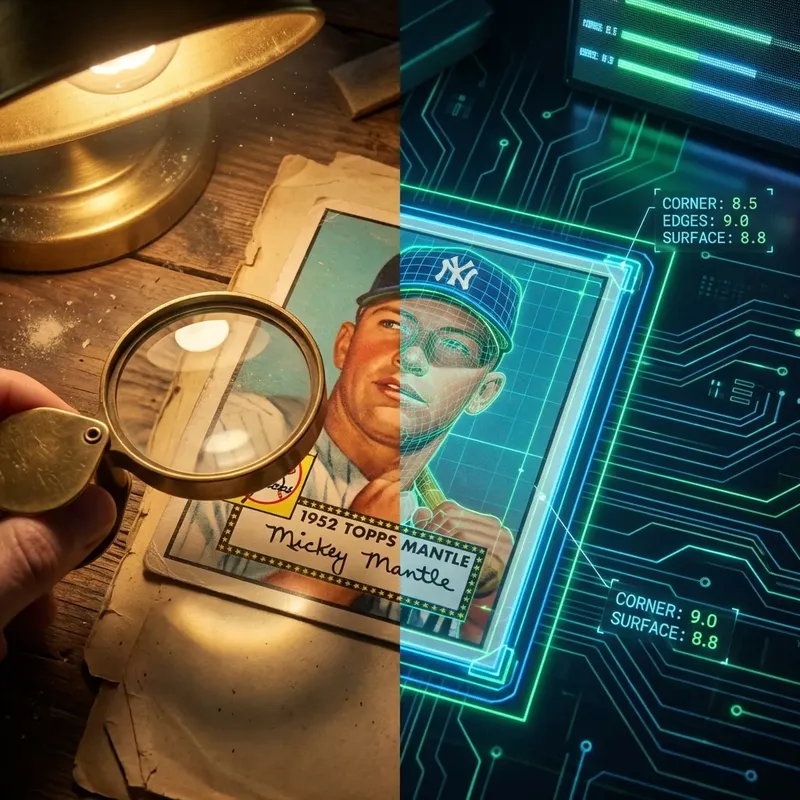
The Analog Limit
For 40 years, grading has been a biological process. A human being sits in a windowless room, picks up your card, wipes his eyes, and makes a decision in roughly 45 seconds.
The Problem? Biology is flawed.
The "Monday Morning" Effect
Grader fatigue is real. A card graded at 9:00 AM on Monday often receives a different grade than the same card graded at 4:45 PM on Friday. Mood, lighting, and recent meals impact the retina's perception of color and contrast.
Optical Limits
The human eye can resolve details down to about 0.1mm at best. Modern printing defects (pixel voids, chrome pitting) often exist at the 0.02mm scale. You literally cannot see what you are grading.
"I submitted the same card three times. I got a 9, a 10, and an 8. It's a casino, not a science."
- Anonymous Collector
Computer Vision
The machine does not get tired. It does not care if the card is a 1952 Mantle or a 2024 Common. It sees only data.
> SCAN_RESOLUTION: 2400 DPI
Our sensors capture surface topology. We don't just see the scratch; we measure its depth, width, and angle of refraction to determine if it breaches the lamination layer.
> GEOMETRIC_PRECISION
"Centering" is math. We calculate the exact pixel count of the left border vs the right border. Result: 50.1% vs 49.9%. No guessing.
> REPEATABILITY: 100%
If you scan the same card 1,000 times, you get the same grade 1,000 times. That is the definition of a Standard.
The Comparison
| Human Grader | Metric | AI System |
|---|---|---|
| Variable (Mood/Time) | Consistency | 100% Static |
| ~0.1mm | Resolution | 0.005mm (Microns) |
| Subjective Est. | Centering | Pixel Count |
| Surface Only | Surface Scan | Topological Depth |
| Days / Weeks | Speed | < 10 Seconds |
Ready to see the truth?
Your cards might be Gem Mint. Or they might be PSA 8s hiding in plain sight. Stop guessing.
Analyze My Cards Now