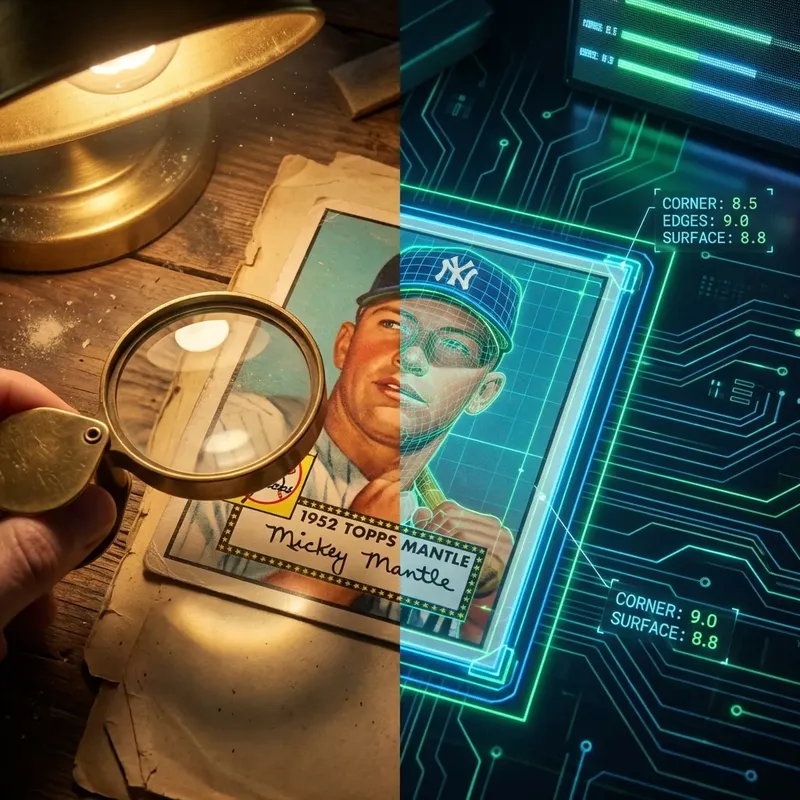
The Short Answer
- TAG uses machine vision and computer vision to grade cards with detailed digital reports.
- AI grading is faster and more transparent than human-only grading.
- PSA still dominates market authority and resale value despite the technology gap.
- Grading kiosks could let collectors slab cards at card shows and shops in minutes.
- The strongest workflow is AI pre-screening followed by human grading for final submission.
Featured Video: PSA’s Monopoly vs. TAG’s AI Disruption
Steven Fiorillo and The Milkman discuss whether TAG and AI grading can challenge PSA’s market dominance. The conversation covers grading standards, digital reports, turnaround times, and the potential for automated grading kiosks at card shows and shops.
Key points from the video:
- PSA is still the market leader, but its turnaround times and upcharges create openings for competitors.
- TAG differentiates with detailed digital reports and a 1,000-point scoring system.
- Machine vision can measure centering, edges, and surface defects more consistently than humans.
- Grading kiosks could one day slab cards in minutes at card shows.
How TAG AI Grading Works
TAG combines machine vision with a human quality-control layer. The machine scans the card at high resolution, measures centering, detects surface defects, and scores corners and edges. The result is a numerical score out of 1,000 and a detailed digital report with images.
The report is the differentiator. Collectors can see exactly why a card received its grade, including close-up scans of flaws. That transparency is something PSA and BGS do not currently offer at scale. The report also provides images that can be reused in eBay listings, which adds practical value for sellers.
PSA’s Market Moat
Despite the technology gap, PSA still commands the highest resale premiums. The reasons are simple:
- Decades of brand trust and buyer recognition.
- Registry sets that incentivize collectors to submit to PSA.
- Direct marketplace integrations and dealer networks.
- The PSA 10 label is the most recognized grade in the hobby.
The video argues that even if TAG is more transparent, PSA’s market authority will not disappear overnight. The likely outcome is a gradual shift where AI graders win on speed and cost, while PSA keeps the high-end market for another few years.
The Grading Kiosk Future
The most speculative part of the discussion is the idea of a grading kiosk. The concept is a machine at a card shop or show that takes a card, scans it, grades it, and slabs it in a few minutes. If the technology works at scale, it could transform the hobby by making grading instant and local.
Challenges remain: authentication, tamper-proof slabs, and market acceptance. Collectors may be skeptical of machine-graded cards until a major brand proves reliability over time. But the idea is no longer science fiction; companies are actively testing it.
Best Workflow for Collectors
The smartest workflow in 2026 is to use AI for pre-screening and humans for final grading. Here is a practical approach:
- Take high-resolution photos of your card.
- Run an AI grade to estimate the likely human grade.
- Send only strong candidates to PSA, BGS, SGC, or CGC.
- Keep borderline cards raw or sell them ungraded.
AI grading will not replace PSA this year. But it is already saving collectors money by helping them avoid wasted grading fees. The best results come from combining AI speed with human market authority.
Frequently Asked Questions
Is AI grading as accurate as human grading?
What is TAG grading?
Will AI replace PSA?
What is a grading kiosk?
Sources & Further Reading
- Steven Fiorillo — PSA vs TAG AI Disruption
- TAG Grading
- CardGrade.io — Complete Guide to AI Card Grading
The PreGradeCards Research Team combines machine-learning engineers, grading analysts, and collector-education specialists to produce accurate, data-driven guides on AI card grading, professional grading standards, and collecting strategy.
With submission floors rising, pre-screening is no longer optional. Use our AI Pre-Grade Calculator to score a card's PSA 10 odds before you pay, and the Submission Planner to pick the right tier.