The Short Answer
- Pre-grade every card to avoid wasting fees on low-grade candidates
- Choose the right grading company based on card type and resale goals
- Use the correct supplies: penny sleeves, Card Savers, and a sturdy box
- Match your physical card order to your online submission form
- Track and insure the package for full declared value
The Quick Answer
For your first card submission, inspect every card for centering, corners, edges, and surface under good lighting. Pre-grade with an AI tool or loupe to remove low-grade candidates. Choose the right grading company (PSA for resale value, BGS for subgrades, CGC for TCG, SGC for speed). Create an online submission, pack cards in penny sleeves and Card Savers, match the physical order to the form, and ship with tracking and full insurance.
Step 1: Inspect Each Card
Before you spend money on grading, inspect every card carefully. Use a bright LED lamp, a 10x loupe, and a clean surface. Look for these four factors:
- Centering: Borders should be even. Use a digital caliper or the centering calculator to measure ratios.
- Corners: Check for whitening, dings, and rounding. Corners are a top reason cards fail to gem.
- Edges: Look for whitening, chipping, and fraying along the sides.
- Surface: Hold the card under light at an angle to spot scratches, print lines, and holo scratches.
Any visible flaw in a high-resolution photo will likely be seen by a grader. Be honest with yourself; optimism is expensive.
Step 2: Pre-Grade Before Submitting
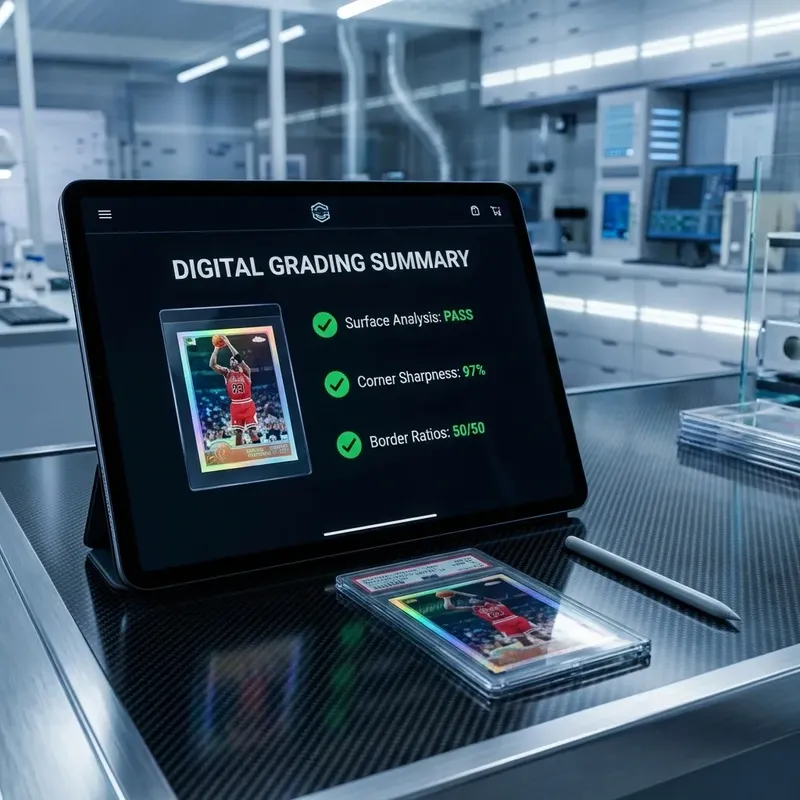
Pre-grading is the single best way to avoid wasted grading fees. Use PreGradeCards or a similar AI tool to get a predicted grade before you pay PSA, BGS, or CGC. If the AI predicts a 7 or 8, that card probably is not worth grading unless the raw value is very high.
Focus your first submission on cards with a realistic chance at PSA 9 or 10. A batch of mostly 10 candidates is much more exciting and profitable than a batch of mixed 7s and 8s.
Step 3: Choose a Grading Company
For first-time submitters, the choice usually comes down to PSA, BGS, CGC, or SGC.
- PSA: Best for resale value and mainstream recognition. Most expensive at $79.99+ per card.
- BGS: Best for subgrades and modern cards. Lower cost than PSA.
- CGC: Strong for Pokemon, Magic, and other TCGs. Competitive pricing.
- SGC: Fast turnaround, good for vintage and lower-value cards.
If your goal is maximum resale value, PSA is usually the answer. If your goal is learning and subgrade detail, BGS is a great first experience.
Step 4: Create the Online Order
Log in to the grading company website and create a new submission. You will need to enter:
- Card year, set, player, and card number
- Declared value (determines service tier and insurance)
- Service level (Regular, Express, etc.)
- Shipping address and return shipping method
Print the submission form and barcode page. These must be included in the package. Double-check spelling and card numbers; errors cause delays.
Step 5: Pack and Ship
Pack cards in penny sleeves and Card Savers, sort them in the exact order of the submission form, and place them between cardboard inside a sturdy box. Include the printed form and barcode. Ship with tracking, insurance for full value, and signature confirmation.
Take photos of every card before sealing the box. These are your insurance evidence if anything goes wrong.
Printable First Submission Checklist
- ☐ Clean workspace and good lighting set up
- ☐ Every card inspected under loupe and lamp
- ☐ Cards pre-graded and low-grade candidates removed
- ☐ Grading company chosen based on resale goals
- ☐ Online submission created and printed
- ☐ Card descriptions and values double-checked
- ☐ Supplies ready: penny sleeves, Card Savers, cardboard, box, tape
- ☐ Cards packed in order with no empty space in box
- ☐ Photos taken of every card front and back
- ☐ Package shipped with tracking, insurance, and signature
- ☐ Grader account monitored for status updates
Frequently Asked Questions
How many cards should I submit the first time?
Start with 5 to 20 cards. A small batch lets you learn the process without a large financial commitment. Choose cards you believe have a strong chance at PSA 9 or 10.
What cards should I NOT grade?
Do not grade cards with visible creases, heavy surface wear, off-center fronts above 60/40, soft corners, or low raw value. The grading fee will not be recovered unless the card is rare or vintage.
How do I choose between PSA and BGS for my first submission?
Choose PSA if you want maximum resale value and market recognition. Choose BGS if you want detailed subgrades and lower fees. For most first-time submitters, PSA is the safer long-term choice.
What if a card comes back lower than expected?
That is normal. Use the result as a learning tool. Compare the graded card to your pre-grade prediction, identify what you missed, and apply that knowledge to your next submission.
Sources & Further Reading
The PreGradeCards Research Team combines machine-learning engineers, grading analysts, and collector-education specialists to produce accurate, data-driven guides on AI card grading, professional grading standards, and collecting strategy.
With submission floors rising, pre-screening is no longer optional. Use our AI Pre-Grade Calculator to score a card's PSA 10 odds before you pay, and the Submission Planner to pick the right tier.