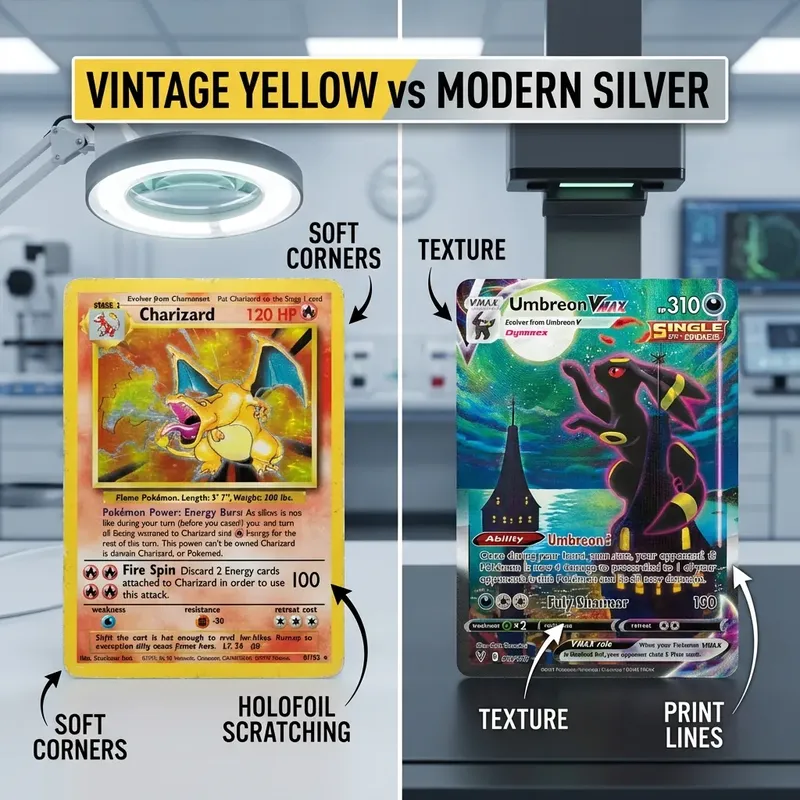
Grading Pokemon is a tale of two eras. The "Wizards of the Coast" (WOTC) era is a battle against attrition—whitening, scratching, and age. The "Modern Era" (Silver borders, Sword & Shield, Scarlet & Violet) is a battle against manufacturing defects—print lines, texture shifts, and poor quality control.
To succeed in 2026, you cannot apply a "one size fits all" logic. You must triage your submission based on the border color.
The Yellow Border Wars
Vintage cards define the hobby. But they are old cardboard. The main enemy here is Whitening.
The "Blue Back" Analysis
Unlike sports cards, Pokemon cards have a dark blue reverse side. This contrast makes even microscopic fraying of the paper stock visible as bright white specks.
- The "Available Light" Test: Hold the back of the card under a desk lamp. Rotate it 360 degrees. Do any corners "flash" white? If yes, it's a PSA 9 (or 8).
- Holo Scratching: The old "Galaxy Foil" is soft. If you see a scratch that breaks the swirl pattern, it's fatal.
- Centering Allowance: The thick yellow border is forgiving. PSA allows 60/40 on the front. You can be visibly off-center and still Gem Mint.
▶ PSA Grading Vintage Pokemon Guide (Search)
The Silver Era & Texture
Creating a "Perfect 10" with modern cards is technically harder due to complex surfaces.
Texture & Print Lines
Modern Full Arts use an etched texture. This texture is prone to "grid lines"—faint horizontal or vertical lines where the foil sheet ended.
- The Grid Line Search: Tilt your VMAX or Alt Art in the light. Look for straight lines cutting through the artwork. PSA hits these hard now.
- Silver Border Centering: Starting with Scarlet & Violet, Pokemon switched to silver borders. These are LESS forgiving than yellow. The blend with the artwork is harsher, making off-centering easier to spot.
- Corner "Nips": Modern packing machines often pinch the top left corner. Check for a tiny indent.
▶ Spotting Print Lines on Modern Cards (Search)
The "Japanese Quality" Variable
We must address the elephant in the room: Japanese Pokemon cards are better made.
The card stock is glossier, the cutting knives are sharper, and the centering is tighter. Because of this, PSA grades Japanese cards harsher. They expect perfection because perfection is the norm. A minor flaw on a Japanese output is a death sentence, whereas on English it might be "market acceptable."
Strategy Verdict: Who to Grade With?
Send to PSA. They respect the history and are slightly lenient on rear centering. They command the highest resale premium for "Base Set" era.
Send to CGC or PSA. CGC's "Pristine 10" label looks incredible with modern art and can outsell a PSA 10. If the centering is perfect 50/50, risk the CGC submission.