The Short Answer
- Kaboom is the hardest iconic insert to grade — roughly 36% of submitted copies come back PSA 10, because thick stock and full-bleed color edges chip and show wear easily.
- Downtown and Color Blast grade much friendlier (~53% and ~55% all-time PSA 10 rates), but recent high-volume sets like 2024 Donruss Downtown football run closer to 22% as raw supply floods in.
- The pop report is a pricing tool, not trivia — a case hit’s PSA 10 premium only justifies the fee when the copy is clean and the player/set has real graded demand.
- Sell raw when the card is clearly flawed — a Kaboom with edge chipping is a PSA 8, and an 8 usually sells for less than raw-plus-fee.
- Star rookie case hits grade worst and pay best — 2024 Donruss Downtowns of Daniels (19.3% gem), Maye (21.0%), Nix (21.7%), and Penix (21.4%) show how brutal modern Downtown gem rates are — and how big the 10 premium becomes.
What a Case Hit Actually Is (and Why the Label Matters)
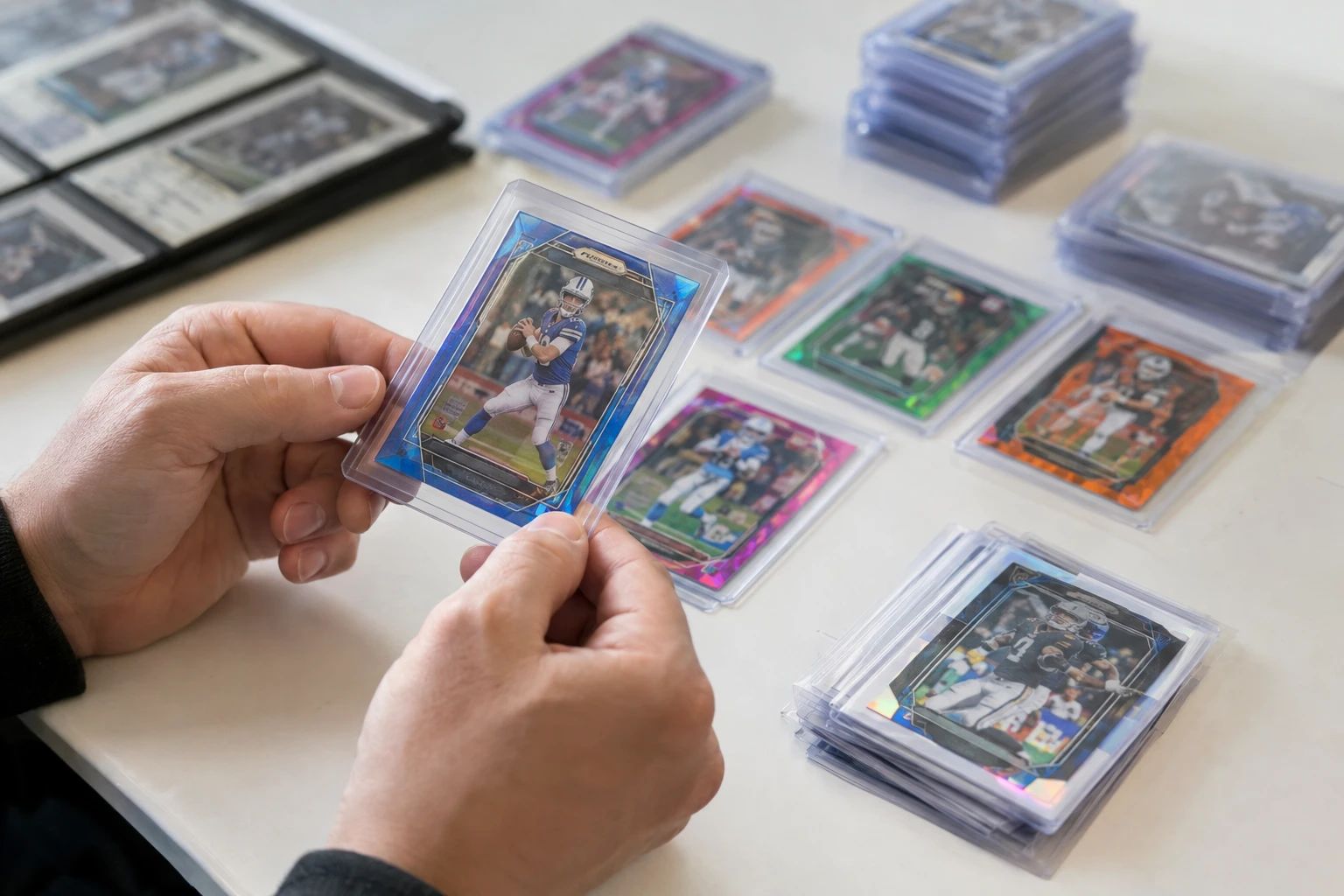
A case hit is an insert so scarce that a sealed case of boxes — usually 12 to 20 boxes, representing hundreds of packs — is only expected to yield one. The label is marketing, but the scarcity is real, and it is the entire reason case hits behave differently than regular inserts when grading.
Three inserts define the modern case-hit era. Kaboom debuted in 2013 Panini Innovation basketball with comic-book explosion artwork and became Panini’s signature SSP, spreading to football, soccer, and UFC products. Downtown started in 2016 Studio Basketball as "From Downtown" — original painted artwork with backgrounds unique to the player’s city — and now lives in Donruss, Optic, and the high-end One and One basketball set. Color Blast splattered its way into football and basketball with a white-on-color splash design that hides wear better than either of its siblings.
The collector behavior these cards produce is what makes grading them interesting: because a case hit is the pinnacle pull of a product, owners almost reflexively send them to PSA. That submission reflex is exactly what the gem-rate data should interrupt.
The Gem-Rate Data: What the Pop Report Actually Says
GemRate’s tracking of the PSA population report gives us real numbers instead of forum folklore. As of October 2026:
| Insert | PSA Graded Population | PSA 10 Rate | What It Means |
|---|---|---|---|
| Kaboom (all sports, all-time) | 45,000+ | ~36% | Nearly two of three submissions fail to gem |
| Downtown (all-time) | Tens of thousands | ~53% | Historically friendlier — but see modern sets below |
| Color Blast (all-time) | Tens of thousands | ~55% | The most forgiving of the big three |
| 2024 Donruss Downtown (football) | ~34,000 | ~22% | Modern volume-era Downtown grades far worse than the all-time rate |
The 2024 Donruss Downtown football numbers deserve a second look because they show the trap in using all-time rates. Star rookies from that set — Jayden Daniels (2,139 graded, 19.3% gems), Drake Maye (1,527 graded, 21.0%), Bo Nix (1,487, 21.7%), Michael Penix Jr. (1,381, 21.4%) — are pulling the set’s gem rate down to roughly one in five. High-volume modern case hits of the most-chased players grade the worst, because every pack-ripper submits them regardless of condition.
The all-time Downtown rate near 53% is inflated by early years, when only the best condition examples got submitted — selection bias working in reverse. If you are holding a fresh 2024-2026 Downtown, the number that describes your card is closer to 20-25% than 53%.
Why Kaboom Grades So Hard
Kaboom’s 36% gem rate isn’t bad luck — it’s design physics. Three structural features do the damage:
- Thicker cardstock. Kaboom is printed on substantially thicker stock than base cards. Thick stock dents instead of flexing, corners blunter under their own weight in the pack, and the extra surface area gives surface defects more places to exist.
- Full-bleed color edges. The comic-explosion art runs to every edge of the card. There is no white border to hide whitening — any edge chip or corner fleck is instantly visible against the saturated background.
- High-gloss surface. The finish that makes Kaboom pop visually also makes every print line, roller mark, and handling scuff visible under raking light.
There is also a hidden grading trap specific to the format: vertical vs. horizontal orientation. Kaboom has been printed in both layouts across different products, and graders have historically been marginally tougher on the horizontal football/basketball issues where edge wear concentrates on the long top and bottom edges. Whatever the orientation, treat edge condition as the pass/fail test before anything else.
The practical consequence: a Kaboom with any visible edge whitening is already a PSA 8-9 at best. Sending it anyway is paying full price for a grade that sells for less than a clean raw copy.
Grade It or Sell It Raw: The Decision Formula
The case-hit grading decision has three inputs: the card’s raw price, its realistic gem probability, and the PSA 10 premium for that specific player/set. The formula:
Grade only if: P(10) × (PSA 10 price) + P(9) × (PSA 9 price) > raw price + grading fee + shipping — and the card is actually clean.
Three worked examples using typical market bands (pull live comps before deciding — these move weekly):
| Scenario | Math | Verdict |
|---|---|---|
| Mid-tier player Kaboom, visible edge chip | P(10)≈0 → result is an 8/9 worth less than raw+fee | Sell raw |
| Star rookie Downtown, pack-fresh, perfect edges | P(10)≈30-40% on clean pulls; 10 premium often 3-6× raw | Grade it |
| Veteran player Color Blast, minor surface line | Gem rate is high but this copy won’t gem | Sell raw or grade only if the 9 premium clears the fee |
The asymmetric part nobody prices: a graded 8 or 9 case hit often sells for LESS than the same card raw. Raw lets the buyer dream; a slabbed 8 kills the dream permanently. That makes the downside of a failed submission worse than the fee alone.
Case Hits by Sport: Where the Grading Value Lives
Football is where the modern case-hit market concentrates: Donruss and Optic Downtown and Kaboom of quarterbacks dominate both pull volume and grading submissions. The 2024 rookie class data above shows how this plays out — the most-pulled players have the most-submitted cards and the worst gem rates, which paradoxically makes their PSA 10s the most valuable relative to population.
Basketball is the historical home of both inserts — Kaboom was born in 2013 Innovation and Downtown in 2016 Studio. Veteran-star basketball case hits (LeBron, Curry, Jordan-era flashback issues) grade at healthier rates because much of the supply was submitted in lower-volume years. The One and One product line keeps Downtown premium in the sport.
Soccer has adopted case hits fastest — Kaboom appears in Donruss/Optic FIFA products, and the scarcity-plus-global-demand combination produces outsized premiums for star players in PSA 10.
UFC and other sports get Kaboom in Donruss/Optic releases; the populations are tiny, which means thin comp data — check actual sold listings rather than asking prices before grading. The record for any Downtown variation remains a useful ceiling reference: the 2020 Donruss Optic Joe Burrow Gold Vinyl 1/1 sold for $108,000 at Goldin in 2022 — graded BGS 7.5, proving that at true 1/1 scarcity, the grade matters less than the existence of the card itself.
The Pre-Submission Condition Checklist for Case Hits
Run this sequence under a bright, directional light source before any case hit goes in a submission:
- Edges first. Rotate slowly and look for whitening, chips, or color breaks along all four edges. On Kaboom, any edge wear is disqualifying for a 10.
- Corners at magnification. Phone macro or a 10x loupe on all eight corner faces. Thick-stock cards hide corner damage that only shows at magnification.
- Surface under raking light. Tilt the card so light skims across it. Print lines, roller marks, and handling gloss interruptions all show here — and all kill gem grades.
- Centering. Measure borders. Case hits are often cut poorly because thick stock shifts during cutting; verify before assuming a clean card is centered.
- Flatness/warp. Thick stock warps. Lay it on a flat surface and check for bowing — visible warp is a grade cap.
- Back surface. The most-skipped check. Flip it and repeat steps 1-3 on the back.
If the card passes all six checks, it has cleared the physical filter. Only then does the market filter — player, set, pop report — matter.
PSA vs. BGS vs. SGC: Which Grader for Case Hits
PSA is the default and usually correct answer for case hits — the PSA 10 premium is largest, the pop report data is deepest (GemRate tracks Kaboom and Downtown specifically), and case hits sell on PSA liquidity more than any other factor.
BGS makes sense in two situations: when the card is so clean that subgrades could push it toward a 9.5 or 10 that outsells PSA’s equivalent, and when you genuinely believe it has pristine-shot potential — a BGS 10 Black Label on a case hit is a market event. The Burrow Gold Vinyl example shows BGS slabs do command real money on true grails.
SGC is the value play — lower fees, solid reputation, but a weaker premium on modern inserts specifically. For a mid-tier case hit where the PSA fee doesn’t clear but you still want it slabbed, SGC is the rational choice.
Where each fails: don’t send Kaboom you suspect is an 8 to anyone — sell it raw. Don’t pay PSA-level fees on cards whose PSA-10 premium is under ~3× the all-in cost. And never grade a case hit just because it is a case hit — the pull felt rare to you, but the pop report is the market’s version of how rare it actually is.
Buying Case Hits: Raw vs. Slabbed
Buy slabbed when the card is for a collection, the grade is what you’re paying for (PSA 10 case hits are display pieces), or the card is expensive enough that authentication risk matters. A slabbed 10 removes all condition uncertainty from a six-figure purchase.
Buy raw when you can grade it yourself profitably — meaning you’ve inspected it against the checklist above and believe it will gem. The market consistently underprices clean raw case hits relative to their PSA 10 outcomes because most sellers either can’t evaluate condition or don’t want to wait on grading. That gap is where grading-side profit lives.
Never buy raw case hits at slab-adjacent prices. If a seller has priced a raw Downtown as if it were already a 10, they’ve priced in your work. Raw price + realistic grading cost + realistic gem-rate discount is the ceiling — not the PSA 10 price with a "you grade it" shrug.
The 1/1 and Low-Numbered Tier: Where Grading Logic Changes
Everything above applies to the mass-market case hit — the base SSP that comes one-per-case. The moment a case hit is serial-numbered or one-of-one, the grading equation inverts. At true 1/1 scarcity, the grade becomes nearly irrelevant to the value, and the slab’s job shifts from price multiplier to authentication and protection.
The canonical example remains the 2020 Donruss Optic Joe Burrow Gold Vinyl 1/1 Downtown — the card that holds the Downtown record at $108,000 — which sold as a BGS 7.5. A grade that would be catastrophic on a base Kaboom is meaningless on a 1/1 because there is no second copy to compare it against; the population report is a population of one.
The practical guidance for numbered case hits:
- 1/1s and /5 or lower: grade for authentication and resale confidence, not for the number. Any top-three slab adds buyer trust; chasing the difference between a 9 and 9.5 isn’t worth a resubmission risk on a five-figure card.
- /10 to /25: grade matters again — these have enough copies that a PSA 10 still commands a real premium over a 9.
- Color Vinyl / Gold Vinyl 1/1s: these are the apex of each case-hit line; at this tier, use whichever grader the buyer market prefers for the specific player (PSA for liquidity, BGS for modern grail prestige).
The one constant across every tier: the rarer the card, the more the slab is an authentication service and the less it is a grading service. Price the decision accordingly.
Mistakes That Burn Grading Fees on Case Hits
- Submitting because it’s a case hit. The pull was rare; the card’s condition is ordinary. The most common grading-fee donation in the hobby.
- Using the all-time gem rate on a modern card. 2024-2026 Downtowns grade at ~20-25%, not 53%. Era matters.
- Ignoring the back. Case hits get flipped, photographed, and handled constantly. Back-surface wear kills more submissions than front wear.
- Grading the wrong parallel. In sets where the case hit exists in both Donruss (paper-ish stock) and Optic (chromium), the Optic version usually grades and sells better — know which one you have.
- Batching case hits into bulk submissions. A card worth hundreds deserves premium-tier handling and tracking; don’t ship it in the same sleeve-and-toploader economy batch as your $5 commons.
Pre-Screening Case Hits with AI Grading
Case hits are the highest-value use case for AI pre-grading, precisely because the fee is small relative to the price swing. A $60 grading fee against a Kaboom that sells for $300 raw and $1,200 in a PSA 10 is a leveraged decision — and AI pre-screening is the tool that tells you which side of it you’re on.
The workflow: photograph the card front and back (a phone camera in good light is enough), run the pre-grade, and read the subgrade breakdown. On edge-sensitive cards like Kaboom, the edges and corners subgrades are the pass/fail line — if the model flags edge whitening you can verify under light, the card is a raw sale, not a submission. If it returns a 9.5-10 prediction with clean subgrades, the gem-rate math says submit.
That pre-filter is what separates the collectors who turn case hits into profit from the ones who turn them into grading-fee statistics — and with modern Downtown sets running a ~22% gem rate on star rookies, the filter is doing real work, not decoration.
Frequently Asked Questions
0
1
2
3
4
5
6
Sources & Further Reading
- cllct — Kaboom’s explosive impact: how Panini changed modern sports cards
- GemRate — Every Kaboom card graded by PSA
- GemRate — Every Downtown card graded by PSA
- GemRate — 2024 Donruss Downtown PSA Pop Report
- Cardlines — Are Panini case hits still rare?
- PSA Population Report
Marcus Chen has evaluated over 50,000 sports cards and TCG cards across PSA, BGS, SGC, and CGC standards. Before joining PreGradeCards, he worked as a submission specialist for a major grading company and trained collectors and dealers on condition assessment.
Create a free account and get 1 free credit — enough for 1 complete AI grading with market pricing. No credit card required.
Sign Up Free →