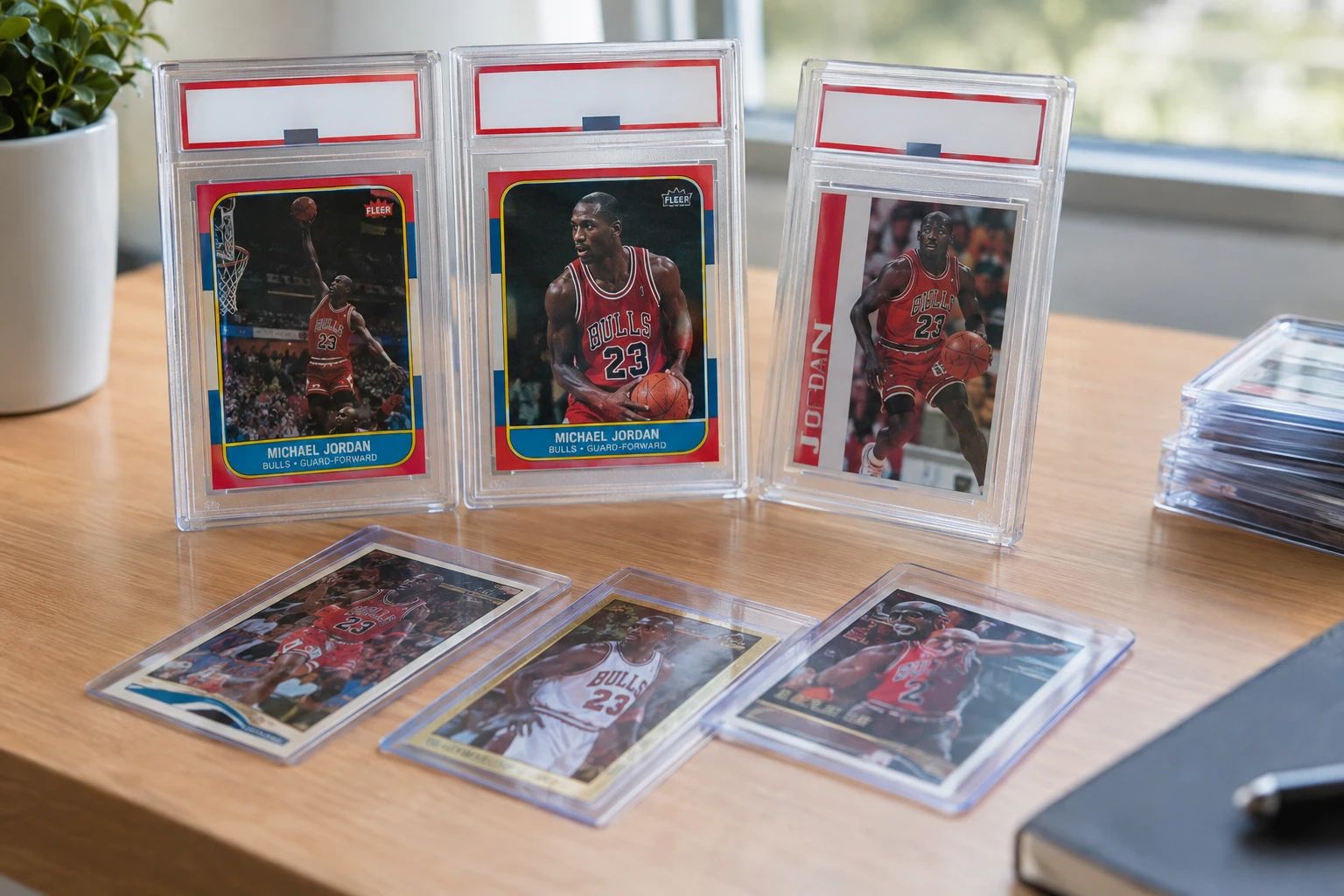
The Short Answer
- 2.6 million+ Jordan cards graded — the most of any athlete in hobby history. 29,072 Jordan cards were graded by PSA in June 2026 alone.
- 1986 Fleer #57 PSA 10 trades at $400,000-$750,000 with only 316 gem mint copies in a population of 32,000+ — a sub-1% gem rate.
- 1985 Star Gatorade Slam Dunk BGS 8.5 surged to $21,995 in June 2026, up from $15,600 in May — a 41% jump in one month.
- Centering is the #1 grade killer for 1980s Fleer Jordan cards — off-center examples are extremely common due to print-run variance.
- PSA 10 premium is 5-15x over PSA 9 — the 1986 Fleer PSA 10 at $400K-$750K vs PSA 9 at $5,000-$12,000 represents a 6x grade cliff.
- Jordan autographed rookie card — a PSA 9 with Gem Mint 10 autograph sold for $2.7 million in October 2025, from a private signing in 2024.
Why Jordan Is the Most Graded Athlete Ever
Michael Jordan's basketball cards have been graded an astounding 2.6 million times across all grading companies — more than any other athlete in the history of the hobby. The second-most graded athlete, Ken Griffey Jr., has approximately 750,000 cards graded. Jordan's lead is nearly 3.5x.
In June 2026 alone, PSA graded 29,072 Jordan cards, making him the 7th-most graded subject that month — remarkable for a player who retired over 20 years ago. This sustained grading volume demonstrates that Jordan's card market is not a nostalgia trend but a permanent pillar of the hobby.
Why Jordan Cards Are Graded So Frequently
- Universal name recognition — Jordan is an undisputed all-time great with brand and name recognition that transcends basketball. Even non-collectors know who Michael Jordan is.
- Large card supply — Jordan's 1990 Fleer #26 alone has 200,000-300,000 copies in circulation. High supply means many cards available for grading.
- PSA 10 scarcity creates incentive — despite high circulation, finding a PSA 10 is difficult and expensive. The grade cliff creates a lottery-ticket dynamic that drives submissions.
- Enduring demand — Jordan cards from the late 1980s and early 1990s are "absolutely red hot this summer" according to SI Collectibles, with particular strength in Fleer cards and stickers.
Most Graded Jordan Cards (All-Time)
| Card | PSA Graded | BGS Graded | SGC Graded | PSA 10 Pop |
|---|---|---|---|---|
| 1990 Fleer #26 | 61,132 | 6,011 | 8,000 | 7,777 |
| 1989 Hoops #200 | 33,372 | 3,263 | 4,328 | 5,940 |
| 1986 Fleer #57 | 28,051 | 14,370 | 4,033 | 316 |
| 1991 Upper Deck #SP1 | 28,070 | 4,464 | 4,548 | 2,773 |
| 1988 Fleer #17 | 27,596 | 6,225 | 3,994 | 652 |
| 1986 Fleer Sticker #8 | 20,995 | 7,462 | 2,965 | 121 |
| 1989 Fleer #21 | 25,251 | 3,209 | 2,527 | 1,224 |
| 1987 Fleer #59 | 20,581 | 6,582 | 3,075 | 215 |
The data reveals a striking pattern: the 1986 Fleer #57 — Jordan's most iconic and expensive card — has a PSA 10 population of just 316 out of 28,051 graded copies. That is a 1.1% gem rate, even lower than the 1986 Fleer Sticker at 0.6% (121 out of 20,995). These sub-1% gem rates are structural, not circumstantial — they reflect the centering variance inherent to 1980s Fleer print runs.
1986 Fleer #57: The Iconic Rookie Card
The 1986-87 Fleer #57 Michael Jordan rookie card is the most iconic basketball card in existence. It depicts Jordan going up for a dunk with his tongue sticking out — one of the most recognizable images in sports. More than 45,000 copies have been authenticated and graded as of January 2026, but fewer than 350 have received a perfect Gem Mint PSA 10 grade.
Value by Grade (July 2026)
| Grade | Population | Average Sale Price | Premium vs PSA 9 |
|---|---|---|---|
| PSA 10 | 316 | $400,000-$750,000 | 6x |
| BGS 9.5 (with 10 subgrades) | 545 | $33,000 | — |
| BGS 10 | 6 | Ultra-rare (no recent public sale) | — |
| PSA 9 | ~3,000 | $5,000-$12,000 (recent avg $17,500) | Baseline |
| PSA 8 | ~5,000 | $1,500-$3,000 | 0.2x PSA 9 |
| PSA 1 | — | $1,960 (9-sale average) | 0.1x PSA 9 |
The 6x premium from PSA 9 to PSA 10 is one of the steepest grade cliffs in the entire sports card market. This reflects the brutal reality that most 1986 Fleer Jordan rookies suffer from centering issues, print defects, or handling damage. When you are dealing with 35+ year old cardboard that was originally sold in wax packs to kids, finding pristine examples becomes an exercise in statistics.
The Autographed Rookie Card
Michael Jordan autographed a few of his 1986 Fleer rookie cards during a private signing in 2024. One copy was later authenticated and graded by PSA, receiving a Mint 9 grade for the card and a Gem Mint 10 grade for the autograph. It sold for $2.7 million in October 2025 — making it one of the most valuable Jordan cards ever sold.
Jordan Card Values by Grade: 2026 Data
Beyond the 1986 Fleer rookie, Jordan has numerous cards that carry significant value. The 1980s and 1990s Fleer cards, stickers, and premium inserts all have active markets with substantial grade premiums.
Key Jordan Cards — Values by Grade (July 2026)
| Card | PSA 10 Value | PSA 9 Value | PSA 10 Pop | Grade Cliff |
|---|---|---|---|---|
| 1986 Fleer #57 | $400K-$750K | $5K-$12K | 316 | 6x |
| 1986 Fleer Sticker #8 | $40,000+ | $3,600 | 121 | 11x |
| 1987 Fleer #59 (2nd year) | $16,000 | $1,500 | 215 | 11x |
| 1988 Fleer #17 | $3,000 | $241 | 652 | 12x |
| 1989 Fleer #21 | $925 | $57 | 1,224 | 16x |
| 1989 Hoops #200 | $140 | $22 | 5,940 | 6x |
| 1990 Fleer #26 | $50-80 | $10-15 | 7,777 | 5x |
| 1991 Upper Deck #SP1 | $380 | $47 | 2,773 | 8x |
| 1985 Star Gatorade #7 | BGS 8.5: $21,995 | — | Low pop | — |
| 1993 Finest Refractor #1 | $168,000 | $5,000-$10,000 | Very low | 20x+ |
| 1997 Metal Universe PMG Green #23 | PSA 9: $312,000 | — | 10 copies total | — |
| 1996 Topps Chrome Refractor #139 | $84,000 | $3,000-$5,000 | Low | 20x+ |
The 1985 Star Gatorade Slam Dunk #7 deserves special attention. In June 2026, a BGS 8.5 example sold for $21,995 — up from $15,600 in May (a 41% jump in one month). Another copy was then purchased directly on eBay for $21,499.99, confirming the new price level. Although not considered his official rookie card, it is among the earliest cardboard releases for Jordan and collectors perceive it as a rookie-adjacent card.
Grading 1980s Fleer: Centering, Surface, and Corners
Grading 1980s Fleer Jordan cards presents unique challenges that differ from modern card grading. Understanding these challenges is essential for anyone considering submitting a raw Jordan card to PSA.
The Three Fleer Grade Killers
- Centering variance. 1980s Fleer print runs show extreme centering variance. The 1986 Fleer #57 has a sub-1% PSA 10 rate primarily because of centering. Off-center examples are extremely common, and PSA's 60/40 front centering requirement for a 10 is strict. Many cards that look "fine" to the naked eye are 65/35 or 70/30 under grader magnification. AI centering analysis achieves 99.2% accuracy and can identify this issue before you spend $79.99+ on grading.
- Surface print defects. 1980s Fleer cardstock was produced with less quality control than modern cards. Print lines, roller marks, and surface dimples are common. These manufacturing defects are not damage from handling — they are original production flaws that PSA still counts against the grade.
- Corner wear from wax pack storage. 1980s Fleer cards were distributed in wax packs that caused corner wear during packaging and handling. Even cards pulled fresh from packs in 1986 and carefully stored may have corner dings from the packaging process itself.
AI Pre-Grading Tips for 1980s Fleer
- Measure centering first — with sub-1% PSA 10 rates driven by centering, this is the attribute most likely to cap your grade. Use AI centering analysis to get a precise ratio before submitting.
- Scan at high resolution — 1980s cardstock has subtle surface textures that require high-resolution scanning for AI to detect print defects.
- Check all four corners individually — wax pack corner wear is often invisible without magnification. Scan each corner at an angle to catch dings.
- Compare to PSA population data — if your card is 1986 Fleer #57 and AI grades it 8-9, the grading fee may still be worthwhile given the $1,500-$12,000 value range for PSA 8-9.
Should You Crack and Resubmit?
Some collectors crack PSA 9 slabs and resubmit hoping for a 10. With the 1986 Fleer #57, the 6x premium from PSA 9 to PSA 10 makes this tempting. However, PSA's consistency rate on resubmissions is approximately 70% — meaning there is a 30% chance the card comes back the same grade or lower. Given the $5,000-$12,000 value of a PSA 9, the risk of a downgrade (and corresponding value loss) usually outweighs the potential upside of an upgrade.
1984 Star Company #101: The Chronological Rookie
The 1984 Star Company #101 Michael Jordan card is his chronological rookie card — the first basketball card ever produced featuring Jordan as a professional player. However, it is not widely recognized as his "true" rookie card due to authentication complexity and Star Company's unique distribution model.
Why the 1984 Star #101 Is Controversial
- Dealer-direct distribution — Star Company sold cards directly to dealers in sealed team bags rather than through traditional retail packs. This means the cards were not widely available to collectors and their condition coming out of the factory varied significantly.
- Authentication challenges — Star Company cards have been counterfeited extensively. PSA authentication is essential for any Star Company Jordan card, and even PSA has faced challenges in authenticating some examples.
- Market perception — most collectors treat the 1986 Fleer #57 as the definitive Jordan rookie card. The Star #101 is the chronological rookie but carries less market weight. A PSA 9 Star #101 is valued at approximately $840,000 according to recent data — actually higher than a PSA 9 Fleer, reflecting the Star card's greater rarity.
Value Comparison: Star vs Fleer
| Card | PSA 9 Value | PSA 10 Value | PSA 10 Pop |
|---|---|---|---|
| 1984 Star #101 | ~$840,000 | Not publicly traded (ultra-rare) | Extremely low |
| 1986 Fleer #57 | $5,000-$12,000 | $400,000-$750,000 | 316 |
The Star #101 PSA 9 at ~$840,000 is actually more valuable than a Fleer PSA 9 at $5,000-$12,000 — but the Fleer is far more liquid, with dozens of sales per month versus essentially zero public transactions for the Star. For most collectors, the 1986 Fleer #57 remains the practical rookie card target.
Jordan Refractors: Finest, Chrome, and Metal Universe
Beyond the Fleer rookies, Jordan's premium insert cards from the 1990s are among the most valuable basketball cards in the hobby. These cards introduced the refractor technology and premium chase card concept that defines the modern hobby.
1993 Topps Finest Refractor #1
Topps debuted the Finest brand in 1993, and with it came the debut of the premium Chrome finish. Jordan earned the first card in the set, and his Refractor parallel is one of the most iconic Jordan cards. Ungraded and most graded copies typically sell for less than $100, but PSA 10 copies command $168,000. The Refractor is rarer and much more valuable than the base card.
1996 Topps Chrome Refractor #139
The 1996 Topps Chrome Refractor #139 Jordan is a cornerstone of the Chrome brand. PSA 10 copies sell for approximately $84,000. The Chrome Refractor represents the evolution of the refractor technology that Topps pioneered with the 1993 Finest set.
1997-98 Metal Universe Precious Metal Gems Green #23
The Precious Metal Gems Green is the rarest Jordan card in existence, with only 10 copies produced. A BGS 8.5 example sold for $1.02 million in November 2023. A PSA 10, if one surfaces, would likely shatter the $2 million barrier. The PMG Red version, with 100 copies, is slightly more available but still commands huge premiums — a PSA 8 sold for over $500,000 in March 2024.
1997-98 Upper Deck Game Jersey Autograph
This card combines three holy grails: game-worn material, on-card autograph, and serial numbering to 25 copies. A graded NM 8 example (#21/25) sold for $2.7 million — making it one of the highest Jordan sales ever. This card represents the intersection of memorabilia, autograph, and scarcity that defines the ultra-premium basketball card market.
Grading Tips for 1990s Refractors
- Refractor surface lines — 1990s refractor coatings can have print lines that are visible under angled light. These are manufacturing defects, not damage, but PSA counts them against the grade.
- Edge wear on Chrome stock — 1990s Chrome cardstock is sturdier than Prizm but can show edge whitening along the colored borders.
- Centering is generally better than Fleer — 1990s Topps Chrome print runs show more consistent centering than 1980s Fleer, making centering less of a grade killer.
- Use 45-degree lighting for AI scanning — refractor surfaces require diffuse lighting to eliminate glare and allow AI to detect surface defects.
Investment Strategy: Which Jordan Cards to Hold
Michael Jordan's card market is the deepest and most liquid in basketball collecting. His cards have maintained value after the 2021 peak, trading in narrower ranges rather than collapsing. For investors, the key question is which Jordan cards to hold and which to avoid.
Tier 1: Core Investment Holdings
- 1986 Fleer #57 PSA 9 — the most liquid Jordan entry point for serious collectors, trading on eBay multiple times per week with predictable price discovery. At $5,000-$12,000, it offers exposure to the Jordan market without the $400K+ PSA 10 price tag.
- 1993 Finest Refractor #1 PSA 10 — at $168,000, this is the cornerstone Jordan refractor. Low population and historical significance make it a long-term hold.
- 1996 Topps Chrome Refractor #139 PSA 10 — at $84,000, this is the Chrome brand's flagship Jordan card. Represents the evolution of refractor technology.
- 1986 Fleer Sticker #8 PSA 9 — at $3,600, this is an accessible entry point to the 1986 Fleer rookie-year set. The sticker was inserted in every pack of 1986 Fleer, making it a companion to the base rookie card.
Tier 2: Value Plays
- 1987 Fleer #59 PSA 9 — Jordan's second-year card at $1,500. Low PSA 10 population (215) means there is room for appreciation if you can find a PSA 10 candidate.
- 1988 Fleer #17 PSA 10 — at $3,000 with a population of 652, this card offers a middle-ground Jordan investment. The 12x grade cliff from PSA 9 ($241) to PSA 10 ($3,000) is steep but justified by the low population.
- 1991 Upper Deck #SP1 PSA 10 — at $380 with a population of 2,773, this is one of the most popular cards of the early 90s. Accessible price point with meaningful upside.
Tier 3: Avoid for Investment
- 1990 Fleer #26 PSA 10 — at $50-80 with 7,777 PSA 10 copies, this card is too common to appreciate meaningfully. Fine for collection building, not for investment.
- 1989 Hoops #200 PSA 10 — at $140 with 5,940 PSA 10 copies, similar oversupply issue as the 1990 Fleer.
- Raw 1980s Fleer cards in uncertain condition — without AI pre-grading, submitting raw 1980s cards is a gamble. The centering variance means most cards will come back PSA 7-8, where values are $200-$3,000 — potentially less than the grading fee plus acquisition cost.
The AI Pre-Grading Imperative for Jordan Cards
Given the extreme grade cliffs in the Jordan market — 6x for the 1986 Fleer, 11x for the sticker, 12x for the 1988 Fleer — AI pre-grading is essential before any submission. At $0.19 per card, AI can identify whether your raw Jordan card has the centering, surface, and corner quality needed for a PSA 10. If AI predicts PSA 8 or below, the grading fee may exceed the premium the grade adds to the card's value — particularly for 1990s cards where even PSA 10 values are modest.
For 1980s Fleer cards, AI pre-grading is especially valuable because the centering variance is so extreme. A card that looks 55/45 to the naked eye may actually be 62/38 under precise measurement — which would cap it at PSA 9 rather than PSA 10. That distinction is the difference between a $12,000 card and a $500,000 card for the 1986 Fleer #57.
Frequently Asked Questions
What is the most valuable Michael Jordan basketball card?
How much is a 1986 Fleer Michael Jordan rookie card worth?
How many Michael Jordan cards have been graded?
Should I grade my Michael Jordan cards?
Why is the 1986 Fleer Jordan PSA 10 so rare?
Is the 1984 Star Company #101 or 1986 Fleer #57 the true Jordan rookie?
Sources & Further Reading
- Michael Jordan's Most Graded Cards and Their Prices — SI Collectibles
- Michael Jordan Cards — Values, Checklist & Price Guide (2026) — ProCards
- A Collector's Guide to Michael Jordan Basketball Cards — Mint City
- PSA's Most Graded Subjects For June — SI Collectibles
- Michael Jordan Card Values: Investment Guide (2026) — Phantom Display
- Beckett Basketball Market Watch July 9 — Beckett News
JT Thompson has focused on vintage sports cards (pre-1980) for more than 20 years. He is a regular contributor to vintage collector forums, has consulted on authentication issues for high-value pre-war cards, and teaches collectors how to spot trimming, recoloring, and restoration on classic cardboard.
Create a free account and get 1 free credit — enough for 1 complete AI grading with market pricing. No credit card required.
Sign Up Free →