Sports Cards Industry News

PSA Backlog July 2026 Update: When Will Value Tiers Reopen for Baseball Card Grading?

PSA's July 14 update shows 11 million cards still backlogged, down from a peak of 14 million. Value tiers remain paused. We break down the timeline, the numbers, and what baseball card collectors should do while they wait.

Marcus Chen Published Jul 20, 2026 Updated Jul 20, 2026 8 min read

The Short Answer

  • PSA backlog is 11 million cards as of July 14, 2026, down from 14 million at peak in early June.
  • Value tiers remain paused — Value Bulk, Value, Value Plus, and Value Max have been closed since June 2, 2026.
  • PSA is clearing ~1 million cards per two-week period, putting value tier reopening on track for mid-October 2026.
  • June 2026 was a record month — 3.5 million cards graded across all major companies, with PSA grading 2.5 million alone.
  • PSA claims 99.4% operational success rate for grading accuracy and card safety despite the surge.
  • Cheapest open PSA tier is Regular at $79.99/card — a 3x increase from the paused Value Bulk at $24.99.

PSA July 14 Backlog Update: The Numbers

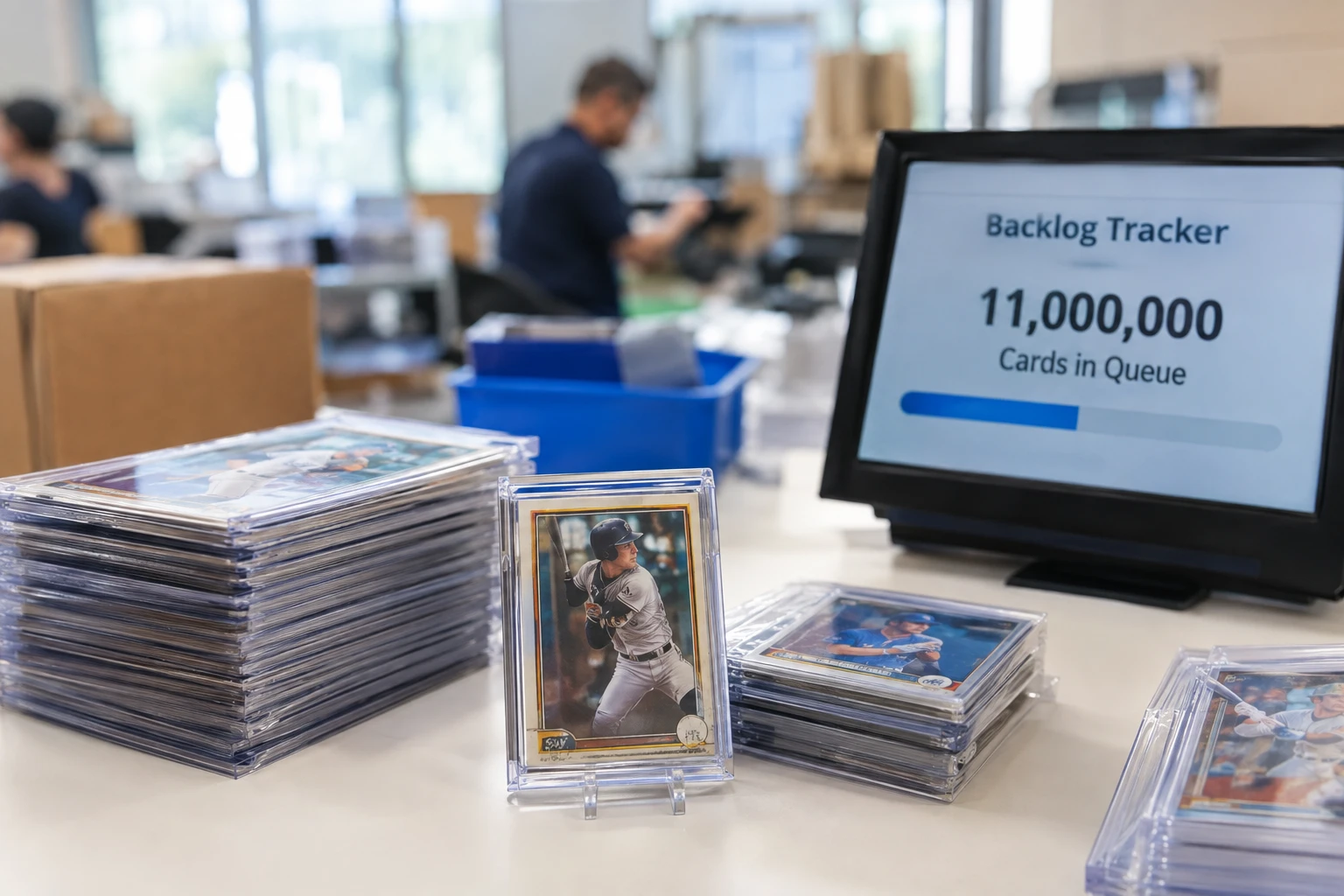
On July 14, 2026, PSA released its third bi-weekly backlog update since announcing the pause of all value-tier grading services on May 28. The update confirmed that PSA's active backlog has dropped to approximately 11 million cards — down from 14 million at the peak in early June and 12 million as of the June 30 update.

PSA stated in the update: "July's grading projections are on track to surpass June's record pace, which exceeded our previous monthly high by more than 10 percent." The company attributed the acceleration to facility expansions, technology integrations, and hiring pipelines that have been under development for years.

Backlog Timeline: May to July 2026

Date Backlog Size Change Notes
May 14, 2026 ~10 million $200M infrastructure investment announced; surge begins
May 28, 2026 ~10 million Value tier pause announced, effective June 2
June 9, 2026 ~14 million +4 million Last-minute surge before pause deadline pushed backlog to peak
June 30, 2026 ~12 million -2 million First bi-weekly update; PSA Backlog Tracker launched
July 14, 2026 ~11 million -1 million Output accelerating; July on track to surpass June record

The trajectory is clear: PSA is reducing the backlog by approximately 1 million cards every two weeks. This rate has been consistent across both reporting periods since the peak, suggesting that PSA's capacity expansion is delivering the throughput improvements they promised.

When Will PSA Value Tiers Reopen?

PSA has stated that value tiers will reopen once the backlog drops to approximately 5 million cards. At the current rate of clearing 1 million cards per bi-weekly period, the backlog would reach 5 million in approximately 12 weeks — placing the reopening in mid-October 2026.

This timeline is slightly ahead of PSA's initial estimate of 5–6 months from the June 9 peak, which would have placed reopening in November or December. The accelerated timeline is driven by two factors: PSA's increased grading throughput (now approximately 90,000 cards per day, up from 15,000 in 2021) and a reduction in new submissions since value tiers closed.

Projected Reopening Timeline

Projected Date Estimated Backlog Milestone
Late July 2026 ~10 million Next bi-weekly update expected
Mid-August 2026 ~9 million Backlog continues steady decline
September 2026 ~7 million Halfway to 5M target
Mid-October 2026 ~5 million Value tiers projected to reopen

However, several variables could shift this timeline. If PSA's throughput continues to accelerate beyond current rates, reopening could come sooner. Conversely, if PSA reopens value tiers and immediately receives a flood of new submissions, they could pause again — a scenario some collectors anticipate given pent-up demand.

PSA has also noted that new submissions have been "fewer than anticipated" since the value tier pause, which has helped accelerate backlog reduction. The company is working overtime and weekends to maintain the current pace.

What Will Value Tiers Cost When They Return?

The biggest open question for baseball card collectors is not just when value tiers will reopen, but what they will look like. PSA raised prices twice in the five months before the pause — most recently in February 2026 — and collectors are debating whether further increases are coming.

PSA Pricing History: Value Tiers

Tier Pre-2025 Price Feb 2026 Price Current Status
Value Bulk $19.99 (min 20 cards) $24.99 (min 50 cards) Paused
Value $24.99 $32.99 Paused
Value Plus $39.99 $49.99 Paused
Value Max $54.99 $64.99 Paused
Regular $69.99 $79.99 Open (delayed)

Three scenarios are being discussed in the hobby community:

  • Scenario 1: Tiers reopen at current prices. Value Bulk returns at $24.99 with a 50-card minimum. This is the best-case for collectors but may not account for the infrastructure costs PSA has absorbed.
  • Scenario 2: Modest price increase. Value Bulk rises to $29.99–$34.99, with higher minimums (100 cards). This aligns with PSA's pattern of incremental increases and would help manage demand on reopening.
  • Scenario 3: Tier restructuring. PSA eliminates certain value options entirely, consolidating into fewer tiers with higher price points. This would be the most collector-unfriendly outcome but would permanently reduce submission volume.

Given that PSA's $200 million infrastructure investment needs to be recouped, and that the company has already demonstrated willingness to raise prices, Scenario 2 appears most likely. Collectors should budget for value tier pricing at least 15–25% above pre-pause levels.

Impact on Baseball Card Collectors

The PSA value tier pause has hit baseball card collectors particularly hard. Baseball cards represent the historical core of the grading hobby, and value tiers were the primary submission path for collectors working through common vintage cards, junk wax era finds, and modern rookie card collections.

Who Is Most Affected?

  • Vintage baseball collectors — Pre-1980 cards that merit grading but have moderate value ($50–300) are caught in a pricing gap. At $79.99 for Regular tier, the grading fee can exceed the card's post-grading value for mid-grade vintage commons.
  • Junk wax era collectors — 1980s and 1990s baseball cards are the quintessential value-tier submission category. PSA 10 examples of stars like Ken Griffey Jr., Frank Thomas, and Cal Ripken Jr. rookies have meaningful premiums, but only at value-tier pricing does the math work.
  • Modern rookie card investors — Collectors building PSA 10 sets of current Topps Chrome and Prizm baseball rookies face a 3x cost increase. A $24.99 bulk submission on a $40 card is viable; a $79.99 Regular submission on the same card often is not.
  • Collection liquidators — Collectors selling inherited or accumulated baseball card collections relied on value-tier bulk pricing to grade and sell entire sets efficiently. The pause has frozen this entire market segment.

The Capital Freeze Problem

Beyond pricing, the backlog creates a capital freeze. Baseball cards submitted to PSA before the pause — some dating to early 2026 submissions — are sitting in PSA's queue for months. A card submitted in March 2026 at the Value tier with an estimated 95 business day turnaround has now been in the system for over 4 months with no clear return date.

For collectors who submitted 50+ cards at value bulk pricing, this means thousands of dollars in cards and grading fees are locked up. These cards cannot be sold, traded, or repositioned while they sit in the queue. The PSA Backlog Tracker shows that value tier submissions still in processing number under 5 million, but there is no individual tracking for specific submissions.

June 2026: Record-Breaking Grading Month

Despite the value tier pause, June 2026 was the single biggest month in card grading history. According to GemRate data, 3.5 million cards were graded across the five major grading companies — crushing the prior record of 3.1 million set in April 2026.

June 2026 Grading Volume by Company

Company Cards Graded vs. May 2026 vs. June 2025
PSA 2.50 million +21% +74%
CGC ~500,000 +15% + significant
TAG ~54,000 Record high New entrant growth
Beckett (BGS) Record high + significant
SGC Declining -19% -75%

PSA alone graded 2.5 million cards in June — a 21% increase over May and 74% year-over-year. TCG cards (Pokémon, One Piece, Magic: The Gathering) accounted for 71% of PSA's volume (1.78 million), while baseball cards made up a significant portion of the remaining 29%.

The record month demonstrates that PSA's capacity expansion is real. The company now grades approximately 90,000 cards per day globally, up from 15,000 per day in 2021. However, the same record volume that is reducing the backlog also means that when value tiers reopen, PSA will face enormous pent-up demand that could trigger another surge.

Quality Concerns During the Backlog

PSA has emphasized that the surge in volume has not come at the expense of quality. The July 14 update stated: "Internal error rates continue to decline, while grading accuracy and card safety remain at a 99.4% operational success rate."

The 0.6% error rate accounts for fewer than 6,000 cards that saw either a grade change at the QA level or were damaged during processing. PSA confirmed this in response to a user question on X (formerly Twitter), providing specific numbers for the first time.

Collector-Reported Issues

Despite PSA's quality assurances, some collectors have reported problems:

  • Slab scuffs and chips — Photos shared on social media show PSA slabs arriving with visible scuffs and chips, suggesting that the increased throughput may be affecting handling quality.
  • Shipping delays post-grading — Some collectors report that their cards were graded a month ago but are still waiting for tracking numbers, indicating a bottleneck in the return shipping process.
  • Grade inconsistency — Community data suggests professional grading companies achieve roughly 85–90% self-consistency, meaning the same card submitted twice receives the same grade about 85–90% of the time. The remaining 10–15% varies by one grade point.

For baseball card collectors, the quality question is particularly important for vintage cards. A PSA 7 vs PSA 8 difference on a 1952 Topps Mickey Mantle can represent hundreds of thousands of dollars in value. Collectors submitting high-value vintage baseball cards during the backlog period should consider using Express or higher tiers, which receive more individualized attention.

What Baseball Card Collectors Should Do Now

While waiting for PSA value tiers to reopen, baseball card collectors have several strategies to keep their collections moving and their capital working.

1. AI Pre-Grade Before Any Submission

The single most important step is to AI pre-grade your baseball cards before spending money on any grading tier. AI grading tools like PreGradeCards analyze centering, corners, edges, and surface from a scan — predicting whether a card will achieve PSA 9 or 10 before you pay the fee.

At $79.99 per card for PSA Regular (the cheapest open tier), pre-grading is essential. If AI predicts a card will grade PSA 8 or below, the grading fee may exceed the premium the grade adds to the card's value. AI pre-grading costs approximately $0.19 per card and takes seconds — compared to $5–15 per card for expert human pre-graders.

2. Prioritize High-Confidence PSA 10 Candidates

Only submit cards that AI grades as 9.5–10 candidates. These gem-mint cards justify the premium tier cost. Cards that AI grades 8–9 should be held raw or sold ungraded — the grading fee and wait time are not justified for cards that won't achieve the top grade.

3. Consider Alternative Graders for Specific Card Types

  • CGC — Open but slow (65–120 working days for Bulk/Economy). Standard tier at $55/card is cheaper than PSA Regular. Good for modern baseball cards where CGC Pristine 10 carries meaningful value.
  • SGC — Historically strong for vintage baseball cards. SGC's "tuxedo" slab aesthetic has a dedicated following. However, SGC has declined significantly post-Collectors acquisition, with turnaround times stretching to 40–50 days.
  • TAG — Growing rapidly (54,000 cards in June 2026) but currently at capacity for lower-priced tiers. TAG has launched its own Backlog Tracker with more detailed information than PSA's.

4. Wait for Value Tiers If You Have a Large Collection

If you have 50+ baseball cards to grade, waiting for value tiers to reopen may be the most cost-effective strategy. At the projected mid-October reopening, Value Bulk at an estimated $25–$35 per card would save $45–$55 per card compared to Regular tier. On a 50-card submission, that is $2,250–$2,750 in savings — worth a 3-month wait for most collectors.

5. Use the Wait to Organize and Catalog

The backlog pause is an opportunity to organize your baseball card collection. Sort by era, identify key cards, and run AI pre-grading on everything. When value tiers reopen, you will have a prioritized submission queue ready to go — with AI-confirmed PSA 10 candidates at the top of the list.

Frequently Asked Questions

When will PSA reopen value tiers for card grading?
PSA projects reopening value tiers once the backlog drops to approximately 5 million cards. As of July 14, 2026, the backlog is at 11 million and declining by ~1 million cards per bi-weekly period. At this rate, value tiers could reopen by mid-October 2026 — slightly ahead of PSA's initial 5–6 month estimate.
How many cards are in the PSA backlog right now?
As of July 14, 2026, PSA's active backlog stands at approximately 11 million cards. This is down from a peak of 14 million in early June 2026 and 12 million as of June 30. PSA provides bi-weekly updates via their Backlog Tracker.
What is the cheapest way to grade baseball cards right now?
The cheapest open PSA tier is Regular at $79.99 per card. CGC Standard at $55 per card is a cheaper alternative. For budget-conscious collectors, AI pre-grading at ~$0.19 per card can identify which cards are worth the submission fee before you spend money.
Will PSA raise value tier prices when they reopen?
PSA has raised prices twice in the year before the pause. Collectors expect a modest increase of 15–25% above pre-pause levels when value tiers return. Value Bulk may reopen at $29.99–$34.99 with higher minimum card counts to manage reopening demand.
Is PSA still accepting submissions during the backlog?
Yes, PSA is accepting submissions for Regular ($79.99/card), Express ($149/card), Super Express ($349/card), Walk-Through ($599/card), and Premium+ service tiers. Only the four value tiers (Value Bulk, Value, Value Plus, Value Max) are paused.
How accurate is PSA grading during the backlog?
PSA reports a 99.4% operational success rate for grading accuracy and card safety, with fewer than 6,000 cards experiencing grade changes or damage. However, some collectors have reported slab scuffs, shipping delays, and isolated grade inconsistencies during the surge period.

Sources & Further Reading

Marcus Chen
Marcus Chen Contributor

Marcus Chen has evaluated over 50,000 sports cards and TCG cards across PSA, BGS, SGC, and CGC standards. Before joining PreGradeCards, he worked as a submission specialist for a major grading company and trained collectors and dealers on condition assessment.

Grade smarter while the queues are long.

With submission floors rising, pre-screening is no longer optional. Use our AI Pre-Grade Calculator to score a card's PSA 10 odds before you pay, and the Submission Planner to pick the right tier.

Related Coverage