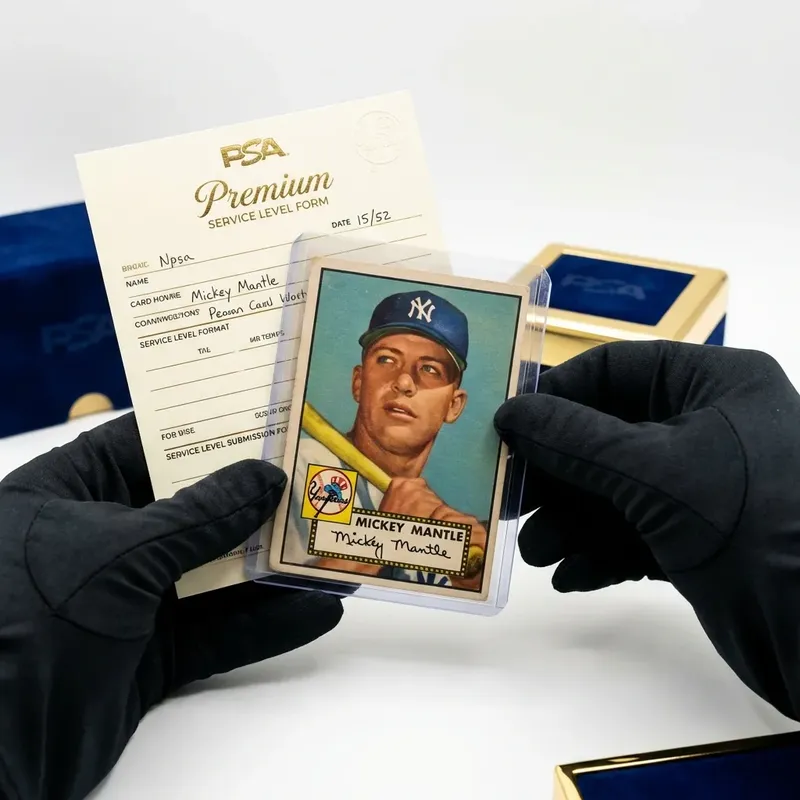
The Short Answer
- Effective June 2, 2026, PSA paused Value Bulk, Value, Value Plus, and Value Max to protect existing submissions.
- The backlog has climbed from ~10 million to 14 million cards after a last-minute submission surge before the pause.
- The cheapest open PSA tier is now Regular at $79.99 per card, with turnaround at 40-50 business days.
- PSA launched a public Backlog Tracker and says Value tiers will return when the queue falls to ~5 million cards, an estimated four to six months.
- Active Collectors Club memberships (as of May 14, 2026) are being extended for free for the duration of the pause.
What Changed on June 2, 2026
PSA made a historic operational decision on May 28, 2026, and implemented it on June 2, 2026: it temporarily stopped accepting new submissions for four of its lowest-cost service tiers. The paused tiers are Value Bulk, Value, Value Plus, and Value Max. PSA's higher-cost tiers — Regular, Express, Super Express, Walk-Through, and Premium — remain open.
The announcement was not a price change, a service shutdown, or a quality issue. It was a triage measure. PSA's active queue had been accelerating toward 10 million cards, and the company chose to protect the submissions already in its possession by cutting off the lowest-margin, highest-volume inflow. The goal is to give the grading floor the breathing room it needs to clear the backlog without letting turnaround times spiral further out of control.
Cards that were already logged under a paused tier before June 2, 2026 are not affected. Those orders continue under their original turnaround estimates. Only new submissions through Value, Value Plus, Value Max, or Value Bulk are blocked. If you have a pending Value Bulk order, you do not need to resubmit or pay a difference. It stays in the queue under the terms you originally accepted.
Current PSA Tier Status (June 2026)
Here is the complete PSA submission landscape as of late June 2026. The four cheapest tiers are closed, and the entry point for new PSA grading has jumped to $79.99 per card.
| Service Tier | Price | Turnaround | Status |
|---|---|---|---|
| Value Bulk | $24.99 | — | PAUSED |
| Value | $32.99 | — | PAUSED |
| Value Plus | $49.99 | — | PAUSED |
| Value Max | $64.99 | — | PAUSED |
| Regular | $79.99 | 40-50 days | OPEN |
| Express | $150 | 15-20 days | OPEN |
| Super Express | $300 | 5-10 days | OPEN |
| Walk-Through | $600+ | 3-5 days | OPEN |
| Premium | $1,000+ | 1-2 days | OPEN |
For collectors who previously used Value Bulk at roughly $25 per card, this is a 3.2x increase in the floor price. For a 50-card submission, the cost jumps from $1,250 plus shipping to $4,000 plus shipping. That changes the breakeven math on nearly every low-to-mid-range modern card.
Why PSA Paused the Value Tiers
The official reason is simple: PSA could not process submissions as fast as collectors were submitting them. In its May 2026 Service Level Update, the company stated that its active backlog was approaching 10 million cards. Even though PSA's daily grading output is at an all-time high and capacity is up roughly five times since 2021, the queue kept growing because incoming submissions grew even faster.
The trigger was a double demand shock. First, PSA announced a $200 million infrastructure investment in early 2026, which signaled confidence to the market. Second, PSA raised prices and extended turnaround times on Value tiers in mid-May. Collectors responded to both signals by submitting more cards, not fewer — a classic last-call rush. The result was a 20% spike in submissions that added approximately 1.6 million cards to the queue in just a few weeks.
PSA had two options: keep accepting cheap submissions and let turnaround times balloon for everyone, or pause the lowest tiers and focus on the cards already in the building. It chose the second option. The company framed the pause as a way to protect the integrity of the PSA standard and the existing backlog, rather than as a retreat from growth.
How the Backlog Hit 14 Million Cards
The backlog did not stay at 10 million. The pause itself caused a final rush. Collectors who had Value submissions in progress, or who wanted to lock in the cheaper rates before June 2, submitted everything they had. Industry reporting estimates that 2 million to 2.5 million additional cards entered PSA's system between May 28 and June 2, pushing the active backlog to 14 million cards by mid-June.
To put that in perspective, PSA's monthly grading capacity is roughly 2.2 to 2.5 million cards. At full capacity, a 14-million-card queue represents five to six months of work even if no new cards arrive. Because higher tiers remain open, new cards will continue to enter the system, so the realistic clearing timeline is longer than the raw math suggests.
PSA now publishes a public Backlog Tracker that it updates monthly. The tracker is the company's transparency tool: collectors can see the same queue numbers PSA management sees, and the reopening of Value tiers will be tied to the backlog reaching specific operational milestones, not to a calendar date.
The $200 Million Capacity Investment
PSA has repeatedly said the pause is not a sign of operational weakness. The company is in the middle of a $200 million capital commitment that includes upgraded facilities, advanced machine-learning logistics technology, and new staff. According to PSA, the investment is fully funded and actively being deployed.
The company plans to hire roughly 1,000 additional employees over 18 months and expand its physical footprint. The goal is to build a grading infrastructure that can handle modern demand without recurring backlogs. The pause is meant to give that new infrastructure the space to come online while protecting the cards already in the system.
The investment is also why PSA kept higher tiers open. Regular, Express, Super Express, and Walk-Through represent a smaller fraction of total volume, and their higher price points help fund the capacity expansion. Keeping them open allows PSA to continue serving the market, especially for high-value cards where the PSA premium matters most, while slowing the inflow of the lowest-cost tiers.
The New $79.99 Floor and What It Means
For the first time in years, the cheapest way to submit a card to PSA is Regular at $79.99. That is a structural change. The old Value Bulk entry point of $24.99 made it economical to grade cards with expected resale values as low as $100 to $150. At $79.99 plus shipping and insurance, the breakeven point roughly triples.
Here is a quick breakeven comparison. Assume a card costs $25 to buy raw, plus $80 to grade, plus $10 in shipping and fees. Total cost is $115. If the card grades PSA 10 and sells for $250, the net profit is roughly $135. If it grades PSA 9 and sells for $90, the seller loses money. At the old Value Bulk price, the same PSA 9 might still break even. The margin of error has vanished.
This means collectors need to be far more selective. The "spray and pray" bulk strategy — submit 100 cards and hope 30 gem — is no longer profitable at PSA unless the cards are high-quality. Pre-screening is no longer optional. It is now the difference between a profitable submission and a loss.
When Will Value Tiers Reopen?
PSA has not set a calendar date. Instead, it tied reopening to the backlog falling from roughly 14 million to 5 million cards. The original May estimate was up to four months. After the surge pushed the queue to 14 million, realistic estimates from industry observers now range from four to six months, possibly extending into the fall or early winter of 2026.
The reopening will likely happen in phases. The lowest-cost tiers, Value Bulk and Value, may return last because they generate the most volume. Value Plus and Value Max could reopen earlier if the backlog clears enough. PSA has also said it will provide monthly updates through the Backlog Tracker, so collectors should watch the tracker rather than guess.
The key variable is not just how many cards PSA grades, but how many new cards enter the system. If the pause and higher prices slow incoming submissions, the backlog will fall faster. If collectors keep submitting through Regular and Express, the queue will fall more slowly. PSA's reopening timeline is therefore a moving target driven by collector behavior as much as by PSA capacity.
Collectors Club Membership Extensions
One of the biggest complaints from hobbyists was that PSA Collectors Club memberships were sold partly on access to the Value Bulk tier. With that tier paused, many members felt they were paying for a benefit they could not use. PSA responded by extending memberships for free.
Any Collectors Club membership that was active as of May 14, 2026, and remains active, will be extended for the full duration of the Value Bulk pause. The extension applies automatically. Members do not need to request it. The exact length of the extension depends on how long the pause lasts, so the final duration will not be known until Value Bulk returns.
To verify your membership status, log into your PSA account and check the Membership section. The status should show as Active. If you purchased a membership after May 14, 2026, you may not be eligible for the free extension, so check the specific terms in your account.
What Collectors Should Do Now
The pause changes strategy for everyone from casual collectors to high-volume dealers. Here is how to adapt.
1. Pre-Screen Every Card Before Submitting
At $79.99 per card, a single PSA 8 can wipe out the profit from several PSA 10s. Use AI pre-grading tools, magnification, good lighting, and centering measurements to filter out cards unlikely to grade 9 or 10. Only submit cards that pass every test. A card that might grade 8 should not go to PSA at current prices.
2. Reserve PSA for Cards Where the PSA Premium Matters
PSA still commands the highest resale premiums in most categories. For key rookies, high-end vintage, rare parallels, and serial-numbered cards, the PSA 10 premium is large enough to justify the $80 fee. For common base cards, low-end inserts, and bulk modern, the PSA premium often does not justify the cost at current prices. Route those elsewhere or wait.
3. Use Alternative Graders for Volume
BGS, SGC, CGC, TAG, and Arena Club are all accepting submissions. BGS and SGC offer faster turnaround at lower prices for many cards. CGC is competitive for TCG. TAG is an option for high-end cards needing fast turnaround. The right alternative depends on the card type and whether resale value depends on the PSA brand.
4. Watch the Backlog Tracker Monthly
PSA's monthly Backlog Tracker is the best signal for when Value tiers will return. Do not rely on rumors or forum speculation. Check the official tracker and compare each month's number to the 5 million target. When the backlog is consistently falling, reopening is closer. If it stalls or rises, expect a longer wait.
5. Consider Holding Borderline Cards
If a card is not time-sensitive, the best move may be to wait. The expected resale value of the same card may not change much between now and when Value tiers reopen. If you believe the card will grade 10 and you do not need cash immediately, holding preserves the option to submit at a lower price later. This is especially true for modern cards where print runs are large and prices are not moving quickly.
Frequently Asked Questions
Which PSA tiers are paused as of June 2026?
What is the cheapest PSA tier now?
How big is the PSA backlog?
When will PSA reopen Value tiers?
Will my in-progress Value order still be graded?
Are Collectors Club memberships being extended?
What should I do with cards I planned to submit to Value Bulk?
Is PSA going out of business?
Sources & Further Reading
- PSA — Service Level Update (May 2026)
- PSA — Backlog Tracker
- The Athletic — PSA Halts Grading Submissions
- Baseball America — PSA Pauses Value Tiers
- Sports Illustrated — PSA Confirms Extended Pause
Emily Rodriguez analyzes grading cost, population, and pricing data across PSA, BGS, SGC, CGC, and TAG. She built the PreGradeCards ROI calculator and submission planner, and her market reports on grading backlog, turnaround times, and slab premiums are cited by collectors and dealers worldwide.
Create a free account and get 2 free credits — enough for 2 complete AI gradings with market pricing. No credit card required.
Get Your Free Credits →