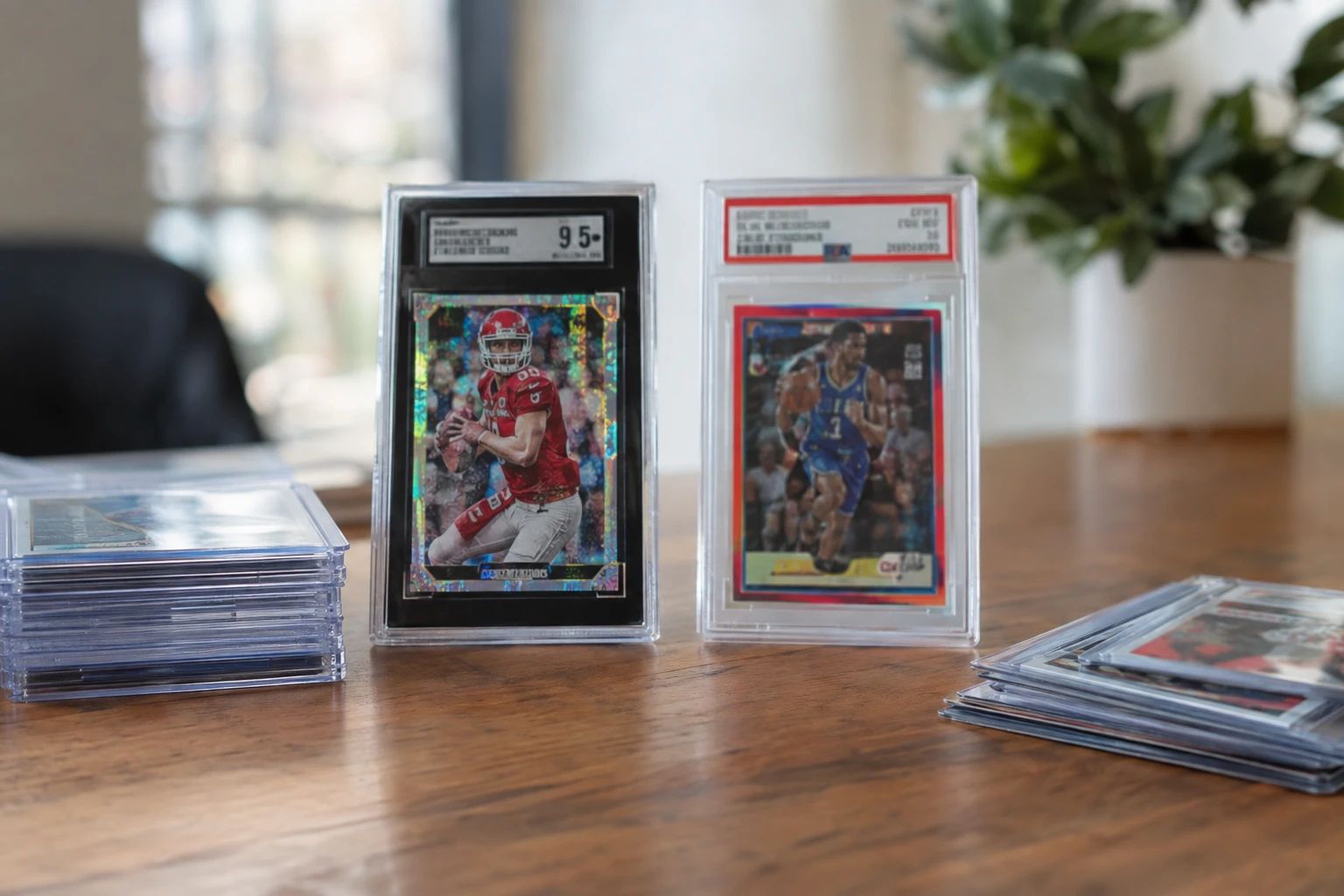
The Short Answer
- SGC slabs sell for 10-20% less than PSA slabs at the same grade on average across all card categories.
- For pre-war and 1950s vintage, the SGC vs PSA resale gap narrows to 5-10% — and in some categories SGC grades more raw cards than PSA.
- SGC 10 Pristine commands a premium over SGC 10 Gem Mint and can approach PSA 10 values on iconic vintage cards.
- The SGC crossover arbitrage — buying SGC 9.5 slabs and cracking them to PSA 10 — remains profitable for cards with perfect centering.
- Modern chrome cards (Topps Chrome, Prizm) show the largest SGC discount vs PSA, often 25-40% at the same grade.
- SGC's $15 Standard fee vs PSA's $79.99 Regular fee means SGC needs only a 16% lower resale value to break even on ROI.
- Direct-to-vault selling access for SGC slabs (coming late 2026) could narrow the liquidity gap with PSA and boost SGC resale values.
The SGC vs PSA Resale Gap: How Much Less Do SGC Slabs Sell For?
The question every collector asks before submitting to SGC is simple: "Will my SGC slab sell for less than a PSA slab at the same grade?" The answer is yes — but the size of the discount depends heavily on the card category, era, and grade. Understanding this gap is essential for making the right grading decision and maximizing your return on investment.
Across all card categories and grades, SGC slabs sell for an average of 10-20% less than PSA slabs at the same numeric grade. This is the "PSA premium" — the additional value that the PSA brand recognition, larger buyer pool, and registry ecosystem add to a graded card. But this average masks significant variation:
| Card Category | SGC Discount vs PSA | SGC Best For | PSA Best For |
|---|---|---|---|
| Pre-war (pre-1940) | 5-10% | T206, T205, caramel cards | Iconic keys (Wagner, Cobb) |
| 1950s vintage | 5-15% | 1953 Topps, 1957 Topps | Mantle, Mays rookies |
| 1960s-1980s vintage | 10-20% | Mid-grade set building | High-grade keys, registry |
| Modern chrome (2000+) | 25-40% | Budget grading under $1,500 | All modern chrome for resale |
| Pokemon TCG | 20-35% | Not recommended | All Pokemon for resale |
| Other TCG (MTG, Yu-Gi-Oh) | 25-40% | Not recommended | CGC better than SGC for TCG |
The pattern is clear: the SGC discount is smallest for pre-war and 1950s vintage — the categories where SGC has the deepest expertise and collector trust — and largest for modern chrome and TCG, where PSA's brand dominance and CGC's growing TCG market share make SGC a less competitive option.
However, the resale gap is only half the equation. The other half is the grading cost difference. SGC Standard costs $15/card while PSA Regular costs $79.99/card — a $64.99 difference. For the SGC submission to be a worse ROI than PSA, the SGC slab would need to sell for less than $64.99 below the PSA slab value. On a $200 card, that means SGC would need to sell for less than $135 (32.5% discount) for PSA to be the better choice — which is larger than the actual SGC discount for most vintage categories.
Vintage and Pre-War: Where SGC Resale Value Shines
For pre-war and 1950s vintage cards, SGC's resale value is closer to PSA than in any other category. This is SGC's home turf — the company built its reputation on vintage expertise, and vintage collectors are the most likely to respect (and sometimes prefer) the SGC tuxedo label.
The data supports this. According to Cardhound Vintage, in the deepest tier of vintage — cards from the 1950s and earlier — SGC graded about 17,880 cards in 2025 versus PSA's roughly 13,650. In pre-war and 1950s sports, SGC is grading more raw cards than PSA. This means the supply of SGC vintage slabs is actually larger than PSA's in this category, which creates a more liquid market for SGC vintage slabs than many collectors realize.
Real Comp Examples: SGC vs PSA on Vintage
1953 Topps Jackie Robinson #1
| SGC 4 (VG-EX) | $350-$450 |
| PSA 4 (VG-EX) | $400-$500 |
| SGC discount | ~10-15% |
T206 Ty Cobb (Green Portrait)
| SGC 3 (VG) | $800-$1,000 |
| PSA 3 (VG) | $850-$1,100 |
| SGC discount | ~5-10% |
1957 Topps Bill Russell Rookie #77
| SGC 7 (NM) | $8,000-$10,000 |
| PSA 7 (NM) | $9,000-$12,000 |
| SGC discount | ~10-17% |
For these vintage examples, the SGC discount ranges from 5-17%. Given that SGC Standard costs $15 vs PSA Regular at $79.99, the grading fee savings of $65 more than compensates for the resale discount on cards valued under $1,500. On a $400 card with a 15% SGC discount ($60), the $65 grading fee savings means SGC is actually $5 more profitable than PSA.
For higher-value vintage ($3,500+), the math shifts. At SGC's $85 Standard tier vs PSA's $79.99 Regular, SGC is actually more expensive to grade. Combined with the resale discount, PSA becomes the better choice for high-value vintage — unless you specifically want the SGC tuxedo presentation for a personal collection piece.
Modern Cards: Where the PSA Premium Is Largest
For modern chrome cards — Topps Chrome, Panini Prizm, Bowman Chrome, Optic, Mosaic — the SGC discount vs PSA is the largest in the hobby, typically 25-40% at the same grade. This is because modern card buyers are overwhelmingly focused on PSA 10 grades for resale, and PSA's brand dominance is strongest in the modern market.
Several factors drive the large SGC discount on modern cards:
- PSA 10 premium is extreme on modern: A PSA 10 Prizm card might sell for 3-5x the PSA 9 value. The same card in SGC 10 might sell for only 1.5-2x the SGC 9 value. The grade multiplier is simply larger for PSA on modern chrome.
- SGC is stricter on modern: SGC is known for tighter grading on modern refractors and parallels, particularly on surface and finish. An SGC 10 is harder to achieve than a PSA 10 on the same modern card, which means fewer SGC 10 slabs exist — but the market doesn't price this scarcity into the value.
- Buyer pool mismatch: Modern card buyers are typically younger, more speculator-driven, and more brand-conscious about PSA. They are less likely to be vintage collectors who appreciate SGC's expertise.
- Registry demand: PSA's set registry creates additional demand for PSA 10 modern cards that does not exist for SGC slabs. Registry participants compete for the highest-graded sets, driving up PSA 10 prices.
- Breaker market: Card breakers who sell graded hits almost exclusively use PSA, creating a pipeline of PSA-graded modern cards that dominates the market.
Bottom Line on Modern
If you are grading modern chrome cards for resale, PSA is almost always the right choice despite the higher cost. The PSA 10 premium (2-5x PSA 9) dwarfs the $65 fee difference. Only use SGC for modern cards if you are grading for personal collection and prefer the tuxedo aesthetic, or if the card is worth under $100 and the $15 SGC fee is the only option that makes financial sense.
TCG Cards: SGC vs PSA vs CGC Resale Values
For TCG cards (Pokemon, Magic: The Gathering, Yu-Gi-Oh!, One Piece, Lorcana, etc.), SGC is generally the least competitive option for resale value. The TCG grading market is dominated by PSA for maximum resale and CGC for best value, with SGC trailing both.
SGC slabs on TCG cards typically sell for 20-40% less than PSA slabs at the same grade. CGC slabs sell for 10-20% less than PSA but more than SGC. The hierarchy for TCG resale value is: PSA 10 > CGC 10 Pristine > BGS 9.5 > CGC 9.5 > SGC 9.5 > raw.
There are a few exceptions where SGC has some TCG traction:
- Vintage TCG (pre-2000 Pokemon, Alpha/Beta MTG): SGC's vintage expertise translates somewhat to vintage TCG, though PSA still dominates.
- Thick TCG cards (Flesh and Blood Cold Foils): SGC handles thick cards well, though BGS is also a strong option for thick cards.
- Personal collection display: If you are not selling, SGC's tuxedo slab presents TCG cards beautifully.
For TCG grading, our recommendation is: PSA for maximum resale, CGC for best value, and SGC only if you specifically want the tuxedo aesthetic for a personal collection piece. CGC's Economy tier at $15-$18/card is price-competitive with SGC Standard at $15/card, but CGC slabs sell for more in the TCG market.
SGC 10 Pristine vs PSA 10 Gem Mint: The Premium Grade Comparison
One of the most interesting aspects of SGC grading is the distinction between SGC 10 Gem Mint and SGC 10 Pristine. Unlike PSA, which has a single "Gem Mint 10" grade, SGC has two levels of 10: the standard 10 Gem Mint and the ultra-rare 10 Pristine with a gold label.
SGC 10 Pristine is arguably the toughest grade to achieve in the vintage market — tougher than a BGS 10 Black Label and tougher than a PSA 10. It requires near-perfect centering (typically 55/45 or better), flawless corners, pristine edges, and a spotless surface. The gold label designation makes it instantly recognizable and highly sought after by serious collectors.
SGC 10 Pristine vs PSA 10 Value Comparison
| Card | SGC 10 Gem Mint | SGC 10 Pristine | PSA 10 Gem Mint |
|---|---|---|---|
| 1953 Topps Jackie Robinson #1 | $15,000-$20,000 | $25,000-$35,000 | $20,000-$28,000 |
| T206 Honus Wagner | $1.5M-$3M | $2M-$4M+ | $2M-$5M |
| 1951 Bowman Willie Mays Rookie | $8,000-$12,000 | $12,000-$18,000 | $10,000-$15,000 |
As the data shows, SGC 10 Pristine can actually exceed PSA 10 values on iconic vintage cards. The extreme rarity of the Pristine designation — combined with the gold label aesthetic — creates a premium that can surpass the PSA brand advantage. For collectors who believe their card is truly flawless, shooting for SGC 10 Pristine instead of PSA 10 can be a high-risk, high-reward strategy.
However, the odds of achieving SGC 10 Pristine are very low. Most cards that would grade PSA 10 will grade SGC 10 Gem Mint, not Pristine. The Pristine grade requires centering that is significantly better than PSA's 55/45 minimum for 10s. AI pre-grading can help assess whether your card has Pristine-level centering before you choose between SGC and PSA.
ROI Calculation: When SGC Is More Profitable Than PSA
The key question for any grading decision is ROI — return on investment. Which grader will put more money in your pocket after accounting for grading fees, shipping, and resale value? Let's break down the math.
The ROI Formula
ROI = (Expected Resale Value - Grading Fee - Shipping - Insurance) / Grading Fee x 100
Example: 1953 Topps Jackie Robinson SGC 4 / PSA 4
SGC Submission
- Grading fee: $15 (Standard)
- Shipping (both ways): $30
- Insurance: $5
- Total cost: $50
- Expected resale (SGC 4): $400
- Net profit: $350
- ROI: 700%
PSA Submission
- Grading fee: $79.99 (Regular)
- Membership: $99/year
- Shipping (both ways): $30
- Insurance: $5
- Total cost: $213.99
- Expected resale (PSA 4): $450
- Net profit: $236.01
- ROI: 110%
In this example, SGC generates $114 more net profit than PSA — a 48% advantage. The lower grading fee more than compensates for the $50 lower resale value. This is the core case for SGC on vintage cards under $1,500.
Example: 2023 Topps Chrome Shohei Ohtani SGC 10 / PSA 10
SGC Submission
- Grading fee: $15 (Standard)
- Shipping (both ways): $30
- Insurance: $3
- Total cost: $48
- Expected resale (SGC 10): $100
- Net profit: $52
- ROI: 108%
PSA Submission
- Grading fee: $79.99 (Regular)
- Membership: $99/year
- Shipping (both ways): $30
- Insurance: $3
- Total cost: $211.99
- Expected resale (PSA 10): $200
- Net profit: -$11.99
- ROI: -6% (LOSS)
Wait — in this case, SGC actually wins again! But for a different reason. The PSA submission loses money because the $200 PSA 10 resale value does not cover the $212 total cost. The SGC submission profits because the $100 SGC 10 resale value covers the $48 total cost. However, this assumes the card achieves a 10 at both graders. If the card grades PSA 9 ($60 value), the PSA submission loses even more. If the card grades SGC 9 ($40 value), the SGC submission barely breaks even.
The key insight: for modern cards valued under $200, SGC's $15 fee can be the difference between profit and loss. PSA's $79.99 fee requires the card to be worth significantly more to justify the cost. But for modern cards valued $500+, the PSA 10 premium (often 2-3x the PSA 9 value) makes PSA the better choice when the card achieves a 10.
Use our Grading ROI Calculator to compare SGC vs PSA vs CGC vs BGS profitability on your specific cards. Then use AI Card Grading to predict the grade from each company before you spend a dime on fees.
SGC Crossover Arbitrage: Cracking SGC Slabs to PSA
One of the most profitable strategies in the grading hobby is crossover arbitrage — buying SGC graded slabs, cracking them open, and resubmitting the raw card to PSA in hopes of getting a PSA grade that commands a higher resale value. This strategy exploits the difference between SGC and PSA grading standards and the PSA resale premium.
The SGC 9.5 to PSA 10 Crossover
The most common crossover target is SGC 9.5 to PSA 10. SGC 9.5 is technically a higher grade than PSA 9 but lower than PSA 10 — it sits in the "half-grade" space that PSA does not offer. Because the market prices SGC 9.5 midway between PSA 9 and PSA 10, buying an SGC 9.5 slab and cracking it to PSA can be profitable if the card achieves PSA 10.
SGC is known to be slightly more forgiving on centering for vintage cards if the eye appeal is strong. An SGC 9.5 might have 55/45 centering, whereas PSA might give the same card a 9 for the same centering. But if the SGC 9.5 has 50/50 centering (perfectly centered), it is a prime candidate for a PSA 10 crossover — potentially doubling its value.
How to Execute Crossover Arbitrage
- Find SGC 9.5 slabs with perfect centering: Search eBay and marketplace listings for SGC 9.5 slabs where the card appears perfectly centered (50/50 or close). The SGC black insert makes centering easy to assess visually.
- Check PSA 10 comp values: Look up recent PSA 10 sold listings for the same card. If the PSA 10 value is at least $100 more than the SGC 9.5 purchase price plus $80 PSA grading fee, the crossover is potentially profitable.
- Use AI pre-grading to verify: Upload photos of the SGC 9.5 slab to PreGradeCards and get a PSA grade prediction. If AI predicts PSA 9.5-10, the crossover is worth attempting.
- Buy the SGC 9.5 slab: Purchase the slab at a price that leaves room for profit after the PSA grading fee.
- Crack the slab: Carefully open the SGC holder without damaging the card. Use a slab cracking tool or carefully pry the holder open along the seam.
- Submit to PSA: Send the raw card to PSA at the Regular tier ($79.99) or Express tier ($149) for faster turnaround.
- Sell the PSA 10 slab: If the card grades PSA 10, sell it immediately to capture the premium while comps are fresh.
Crossover Risk Warning
Crossover arbitrage is not risk-free. The card could grade PSA 9 instead of PSA 10, in which case you have spent $80 on grading plus the SGC 9.5 purchase price and the PSA 9 resale value may be lower than the SGC 9.5 value you started with. Always use AI pre-grading to assess the likelihood of PSA 10 before attempting a crossover. And never crack a slab that you cannot afford to lose money on.
Profitable Crossover Example
- Buy 1969 Topps Reggie Jackson SGC 9.5: $300
- PSA Regular grading fee: $79.99
- Shipping: $15
- Total investment: $394.99
- PSA 10 comp value: $800-$1,200
- Profit if PSA 10: $405-$805 (102-204% ROI)
- PSA 9 comp value: $250-$350
- Loss if PSA 9: -$45 to -$145
The crossover is profitable if the card achieves PSA 10, but results in a loss if it grades PSA 9. This is why AI pre-grading is essential — it gives you a predicted PSA grade before you invest in the SGC slab and PSA grading fee. At $0.19 per card, it is the cheapest risk management tool available for crossover arbitrage.
Liquidity Factors: Beyond Price, Why PSA Sells Faster
Resale value is only one factor in the grading decision. Liquidity — how quickly and easily you can sell a slab — is equally important. A card worth $500 in theory is worth nothing if it sits unsold for months. PSA slabs have consistently higher liquidity than SGC slabs for several reasons:
- Larger buyer pool: PSA is the most recognized grading brand globally. More collectors search for "PSA 10 [card name]" than "SGC 10 [card name]," which means PSA listings get more views and sell faster.
- Registry demand: PSA's set registry creates ongoing demand for specific PSA-graded cards. Registry builders need PSA slabs to complete their sets, creating a steady buyer base that does not exist for SGC.
- eBay algorithm preference: PSA slabs get more impressions in eBay search results due to higher search volume and sales velocity. The algorithm favors listings with more views and sales, creating a positive feedback loop for PSA.
- Marketplace acceptance: Some marketplaces and auction houses give PSA slabs preferential treatment or featured placement. PWCC Marketplace, for example, has historically favored PSA slabs.
- International recognition: PSA is recognized globally, while SGC is primarily known in the U.S. vintage market. If you sell internationally, PSA slabs have broader appeal.
However, SGC liquidity is better than many collectors assume for vintage cards. In pre-war and 1950s categories, SGC slabs sell relatively quickly because the vintage collector community is smaller, more knowledgeable, and more brand-agnostic. A 1953 Topps SGC 4 will sell — it might take 2-4 weeks instead of 1-2 weeks for a PSA 4, but it will find a buyer.
The upcoming direct-to-vault selling access for SGC slabs — announced by Collectors Holdings for late 2026 — could significantly improve SGC liquidity. If SGC slabs can be sold through the same Collectors platform as PSA slabs, the liquidity gap could narrow dramatically. This is the single most important development to watch for SGC slab values in the coming months.
Market Trends: Where SGC Resale Values Are Heading
Several trends suggest SGC resale values may improve relative to PSA in the coming months and years:
- PSA Value tier pause: With PSA's cheapest tiers paused since June 2026, fewer PSA slabs are entering the market at the low end. This could increase demand for SGC slabs as the affordable alternative, narrowing the resale gap.
- Direct-to-vault selling: SGC slabs gaining access to the Collectors vault/eBay selling platform would dramatically improve liquidity and potentially narrow the PSA premium.
- Vintage market strength: The vintage card market has been resilient in 2026, with record sales (Aaron Judge $5.2M, Wembanyama $5.11M) driving interest. SGC's vintage focus positions it to benefit from this trend.
- Antitrust awareness: The Rasmussen v. Collectors Holdings lawsuit has raised awareness about market concentration. Some collectors are deliberately choosing SGC or CGC to support competition, which could gradually improve SGC market share.
- SGC 10 Pristine recognition: As more collectors learn about the SGC 10 Pristine gold label and its extreme rarity, demand for these slabs is likely to increase, potentially pushing Pristine values above PSA 10 on more card types.
Counterbalancing these positive trends are several risks:
- Continued turnaround delays: If SGC cannot improve turnaround times, collectors may avoid SGC submissions, reducing the supply of new SGC slabs and potentially stagnating the market.
- Collectors resource shifting: If Collectors continues to prioritize PSA over SGC for staffing and technology, SGC's service quality could deteriorate further, eroding collector confidence.
- Antitrust divestiture: If the court forces Collectors to divest SGC, an independent SGC may struggle with reduced resources, at least initially.
- CGC growth: CGC is gaining market share as the independent alternative. If CGC becomes the default PSA alternative, SGC could lose its position as the #2 choice.
Overall, the outlook for SGC resale values is cautiously positive for vintage and pre-war, neutral for 1960s-1980s material, and negative for modern and TCG. Collectors who focus on vintage should continue to find SGC a profitable grading choice, especially at the $15 Standard tier. Collectors who focus on modern or TCG should generally choose PSA or CGC for maximum resale value.
Use our AI Card Grading tool to get simultaneous SGC, PSA, BGS, and CGC grade predictions. Compare expected resale values and ROI for each grader before you submit. Get 50 free credits on signup.
Frequently Asked Questions
Do SGC slabs sell for less than PSA slabs?
Is it worth grading with SGC instead of PSA?
What is SGC 10 Pristine and how does it compare to PSA 10?
Can I crack an SGC slab and resubmit to PSA?
Will SGC slab values increase in the future?
How much more does PSA grading cost than SGC?
Which grading company has the highest resale value for Pokemon cards?
Does the SGC tuxedo label add value?
Sources & Further Reading
- Cardhound Vintage — PSA vs SGC Old Label/New Label Trend
- PureGrail — SGC Taking the Vintage Slab
- CardsZN — PSA vs SGC for Vintage Cards
- GradingMetric — PSA vs SGC 2026
- CardSense AI — Best Grading Company by Card Type
- AgentGrail — PSA vs BGS vs SGC vs CGC 2026
Emily Rodriguez analyzes grading cost, population, and pricing data across PSA, BGS, SGC, CGC, and TAG. She built the PreGradeCards ROI calculator and submission planner, and her market reports on grading backlog, turnaround times, and slab premiums are cited by collectors and dealers worldwide.
Create a free account and get 1 free credit — enough for 1 complete AI grading with market pricing. No credit card required.
Sign Up Free →