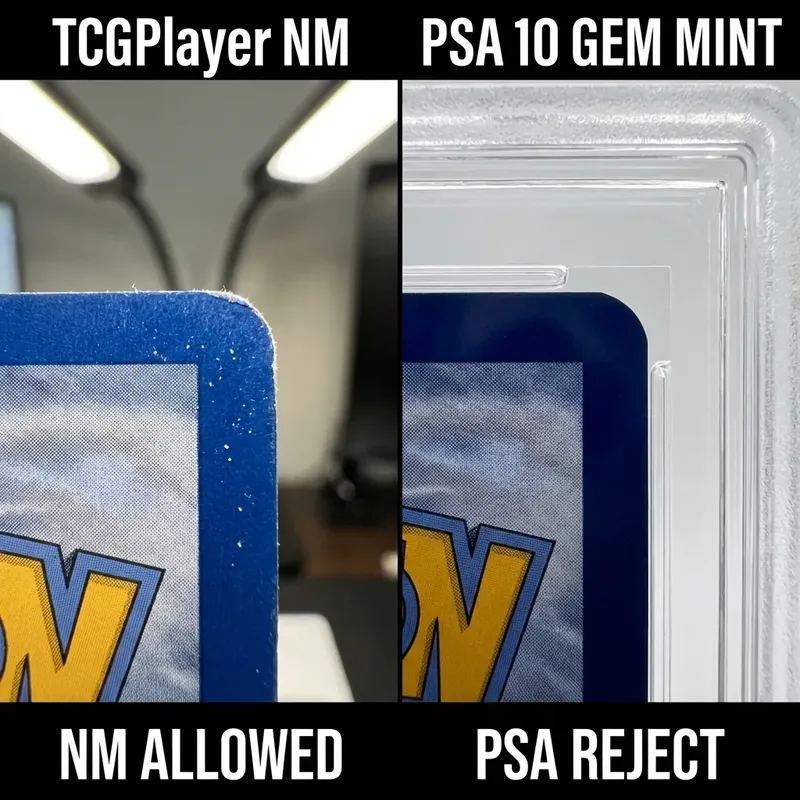
"It was sold as Near Mint, so it should get a 9 or 10, right?" This is the single most expensive assumption in the card hobby. The answer, statistically, is no.
The Definition Gap
The root of the problem lies in the official conditioning guidelines. TCGPlayer, the world's largest marketplace, explicitly allows imperfections in their "Near Mint" category. PSA, however, demands near perfection for a Gem Mint 10.
TCGPlayer "Near Mint" Definition
"Cards in Near Mint (NM) condition show minimal to no wear from shuffling, play or handling and can have a nearly unmarked surface, crisp corners and unblemished edges outside of a few minor flaws."
Key Phrase: "A few minor flaws."
Specifically, the guidelines allow for up to 3 points of imperfection. This could be:
- A small scratch.
- Minor edge whitening.
- Clouding on the surface.
To a PSA grader, "3 points of imperfection" is not a PSA 10. It is often not even a PSA 9. It is the textbook definition of a PSA 7.
The Data: Where "NM" Truly Lands
PSA 7 is known as the "Near Mint" grade. PSA 8 is "Near Mint-Mint". PSA 9 is "Mint". See the pattern? If you buy a "Near Mint" card, and you get a PSA 7 "Near Mint" slab, you got exactly what you paid for.
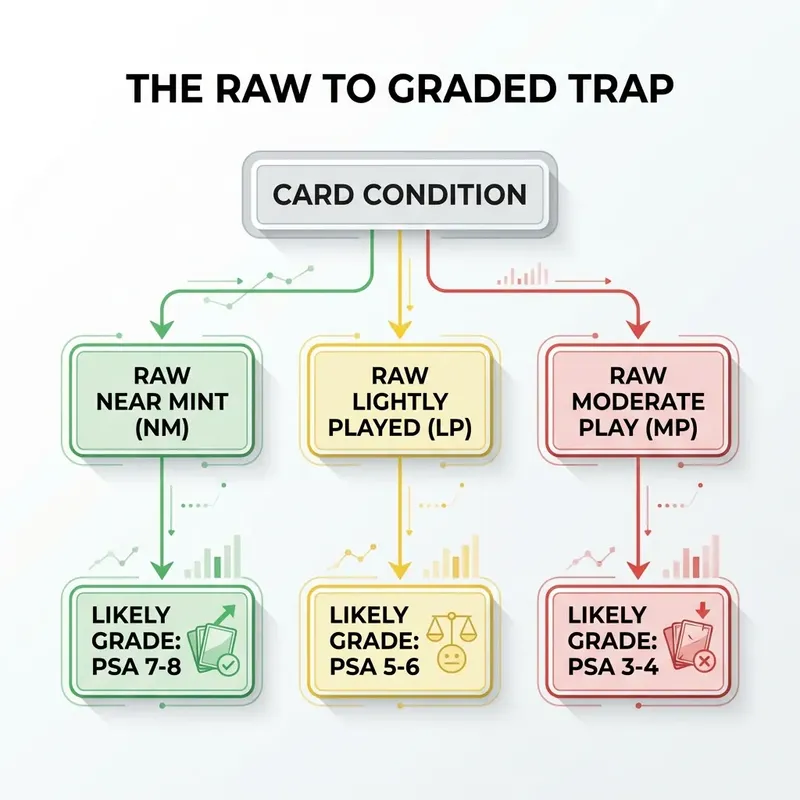
Zero whitening. Zero scratches. Perfect centering.
Minor corner wear. Slight edge chipping. Allowed by TCGPlayer NM.
The Calculus of Conditioning
Marketplaces condition cards for players (Magic: The Gathering, Pokemon TCG). Players care if a card looks good in a sleeve across a table. They do not care about a 1mm micro-scratch visible only under 10x magnification.
Graders condition cards for investors. They check under loupes and harsh LED lights. The two standards are incompatible.
The "NM Trap" Math
Let's say you buy a raw Sheoldred, the Apocalypse for $60 (NM). You verify it has no bends, but it has one white dot on the back corner. By TCGPlayer standards, this is a perfect NM copy. You grade it ($15 fee). It comes back a PSA 8.
- Cost Basis: $75 ($60 card + $15 grade)
- PSA 8 Value: $60
- Net: -$15
Now imagine you did this 100 times. This is how new submissions bleed money.
How to Beat the System
If you cannot trust "Near Mint", how do you source cards to grade? You have to change your purchasing behavior.
1. Assume NM = PSA 7
When calculating your arbitrage margins, never assume a raw NM card is a 10. Run your numbers assuming it is a 9 at best, and likely an 8. If the math doesn't work at PSA 8 prices, do not buy the raw card.
2. Request Photos (The Hard Way)
On TCGPlayer, listings with photos are rare but valuable. On eBay, never buy a stock photo listing for grading. If you can't see the corners, assume they are soft.
3. Buy "Mint" from Specialists
Some sellers specifically list cards as "Pack Fresh" or "Mint" (though TCGPlayer lacks a Mint category). Look for descriptions that explicitly mention "Gradable" or "Center Stage".
The Verdict
TCGPlayer is an incredible resource for filling binders and building decks. But for grading? It is a minefield. The "Near Mint" label is accurate for gameplay, but deceptive for grading. Adjust your expectations, or adjust your sourcing strategy.