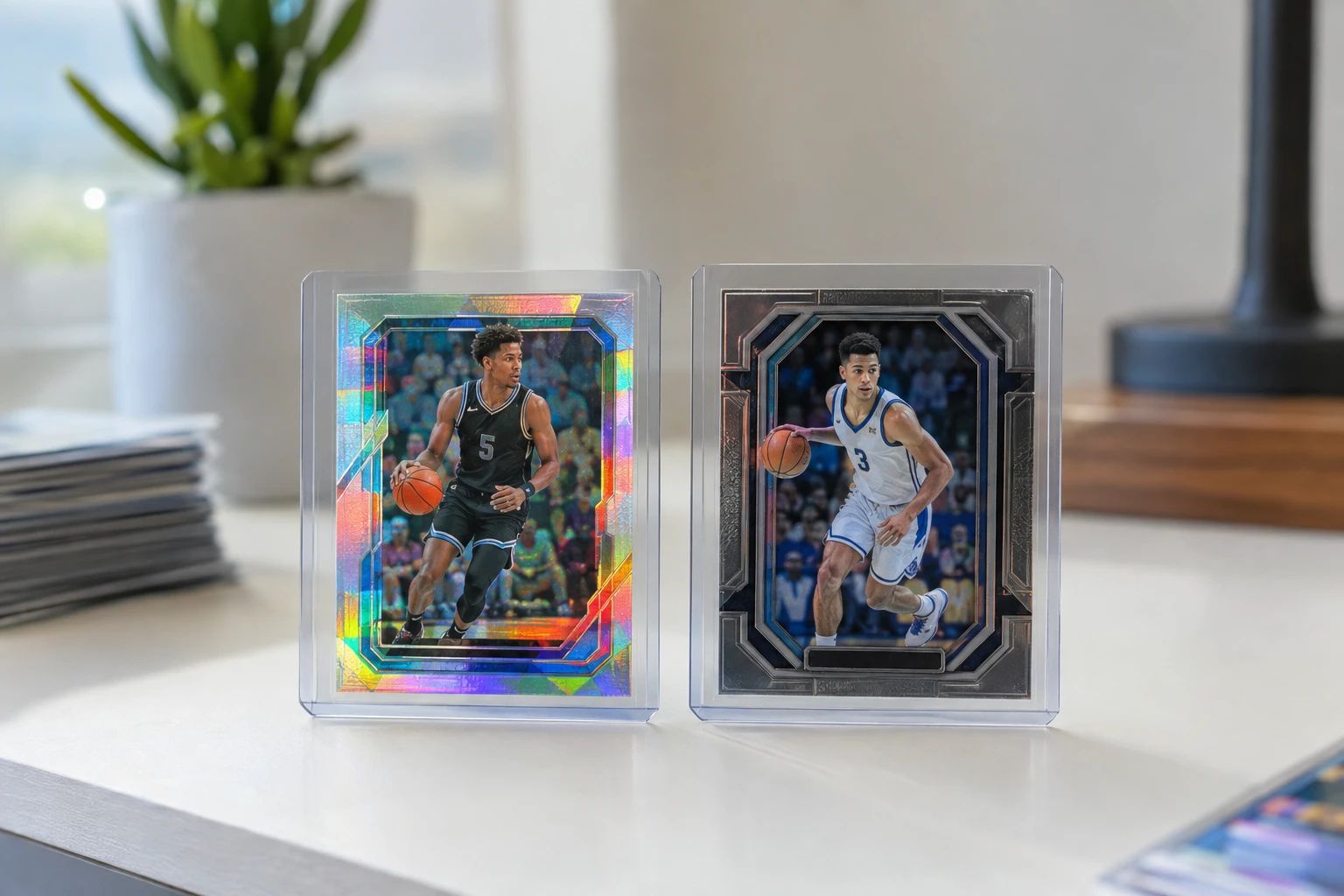
The Short Answer
- Topps Chrome returned to NBA basketball in December 2025 after a 16-year absence, with hobby boxes retailing at $369.99 and selling out in under 2 minutes.
- Prizm Silver is the "Bitcoin of basketball cards" — the most liquid, most searched, and most recognized modern rookie card parallel in the hobby.
- Topps Chrome has sturdier cardstock — "snaps like a credit card" — with better centering consistency and higher PSA 10 gem rates than Prizm.
- Prizm has 40-50% PSA 10 failure rate on centering alone due to print-run variance, versus Chrome's more consistent centering.
- Chrome Refractor is gunning for Prizm Silver's spot as the de facto investor parallel, but lacks a decade of comp history and collector muscle memory.
- Panini unlicensed 2025-26 products trade at a significant discount — a Bernard King Cracked Ice Auto /25 sold for just $0.99 on eBay.
The History: Prizm Dominance and Chrome's Return
For most of the last decade, there was no real debate between Topps Chrome and Panini Prizm in basketball. Topps Chrome basketball was a ghost — off the market since 2009, replaced by Panini's stranglehold on the NBA license. Prizm filled the chromium void, grew into the hobby's most recognized brand, and collected years of price history, collector loyalty, and generational rookie cards.
Then Fanatics happened. Topps came back with full NBA licensing in October 2025, and suddenly there is an actual fight on our hands.
Timeline: How We Got Here
- 2009: Panini acquires exclusive NBA trading card license. Topps exits basketball.
- 2012-13: Panini launches Prizm as its chrome-style flagship. Prizm Silver becomes the default modern rookie card standard.
- 2022: Fanatics announces it will take over the NBA license, acquiring Topps in the process.
- October 2025: Topps returns to NBA-licensed basketball cards for the first time in 16 years with 2025-26 Topps Basketball flagship.
- December 18, 2025: 2025-26 Topps Chrome Basketball releases. Hobby boxes retail at $369.99 and sell out in under 2 minutes. Jumbo boxes at $699.99 flip for $1,400+ on eBay within 24 hours.
- 2025-26 season: Both Topps and Panini produce NBA cards simultaneously — Panini with unlicensed products (no team logos), Topps with full NBA licensing.
Prizm now has over a decade of comp history. Every major rookie from Luka Doncic to Giannis Antetokounmpo to Zion Williamson has a Prizm RC. Collectors know how the rainbow works, what grades sell, and what a Silver PSA 10 is worth. That market fluency cannot be manufactured overnight.
Topps Chrome basketball, for all its shiny return energy, is essentially starting fresh. The name carries legacy — the Kobe Bryant Chrome RC from 1996-97 is legendary — but in terms of modern pricing behavior, comps, and collector habit, it is year one.
Cardstock Quality: Chrome vs Prizm
The physical quality of the cards is where the Topps Chrome vs Prizm debate gets interesting. While Prizm has dominated the market for over a decade, collectors have increasingly criticized its cardstock quality in recent years.
Cardstock Comparison
| Attribute | Topps Chrome | Panini Prizm |
|---|---|---|
| Cardstock feel | Sturdy — "snaps like a credit card" | Thinner — "plasticky" surface |
| Surface durability | Resists scratching better | Prone to surface scratches from pack wrappers |
| Centering consistency | Generally more consistent | 40-50% fail PSA 10 on centering alone |
| Edge quality | Less prone to edge whitening | White flecking on dark parallels |
| Surface issues | Refractor lines (print lines in coating) | Surface dimples, print defects |
| Corner durability | Sturdier corners from pack | Corners can ding from pack wrapper |
Topps Chrome cards feel like credit cards. They have a snap to them. They do not scratch if you look at them wrong. Prizm, especially in the last few years, has felt increasingly plasticky. The surface issues on recent Prizm runs have been a nightmare for graders.
The sturdier Chrome cardstock has a direct impact on grading outcomes. Because the cards are less prone to corner dings and edge wear from the packaging process, a higher percentage of Chrome cards straight from packs are in PSA 10 candidate condition. Prizm cards, by contrast, often arrive with micro-scratches and edge whitening just from normal pack opening.
PSA 10 Gem Rates: Which Brand Grades Better?
The cardstock quality differences translate directly into PSA 10 gem rates. While comprehensive gem rate data for 2025-26 Topps Chrome is still developing (the product is only 7 months old), early evidence and historical data from Topps Chrome baseball provide reliable benchmarks.
Estimated PSA 10 Gem Rates
| Product | Est. PSA 10 Gem Rate | Primary Grade Killer | AI Accuracy (±1 grade) |
|---|---|---|---|
| Topps Chrome Basketball (2025-26) | ~15-20% (est. based on Chrome baseball) | Refractor lines, surface | 93% |
| Panini Prizm Basketball (2023-24) | ~8-12% | Centering (40-50% fail), surface scratches | 89% |
| Panini Prizm (recent years average) | ~8.88% (industry average) | Centering variance, edge whitening | 89% |
| Topps Chrome Refractor parallel | ~12-18% (est.) | Refractor coating lines | 93% |
| Panini Prizm Silver parallel | ~10-15% | Centering, surface scratches | 89% |
The estimated 15-20% gem rate for Topps Chrome is meaningfully higher than Prizm's 8-12%. This means that for every 100 cards submitted, Chrome yields 3-12 more PSA 10 copies than Prizm. For investors, this translates to higher expected value per submission — the cost of grading is the same, but the probability of achieving the premium PSA 10 grade is higher with Chrome.
However, higher gem rates also mean higher PSA 10 populations, which can soften prices over time. A high pop count on a card people actually like is fine. A high pop count on a card people are only buying because they are bored is a disaster. People like Chrome. They want to display it. The question is whether the higher gem rate will create oversupply that depresses premiums.
Resale Value and Liquidity Comparison
While Chrome may grade better, Prizm has a decisive advantage in market liquidity and resale value — at least for now. A decade of comp history and collector loyalty creates a moat that cannot be crossed overnight.
Resale Value Comparison (2025-26 Rookie Class)
| Metric | Topps Chrome | Panini Prizm |
|---|---|---|
| Flagship rookie PSA 10 (Cooper Flagg) | $700 (Chrome base #251) | $200-400 (unlicensed Prizm) |
| Refractor/Silver PSA 10 | $1,200+ (Chrome Refractor) | $400-500 (Prizm Silver, est.) |
| Hobby box price (secondary market) | $369.99 retail, $600+ secondary | $567-$2,000+ (varies by year) |
| Liquidity (cards sold per week) | Developing — strong early demand | Very high — deepest buyer pool in hobby |
| Comp history depth | 7 months | 13+ years |
| Collector familiarity | Growing — legacy brand recognition | Universal — "Bitcoin of basketball cards" |
The Liquidity Advantage
Prizm Silver is the most searched rookie card parallel in the hobby. When a player breaks out — drops 40 on a Wednesday and suddenly everyone needs that card — Silver Prizm is the easiest version to find and the easiest version to sell. High population, yes. But also high demand, fast transaction speed, and a buyer pool that includes everyone from teenagers to hedge fund guys.
Chrome Refractors have a similar logic but smaller buyer familiarity right now. Give it time. The Refractor is Chrome's calling card the same way the Silver is Prizm's. As Topps builds out multiple years of NBA product, the Chrome Refractor will develop its own collector muscle memory. It just has not yet.
The Pricing Gap
For the 2025-26 rookie class, Topps Chrome commands a significant premium over Panini Prizm — but this is partly because the 2025-26 Prizm products are unlicensed (no NBA team logos). The licensing gap creates an artificial price differential that may not reflect the true quality comparison between the two brands.
When Panini eventually produces licensed products again (if they regain any licensing rights), or when comparing older licensed Prizm years to Chrome, the pricing gap narrows considerably. 2023-24 Panini Prizm Basketball hobby boxes (licensed, Wembanyama rookie year) currently go for $2,000+ on the secondary market.
Grading Tips: Chrome Refractor Lines vs Prizm Scratches
Each brand presents unique grading challenges that require different AI pre-grading approaches. Understanding the specific failure modes of each product is essential for maximizing PSA 10 rates.
Topps Chrome Grading Challenges
- Refractor lines. Chrome cards can have print lines in the refractor coating that are visible under angled light. These are not scratches but manufacturing defects in the coating application. They can cap a card at PSA 9 even though the underlying cardstock is perfect.
- Surface inspection requires angled lighting. The refractor surface creates rainbow reflections that can obscure surface defects under direct lighting. Use two 45-degree softbox lights in a dark room with a black matte background for AI scanning.
- Centering is generally reliable. Topps Chrome print runs show more consistent centering than Prizm. This means centering is less likely to be the grade killer — focus your AI analysis on surface and corners instead.
- Edge wear is minimal. The sturdier Chrome cardstock resists edge whitening better than Prizm. Edges are unlikely to be the grade killer for pack-fresh Chrome cards.
Panini Prizm Grading Challenges
- Centering variance is the #1 killer. 40-50% of Prizm cards fail PSA 10 on centering alone. The 60/40 front requirement is strict, and Prizm cards frequently come 65/35 or worse from the pack. Always check centering first with AI analysis.
- Surface scratches from pack wrappers. Prizm's chromium-style surface is prone to fine scratches from the pack wrapper itself. Even careful pack openers introduce micro-scratches visible under grader magnification. Unlike Chrome's sturdier coating, Prizm's surface scratches easily.
- Edge whitening on dark parallels. Prizm card edges show white flecking along the colored border, particularly on dark parallel colors (Black, Gold). This edge whitening is visible without magnification and will cap a card at PSA 9 if significant.
- Surface dimples. Prizm cards can have small surface dimples or indentations in the coating that are not visible to the naked eye but are detectable under grader magnification. AI surface analysis can identify these before submission.
AI Pre-Grading Workflow Differences
| Step | Topps Chrome | Panini Prizm |
|---|---|---|
| 1. Check centering | Quick verify — generally good | Check first — 40-50% fail rate |
| 2. Check surface | Look for refractor lines under angled light | Look for scratches and dimples |
| 3. Check edges | Quick verify — minimal edge wear | Check for white flecking on dark parallels |
| 4. Check corners | Standard check | Check for pack-wrapper dings |
| 5. Lighting setup | 45-degree softboxes, dark room, black background | Same — eliminate glare from chromium surface |
Investment Outlook: Which Brand to Hold?
The investment question is not which brand is "better" — it is which brand holds value longer and which offers better risk-adjusted returns. The answer depends on your time horizon and investment style.
Prizm: The Liquidity Play
- Deepest liquidity in the hobby. Prizm Silvers are the most tradable basketball cards on the market. When you need to sell quickly, Prizm has the deepest buyer pool.
- 13+ years of comp history. Every major rookie since 2012 has a Prizm RC. The market knows how to price these cards.
- Brand loyalty. An entire generation of collectors grew up with Prizm as the standard. That cultural weight is not easy to replicate.
- Historical appreciation. 2022-23 Prizm hobby boxes average $750. 2023-24 Prizm boxes (Wemby year) are over $2,000. Strong rookie classes drive long-term value.
- Risk: overproduction. Panini released more products per year than any previous manufacturer, diluting scarcity. The hope is that Fanatics/Topps will consolidate the product lineup.
Topps Chrome: The Quality Play
- Superior cardstock quality. Sturdier cards with better centering and higher PSA 10 gem rates. This means better expected value per grading submission.
- Historical significance. The 2025-26 Chrome Basketball is the first NBA Chrome product in 16 years. Cards from this release are historically significant regardless of player performance.
- Legacy brand recognition. Topps Chrome is the most prestigious modern sports card brand across all sports. The Kobe Bryant 1996-97 Chrome RC sells for $50,000+ PSA 10. LeBron James 2003 Chrome RC is $200,000+ PSA 10.
- Lower supply. Chrome hobby boxes are priced higher ($369.99 vs Prizm's ~$200), which may result in lower total production and tighter supply.
- Risk: unproven market. Chrome basketball is starting fresh. No modern comp history. The market is still discovering how to price these cards.
The Recommended Strategy: Diversify Across Both
Smart investors should hold both brands. The market loves the shiny new thing, especially when the shiny new thing is actually the shiny old thing. But Prizm Silver has too much momentum to die overnight. It is the Bitcoin of basketball cards. Topps Chrome is Ethereum — it has more utility (better autos, better designs, better cardstock), and it is catching up fast.
Recommended allocation for modern basketball card portfolios:
- 50% Prizm Silvers and numbered parallels — for liquidity and comp history
- 35% Topps Chrome Refractors and autos — for quality and historical significance
- 15% Topps Finest, Cosmic Chrome, and other premium products — for diversification and upside optionality
If you are holding thousands of dollars in base Prizm rookies, consider diversifying into Chrome. The market is currently pricing Chrome at a premium to unlicensed Prizm, and that premium is likely to persist as long as Topps holds the NBA license exclusively.
The Unlicensed Question: Do Panini Cards Still Matter?
The 2025-26 season presents a unique situation: Panini is producing NBA cards without the NBA license (no team logos, no NBA branding), while Topps produces fully licensed cards. This creates a natural experiment in how licensing affects card values.
Early Sales Data: Unlicensed Panini Products
- 2025-26 Donruss Basketball — Hobby boxes selling for ~$190 (two-box lots at $381). For a product with 3 autographs, this is exceptional value, but also shows collector hesitation.
- VJ Edgecombe Cracked Ice Auto /25 — sold for $485. Edgecombe has an exclusive autograph deal with Panini, which supports value for his cards specifically.
- Bernard King Cracked Ice Auto /25 — sold for $0.99 plus shipping. For a Hall of Fame player, this demonstrates the unlicensed penalty: collectors will not pay premium prices for unlicensed cards of non-premium players.
- 2025-26 Signature Series Basketball — holding value better than Donruss. VJ Edgecombe Kaboom SSP sold for $1,200. Azzi Fudd Kaboom SSP (NIL card) sold for $543.
The Licensing Premium
The data suggests that licensing creates a significant value premium. A licensed Stephon Castle Kaboom sold for $1,500, while the unlicensed VJ Edgecombe Kaboom sold for $1,200 — only a 20% discount. However, for non-premium players, the unlicensed penalty is severe: the Bernard King at $0.99 shows that unlicensed cards of retired players may have essentially zero market value.
Historical Precedent
When a manufacturer loses a license, its products often become "closed era" collectibles. Upper Deck basketball products from the 1990s — SP Authentic, SPx, Ultimate Collection — carry premiums for key rookie cards because the supply is fixed. The 1997 Upper Deck SP Authentic #128 Tim Duncan rookie remains highly sought after.
If Panini eventually stops producing NBA cards entirely, its licensed products (2009-10 through 2023-24) could appreciate as "last era" collectibles. The 2023-24 Prizm Wembanyama rookie is a prime example — it is the last fully licensed Panini NBA product, and its values are surging.
What This Means for Collectors
- For 2025-26 and beyond: Topps Chrome is the preferred investment. Licensed products with better cardstock quality.
- For 2023-24 and earlier: Panini Prizm remains the gold standard. These are fully licensed products with a decade of comp history.
- For unlicensed Panini products: Only invest in exclusive autograph subjects (like VJ Edgecombe) or ultra-rare inserts (Kabooms). Base cards and commons have minimal value without licensing.
- Long-term view: Panini's licensed rookie cards (Prizm, Donruss Optic, Select) for stars like Wembanyama, Luka Doncic, and Giannis will remain valuable as "closed era" collectibles.
Frequently Asked Questions
Which is better for investment: Topps Chrome or Panini Prizm?
Does Topps Chrome or Panini Prizm have a higher PSA 10 gem rate?
Why are 2025-26 Panini Prizm cards cheaper than Topps Chrome?
What are the main grading differences between Chrome and Prizm?
Will Panini Prizm basketball cards become worthless?
Should I grade Topps Chrome or Panini Prizm cards?
Sources & Further Reading
- Topps Chrome vs Prizm Basketball: Which Holds Value? — CardSZN
- Topps Chrome Basketball Is Back: The Good, The Bad, & The Shiny — CardSZN
- 2025-26 Topps Chrome Basketball Preview — Cardlines
- A Look at How Panini's First Unlicensed Basketball Cards are Selling — SI Collectibles
- NBA Card Brands: Panini vs Topps vs Upper Deck — The Card Shop Finder
- NBA Card Price Trends & Market Analysis (2026) — The Card Shop Finder
Create a free account and get 1 free credit — enough for 1 complete AI grading with market pricing. No credit card required.
Sign Up Free →