The Short Answer
- AI grading tools predict PSA/CGC/BGS grades from a photo in under 60 seconds.
- Four grading criteria — centering, corners, edges, surface — are all analyzed automatically.
- PSA Value tiers are paused in 2026; cheapest PSA option is $79.99. Pre-grading prevents wasted fees.
- PreGradeCards offers free credits and AI grading starting at a fraction of professional costs.
- Only submit cards that AI grades 9–10 to maximize ROI and avoid capital being frozen for months.
What AI Card Grading Actually Does
When a collector asks "what grade is my card?", they're really asking four sub-questions at once: How centered is it? Are the corners sharp? Are the edges clean? Is the surface free of scratches, print lines, and haze? Traditional answers required either a trained human eye, expensive equipment, or mailing the card to PSA and waiting weeks.
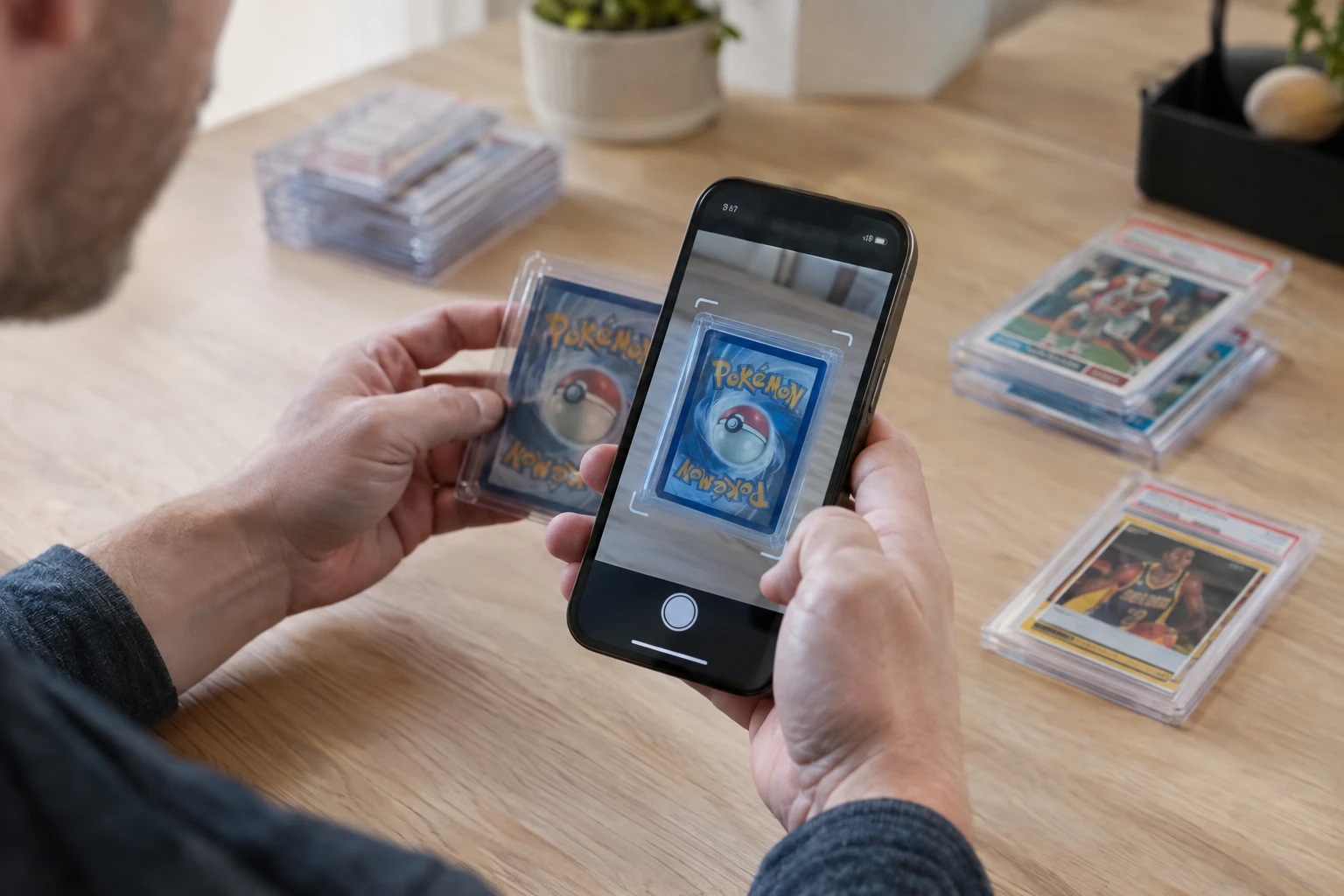
AI card grading changes all of that. Modern tools like PreGradeCards AI use computer vision — the same technology behind facial recognition and self-driving cars — to analyze a high-resolution photo of your card across every grading dimension. The algorithm measures the exact pixel distance from the card image to each border, detects micro-scratches and surface clouding invisible to the naked eye, and compares the card's condition profile against millions of previously graded cards to output a predicted grade on the PSA, CGC, or BGS 1–10 scale.
The whole process takes under 60 seconds. You upload a photo. The AI returns a grade, a confidence score, and condition notes flagging any issues it found. For most collectors, that is enough to decide whether a card deserves a $79.99 PSA Regular submission or should stay raw.
This is not a party trick. In a hobby where the cheapest professional grading tier costs $79.99 per card and backlogs stretch to 14 million cards, AI pre-grading is practical risk management. Grade 100 cards with AI first for nearly nothing. Identify the dozen with gem-mint potential. Send only those twelve to PSA. That is how professionals think about grading in 2026.
The Four Grading Criteria Every AI Tool Analyzes
Every major grading company — PSA, BGS, CGC, SGC, and TAG — evaluates cards on the same four criteria. Understanding them helps you interpret AI grades correctly and know where your card is strong or vulnerable.
1. Centering
Centering measures how evenly the card image is positioned within its borders. PSA grades centering as a ratio: a card must be no worse than 60/40 left-to-right and 75/25 top-to-bottom to be eligible for a PSA 10. Off-centering is the single most common reason cards fail to reach PSA 10 — even cards that look sharp to the eye. AI centering tools measure this ratio in pixels, returning an exact percentage rather than a human estimate.
A 2026 study of 50,000 Pokémon submissions found that 38% of cards submitted to PSA failed to grade 9 or above solely due to centering issues that could have been caught before submission. That's hundreds of thousands of dollars in avoidable fees industry-wide, per month.
2. Corners
Corner wear is graded on how sharp, undamaged, and free of fraying the four card corners are under magnification. A single bent corner drops a card from PSA 10 territory to PSA 7–8. AI corner analysis examines each corner independently, zooming to pixel level to detect fuzzing, creasing, or dinging that photos might obscure.
3. Edges
Edges refer to all four sides of the card. Common edge defects include chipping (tiny paint flakes), nicking, and factory cut lines. Edge issues are often hidden by sleeve wear during collection and only surface under proper lighting. AI edge detection uses lighting-simulation models to catch even subtle chipping that human pre-graders miss.
4. Surface
Surface condition covers both the card front (scratches, print lines, haze, scuffs) and back. This is the most subjective category for human graders and arguably where AI adds the most value — the algorithm detects micro-scratches and print artifacts at a consistency no human can match across thousands of cards per day.
How Accurate Are AI Card Grades vs. PSA in 2026?
The most common question from skeptical collectors is: "Can AI actually grade cards as well as PSA?" The honest answer is nuanced.
AI pre-grading tools are not trying to replace PSA authentication — they're trying to predict what PSA will grade your card before you pay to find out. That's a different task, and one AI handles exceptionally well.
Independent studies have found AI grading tools achieve 85–92% agreement with PSA grades on modern cards in good condition, meaning if the AI says PSA 10, the card grades PSA 10 most of the time. The gap widens on vintage cards (pre-1980) where paper aging, factory defects, and historical printing inconsistencies require nuanced judgment that current AI models don't yet match. For modern TCG cards — Pokémon, Magic, Yu-Gi-Oh, One Piece, and similar — AI accuracy is strong enough to make real submission decisions.
TAG Grading, one of the fastest-growing grading companies in 2026, built its entire business model on AI-assisted grading: their machine vision analyzes cards before a human makes the final call. TAG's graded May 2026 volume was up 40% year-over-year, signaling collector acceptance of AI-backed grades.
The key takeaway: use AI to make the decision of whether to submit, not as a substitute for the PSA/CGC/TAG slab itself. The slab provides authentication, protection, and market liquidity. The AI pre-grade saves you from paying for the slab on a card that won't reach gem-mint.
Why AI Pre-Grading Matters More Than Ever in 2026
The 2026 grading landscape makes AI pre-grading not just useful but essential for any collector who cares about returns.
PSA paused all Value tiers on June 2, 2026. After a surge of submissions following their $200 million infrastructure announcement pushed their backlog to 14 million cards, PSA halted Value Bulk, Value, Value Plus, and Value Max submissions. The cheapest way to submit to PSA as of July 2026 is their Regular tier at $79.99 per card with a 50-business-day turnaround. For a stack of 100 cards, that's $7,999 in grading fees alone before you know a single grade.
TAG closed its cheap tiers too. TAG's Basic, Standard, and Express tiers filled at capacity in May 2026. Their Priority tier runs $149 per card and Walkthrough at $299. TAG's 40% year-over-year growth shows demand, but capacity isn't keeping up.
CGC is open but slow. CGC's Bulk tier now runs approximately 120 working days (~5.5 months). Economy runs ~65 working days. Great on cost, brutal on capital velocity.
In this environment, submitting a card that grades PSA 8 instead of PSA 10 is a double loss: you paid $79.99 for a grade that might not recoup the fee, and your capital was frozen for 50+ business days. AI pre-grading that catches that PSA 8 card before submission costs a fraction of one PSA Regular submission fee. The math is unambiguous.
Step-by-Step: How to Get Your AI Card Grade
Getting an AI grade on any card takes under five minutes once you know the process. Here is the workflow used by experienced pre-graders:
- Remove the card from its sleeve. Grading tools need a clean photo without sleeve glare or plastic distortion. Use a penny sleeve if you must handle it, but remove before photographing.
- Photograph in natural or diffuse light. Harsh direct light creates glare that fools AI surface detection. Place the card on a neutral gray or black background and photograph straight down. Both front and back are required.
- Upload to PreGradeCards. The tool accepts JPG, PNG, and HEIC. Higher resolution images (at least 1200px on the long side) produce more accurate results, especially for corner and edge analysis.
- Review your grade report. PreGradeCards returns a predicted grade on the PSA 1–10 scale with individual scores for centering, corners, edges, and surface. Read the condition notes — they explain exactly what the AI flagged.
- Make the submission decision. If your predicted grade is 9.5–10: submit to PSA, CGC, or TAG. If 8–9: hold the card raw or sell raw on eBay or TCGPlayer. If 7 or below: keep as a player card or include in a trade stack. No grading fees at any price make sense.
For bulk pre-grading (50+ cards), PreGradeCards' batch upload feature lets you process an entire binder page at once, returning grades and condition flags for every card in the batch. This is how serious flippers and dealers screen hundreds of cards from a break or buy-list before deciding what to slab.
AI Grading by Card Type: Pokémon, MTG, Yu-Gi-Oh!, and More
Different TCG card types have different grading standards and different failure modes. Here's how AI pre-grading applies to each major category in 2026:
Pokémon Cards
Pokémon dominates the grading market — PSA graded 1.78 million TCG cards in June 2026 alone, with Pokémon representing the lion's share. The most graded Pokémon cards are modern alt art cards, vintage Base Set holos, and set-specific chase cards like Mega Darkrai ex from Mega Evolution — Pitch Black. AI grading catches the centering issues that plague modern Pokémon print runs (factory centering is notoriously inconsistent) and flags the silvering on holo surfaces that kills PSA 10 grades.
Magic: The Gathering
MTG has its own grading quirks. Older cards (Beta, Unlimited, Alpha) have intentional rounded corners from printing, and AI tools must be calibrated for vintage paper stock. Modern foil MTG cards are the most challenging for AI surface analysis because foil refraction creates visual artifacts that look like scratches but aren't. Top-tier AI tools account for this; cheaper apps often don't. Cards with high AI-predicted grades for modern MTG foils tend to earn strong PSA or CGC scores.
Yu-Gi-Oh!
Yu-Gi-Oh cards are non-standard size (59×86mm vs. the standard 63×88mm), which means centering ratios must be recalculated for the card's actual dimensions. Ghost Rares and Starlight Rares have intricate holographic surfaces that AI surface detection must handle carefully — surface scrubbing and handling marks are common on these premium cards and are among the most value-damaging defects an AI tool will flag.
One Piece, Lorcana, Dragon Ball Super
Newer TCGs like One Piece and Lorcana have grown rapidly in 2026. Their cards share standard sizing but have unique surface finishes — One Piece's alternate art leaders have a distinctive matte texture that registers differently in AI surface analysis. Dragon Ball Super's SCR and God Rare cards feature gold foil borders that require proper diffuse lighting to grade accurately via AI.
Submit, Hold, or Sell Raw? The AI-Powered Decision Tree
Once you have your AI grade, the decision framework is straightforward. Here is how professional flippers and dealers make the call:
| AI Predicted Grade | Recommended Action | Reasoning |
|---|---|---|
| 9.5 – 10 | Submit to PSA/CGC/TAG | Gem-mint potential; graded premium justifies $79–$149 fee. |
| 8.5 – 9 | Hold raw or sell raw | PSA 9 premium may not cover fee; raw 8.5-condition cards sell well on eBay. |
| 7 – 8 | Sell raw or trade | Graded value below cost of submission; raw trade value is better. |
| Below 7 | Keep as player/trade fodder | No grading tier makes economic sense; use in decks or low-value trades. |
The decision changes based on card value. A card worth $5 raw doesn't merit PSA grading at any grade. A card worth $500 raw in PSA 10 might be worth submitting even on a predicted 9 if the 10 pop is low and the 10 multiplier is high. PreGradeCards shows you the current PSA 10 population and price comps alongside your AI grade, so you can run the ROI math instantly.
Cost Comparison: AI Pre-Grading vs. PSA vs. CGC vs. TAG in 2026
Here is how the costs stack up for a 50-card submission batch as of July 2026:
| Service | Cost Per Card | Turnaround | Output |
|---|---|---|---|
| PreGradeCards AI | Free – ~$0.19 | Under 60 seconds | Predicted grade + condition report |
| PSA Regular | $79.99 | 50 business days | Authenticated slab |
| CGC Bulk | ~$17 | ~120 working days | Authenticated slab |
| TAG Priority | $149 | ~5 business days | AI-verified slab + DIG report |
| SGC Regular | ~$25–$40 | 30–45 business days | Authenticated slab |
The PreGradeCards AI service offers free credits for new accounts — meaning you can grade your first batch for free before committing a single dollar to a professional grading submission. For collectors who grade 10+ cards a month, the ROI of catching even one would-be PSA 8 before submitting more than pays for the entire AI service for a year.
The hobby in 2026 rewards collectors who work smart. With PSA at $79.99 minimum, TAG at $149 for available tiers, and CGC running 5+ months, the cost of a wrong submission decision has never been higher. AI pre-grading is the cheapest insurance in the hobby.
Frequently Asked Questions
What does "AI card grading" mean?
How accurate is AI card grading compared to PSA?
Can I get a free AI card grade?
What is the cheapest way to grade cards with PSA in 2026?
Should I use AI grading before submitting to PSA?
Does AI grading work for Pokémon, MTG, and Yu-Gi-Oh cards?
How do I photograph my card for AI grading?
Sources & Further Reading
- PSA Value Tier Pause — Sports Collectors Digest
- PSA Backlog Falls to 12 Million — SI Collectibles
- TAG Grading AI Review — CardSense AI
- AI vs Human Card Grading — CardGrade.io
- Card Grading Backlog 2026 — CardGrade.io
Marcus Chen has evaluated over 50,000 sports cards and TCG cards across PSA, BGS, SGC, and CGC standards. Before joining PreGradeCards, he worked as a submission specialist for a major grading company and trained collectors and dealers on condition assessment.
Create a free account and get 1 free credit — enough for 1 complete AI grading with market pricing. No credit card required.
Sign Up Free →