The Short Answer
- 8.88% of cards submitted to PSA earn Gem Mint 10 — roughly 1 in 11 cards.
- 60/40 centering is the maximum border ratio allowed for PSA 10 — anything worse drops to PSA 9.
- Surface defects are the #1 reason cards fail PSA 10 — print lines, scratches, and clouding are common killers.
- Vintage cards (pre-1980) have much lower PSA 10 rates — often under 1% due to age and handling.
- Modern cards from 2020+ have higher PSA 10 rates (15-25%) due to better printing and handling.
How Rare Are PSA 10 Gem Mint Cards?
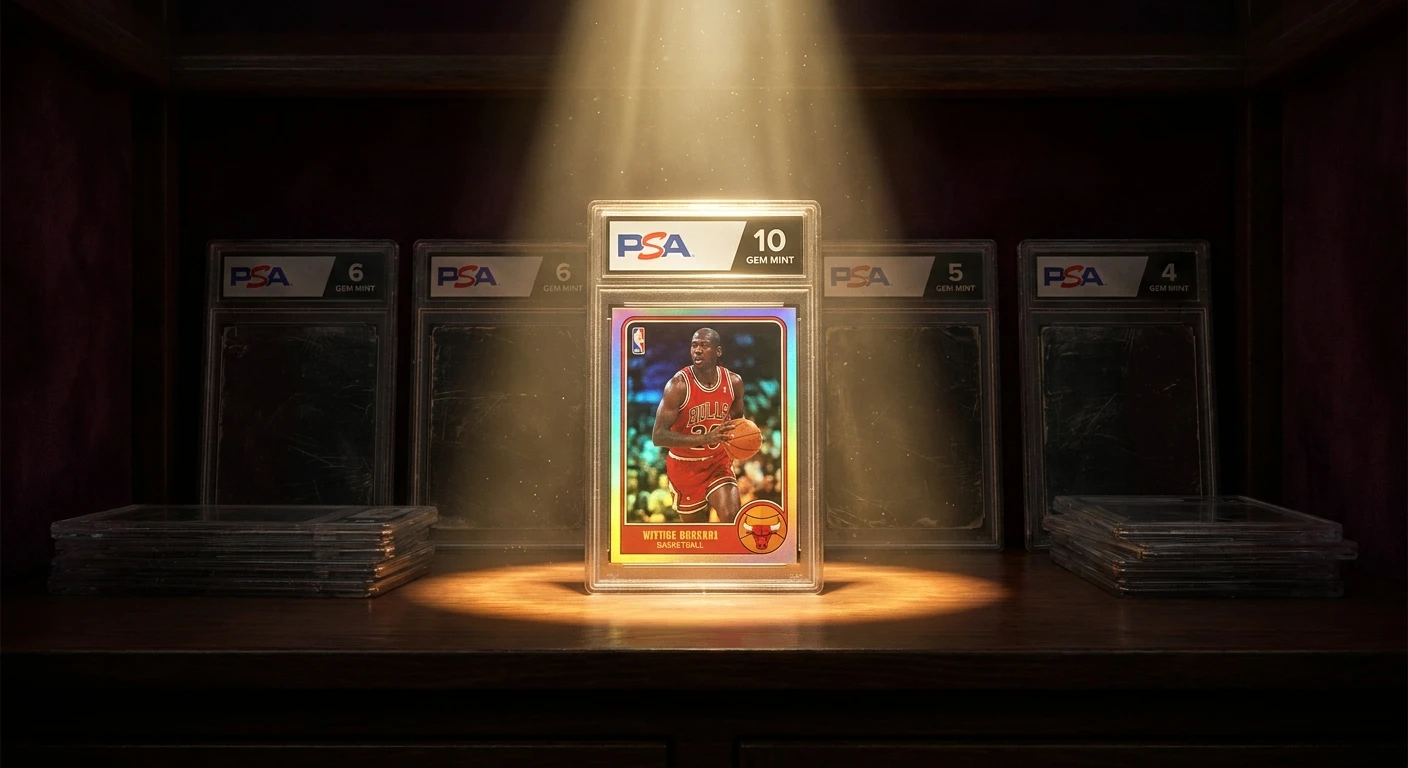
PSA 10 Gem Mint is the holy grail of card grading. The grade requires perfection across four condition factors: centering, corners, edges, and surface. Any flaw, no matter how minor, disqualifies a card from achieving the coveted 10.
PSA 10 Rates by Card Era
| Era | PSA 10 Rate | PSA 9 Rate | Why So Rare? |
|---|---|---|---|
| Pre-1960 | 0.1-0.5% | 2-5% | Age, handling, poor production |
| 1960-1980 | 0.5-2% | 5-10% | Junk wax era printing, handling |
| 1980-2000 | 3-8% | 15-25% | Better printing, but handling issues |
| 2000-2010 | 8-15% | 25-35% | Improved quality control |
| 2010-2020 | 12-20% | 30-40% | Premium cardstock, better care |
| 2020-Present | 15-30% | 35-45% | Best modern production quality |
Key insight: Modern cards (2020+) have 3-5x higher PSA 10 rates than vintage cards due to better printing technology, premium cardstock, and increased collector awareness about handling and storage.
What Disqualifies a Card from PSA 10?
PSA graders reject cards for PSA 10 based on these specific flaws:
Automatic PSA 10 Disqualifiers
| Defect | Max Grade | Why It Disqualifies |
|---|---|---|
| Print line | PSA 9 | Manufacturing defect visible to naked eye |
| Surface scratch | PSA 9 | Any surface break destroys perfection |
| Corner whitening | PSA 9 | Any loss of color on corner |
| Edge chipping | PSA 8-9 | Physical damage to card edge |
| Off-center (60/40+) | PSA 9 | Borders exceed 60/40 ratio |
| Fingerprint/oil | PSA 8-9 | Contamination on surface |
| Wax/gum stain | PSA 6-8 | Vintage cards with original packaging residue |
| Crease | PSA 1-4 | Structural damage to card |
Is 60/40 Still PSA 10? Centering Requirements
PSA Centering Standards
| Grade | Centering Ratio | Visual Description |
|---|---|---|
| PSA 10 | 55/45 to 60/40 | Borders nearly equal, max 60% on one side |
| PSA 9 | 60/40 to 65/35 | Noticeable but not extreme off-center |
| PSA 8 | 65/35 to 70/30 | Clearly off-center, eye-catching |
| PSA 7 | 70/30 to 75/25 | Severely off-center |
| PSA 5-6 | 75/25+ | Extreme off-center, borders almost gone |
Measuring centering: Use a digital caliper or centering tool to measure border widths. Divide the larger measurement by the smaller. If the result is 1.36 or less (55/45), you have PSA 10 centering. If it's 1.5 or more (60/40), it's still PSA 10. Above 1.86 (65/35) drops to PSA 9.
Rarest PSA 10 Cards in Existence
Some PSA 10 cards are so rare that only a handful exist in the world:
Rarest PSA 10 Populations
| Card | PSA 10 Pop | Est. Value |
|---|---|---|
| T206 Honus Wagner | ~3 | $3-10M |
| 1952 Topps Mickey Mantle | ~3 | $3-12M |
| 1999 Pokemon 1st Ed Holo Charizard | 121 | $300K+ |
| 1986-87 Fleer Michael Jordan RC | 318 | $200K+ |
| 2003 Topps Chrome LeBron James RC | ~400 | $50K+ |
The T206 Wagner and 1952 Mantle are so rare in PSA 10 because of their age, handling history, and the fact that virtually no cards from that era survived in Gem Mint condition. For modern cards like the Charizard, scarcity comes from printing quality control — even fresh from the pack, most cards have minor flaws that prevent PSA 10.
How Many PSA 10s Exist? Total Population
While individual cards can be extremely rare in PSA 10, the total population of PSA 10 slabs is actually quite large. PSA has graded over 40 million cards, and approximately 8.88% have achieved Gem Mint 10 status.
PSA 10 by Sport/Category
| Category | Est. PSA 10 Pop | % of Category |
|---|---|---|
| Baseball | 1.2M+ | ~7% |
| Basketball | 800K+ | ~10% |
| Football | 600K+ | ~9% |
| Pokemon/TCG | 500K+ | ~12% |
| Other | 400K+ | ~8% |
TCGs like Pokemon have higher PSA 10 rates because modern cards are better protected from the moment of opening, and collectors are more aware of condition factors.
How Hard Is It to Get PSA 10? Improving Your Odds
While only 8.88% of cards earn PSA 10, you can improve your odds through careful pre-screening:
Pre-Screening Checklist for PSA 10
- Centering check: Use calipers to verify 60/40 or better (ideally 55/45)
- Magnification inspection: Check for print lines under 10x magnification
- Corner examination: Look for any whitening or fuzzing on all four corners
- Edge review: Check for chipping or roughness along all edges
- Surface analysis: Inspect for scratches, clouding, or indentations under good lighting
- AI pre-grade: Use PreGradeCards to get 89% accurate PSA grade prediction
Frequently Asked Questions
Is 60/40 centering still PSA 10?
Yes — 60/40 centering is the maximum allowed for PSA 10. Anything better (55/45, 52/48, 50/50) is also PSA 10. Once centering exceeds 60/40 (like 65/35), the card drops to PSA 9 regardless of other factors.
Is PSA 9 worth getting?
Yes — PSA 9 Mint cards still command significant premiums over raw cards (typically 2-3x raw value). While not as valuable as PSA 10, PSA 9 is still a strong grade that appeals to many collectors. For cards where PSA 10 probability is low, PSA 9 is often the smart financial target.
Is PSA 8 a bad grade?
No — PSA 8 Near Mint-Mint is a solid grade for vintage cards (pre-1990). For modern cards, PSA 8 is less desirable but still protects and authenticates the card. An 8 indicates minor wear visible upon close inspection. For a 1952 Mantle, PSA 8 is excellent; for a 2023 rookie, it's disappointing.
Is PSA 7 a bad grade?
PSA 7 Near Mint shows noticeable wear but is still a collectible grade. For vintage cards, 7 is acceptable. For modern cards, it indicates significant condition issues. The card still gets authenticated and slabbed, but resale value is typically only 1.5-2x raw vs 5-10x for PSA 10.
Can you get a 10 grade on PSA?
Yes — roughly 8.88% of cards submitted to PSA earn Gem Mint 10. It requires perfection across centering, corners, edges, and surface. Modern cards (2020+) have 15-30% PSA 10 rates, while vintage cards often have sub-1% rates. Pre-screening your cards with magnification and AI tools can significantly improve your odds.
Why are CGC 10s so cheap compared to PSA?
CGC 10 Pristine requires stricter standards than PSA 10 (all sub-grades must be 10), but CGC has weaker market recognition in sports cards. CGC dominates TCGs (Pokemon/Magic) where their 10s command premiums. For sports cards, PSA's 25+ year head start established them as the value leader. CGC 10s are "cheap" in sports but "expensive" in TCGs — it's about market perception, not quality.
Sources & Further Reading
Sarah Williams leads PreGradeCards educational content and collector onboarding. She has been a full-time collector and dealer for 12 years, specializing in modern sports cards and Pokémon TCG, and has written grading guides read by over 300,000 collectors.
With submission floors rising, pre-screening is no longer optional. Use our AI Pre-Grade Calculator to score a card's PSA 10 odds before you pay, and the Submission Planner to pick the right tier.