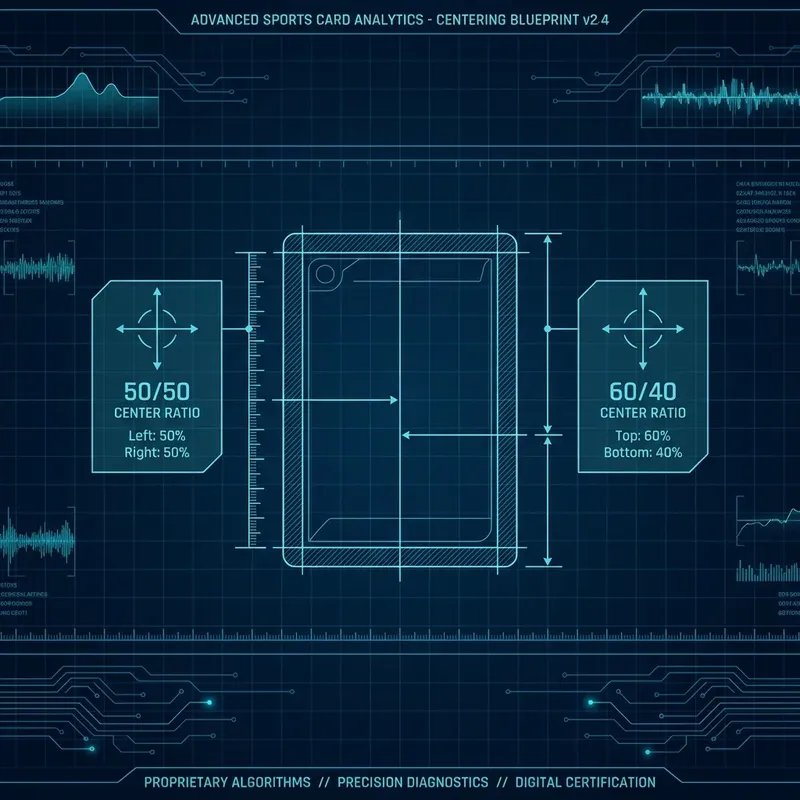
The Short Answer
- Centering is one of the four grading pillars (corners, edges, surface, centering) and accounts for up to 30% of the final grade decision
- PSA requires approximately 55/45 left-right and top-bottom centering for a Gem Mint 10; BGS often requires 50/50 or tighter
- A card that is otherwise flawless can be capped at PSA 8 if centering reaches 60/40 or worse
- Centering is measured with simple tools: a ruler, a centering calculator, or AI-based analysis like PreGradeCards
- AI centering measurement achieves 99.2% pixel-level precision, far exceeding human estimation
What Is Card Centering?
Card centering measures how evenly the printed image is positioned between the card borders. A perfectly centered card has equal white or colored borders on the left and right sides and equal borders on the top and bottom. Collectors describe centering as a ratio, such as 50/50 (perfect), 55/45 (slightly off-center), or 60/40 (noticeably off-center).
Centering matters because professional grading companies treat it as one of the four primary condition factors. For modern cards, a 10-grade usually requires the borders to be within 55/45 on both axes. Even a tiny visual shift that most casual collectors ignore can cost the card a full grade point and thousands of dollars in resale value.
Why Grading Companies Weight Centering So Heavily
Professional graders view centering as a proxy for manufacturing quality. When a card leaves the factory perfectly centered, it signals that the card was cut from a well-aligned sheet. Off-center cards suggest sheet drift, misalignment during cutting, or trimming. Because centering is a factory attribute that cannot be fixed by the owner, graders penalize it harshly.
Centering Standards by Grading Company
Each grading company has its own centering tolerance, and the tolerance differs by grade. Here is the practical standard for modern cards in 2026:
| Grade | PSA | BGS | SGC | CGC |
|---|---|---|---|---|
| Gem Mint 10 | ~55/45 | ~50/50 | ~55/45 | ~55/45 |
| Mint 9 | ~60/40 | ~55/45 | ~60/40 | ~60/40 |
| NM-MT 8 | ~65/35 | ~60/40 | ~65/35 | ~65/35 |
These are rules of thumb, not published guarantees. PSA graders also consider the overall visual appeal of the card, so a 55/45 card with exceptional corners and surface may still earn a 10, while a 55/45 card with other minor flaws may be capped at 9.
BGS Sub-Grades and Centering
BGS is the strictest major grader on centering. A BGS 10 Pristine typically requires centering no worse than 50/50, and a BGS Black Label 10 requires near-perfect 50/50 on both axes with all other sub-grades at 10. This is why BGS Black Label cards command a premium over PSA 10s in many markets.
How Centering Affects Grade and Value
Centering is not just a technical detail. It directly translates to dollars. Consider a 2023 Victor Wembanyama Prizm Silver rookie card in otherwise Gem Mint condition:
| Centering Ratio | Likely Grade | Estimated Value |
|---|---|---|
| 50/50 to 55/45 | PSA 10 | $800-$1,200 |
| 60/40 | PSA 9 | $200-$350 |
| 65/35 | PSA 8 | $80-$150 |
In this example, a single millimeter of border imbalance can reduce value by 60-85%. For high-end cards, the difference between 50/50 and 60/40 can be measured in thousands or tens of thousands of dollars.
The Multiplier Effect on Graded Populations
Because centering is a factory defect, it is also one of the main reasons PSA 10 populations stay low. Even if corners, edges, and surface are perfect, only a fraction of printed cards leave the factory with 55/45 or better centering. That scarcity is why Gem Mint cards carry a premium.
How to Measure Centering
There are three ways to measure centering at home:
Method 1: Ruler and Math
Measure the left border in millimeters and the right border. Add them together, then divide each side by the total to get a percentage. For example, if left = 3.0mm and right = 2.5mm, the ratio is 3.0 / 5.5 = 54.5% and 2.5 / 5.5 = 45.5%, written as 55/45. Repeat for top and bottom.
Method 2: Centering Calculator
Use a digital centering tool or the free PreGradeCards Centering Calculator. Enter the border widths in pixels or millimeters and the tool returns the exact ratio and grade prediction.
Method 3: AI Analysis
Upload a straight-on photo to PreGradeCards. The AI detects card edges, printed boundaries, and calculates centering ratios with sub-millimeter precision. This is the fastest method for batch pre-screening.
AI Centering Analysis vs. Manual Measurement
Human collectors measuring with a ruler typically achieve ±2-3% accuracy on clean cards and worse on low-contrast borders. AI centering analysis, trained on thousands of graded cards, measures to the pixel and corrects for camera angle and perspective distortion.
PreGradeCards reports a 99.2% centering precision rate when compared to PSA graders. This matters because the difference between 55/45 and 58/42 is only a few millimeters, but it can be the difference between a 10 and a 9.
When to Use Each Method
- Ruler: Quick checks on single high-value cards with sharp borders.
- Centering calculator: Precise digital measurement when you have a photo or scan.
- AI analysis: Batch screening, pre-submission sorting, and cards with subtle borders.
Can You Fix Poor Centering?
No. Centering is determined by how the card was cut from the sheet. You cannot shift the printed image. However, you can avoid wasting grading fees by measuring centering before submission. If a card measures worse than 60/40, it is unlikely to earn a 10 and may not even earn a 9 with strict graders. You can sell it raw or target PSA 8-9 depending on value.
The only exception is vintage cards, where factory rough cuts are sometimes expected and graders tolerate slightly looser centering. Even then, 70/30 centering on a modern card is a grade killer, while 65/35 on a 1952 Topps card may still be acceptable for a lower grade.
Frequently Asked Questions
Why is centering analysis important when evaluating collectible cards?
What centering ratio do I need for PSA 10?
Is BGS stricter on centering than PSA?
How do I measure card centering accurately?
Can AI detect centering better than a human?
Does centering affect the value of a graded card?
What is the worst centering ratio that still grades 8?
Should I still submit a card with 60/40 centering?
Sources & Further Reading
Marcus Chen has evaluated over 50,000 sports cards and TCG cards across PSA, BGS, SGC, and CGC standards. Before joining PreGradeCards, he worked as a submission specialist for a major grading company and trained collectors and dealers on condition assessment.
With submission floors rising, pre-screening is no longer optional. Use our AI Pre-Grade Calculator to score a card's PSA 10 odds before you pay, and the Submission Planner to pick the right tier.