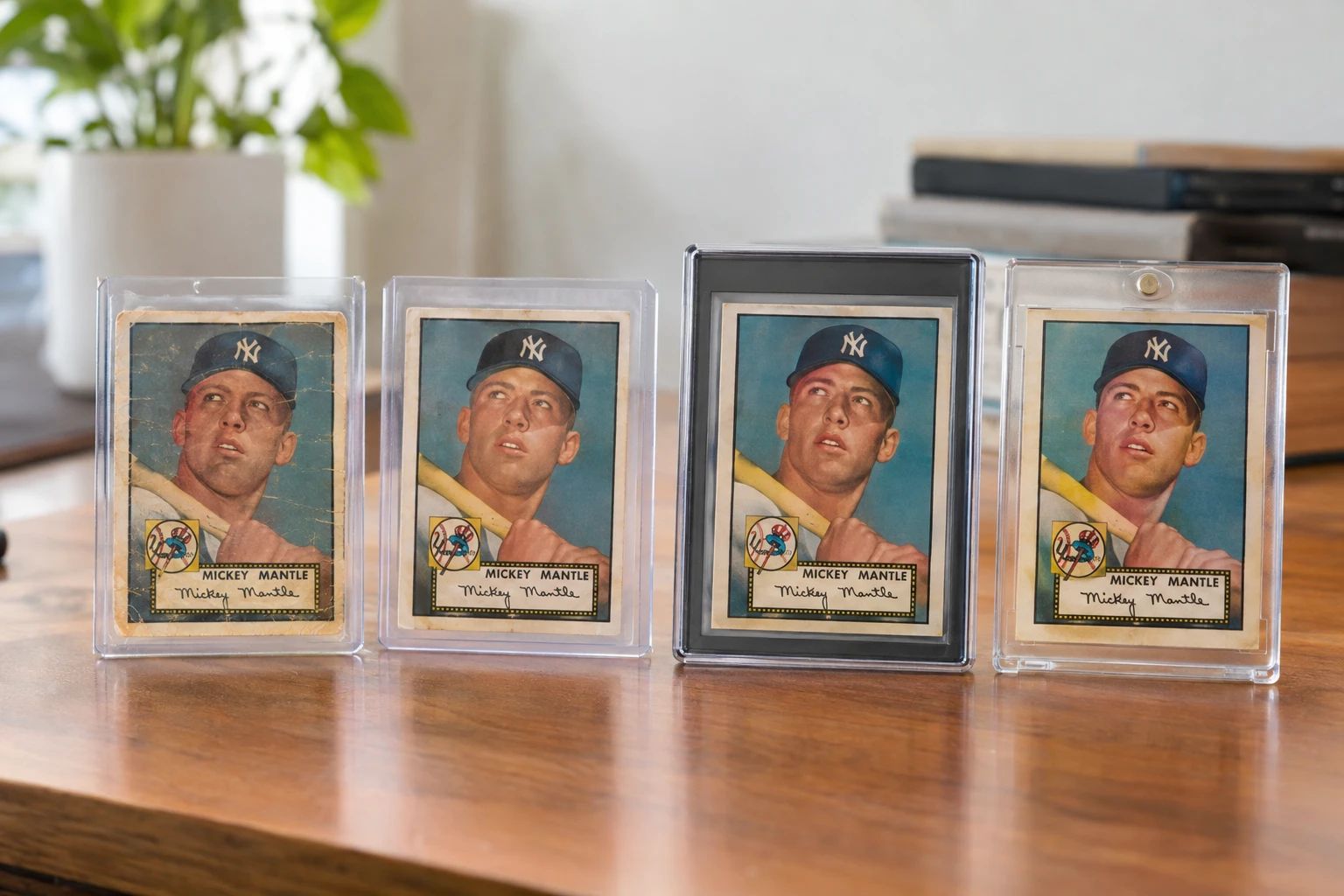
The Short Answer
- 1952 Topps #311 Mickey Mantle is the most iconic baseball card — a PSA 8 sold for $1,555,500 on July 10, 2026, and a PSA 1.5 sold for $85,000 on July 19, 2026.
- Over 60% of submitted 1952 Mantles are fake — PSA's May 2026 fraud report found 112 of 181 submitted copies were counterfeit.
- The grade determines a 100x price spread — a PSA 3 sold for $240,000 while an SGC 3.5 brought $101,475 in early 2026.
- PSA commands the highest resale premium for 1952 Mantle cards, but SGC has a strong niche following for vintage.
- Authentication is the primary concern — reprints, re-backed cards, and trimmed copies are widespread. A blacklight test is the first authentication step.
- Vintage grading standards are era-calibrated — PSA allows 75/25 centering on PSA 8 vintage cards vs 65/35 on modern cards.
Why the 1952 Topps Mantle Is the Hobby's Holy Grail
The 1952 Topps Mickey Mantle #311 is the single most recognized baseball card in the collecting hobby. It is not the rarest card — the T206 Honus Wagner is rarer — but the 1952 Mantle is the card that every collector knows, every investor tracks, and every auction house features as a headline lot.
The card was part of Topps' second-ever baseball card set, released in 1952 as the company's first major color card production. The set featured 407 cards, with Mantle as card #311 in the high-number series (#311–407). The high-number series was produced in lower quantities and released late in the season, making surviving copies significantly scarcer than low-number cards from the same set.
Key Facts About the 1952 Topps Mantle
- Card number: #311 in the 1952 Topps set
- Position: High-number series (cards #311–407), produced in lower quantities
- Dimensions: Oversized for the era at 2-5/8" x 3-3/4" (larger than modern cards)
- Design: Vivid color portrait of a young Mantle, with a bat-on-shoulder pose and a patriotic red, white, and blue border
- Highest known grade: PSA 9 (only 6 known copies at this grade); PSA 10 has never been awarded
- Record sale: $12.6 million for an SGC 9.5 copy at Heritage Auctions in August 2022 — at the time, the highest price ever paid for any sports card
In 2026, the 1952 Mantle continues to be the benchmark for the vintage baseball card market. Its price movements are a leading indicator for the entire vintage card segment. When Mantle prices rise, the broader vintage market follows.
1952 Mantle Value by PSA Grade: 2026 Data
The value of a 1952 Topps Mickey Mantle card is almost entirely determined by its PSA grade. The spread between grades is enormous — a single grade point can represent hundreds of thousands of dollars in value.
Recent Sales and Estimated Values by Grade (July 2026)
| PSA Grade | Condition Description | Recent Sale / Est. Value | Date |
|---|---|---|---|
| PSA 9 (Mint) | Near-flawless; only 6 known | $5.2 million (2021 sale) | 2021 |
| PSA 8 (NM-MT) | Near mint to mint | $1,555,500 | July 10, 2026 |
| PSA 7 (NM) | Near mint | $500,000–800,000 (est.) | 2026 market |
| PSA 5 (EX) | Excellent | $200,000–350,000 (est.) | 2026 market |
| PSA 3 (VG) | Very good | $240,000 | Early 2026 (Huggins & Scott) |
| SGC 3.5 (VG+) | Very good plus | $101,475 | Early 2026 (Robert Edward) |
| PSA 1.5 (Fair) | Fair condition, heavy wear | $85,000 | July 19, 2026 |
| PSA 1 (Poor) | Poor, major damage | $40,000–60,000 (est.) | 2026 market |
The data reveals a striking reality: even a PSA 1.5 copy — a card with heavy wear, visible creasing, and significant condition issues — sold for $85,000. This is the second-highest sale at that grade, falling just short of an $89,125 sale in April 2026. A PSA 3 and an SGC 3.5 of the same card sold for $240,000 and $101,475 respectively in early 2026 — a 2.4x difference explained by both the grade difference (3 vs 3.5) and the grading company premium (PSA vs SGC).
The 100x price spread between a PSA 1 ($40,000–60,000) and a PSA 8 ($1.5M+) for the same card is the most dramatic grade-value relationship in the entire sports card hobby. This is why accurate grading of the 1952 Mantle is so critical — and why authentication is the first and most important step.
Authentication: How to Spot Fakes and Reprints
PSA's May 2026 fraud report revealed a staggering statistic: of 181 submitted 1952 Topps Mickey Mantle cards, 112 came back as counterfeit — a fake rate above 60%. This makes authentication the single most important consideration for anyone who believes they own a 1952 Mantle.
Types of Fakes in the Market
- Modern reprints: High-quality digital reprints that mimic the original design but use modern printing technology. The dot pattern under magnification differs from original 1952 lithographic printing.
- Re-backed cards: Original fronts glued onto modern cardstock backs. The card feels thicker and the back design may not align perfectly with the front.
- Trimmed cards: Authentic cards with edges shaved to improve apparent condition. A trimmed 1952 Mantle will measure smaller than the standard 2-5/8" x 3-3/4" dimensions.
- Altered cards: Authentic cards with recolored corners, pressed creases, or chemically cleaned surfaces designed to improve the apparent grade.
Authentication Checklist: 5 Steps Before Submitting
- Measure the card. A genuine 1952 Topps card measures 2-5/8" x 3-3/4". If your card is even 1/16th of an inch smaller on any side, it may be trimmed. Use a precision ruler — not a standard ruler with wide markings.
- Use a blacklight (longwave UV). Original 1952 ink and paper fluoresce differently than modern reproductions. Under UV light, modern reprints often show brighter, whiter fluorescence. Original cardstock has a dull, off-white fluorescence. A $20 longwave UV light is the first tool every vintage card collector should buy.
- Examine the printing pattern under magnification. Original 1952 Topps cards use lithographic printing with irregular, watercolor-like ink patterns. Modern reprints show fine dot matrix patterns visible under 10x magnification.
- Check the back for factory markings. The back of a genuine 1952 Topps card carries the card number, player stats, and a copyright line. Missing or incorrect copyright information is a red flag. Compare against verified examples.
- Feel the cardstock. Original 1952 Topps cardstock has a specific thickness and texture. Reprints often feel slicker or thinner. This is a subjective test but experienced collectors can often identify reprints by feel alone.
PSA now uses AI imaging models alongside human graders to detect counterfeits. The company stated that its human graders work alongside AI trained on years of scanned card data, flagging trimmed edges and known forgery patterns before a card is ever certified. This AI-human hybrid approach has improved counterfeit detection rates significantly.
If your card passes all five authentication checks, the next step is to assess its likely grade before submitting. Even an authentic 1952 Mantle in poor condition is worth grading — a PSA 1 still sells for $40,000–60,000. But knowing the likely grade helps you choose the right submission tier and set realistic value expectations.
PSA vs SGC for the 1952 Topps Mantle
For the 1952 Topps Mickey Mantle, the choice of grading company significantly impacts resale value. PSA and SGC are the two primary options for vintage baseball cards, and each has distinct advantages.
PSA vs SGC for the 1952 Mantle: 2026 Comparison
| Feature | PSA | SGC |
|---|---|---|
| Resale value premium | Highest — the market standard for vintage | High — strong niche following, 10–20% below PSA |
| Slab aesthetics | Clinical, clear, minimalist | "Tuxedo" black border — premium look |
| Turnaround time (2026) | Slow — months (backlog impact) | 40–50 days (Standard tier) |
| Minimum size requirements | Strict — rejects slightly undersized cards | Fair — more accommodating of vintage sizing |
| Authentication reputation | Industry leader — AI + human hybrid system | Strong — historically trusted for pre-war |
| Ownership | Collectors Holdings (also owns BGS, SGC) | Collectors Holdings (acquired 2023) |
| Cheapest open tier (July 2026) | Regular $79.99/card | Standard (price varies by declared value) |
For the 1952 Mantle specifically, PSA is the recommended grading company for maximum resale value. The PSA brand carries the highest premium in the vintage market, and the PSA population report is the most widely referenced rarity database. A PSA 8 Mantle will sell for more than an SGC 8 equivalent — the July 2026 sale of $1,555,500 for a PSA 8 demonstrates this premium.
However, SGC has two advantages worth considering. First, SGC's turnaround time is significantly faster (40–50 days vs PSA's months-long backlog). If you need to sell the card quickly, SGC can get it slabbed and to market faster. Second, SGC is more accommodating of vintage card sizing — if your Mantle is slightly undersized (a common issue with 1952 Topps cards that were stored in tight holders), PSA may reject it while SGC will grade it.
The record $12.6 million sale in 2022 was for an SGC 9.5 copy — proving that for the very highest grades, SGC can match or exceed PSA values. But for grades PSA 8 and below, PSA consistently commands higher resale prices.
Vintage Grading Standards for 1952 Topps
PSA applies different grading standards to vintage cards than to modern cards. The 1952 Topps set is one of the most challenging vintage sets to grade at high levels, due to the production technology and storage conditions of the era.
Era-Specific Grading Standards for 1952 Topps
| Attribute | PSA 8 Standard (Vintage) | PSA 8 Standard (Modern) |
|---|---|---|
| Centering (front) | 75/25 allowed | 65/35 maximum |
| Corner rounding | Slight rounding OK (PSA 6–7 max with more) | Any visible rounding caps at PSA 5 |
| Edge wear | Minor wear acceptable (PSA 5–6 max with more) | Minor wear caps at PSA 4 |
| Surface wear | Light wear OK (PSA 5–6 max with more) | Light wear caps at PSA 4 |
| Print defects | Common and tolerated (PSA 6–7 max) | Caps at PSA 5 |
1952 Topps Set-Specific Issues
- Poor centering is endemic. 1952 Topps cards are notoriously off-center. The high-number series (including Mantle #311) is particularly affected. A 70/30 centered 1952 Mantle is considered normal and may still achieve PSA 7–8.
- Corner wear is nearly universal. The oversized dimensions of 1952 Topps cards meant they were stored in boxes and drawers that damaged corners. Sharp corners on a 1952 Mantle are extremely rare.
- Print defects are common. 1952 Topps print quality was inconsistent. Print lines, color registration errors, and snow (white specks in the printing) are normal and do not significantly impact grade on vintage cards.
- Gum and wax stains. Cards stored near wax pack wrappers or with gum residue show staining on the back. Light staining is expected and tolerated on vintage cards.
- Paper loss from album storage. Cards removed from photo albums often have paper or adhesive residue on the back. Even a tiny speck of paper loss can cap the grade at PSA 1.5–2.
The key principle: PSA graders evaluate 1952 Topps cards within the context of their production era. A 1952 Mantle with slight corner rounding, minor edge wear, and 70/30 centering might grade PSA 4–5 — and still be worth $100,000–240,000. The same condition on a 2023 Topps card would grade PSA 2–3 and be worth $5. Era context is everything in vintage grading.
Should You Grade Your 1952 Mantle?
If you own an authentic 1952 Topps Mickey Mantle, the answer is almost certainly yes — grade it. Even a PSA 1 (Poor) copy is worth $40,000–60,000. The grading fee, even at PSA Express ($149) or Walk-Through ($599), is negligible relative to the card's value at any grade.
Decision Framework
- If the card is authentic and in any condition: Grade it. The authentication alone adds significant value — an ungraded "authentic" 1952 Mantle is difficult to sell because buyers cannot verify it without expert inspection.
- If you are unsure about authenticity: Submit to PSA for authentication only. PSA will return the card as "Authentic" or "Counterfeit" without assigning a grade if it is genuine but heavily altered. An "Authentic" (no grade) 1952 Mantle still has significant value.
- If the card may be trimmed or altered: PSA will return it with an "Evidence of Trimming" or "Altered" designation and no grade. This is still useful information — it confirms the card is genuine but altered, which affects value but does not eliminate it.
- If you need to sell quickly: Consider SGC for faster turnaround (40–50 days vs PSA's months-long backlog). The resale premium is slightly lower but the speed to market may be worth the trade-off.
What NOT to Do Before Grading
The single most expensive error in vintage card collecting is "improving" a card before understanding it. Do not:
- Clean the card — any cleaning solution, even water, can damage the surface and lower the grade.
- Trim edges — trimming is the #1 scourge of vintage cards. Even a 1/64th inch trim will result in a "Trimmed" designation and destroy the card's value.
- Press creases — pressing a creased card flat may improve its appearance temporarily but PSA graders can detect pressing. The card will receive an "Altered" designation.
- Recolor faded corners — using a marker to touch up white corners is easily detected under UV light. The card will be flagged as altered.
- Erase pencil marks — erasing can damage the surface. PSA accepts vintage cards with pencil marks and assigns an "MK" (marked) designation that reduces value by 20–40% but does not destroy it.
Every one of these actions can reduce a card's grade, eliminate provenance clues, or signal tampering to an experienced grader. The best approach is to leave the card exactly as it is and submit it in its current condition.
Submission Tips for High-Value Vintage Cards
Submitting a 1952 Topps Mickey Mantle for grading requires more care than a modern card submission. The card's value — potentially hundreds of thousands or millions of dollars — demands extra precautions.
Choosing the Right Submission Tier
For a 1952 Mantle, use PSA Express ($149/card) or higher — not Regular ($79.99). Express tier receives faster turnaround and more individualized grader attention. For a card worth $100,000+, the extra $70 is meaningless insurance. If the card is expected to grade PSA 7 or higher, consider Walk-Through ($599/card) for maximum attention and speed.
Packaging and Shipping
- Place the card in a penny sleeve and semi-rigid holder. Do not use a top loader for extremely high-value vintage cards — semi-rigid holders (like Cardboard Gold) provide better protection and are easier for PSA to remove without damaging the card.
- Use a Team Set Bag or similar sealed plastic holder around the semi-rigid holder to prevent moisture exposure during transit.
- Place between two pieces of cardboard cut slightly larger than the holder. Tape the cardboard edges — not the holder itself.
- Ship in a bubble mailer inside a small box. Double packaging prevents damage from sorting machines.
- Insure for full declared value. USPS Registered Mail with insurance is the standard for high-value card submissions. The declared value should reflect the card's expected post-grading value, not the raw value.
- Take clear photos before shipping. Document the card's condition front and back before it leaves your possession. These photos serve as proof of condition if any damage occurs in transit.
- Use tracking and signature confirmation. Require a direct signature — not just delivery confirmation — for any package containing a card worth more than $10,000.
What to Expect After Submission
Given the current PSA backlog, expect a wait of 2–4 months for Express tier submissions. PSA's Backlog Tracker provides bi-weekly updates on overall progress but does not offer individual submission tracking. The company has stated that Express and higher tiers are being processed faster than Regular and value tiers, but the backlog affects all tiers to some degree.
When the card returns graded, verify the slab authenticity through PSA's certification lookup tool. Enter the certification number printed on the slab label to confirm it matches PSA's database. This step is essential for any future sale — buyers will verify the certification number before purchasing.
Frequently Asked Questions
How much is a 1952 Topps Mickey Mantle card worth?
How can I tell if my 1952 Mantle is real?
Should I grade my 1952 Mantle with PSA or SGC?
What is the highest grade ever given to a 1952 Topps Mantle?
Can AI pre-grade vintage baseball cards like the 1952 Mantle?
Why are 1952 Topps Mantle cards so valuable?
Sources & Further Reading
- Biggest Sports Card Sales of the Week: Ohtani Leads — SI Collectibles
- PSA Buyback Scandal — Nerdbot
- Mickey Mantle Card Value Guide — Baseball Card Roadshows
- Mickey Mantle Baseball Card Guide — OrbSportsCards
- Attic Baseball Finds Guide — Baseball History
- Vintage Card Grading: Pre-1980 Guide — PreGradeCards
Marcus Chen has evaluated over 50,000 sports cards and TCG cards across PSA, BGS, SGC, and CGC standards. Before joining PreGradeCards, he worked as a submission specialist for a major grading company and trained collectors and dealers on condition assessment.
Create a free account and get 1 free credit — enough for 1 complete AI grading with market pricing. No credit card required.
Sign Up Free →