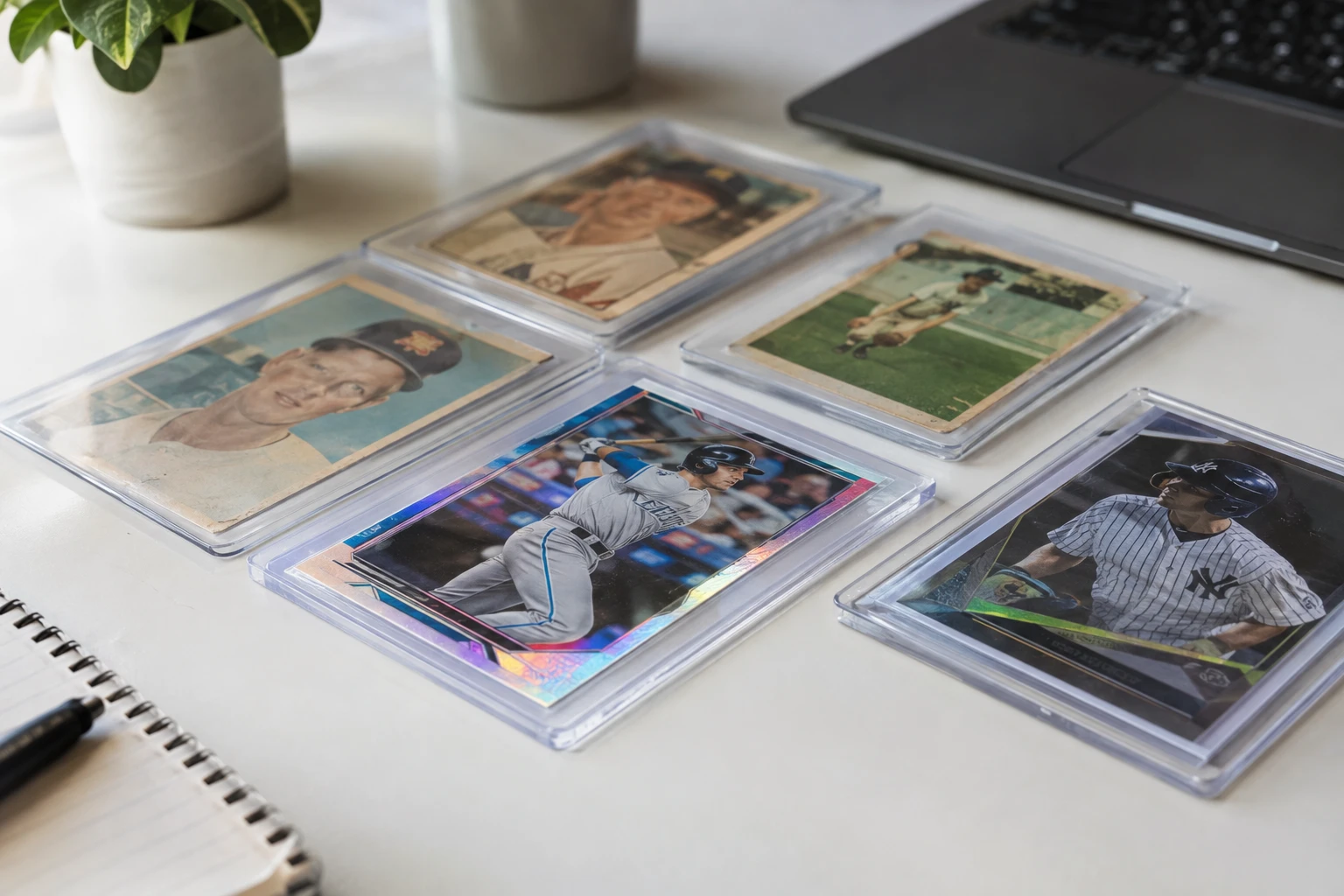
The Short Answer
- 1952 Topps Mickey Mantle is the most valuable baseball card — PSA 9 sold for $5.2 million.
- Topps Chrome and Prizm cards require diffuse lighting for AI surface analysis due to refractor finishes.
- Vintage baseball cardstock (pre-1980) requires era-calibrated AI corner and edge analysis.
- Print lines on 1980s–90s Donruss and Score cards are a leading AI surface flag for those eras.
- Shohei Ohtani and Aaron Judge rookies are the highest-ROI modern baseball grading targets in 2026.
Baseball Card Grading Market in 2026
Baseball cards are the historical foundation of the card grading hobby. PSA, Beckett, and SGC all built their businesses primarily on baseball cards before TCGs became the dominant submission category. In 2026, baseball remains a major grading segment even as Pokémon and other TCGs have taken the volume lead.
The baseball card grading market in 2026 is defined by three distinct collector groups:
- Vintage collectors — targeting pre-1980 cards: T206, 1952 Topps, 1954 Topps, 1955 Topps, Bowman sets. These collectors are chasing PSA 8+ grades on cards that survived 60–100 years in varying conditions.
- Junk wax era collectors — 1980s–early 1990s overproduced cards where condition is everything because print runs were enormous. A PSA 10 1989 Upper Deck Ken Griffey Jr. rookie is scarce despite millions of copies printed, because gem-mint examples are genuinely rare.
- Modern card investors — targeting Topps Chrome and Prizm rookies from current MLB stars. High serial-numbered parallel cards, autographs, and 1st Bowman Chrome cards for prospects who break out.
Vintage Baseball Cards: What AI Grading Must Account For
Vintage baseball cards — those from the 1800s through 1979 — present the most complex AI grading challenges of any card category. Cards have survived decades of handling, storage, and environmental exposure. The cardstock, print techniques, and condition expectations differ fundamentally from modern cards.
The Most Valuable Vintage Baseball Cards to Grade
- T206 Honus Wagner — the Holy Grail of sports cards, sold for $5.1–7.25 million depending on the copy. Any T206 card merits professional review before grading.
- 1952 Topps #311 Mickey Mantle — PSA 9 sold for $5.2 million in 2021. High-grade copies remain the pinnacle of modern auction records.
- 1914 Baltimore News Babe Ruth — the Babe Ruth rookie card equivalent.
- 1952 Topps set — beyond Mantle, the high-number series (#311–407) are all scarce in high grade.
- 1954 and 1955 Topps Hank Aaron rookies — dual Hall of Famer grading targets.
Vintage Baseball AI Grading Considerations
PSA applies different grading standards to pre-war and early post-war cards relative to modern cards. Some vintage leniency exists — a card with a small paper loss that would prevent PSA 7 on a modern card might receive PSA 5 or 6 on a 100-year-old card where survival itself is the primary achievement.
AI grading tools must be calibrated for era-appropriate expectations. PreGradeCards applies vintage baseball era profiles when the card year is specified. For cards from 1900–1950, the corner radius expectations, paper stock texture, and print variation baselines differ fundamentally from modern cards.
Topps Chrome and Refractors: AI Surface Analysis Requirements
Topps Chrome is the dominant premium modern baseball card product. Its refractor finish — a light-diffracting metallic surface applied to the base card — creates the same photography challenges as Pokémon foil cards: direct light produces glare that overwhelms surface condition details.
Refractor Varieties and Their AI Analysis Needs
- Base Refractor — rainbow light diffraction pattern. Photograph with two 45-degree side lights to eliminate direct specular reflection.
- Gold Refractor (/50) — gold-tinted diffraction. Same lighting as base refractor; gold tone can create warm-color glare with tungsten lights.
- Prizm Refractor — Panini Prizm's equivalent; available in baseball via Prizm Baseball. Similar analysis requirements to Topps Refractor.
- Auto (autograph) Chrome — the autograph ink is applied over the refractor surface. AI surface analysis must distinguish between intentional ink (the auto) and surface damage. Always specify "auto" card type when uploading.
Chrome Card-Specific Grade Killers
Chrome baseball cards have three unique grade vulnerabilities:
- Scratches from pack opening — chrome refractor surfaces scratch from the foil pack interior during opening. Even careful openers sometimes introduce fine scratches.
- Centering variance — Topps Chrome print runs show consistent centering variance. AI centering is critical on Chrome cards.
- Surface dimples — small circular pressure marks occasionally appear on Chrome cards from packing. AI surface detection catches these before submission.
Modern Rookie Cards: Ohtani, Judge, and Cooper Flagg
Modern baseball rookie cards with the highest 2026 grading ROI:
Shohei Ohtani
Ohtani's 2018 Topps Update rookie cards remain among the most liquid modern baseball grading targets. PSA 10 Ohtani rookies command significant premiums, and his continued dominance as the sport's most compelling player sustains long-term collector demand. 2018 Topps Chrome Update Ohtani is the benchmark submission.
Aaron Judge
Judge's 2013 Bowman Chrome Draft autograph is the flagship grading target — a PSA-graded copy set a record at $5.2 million. More accessible are his 2017 Topps Update and Topps Chrome rookies, which have PSA 10 premiums in the $200–$1,000+ range depending on parallel.
Cooper Flagg Crossover Appeal
While primarily a basketball card story, Cooper Flagg's sports card market surge in 2026 has elevated the general sports rookie card grading market. Baseball equivalents — top MLB draft prospects — have seen increased submission interest as collectors apply the same "get in early" grading strategy to baseball that drove the Flagg wave.
1989 Upper Deck Ken Griffey Jr.
The 1989 Upper Deck Griffey Jr. rookie remains a perennial grading target. Despite enormous print runs, PSA 10 copies are genuinely scarce — the "junk wax era" paradox. AI pre-grading on Griffey Jr. rookies identifies the rare gem-mint survivors in a sea of VG-EX copies.
Era-Specific AI Calibration for Baseball Cards
Baseball cards span 130+ years of manufacturing history. AI grading tools that apply modern card standards to vintage cards produce inaccurate results. Here is how era calibration works:
| Era | Key Manufacturers | AI Calibration Notes |
|---|---|---|
| Pre-War (1900–1941) | T206, Goudey, Play Ball | Thick paper stock; era-appropriate corner expectations; print defects are normal |
| Post-War Vintage (1948–1979) | Bowman, Topps | Wax stains common; paper brittleness factored; centering standards more lenient |
| Junk Wax (1980–1993) | Topps, Donruss, Fleer, Score, Upper Deck | Print lines common on Donruss/Score; surface scratches from mass packing common |
| Chrome Era (1993–present) | Topps Chrome, Bowman Chrome, Prizm | Refractor-aware surface analysis; centering particularly important |
| Modern Premium (2018–present) | Topps Now, Bowman Sterling, National Treasures | High print quality; AI centering on serially numbered cards |
PSA vs SGC vs BGS for Baseball Cards in 2026
Baseball cards have a more nuanced grader choice than TCGs:
PSA — The Standard for Most Baseball
PSA dominates baseball card grading liquidity. PSA 10 is the universal benchmark for modern rookies, vintage high grades, and Chrome parallels. Despite SGC and BGS being Collectors Holdings siblings, PSA remains the highest-premium grader for baseball across all eras.
SGC — Best for Pre-War Vintage (If You Can Access It)
SGC historically had the strongest reputation for pre-war card grading. The tuxedo slab design complements vintage aesthetics. Post-Collectors acquisition, SGC's submission volume has collapsed (~36,000 cards in Nov 2025 vs much higher pre-acquisition levels), but for true vintage collectors who can access SGC tiers, the grades remain respected.
BGS (Beckett) — Subgrades for High-End Modern
BGS subgrades (centering, corners, edges, surface all scored separately) add value on high-end modern baseball where condition transparency matters to buyers. A BGS 10 Pristine (all 10 subgrades) is the most condition-documented grade available. Relevant for ultra-premium modern rookies where subgrade breakdowns justify the premium.
The National Sports Collectors Convention 2026: Grading Opportunity
The National Sports Collectors Convention runs July 29 – August 2, 2026 in Rosemont, Illinois. For baseball card collectors, The National offers one of the few opportunities for PSA Walk-Through grading — same-day grading at the show that bypasses the standard 50-business-day Regular turnaround.
The National grading strategy:
- AI pre-grade before attending. Walk-Through grading is expensive. Only bring gem-mint AI-confirmed cards for on-site submission.
- Prioritize time-sensitive submissions. Modern rookie cards where market timing matters should be Walk-Through candidates if you're attending.
- Raw card buying at the show. The National is a premier raw card buying opportunity. Pre-configure your PreGradeCards batch upload workflow — you can AI-grade cards you buy at the show and submit Walk-Through same day if they pass.
PSA extended member subscriptions for the backlog period. Check your PSA membership status before The National — an active membership saves $15/card on Regular and may apply to Walk-Through pricing as well.
AI Pre-Grading Workflow for Baseball Card Collections
- Identify the era and manufacturer. Vintage (pre-1980), junk wax (1980–1993), Chrome era (1993+), or modern premium. Era determines the AI calibration profile.
- Check for known print defects by manufacturer. Donruss/Score 1980s cards: print lines. Topps Chrome: surface dimples and pack scratches. T206: paper texture variation.
- Set up appropriate lighting. Refractor Chrome cards: two 45-degree softbox lights. Vintage non-foil: single diffuse overhead or window light. Never use direct flash on any baseball card.
- Photograph front and back. Baseball card backs often show condition issues (creases, stains) that the front hides.
- Upload with year and manufacturer specified. Era-calibrated analysis requires this information to apply correct corner and surface baselines.
- Check centering first. Topps Chrome centering variance is significant — many Chrome cards fail PSA 10 on centering alone.
- Review surface flags for era-appropriate issues. Print lines on junk wax era, scratch patterns on Chrome, paper quality on vintage.
- Run ROI math before submitting. Baseball cards span enormous value ranges. Confirm PSA 10 premium justifies fee before any submission.
Frequently Asked Questions
What is the most valuable baseball card to grade?
Are Topps Chrome refractors worth grading?
Should I grade 1989 Upper Deck Ken Griffey Jr. rookies?
Can AI accurately grade vintage baseball cards?
Is SGC still worth using for baseball cards in 2026?
What baseball cards should I bring to The National 2026?
Sources & Further Reading
- Aaron Judge $5.2M Rookie — Sports Illustrated Collectibles
- AI Sports Card Grading — CardGrade.io
- PSA vs BGS vs SGC 2026 — OrbSportsCards
- Sports Card Grading in New York: PSA Alternatives 2026
Marcus Chen has evaluated over 50,000 sports cards and TCG cards across PSA, BGS, SGC, and CGC standards. Before joining PreGradeCards, he worked as a submission specialist for a major grading company and trained collectors and dealers on condition assessment.
Create a free account and get 1 free credit — enough for 1 complete AI grading with market pricing. No credit card required.
Sign Up Free →