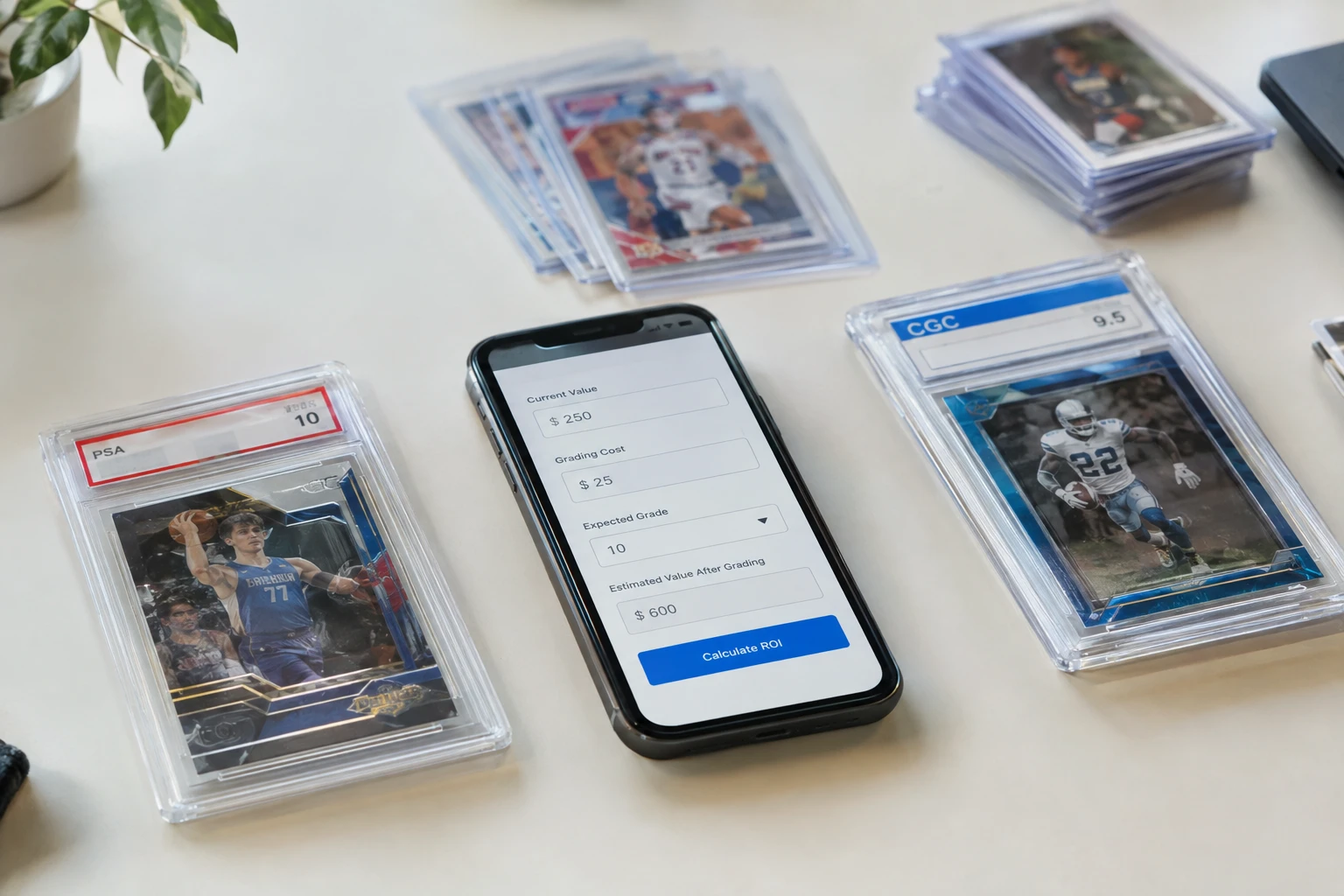
The Short Answer
- PSA 10 rate across all submissions is 8.88% — without AI pre-grading, most cards won't grade 10.
- The ROI break-even formula: Graded value × PSA 10 probability > Raw value + Fee + Shipping + Platform fee.
- AI pre-grading increases effective PSA 10 rate to 40–60% by filtering to gem-mint candidates only.
- PSA Collectors Club membership ($199/yr) breaks even at 14+ Regular submissions per year.
- Card value floor for PSA Regular: raw card must be worth at least $30 raw for positive expected ROI.
- CGC Bulk floor: raw card must be worth $8–10 for positive EV at $17 fee — but 120-day lockup matters.
The Grading ROI Formula Explained
Every grading submission decision is an investment decision. Here is the fundamental expected-value formula:
Where P10, P9, P8 are the probabilities of receiving each grade. If Expected Value is positive, grading is mathematically worth it. If negative, hold raw.
The Key Variables
- PSA 10 value: Check eBay sold listings filtered to "Graded" + specific grade. Use 90-day median, not highest sale.
- PSA 9 value: Typically 40–70% of PSA 10 value depending on card type.
- P10 (probability of PSA 10): Hobby-wide average is 8.88%. With AI pre-grading screening for gem-mint candidates only, this rises to 40–60%.
- Raw value: What the card sells for raw NM on eBay right now.
- Grading fee: PSA Regular $79.99; CGC Bulk ~$17; TAG Priority $149.
- Shipping (round trip): Approximately $15–25 total (shipping to PSA + return insured shipping).
- Platform fee: eBay takes 12.9% on card sales. Factor this on any graded value you'll sell.
Simple Break-Even Calculation
For PSA Regular ($79.99 fee + ~$20 shipping = ~$100 all-in), you need the graded card to sell for at least $100 more than the raw price to break even. At a PSA 9 value of 50% of PSA 10, you need a card where:
- PSA 10 value ≥ Raw value + $200 (accounting for grade uncertainty)
- Or PSA 9 value ≥ Raw value + $100 (if you're confident it will grade 9)
PSA 10 Rate Reality: 8.88% Without AI Pre-Grading
The most important number in all of card grading: PSA grades approximately 8.88% of submitted cards as PSA 10 across all card types and all submission tiers. This is the average across all the millions of cards PSA grades monthly.
What this means for a random submission without pre-grading:
- ~8.88% chance of PSA 10
- ~30% chance of PSA 9
- ~32% chance of PSA 8
- ~29% chance of PSA 7 or below
Running the expected value math on a card with PSA 10 = $200, PSA 9 = $80, PSA 8 = $40, raw = $30:
EV = $17.76 + $24 + $12.80 + $5.80 − $30 − $100
EV = −$69.64 (NEGATIVE)
Without AI pre-grading and at 8.88% PSA 10 rates, even a card with a $200 PSA 10 value is a losing submission at $79.99+. This is why most cards submitted to PSA without pre-screening produce negative ROI for the submitter.
This is not a niche edge case — it applies to the majority of submissions. The collectors who profit from grading are those who pre-screen to dramatically increase their effective PSA 10 rate.
How AI Pre-Grading Transforms the ROI Math
AI pre-grading changes the expected value calculation by filtering the submission pool to gem-mint candidates only. Instead of submitting every card with a positive PSA 10 value, you submit only the cards that AI analysis confirms are likely PSA 9–10.
Real-world data from collectors using AI pre-screening: PSA 10 rates on AI-pre-graded submissions run 40–60% vs. the 8.88% baseline. TCG AI Pro reports a user who increased their PSA 10 success rate from 25% to 60% using AI pre-screening.
Re-running the same math with a 50% PSA 10 rate (AI-pre-graded gem-mint candidates only):
EV = $100 + $32 + $4 − $130
EV = +$6 (POSITIVE — marginal but profitable)
On a card with a higher PSA 10 value (say, $400 PSA 10, same AI pre-grade 50% rate):
EV = $200 + $48 + $6 − $130
EV = +$124 (POSITIVE — strong ROI)
AI pre-grading doesn't just improve the odds — it changes the fundamental economics of which cards are worth submitting at all. The break-even card value threshold drops significantly when your effective PSA 10 rate is 50% instead of 8.88%.
PSA ROI by Card Type: Pokémon, MTG, Sports Cards
Pokémon Cards
Minimum raw value for positive ROI at PSA Regular ($79.99): approximately $35–50 raw NM.
The PSA 10 premium on Pokémon is strong — modern alt art SIRs and vintage holos show 3–10x raw-to-PSA-10 multiples. The PSA 10 population on modern Pokémon is relatively high (sets get mass submitted), which compresses premiums over time. AI pre-grading on Pokémon is especially valuable for timing — submitting early in a set's lifecycle captures the low-pop premium before population builds.
Magic: The Gathering
Minimum raw value for positive ROI at PSA Regular: approximately $50–80 raw NM for non-foil, $30–50 for premium foils (stronger premiums).
MTG has a wide value range. Reserved List vintage cards have very strong PSA 10 premiums (5–15x on Black Lotus tier). Modern foils and serialized cards have strong premiums but higher submission costs due to foil complexity. MTG has lower baseline PSA 10 rates than DBS — more variable factory print quality.
Sports Cards (Baseball, Basketball, Football)
Minimum raw value for positive ROI at PSA Regular: approximately $30–50 raw NM for rookie cards.
Modern sports card ROI depends heavily on whether the player has long-term value potential. Cooper Flagg rookie cards in 2026 are a strong example of high-ceiling PSA 10 investments. Veteran star player cards (Wembanyama, LeBron, Ohtani) have more established PSA 10 premiums and lower speculation risk.
Yu-Gi-Oh and One Piece TCG
Yu-Gi-Oh LOB 1st Edition Blue-Eyes: unequivocally worth PSA grading at any near-mint condition. Modern Yu-Gi-Oh Starlight Rares: PSA 10 values of $150+ make the $79.99 fee worthwhile. One Piece Luffy alt arts ($4,600 raw): absolutely submit to PSA. One Piece standard alt arts ($50–100 raw): CGC is better economics.
CGC Bulk ROI: Lower Fee, Longer Capital Lockup
CGC Bulk at approximately $17 per card is the cheapest professional grading option in 2026 — but the 120 working day turnaround (~5.5 months) changes the ROI calculation by locking up capital for an extended period.
CGC Bulk Break-Even
At $17 fee + ~$10 return shipping per card (~$27 all-in per card), the CGC Bulk break-even is much lower than PSA Regular. A card with $35 PSA 10 value (but $8 raw) can be CGC-profitable in a way it couldn't justify PSA at $79.99.
The Opportunity Cost Problem
The issue with CGC Bulk is capital lockup. If you spend $1,700 on 100 CGC Bulk submissions, that $1,700 is inaccessible for 5.5 months. In a hobby where new valuable sets release monthly, that capital could be deployed more productively elsewhere.
When CGC Bulk Makes Sense
- Bulk modern Pokémon where individual cards are $5–25 raw but consistently pop 9–10
- Yu-Gi-Oh Starlight Rares and Ghost Rares in the $40–80 raw range
- One Piece alt art Leaders in the $50–100 raw range
- Dragon Ball SCRs in the $30–60 raw range
In all cases: AI pre-grade the batch before submission. CGC Bulk at $17 for a card that returns CGC 7 is still $17 wasted.
Hidden Fees That Kill Grading ROI
The grading fee is only one part of the true submission cost. These hidden fees erode ROI and are often underestimated:
| Fee Type | Estimated Cost | Notes |
|---|---|---|
| PSA submission shipping (outbound) | $8–15 | Insured, tracked — required |
| PSA return shipping | $10–20 | Insured return from PSA vault |
| Declared value upcharge | Varies | PSA charges extra for cards declared over $499 |
| eBay seller fee | 12.9% of sale price | Applies to every graded card you sell on eBay |
| PayPal / payment processing | ~3% | Absorbed into eBay fee in most cases |
| Bubble mailer / top loader supplies | $0.50–2/card | Small but real per-card cost |
| PSA Collectors Club membership | $199/year ÷ cards submitted | Saves $15/card on Regular; break-even at 14 cards/year |
| Capital opportunity cost (CGC Bulk) | 5.5 months locked capital | Not a dollar fee but a real economic cost |
Total true cost for a single PSA Regular submission (including round-trip shipping and eBay sale fees on a $200 PSA 10): approximately $100 + $200 × 12.9% = ~$125.80. The card needs to sell in PSA 10 for at least $125.80 more than its raw value to break even — before accounting for time investment.
When Card Grading Is NOT Worth It in 2026
Just as important as knowing when to grade is knowing when not to. Here are the clear negative-ROI scenarios:
Cards with Crowded PSA 10 Pop Reports
A card with 10,000+ PSA 10 copies has no scarcity premium. PSA 10 of a common modern Pokémon rare with 15,000 PSA 10 copies in the pop report is worth only fractionally more than raw NM. Grading adds cost with no price benefit.
Any Card Under ~$30 Raw for PSA Regular
At $79.99 fee + ~$20 shipping, a card needs at least a $100 uplift in graded value to break even. Cards under $30 raw rarely achieve this. The math is simple: don't grade cheap cards at PSA Regular.
Bulk Modern Pokémon Commons and Uncommons
No common or uncommon card should ever be submitted to PSA at current fee floors. CGC Bulk at $17 is still irrational for cards worth $1–3 raw.
Cards You Plan to Hold for 5+ Years
The capital lockup cost of grading is real. If you're buying a card to hold for 5 years ungraded, the cost of grading now (capital frozen during appreciation period) may not justify the slab premium. Some collectors prefer holding raw and grading closer to a sale event.
Any Card Without AI Pre-Grade Confirmation
At 8.88% PSA 10 rate without pre-screening, submitting without AI confirmation is a losing bet at current fee floors. No submission should happen in 2026 without an AI pre-grade first.
The Complete AI-Powered ROI Workflow: Step by Step
- Look up raw NM price. eBay sold listings, 90-day median. This is your baseline.
- Look up PSA 10 sold price. eBay sold, PSA 10 filter, 90-day median. Check pop report — low pop amplifies premium.
- Calculate gross upgrade value: PSA 10 price − Raw price.
- Calculate total submission cost: Fee ($79.99 PSA Regular or $17 CGC Bulk) + Shipping (~$20 round trip PSA) + eBay fee (12.9% × PSA 10 price).
- Apply expected grade probability WITHOUT AI: 8.88% × PSA 10 value + 30% × PSA 9 value. Is the expected value positive? If yes, proceed to AI screening. If no, stop here — the card doesn't have enough upside at baseline rates.
- AI pre-grade the card on PreGradeCards. Free credits available. Get the predicted grade and condition flags.
- Apply AI-adjusted probability: If AI grades 9.5–10, apply 50–60% PSA 10 probability. If AI grades 9, apply 30% PSA 10. If AI grades 8.5 or below, do not submit.
- Re-run expected value with AI-adjusted probability. Is it positive? Submit. Marginal? Consider CGC instead of PSA. Negative? Hold raw and sell.
- Choose the right grader: PSA for maximum resale premium. CGC for lower fee and acceptable premium. TAG for speed and data transparency.
This workflow takes about 5 minutes per card and eliminates the guesswork that produces negative-ROI submissions. It is the difference between grading as a profitable activity and grading as an expensive hobby expense.
Frequently Asked Questions
Is card grading worth it in 2026?
What is the PSA 10 rate in 2026?
What is the minimum card value worth grading at PSA in 2026?
Is CGC grading worth it?
Does AI pre-grading actually improve submission ROI?
What are the hidden fees in card grading?
Sources & Further Reading
- Is PSA Grading Worth It in 2026? — CardPulse
- PSA Grading Cost Per Card 2026 — ThePullRate
- How Much Does PSA Grading Cost? — PreGradeCards
- AI Card Grading 2026 — CardGrade.io
Create a free account and get 1 free credit — enough for 1 complete AI grading with market pricing. No credit card required.
Sign Up Free →