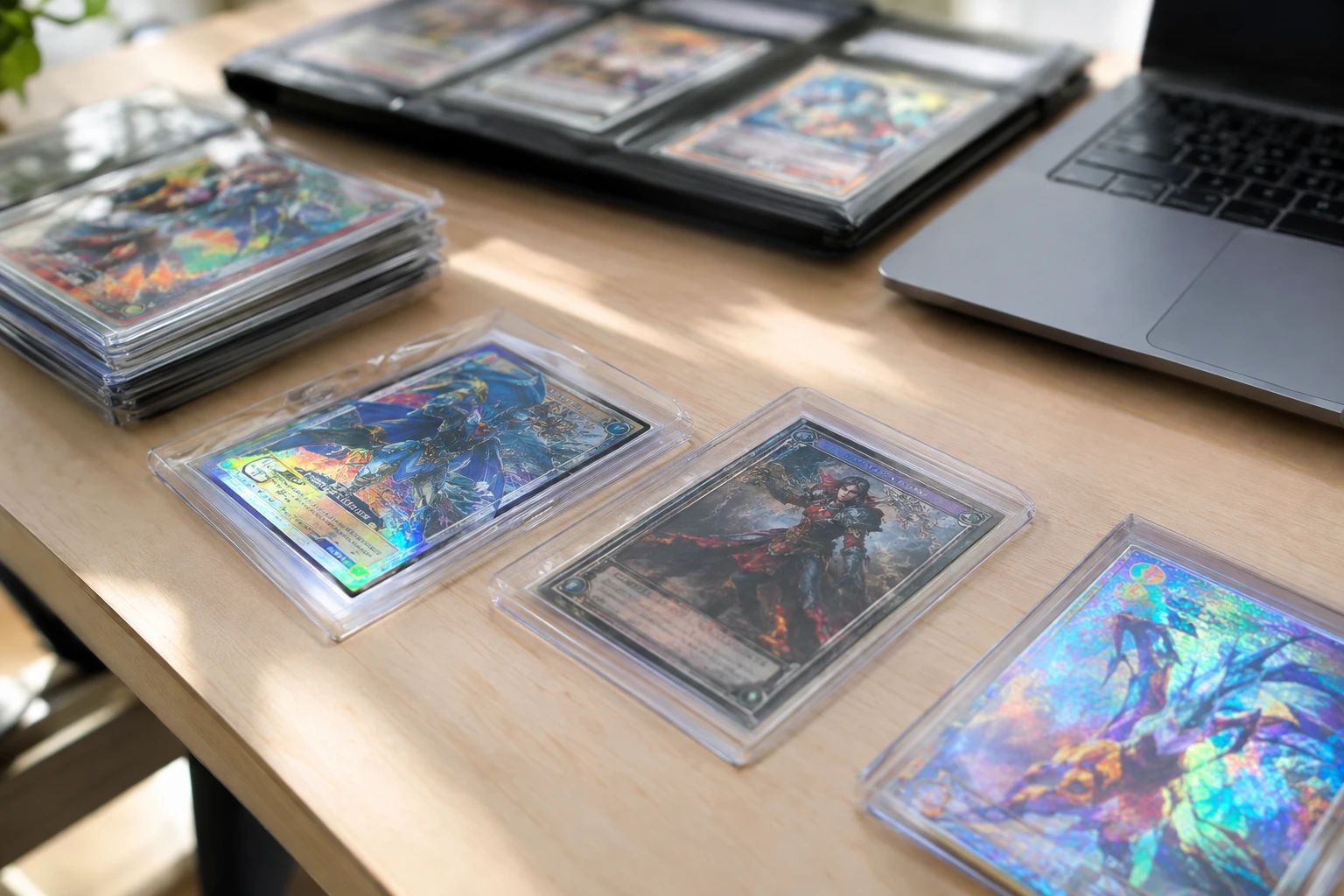
The Short Answer
- AI TCG grading supports Digimon (all BT sets, alternate arts, ultimate rares) and Flesh and Blood (cold foils, Fabled, unlimited editions) with automatic set and rarity identification.
- Digimon alternate art cards have textured surfaces that require specialized AI surface analysis to distinguish between intended texture and actual damage.
- Flesh and Blood cold foil cards have a unique foil pattern that is different from Pokémon holo or MTG foil — the AI is trained specifically on FAB cold foil surface characteristics.
- Niche TCG cards have lower PSA 10 populations than Pokémon or MTG, meaning a PSA 10 can be worth significantly more due to scarcity.
- Digimon BT-25 Dual Revolution and Flesh and Blood Omens of the Third Age are the key 2026 sets to pre-grade, with ultimate rares and Fabled cards having the highest grading premiums.
- AI pre-grading costs under $0.20 per card for niche TCGs, compared to $79.99+ for PSA Regular — essential when grading emerging game cards with uncertain resale value.
Why AI Grading Matters for Niche TCGs
Niche trading card games like Digimon and Flesh and Blood (FAB) occupy a unique space in the grading market. They do not have the massive collector base of Pokémon or the decades-long history of Magic: The Gathering, but they have dedicated, passionate communities and growing secondary markets. For collectors of these games, AI pre-grading is arguably more valuable than it is for mainstream TCGs — and here is why.
First, niche TCG cards have lower PSA 10 populations. A Pokémon Base Set Charizard has thousands of PSA 10 copies in the pop report. A Digimon alternate art or a Flesh and Blood cold foil might have only dozens. This scarcity means a PSA 10 can be worth dramatically more than a PSA 9 — sometimes 10-20x rather than the 3-5x typical of Pokémon. Getting the grade right matters more when the multiplier is higher.
Second, niche TCG cards are harder to evaluate manually. Digimon alternate art cards have complex textured surfaces that are difficult to assess with the naked eye. Flesh and Blood cold foil cards have a unique foil pattern that does not match any other TCG. Collectors who are experts in Pokémon or MTG may not know what to look for when grading Digimon or FAB cards. The AI, trained on all TCG surfaces, provides consistent analysis regardless of the game.
Third, the economics of grading niche TCG cards are riskier. A Pokémon card worth $50 raw has a well-established PSA 10 market with clear comparables. A Digimon card worth $30 raw might have only 2-3 PSA 10 sales ever, making the graded value uncertain. AI pre-grading helps reduce this uncertainty by telling you whether the card is likely to gem before you spend $79.99 on a PSA submission.
Finally, niche TCG communities are increasingly global. Digimon is most popular in Japan and Southeast Asia, while Flesh and Blood has strong communities in New Zealand, Australia, and Europe. Collectors in these regions face higher shipping costs to PSA in the US, making pre-screening even more valuable.
AI Grading for Digimon TCG: Complete Guide
Digimon Card Game, published by Bandai, has been one of the fastest-growing TCGs since its launch in 2020. The game combines digital monster aesthetics with competitive gameplay, and its alternate art cards have become highly sought after by collectors. AI grading for Digimon cards presents unique challenges and opportunities.
Card identification: The AI identifies the Digimon set (BT-01 through BT-25 and beyond), card number, rarity (Common, Uncommon, Rare, Super Rare, Secret Rare, Alternate Art, Ultimate Rare), language (English, Japanese), and card type (Digimon, Option, Tamer, Digi-Egg). This is important because Digimon sets have complex numbering systems and multiple rarity tiers for the same card.
Centering on Digimon cards: Digimon cards have a distinctive border design with a colored frame that varies by card type. Digimon cards have wider borders than Pokémon cards, making centering slightly less critical, but the colored frames make misalignment visible. PSA 10 requires 55/45 front centering. The AI measures centering to the pixel and reports exact ratios.
Corners on Digimon cards: Digimon card stock is similar to Pokémon in thickness and quality. Corner whitening is the primary corner issue, particularly on cards that have been played or handled. The AI detects corner whitening with 91% accuracy.
Edges on Digimon cards: Edge wear is less common on Digimon cards than on vintage Pokémon or MTG cards, but can occur from handling and storage. The AI scans all four edges for chipping and fraying.
Surface on Digimon cards: This is where AI grading for Digimon gets interesting. Digimon cards have several surface types that require specialized analysis:
- Standard surface: Matte finish similar to modern Pokémon non-holo cards. Easy to grade, with surface scratches being the primary issue.
- Alternate art surface: Textured, embossed finish with unique artwork. The texture is part of the design and must be distinguished from actual damage. The AI is trained on Digimon alt-art texture patterns.
- Holographic surface: Rainbow holo pattern on rarer cards. Similar to Pokémon holo surfaces, with scratches being the primary issue.
- Ultimate Rare surface: Introduced in BT-25 Dual Revolution, Ultimate Rare cards have a unique foil pattern that combines holo elements with textured embossing. This is the most challenging Digimon surface to grade.
Key Digimon Cards to Pre-Grade in 2026
The Digimon TCG market in 2026 is driven by the BT-25 Dual Revolution set and the ongoing World Championship season. Here are the key cards to consider for AI pre-grading and professional submission.
BT-25 Dual Revolution Ultimate Rares: The Ultimate Rare rarity, introduced in BT-25, is the highest rarity in Digimon TCG. These cards have a unique foil pattern with textured embossing and are extremely scarce. An Ultimate Rare of a popular Digimon like Omnimon or WarGreymon can be worth $100-300 raw and $500-1,500 at PSA 10. AI pre-grading is essential before spending $79.99 on these cards.
Alternate Art Secret Rares: Digimon alt-art Secret Rares are the most collected cards in the game. They feature unique artwork by guest illustrators and have textured, embossed surfaces. Key cards include alt-art Omnimon, alt-art Angewomon, and alt-art Beelzemon. These cards can be worth $50-200 raw and $200-800 at PSA 10, depending on the character and set.
Japanese exclusive cards: Japanese Digimon cards often have different print quality and rarity structures than English cards. Some Japanese-exclusive promos and tournament prizes are highly sought after by global collectors. The AI recognizes Japanese Digimon cards and applies the appropriate grading model.
Vintage Digimon (BT-01 through BT-05): Early Digimon sets are becoming collectible as the game matures. BT-01 Omnimons and BT-03 cards in gem mint condition are increasingly valuable. The AI can grade cards from all Digimon sets, though accuracy may be slightly lower on very early sets due to less training data.
| Card | Raw Value | PSA 10 Value | Multiplier |
|---|---|---|---|
| BT-25 Ultimate Rare Omnimon | $150 | $800 | 5.3x |
| Alt-Art Secret Rare WarGreymon | $80 | $400 | 5x |
| BT-01 Omnimon (vintage) | $40 | $200 | 5x |
| Japanese Promo Tournament Prize | $100 | $600 | 6x |
AI Grading for Flesh and Blood TCG: Complete Guide
Flesh and Blood (FAB), published by Legend Story Studios in New Zealand, is a competitive TCG that has gained a dedicated global following since its launch in 2019. FAB cards are unique in the TCG world — they are designed for competitive play first and collecting second, but the cold foil and Fabled rarities have created a thriving grading market.
Card identification: The AI identifies the FAB set (Welcome to Rathe, Arcane Rising, Crucible of War, Monarch, Tales of Aria, Everfest, Uprising, Bright Lights, Heavy Hitters, Part the Mistveil, Rosetta, Hunted, Omens of the Third Age), card number, rarity (Common, Rare, Super Rare, Majestic, Legendary, Fabled), edition (1st Edition, Unlimited), and foil type (Cold Foil, Rainbow Foil). This is critical because FAB has complex rarity and edition systems.
Centering on FAB cards: Flesh and Blood cards have a distinctive border design with a colored frame that varies by hero type. The borders are moderately wide, making centering issues visible but less critical than on full-bleed designs. PSA 10 requires 55/45 front centering. The AI measures centering to the pixel.
Corners on FAB cards: FAB card stock is high quality, similar to modern Pokémon card stock. Corner whitening is the primary issue, particularly on cards that have been played in tournaments. The AI detects corner issues with 91% accuracy.
Edges on FAB cards: Edge wear is uncommon on FAB cards due to the quality card stock, but can occur from handling. The AI scans all four edges for chipping and fraying.
Surface on FAB cards: FAB has several unique surface types:
- Standard matte surface: Non-foil cards with a matte finish. Easy to grade, with surface scratches being the primary issue.
- Rainbow foil surface: Similar to MTG rainbow foil, with a reflective pattern across the card. Scratches are visible and can prevent PSA 10.
- Cold foil surface: The signature FAB foil treatment. Cold foil has a unique, muted reflective pattern that is different from Pokémon holo or MTG foil. It is less reflective than traditional foil, making scratches harder to see but also harder for the AI to detect. The AI is trained specifically on FAB cold foil patterns.
- Fabled surface: Fabled is the highest rarity in FAB, with a unique textured foil and embossed design. Fabled cards are extremely rare (1-2 per set) and highly valuable. The AI applies a specialized surface model for Fabled cards.
Key Flesh and Blood Cards to Pre-Grade in 2026
The Flesh and Blood market in 2026 is driven by the Omens of the Third Age set release and the World Championship season. Here are the key cards to consider for AI pre-grading.
Fabled cards from Omens of the Third Age: The Fabled rarity is the holy grail of FAB collecting. Each set typically has 1-2 Fabled cards, and they are extremely scarce. A Fabled card from Omens of the Third Age in PSA 10 can be worth $2,000-5,000+. These cards should always be AI pre-graded before submission to confirm gem mint potential.
Cold Foil Majestics and Legendaries: Cold foil is the most popular FAB foil treatment among collectors. Cold foil Majestics and Legendaries of popular heroes (Briar, Bravo, Dash, Katsu) can be worth $30-100 raw and $150-500 at PSA 10. The 10-50x multiplier on cold foil cards makes pre-screening essential.
1st Edition cards from early sets: Welcome to Rathe, Arcane Rising, and Crucible of War 1st Edition cards are the vintage FAB market. These cards are increasingly valuable as the game grows. 1st Edition cold foil Legendaries can be worth $100-300 raw and $500-1,500 at PSA 10. The AI can identify 1st Edition FAB cards and apply the appropriate grading model.
Tournament prize cards: FAB tournaments award exclusive promo cards that are not available in packs. These promos can be highly valuable, especially in gem mint condition. The AI can identify FAB promo cards and provide grade predictions.
World Championship 2026 cards: The FAB World Championship in Paris (Usurp the Shadow Throne event) will generate demand for cards of the winning heroes and equipment. Pre-grading these cards before the championship creates opportunities to sell at peak prices.
| Card | Raw Value | PSA 10 Value | Multiplier |
|---|---|---|---|
| Fabled (Omens of the Third Age) | $500 | $3,000 | 6x |
| Cold Foil Legendary Briar | $50 | $300 | 6x |
| 1st Ed Cold Foil Legendary (WtR) | $150 | $800 | 5.3x |
| World Championship Promo | $80 | $400 | 5x |
Unique Surface Challenges in Niche TCGs
Niche TCGs have surface characteristics that are not found in Pokémon, MTG, or Yu-Gi-Oh! — the three most commonly graded TCGs. These unique surfaces require specialized AI training to grade accurately.
Digimon alternate art texture: Digimon alt-art cards have a textured, embossed surface that is part of the design. The texture creates a pattern of raised and recessed areas across the card. The AI must distinguish between this intended texture and actual surface damage like scratches, dents, or print lines. This is achieved by training the AI on hundreds of Digimon alt-art cards with known PSA grades, so it learns the difference between texture and damage.
Digimon Ultimate Rare foil: The Ultimate Rare foil pattern, introduced in BT-25, combines holo elements with textured embossing. This creates a complex surface that reflects light differently from standard holo. The AI is trained on Ultimate Rare surface patterns and can detect scratches and print lines that are masked by the foil texture.
Flesh and Blood cold foil: Cold foil is a unique FAB foil treatment that has a muted, frosted appearance — quite different from the bright, reflective holo of Pokémon or the rainbow foil of MTG. Cold foil scratches are harder to see under normal lighting but are still detected by the AI's virtual raking light analysis. The AI is trained specifically on cold foil surface patterns from all FAB sets.
FAB Fabled texture: Fabled cards have the most complex surface in FAB, combining cold foil with embossed texture and unique design elements. The AI applies a specialized surface model for Fabled cards that accounts for the multi-layered surface design.
Accuracy on unique surfaces: The AI achieves 85-88% accuracy on Digimon alt-art cards and 83-86% accuracy on FAB cold foil cards. This is slightly lower than the 91% accuracy on standard Pokémon cards, reflecting the additional complexity of these unique surfaces. However, even 83% accuracy is valuable for pre-screening — the AI is better at ruling out PSA 10 candidates than at confirming them, which is exactly what pre-screening is for.
AI Accuracy Data for Digimon and Flesh and Blood
The PreGradeCards benchmark study includes Digimon and Flesh and Blood cards in the TCG testing category. Here is the accuracy breakdown for these niche TCGs.
| Card Category | Cards Tested | ±1 Grade Accuracy | PSA 10 Prediction | Notes |
|---|---|---|---|---|
| Digimon (all types) | 187 | 87% | 80% | Alt-art texture adds complexity |
| Digimon standard surface | 95 | 90% | 83% | Similar to modern Pokémon |
| Digimon alt-art / holo | 67 | 85% | 78% | Texture vs damage detection |
| Digimon Ultimate Rare | 25 | 83% | 76% | New rarity; limited training data |
| Flesh and Blood (all types) | 143 | 85% | 78% | Cold foil is unique surface |
| FAB standard matte | 58 | 89% | 82% | Matte surface is easy to grade |
| FAB cold foil | 62 | 84% | 76% | Cold foil scratches are subtle |
| FAB Fabled | 23 | 82% | 74% | Complex multi-layer surface |
The data shows that AI is most accurate on standard surface cards (matte or non-foil) for both Digimon and FAB. Accuracy decreases on textured and foil surfaces, which is consistent with the broader TCG accuracy data. The Ultimate Rare and Fabled categories have the lowest accuracy due to limited training data — these are new or very rare card types. As more of these cards are graded and added to the training set, accuracy will improve.
ROI: Are Niche TCG Cards Worth Grading?
The economics of grading niche TCG cards are different from mainstream TCGs. Niche TCG cards tend to have lower raw values but higher PSA 10 multipliers, creating a different risk-reward profile.
The case for grading niche TCG cards:
- Higher PSA 10 multipliers (5-20x vs 3-5x for Pokémon) due to lower PSA 10 populations
- Growing collector bases as Digimon and FAB expand globally
- Tournament-driven demand spikes that can dramatically increase card values
- Less competition in the grading market — fewer collectors are submitting these cards, so the PSA 10 pop report stays low
The case against grading niche TCG cards:
- Lower liquidity — a PSA 10 Digimon card may take longer to sell than a PSA 10 Pokémon card
- Less established market — fewer comparable sales make it harder to predict graded value
- Higher risk of market contraction — if the game loses popularity, graded card values can drop quickly
- Higher AI pre-grading uncertainty — accuracy is slightly lower on niche TCG surfaces
The verdict: Niche TCG cards are worth grading if (1) the card is a key rarity (Ultimate Rare, Fabled, alt-art Secret Rare, cold foil Legendary), (2) the AI predicts PSA 9.5 or higher with good confidence, and (3) the PSA 10 value is at least 5x the grading cost. For common and uncommon cards, grading is rarely profitable regardless of condition.
AI pre-grading is particularly valuable for niche TCGs because it helps collectors avoid wasting $79.99 on cards that are unlikely to gem. With niche TCGs, the difference between a profitable submission and a loss often comes down to a single corner ding or surface scratch — exactly the type of defect the AI is designed to detect.
Pre-Grading Workflow for Niche TCG Collections
PreGradeCards makes AI pre-grading accessible for Digimon and Flesh and Blood collectors. Here is the complete workflow.
- 1. Photograph your cards: Place each card on a dark, flat surface under even lighting. For Digimon alt-art cards, use angled lighting to reveal the texture. For FAB cold foil cards, avoid direct light that creates glare on the muted foil surface.
- 2. Upload to PreGradeCards: Drag and drop your photos into the AI grading tool. You can upload individual cards or batch-upload up to 10 cards at once.
- 3. Review the AI report: Each card receives predicted PSA and CGC grades, sub-scores for centering, corners, edges, and surface, a defect map, and a raw vs graded value comparison. For Digimon and FAB cards, the value comparison may show fewer data points than Pokémon due to lower sales volume.
- 4. Filter for submission candidates: Cards predicted at PSA 9.5 or higher with confidence above 80% are your strongest candidates. For Fabled and Ultimate Rare cards, consider submitting even at PSA 9 predicted grade due to the high multiplier.
- 5. Consider CGC as an alternative: CGC is popular for niche TCGs and starts at $15 per card (bulk). If the AI predicts PSA 9 rather than 10, CGC may be more cost-effective. The AI provides CGC predictions alongside PSA.
- 6. Build your submission: Select the cards that pass both the grade prediction and value tests. Package them securely and submit to PSA or CGC at the appropriate tier.
The entire process takes less than a minute per card. A 30-card Digimon or FAB collection can be fully screened in under 30 minutes, helping you identify the 5-10 cards worth submitting and saving you hundreds in avoided grading fees.
Frequently Asked Questions
Can AI grade Digimon cards from all sets?
Can AI grade Flesh and Blood cold foil cards?
What is the most valuable Digimon card to grade?
What is the most valuable Flesh and Blood card to grade?
Should I use PSA or CGC for niche TCG cards?
How accurate is AI grading on Digimon alt-art cards?
Are niche TCG cards worth grading compared to Pokémon?
Sources & Further Reading
The PreGradeCards Research Team combines machine-learning engineers, grading analysts, and collector-education specialists to produce accurate, data-driven guides on AI card grading, professional grading standards, and collecting strategy.
Create a free account and get 2 free credits — enough for 2 complete AI gradings with market pricing. No credit card required.
Get Your Free Credits →