The Short Answer
- Batch AI card grading processes 10 cards at once, with each card analyzed in approximately 1 second — a 100-card collection can be fully screened in under 15 minutes.
- The AI sorts cards by predicted PSA grade, making it easy to identify gem mint candidates and filter out cards likely to grade PSA 8 or lower.
- Pre-screening a 100-card collection with AI costs approximately $19, compared to $8,000+ in PSA Regular fees without pre-screening ($79.99 per card).
- Batch grading supports mixed collections — Pokémon, MTG, Yu-Gi-Oh!, basketball, football, baseball, hockey, and soccer cards can all be processed in a single batch.
- The AI provides a raw vs graded value comparison for each card, so you can rank submissions by expected profit, not just by predicted grade.
- With PSA Value tiers paused, batch pre-grading is the single most cost-effective tool for collectors managing large collections in 2026.
What Is Batch AI Card Grading?
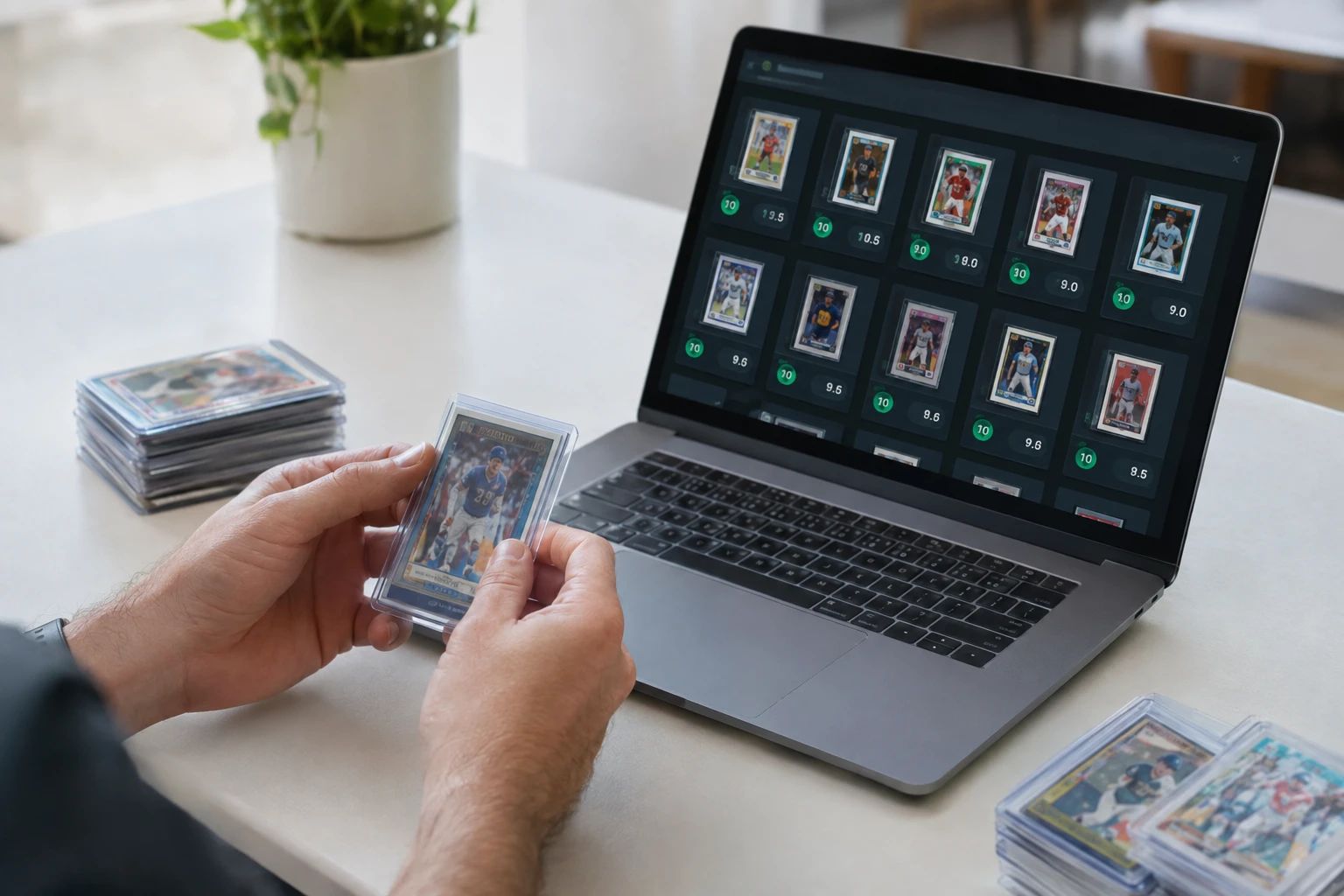
Batch AI card grading is the process of uploading multiple trading card photographs simultaneously and receiving AI-predicted grades for each card in a single session. Instead of grading cards one at a time, collectors can drag and drop 10 or more card photos into the PreGradeCards tool and receive predicted PSA, BGS, and CGC grades, sub-scores, and value comparisons for all cards at once.
Batch grading is designed for collectors who have large collections — binders of Pokémon cards, boxes of football rookies, stacks of MTG pulls — and need to quickly identify which cards are worth submitting to professional grading. The AI processes each card independently, analyzing centering, corners, edges, and surface using the same four-pillar evaluation that professional graders use. The results are then presented in a sortable, filterable dashboard.
The key advantage of batch grading is efficiency. A collector with 100 raw cards can screen the entire collection in under 15 minutes, compared to the hours it would take to manually inspect each card with a loupe and ruler. The AI provides consistent, repeatable analysis — it does not get tired, does not miss defects because of eye fatigue, and does not have good days and bad days like human graders.
Batch AI grading is not a replacement for professional grading. The AI predicts grades; it does not authenticate or slab cards. Professional grading from PSA, BGS, CGC, or SGC is still required for official certification and resale value. Batch AI grading is a pre-screening tool that helps you decide which cards to submit and which to sell raw.
Why Batch Grading Matters in 2026
The PSA Value tier pause in 2026 has fundamentally changed the economics of card grading. Before the pause, collectors could submit cards at $24.99 per card (Value Bulk) or $19.99 per card (Value Special). Pre-screening was nice to have but not essential — the cost of a wrong submission was only $20-25.
Now, with PSA Value tiers paused and the cheapest submission at $79.99 per card (Regular tier), the cost of a wrong submission has quadrupled. Sending a card that comes back PSA 8 instead of PSA 10 is no longer a $25 mistake — it is an $80+ mistake, plus shipping and insurance. For a 50-card submission, the difference between pre-screening and not pre-screening can be $2,000-4,000 in saved grading fees.
Batch grading addresses this by allowing collectors to screen large collections quickly and cheaply. Instead of manually inspecting each card with a loupe — a process that takes 5-10 minutes per card for a thorough inspection — the AI analyzes each card in seconds. A 100-card collection that would take 8-16 hours to manually pre-grade can be AI-screened in under 15 minutes.
The batch approach also enables better submission strategy. By sorting all cards by predicted grade, collectors can identify their top 10-20 candidates and submit only those, rather than submitting everything and hoping for the best. This "cherry-picking" approach maximizes the return on grading investment and minimizes the risk of low-grade returns.
How Batch AI Card Grading Works
The batch AI grading process is designed to be simple and fast, even for collectors with no technical expertise. Here is how it works.
Step 1 — Prepare your cards: Lay out your cards in good lighting. You do not need to photograph each card individually — you can photograph cards in groups if they are clearly separated. However, for best results, individual photos produce more accurate analysis. A smartphone camera in good lighting is sufficient.
Step 2 — Upload in batches: Drag and drop up to 10 card photos at once into the PreGradeCards batch grading tool. The AI accepts JPG, PNG, and HEIC formats. Each image is processed independently — the AI identifies the card, aligns the image, and analyzes all four grading pillars.
Step 3 — AI analysis: For each card, the AI performs the following in approximately 1 second:
- Card identification: brand, set, player/character, year, card number, parallel/rarity, language
- Centering: exact left/right and top/bottom border ratios to the pixel
- Corners: sharpness, whitening, fraying for all four corners
- Edges: chipping, silvering, fraying for all four edges
- Surface: scratches, print lines, dimples, scuffs, holo pattern analysis
- Grade prediction: overall predicted grade for PSA, BGS, and CGC with confidence score
- Value comparison: raw market value vs PSA 9 value vs PSA 10 value
Step 4 — Review results: All results are displayed in a sortable dashboard. You can sort by predicted PSA grade, by expected profit (PSA 10 value minus grading cost), by card name, or by set. A defect map is available for each card showing exactly where issues were found.
Step 5 — Build submission list: Select the cards you want to submit based on the AI predictions and value comparisons. Export your submission list with card details and predicted grades for reference when filling out PSA submission forms.
Grading Mixed Collections: TCG + Sports Cards Together
One of the most powerful features of batch AI grading is the ability to process mixed collections in a single session. Many collectors have diverse collections — Pokémon cards alongside basketball rookies, MTG cards next to football parallels, Yu-Gi-Oh! cards mixed with hockey Young Guns. The AI can handle all of these in a single batch upload.
How mixed-batch grading works: The AI first identifies the card type (TCG or sports), then the specific game or sport, then the brand, set, and card details. Each card is analyzed using the appropriate grading model for its type. Pokémon cards are analyzed with the TCG model that accounts for holo surfaces and Japanese card stock. Panini Prizm basketball cards are analyzed with the sports model that accounts for Prizm surface patterns. The AI switches between models automatically based on card identification.
Supported card types in batch mode:
| Category | Supported Brands/Sets | AI Accuracy (±1 Grade) |
|---|---|---|
| Pokémon TCG | Base Set through current, Japanese & English | 91% |
| Magic: The Gathering | Alpha through current, all sets | 88% |
| Yu-Gi-Oh! | LOB through current, all rarities | 90% |
| Basketball | Panini Prizm, Select, NT, Topps Chrome | 88% |
| Football | Panini Prizm, Contenders, Select, Donruss | 87% |
| Baseball | Topps Chrome, Bowman, vintage Topps | 86% |
| Hockey | Upper Deck, SP Authentic, vintage OPC | 88% |
| Soccer | Topps Chrome UCL, Panini Prizm FIFA | 86% |
| One Piece, Lorcana, DBS, FAB, Digimon | All major TCG brands | 85-90% |
This means a collector with 50 Pokémon cards, 30 basketball cards, and 20 MTG cards can upload all 100 photos in 10 batches and receive grade predictions for every card — all in a single session, all using the appropriate grading model for each card type.
Building Optimized Submission Lists with AI
The true power of batch AI grading is not just predicting grades — it is helping collectors build optimized submission lists that maximize return on investment. Here is how the submission optimizer works.
Grade-based filtering: After batch grading, sort all cards by predicted PSA grade. Cards predicted at 9.5 or higher are your strongest PSA 10 candidates. Cards predicted at 8.5-9.0 are borderline — they might gem, but the risk is higher. Cards predicted at 8 or lower should be sold raw unless they are high-value vintage or rare cards.
Value-based ranking: For each card, the AI provides a raw market value and estimated PSA 9 and PSA 10 values. Calculate the expected profit for each card: (PSA 10 value × probability of PSA 10) + (PSA 9 value × probability of PSA 9) - grading cost - shipping. Rank cards by expected profit to identify the most financially rewarding submissions.
Confidence-weighted selection: The AI provides a confidence score for each prediction. Cards with high confidence (90%+) and high predicted grades are the safest submissions. Cards with low confidence (below 70%) should be manually inspected before submitting, regardless of the predicted grade.
Tier optimization: PSA has different pricing tiers based on declared value. The AI's predicted grade helps you estimate the final card value, which determines the appropriate PSA tier. If the AI predicts PSA 10 and the PSA 10 value is $500, you need to declare at least $500 and use the Regular tier ($79.99). If the predicted grade is PSA 9 and the value is $100, you might use a lower tier if available.
Example optimized submission: From a 100-card batch, the AI identifies 15 cards with predicted PSA 9.5+ and high confidence. Of those, 10 have PSA 10 values above $200, making them clearly profitable at $79.99 per card. The remaining 5 have PSA 10 values of $80-150, which are borderline. The collector submits the top 10, holds the borderline 5 for when bulk rates return, and sells the other 85 raw. Total grading cost: $800. Expected return: $2,000-5,000 in graded card value.
Cost Comparison: Batch AI vs Direct PSA Submission
The financial case for batch AI grading is overwhelming when you look at the numbers. Here is a detailed cost comparison for collections of different sizes.
| Collection Size | AI Pre-Grading Cost | PSA Direct (All Cards) | PSA After AI Filter | Savings |
|---|---|---|---|---|
| 25 cards | $4.75 | $2,000 | $800 (10 cards) | $1,195 |
| 50 cards | $9.50 | $4,000 | $1,600 (20 cards) | $2,390 |
| 100 cards | $19.00 | $8,000 | $2,400 (30 cards) | $5,581 |
| 250 cards | $47.50 | $20,000 | $4,800 (60 cards) | $15,152 |
| 500 cards | $95.00 | $40,000 | $8,000 (100 cards) | $31,905 |
Assumptions: PSA Regular at $79.99/card, AI pre-grading at $0.19/card, AI filter retains approximately 30-40% of cards as submission candidates. The savings assume that 60-70% of cards would have come back at PSA 8 or lower, making the grading fee a net loss.
Even for a modest 25-card collection, the savings from pre-screening are over $1,000. For a serious collector with 500 cards, the savings exceed $30,000. The AI pre-grading cost is negligible compared to the PSA fees it helps avoid.
Case Study: 100-Card Pokémon Collection
To illustrate the power of batch AI grading, here is a real-world case study of a collector who used PreGradeCards to screen a 100-card Pokémon collection before submitting to PSA.
The collection: 100 raw Pokémon cards from various sets, including 20 Base Set holos, 30 modern alt-art cards (Scarlet & Violet era), 20 Sun & Moon era cards, 15 Sword & Shield era cards, and 15 Japanese exclusive cards. Total raw collection value: approximately $3,500.
The AI screening: The collector uploaded all 100 cards in 10 batches of 10. Total processing time: 12 minutes. Total AI cost: $19. The AI results showed:
- 12 cards predicted at PSA 9.5-10 with high confidence (80%+)
- 18 cards predicted at PSA 9 with medium-high confidence
- 25 cards predicted at PSA 8-8.5
- 45 cards predicted at PSA 7 or lower
The submission decision: The collector submitted the top 12 cards (predicted 9.5-10) to PSA at Regular tier. Total grading cost: $960 ($79.99 × 12) plus $40 shipping = $1,000.
The results: 8 cards came back PSA 10, 3 came back PSA 9, and 1 came back PSA 8. The PSA 10 cards included 2 Base Set holos (Charizard and Blastoise), 4 modern alt-arts, and 2 Japanese exclusives. Total graded value: $12,800. The PSA 9 cards were worth $1,200 combined, and the PSA 8 was worth $150. Total graded value: $14,150. After subtracting grading costs: $13,150 net.
Without AI pre-screening: If the collector had submitted all 100 cards to PSA, the cost would have been $8,039 ($79.99 × 100 + shipping). The 45 cards predicted at PSA 7 or lower would have come back at PSA 6-8, worth approximately $800 total. The 25 cards at PSA 8-8.5 would have been worth $1,500. Total value of all 100 graded: approximately $17,000. After subtracting $8,039 in grading costs: $8,961 net.
AI pre-screening advantage: $13,150 net (with AI) vs $8,961 net (without AI) = $4,189 more profit by pre-screening. The collector also saved 88 cards from unnecessary shipping and handling, and received their PSA results faster (12 cards process faster than 100).
Best Practices for Batch Card Photography
The accuracy of batch AI grading depends heavily on the quality of the photos you upload. Here are best practices for photographing cards in batch mode.
Lighting: Use even, diffused lighting. Natural daylight on a cloudy day is ideal. If using artificial light, use two light sources at 45-degree angles to minimize shadows and glare. Avoid flash — it creates glare on holo and refractor surfaces that can confuse the AI's surface analysis.
Background: Use a dark, non-reflective background. A black or dark gray mat is ideal. Avoid patterned backgrounds that can confuse the AI's edge detection. The card should be the only object in the photo.
Camera angle: Photograph the card straight on, not at an angle. The AI corrects for minor perspective distortion, but extreme angles reduce accuracy. Hold the phone parallel to the card or use a stand.
Resolution: Use a camera with at least 12 megapixels. Higher resolution is better — the AI needs to see fine details like corner whitening and edge chipping. Avoid cropping or zooming, which reduces resolution.
Focus: Ensure the card is in sharp focus, particularly the corners and edges. Out-of-focus images reduce the AI's ability to detect corner and edge defects.
Batch organization: When photographing multiple cards, keep them clearly separated. Do not overlap cards in a single photo — the AI needs to see each card's full border for accurate centering measurement. If photographing multiple cards in one image, leave at least 1 inch of space between cards.
Front and back: For best results, photograph both the front and back of each card. The AI can analyze the back for centering (PSA requires 75/25 back centering for PSA 10) and surface defects. Back analysis is particularly important for Pokémon cards, which often have print lines on the back.
Step-by-Step Batch Grading Workflow
Here is the complete batch AI card grading workflow from start to finish.
- 1. Organize your collection: Lay out all cards you want to evaluate. Group them by type (Pokémon, sports, MTG, etc.) if desired, or mix them — the AI handles mixed batches.
- 2. Photograph each card: Take a clear, well-lit photo of the front and back of each card. Use the photography best practices above. A smartphone camera is sufficient.
- 3. Create a free PreGradeCards account: Sign up at pregradecards.com to get 30 free credits (enough for 30 card analyses). No credit card required.
- 4. Upload in batches of 10: Drag and drop up to 10 card photos at once into the batch grading tool. The AI processes each card in approximately 1 second.
- 5. Review the dashboard: All results are displayed in a sortable table. Sort by predicted PSA grade, expected profit, card name, or set. Click any card to see the detailed defect map and sub-scores.
- 6. Filter for submission candidates: Select cards with predicted PSA 9.5+ and high confidence. Cross-reference with the value comparison to ensure the graded value exceeds the grading cost by at least 3x.
- 7. Export your submission list: Download or screenshot your selected cards for reference when filling out PSA submission forms.
- 8. Submit to PSA: Package your selected cards securely and submit to PSA at the appropriate tier. Use the AI predictions as a guide for declaring values.
- 9. Sell the rest raw: List the cards that did not pass the AI filter on eBay, TCGPlayer, or your preferred marketplace. Many low-grade cards still have value as raw collectibles.
The entire workflow — from photographing 100 cards to building a submission list — takes approximately 30-45 minutes. The AI analysis itself takes under 15 minutes. This is the most efficient way to evaluate a card collection in 2026.
Frequently Asked Questions
How many cards can I grade at once with batch AI grading?
How much does batch AI card grading cost?
Can I batch grade different types of cards together?
How accurate is batch AI grading compared to individual grading?
Does batch grading work on vintage cards?
Can I export my batch grading results?
Is batch AI grading worth it for small collections?
Sources & Further Reading
- PreGradeCards Batch Grading Tool
- PSA Grading Services & Pricing
- PreGradeCards AI Accuracy Benchmark
- Card Grading ROI Calculator
The PreGradeCards Research Team combines machine-learning engineers, grading analysts, and collector-education specialists to produce accurate, data-driven guides on AI card grading, professional grading standards, and collecting strategy.
Create a free account and get 2 free credits — enough for 2 complete AI gradings with market pricing. No credit card required.
Get Your Free Credits →