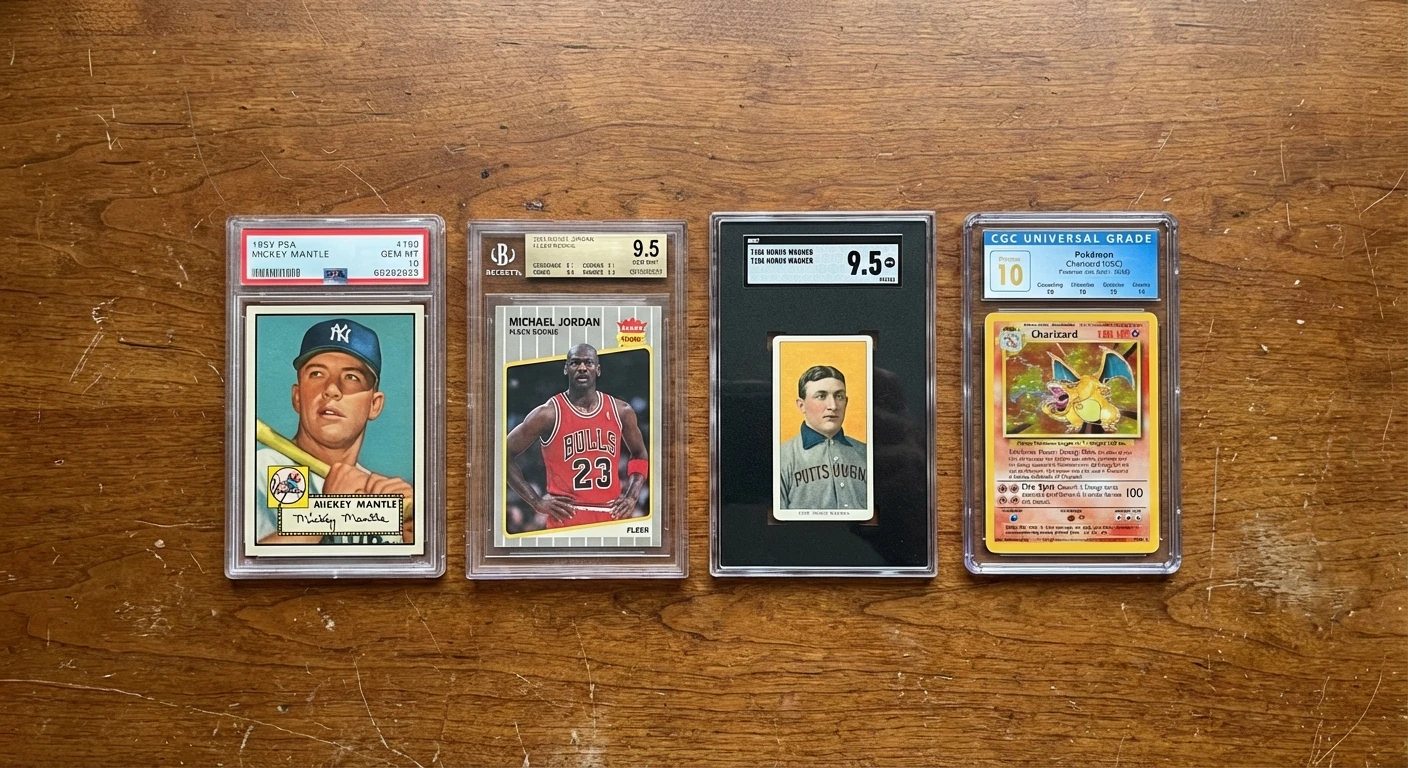
Why Look Beyond PSA in 2026?
PSA dominates the grading market. They grade ~90,000 cards per day, their slabs command the highest resale premiums, and they're the default choice for most collectors. So why would you go anywhere else?
Because the math has changed.
As of February 10, 2026, PSA raised prices by $5/card across their five most popular tiers. Their cheapest option — Value Bulk — now costs $24.99/card (requires Collectors Club membership and 20-card minimum). The next tier up, Value, is $32.99/card. That's before shipping, supplies, and insurance.
The bottom line: At $25–33/card all-in, a card needs to gain at least that much in value from being graded to justify the cost. For a $30 raw card, that means it needs to sell for $55–63+ graded — a premium only PSA 10s and strong 9s consistently deliver. For everything else, alternatives can save you $7–18 per card.
Meanwhile, competitors have gotten better. BGS includes sub-grades at $19. SGC delivers in ~30 days at $18. CGC starts at $15. The gap in slab quality and market acceptance has narrowed significantly since 2021.
For the full pricing breakdown, see our Card Grading Costs 2026 guide. For details on the PSA price increase specifically, see PSA Raises Prices Again: Feb 2026.
Quick Comparison: PSA vs. Alternatives
| Company | Cheapest Tier | Fastest Affordable | Sub-grades? | Best For |
|---|---|---|---|---|
| PSA | $24.99 (95 days) | $79.99 (25 days) | No | Max resale value |
| BGS | $19 (75+ days) | $80 (10 days) | Yes (included) | Basketball, sub-grade detail |
| SGC | $18 (~30 days) | $60 (5–10 days) | No | Vintage, speed + value |
| CGC | $15 (150 days) | $55 (15 days) | Yes (optional) | Pokémon, TCG, budget |
| HGA | $20 (60+ days) | $65 (15 days) | Yes | Custom labels, modern cards |
| TAG | $18 (45+ days) | $50 (10 days) | Yes | AI-assisted, NFC slabs |
BGS (Beckett Grading Services)
BGS is the closest direct competitor to PSA in terms of market recognition and resale value. Their key differentiator: sub-grades are now included at every tier — Centering, Corners, Edges, and Surface — giving buyers granular detail that PSA's single number doesn't provide.
The coveted BGS Black Label 10 (perfect 10 on all four sub-grades) commands premiums that rival or exceed PSA 10s on certain cards, particularly in basketball. A BGS 9.5 with strong sub-grades is widely considered equivalent to a PSA 10 by serious collectors.
At $19/card for the Base tier, BGS is $6 cheaper than PSA's cheapest option — and you get sub-grades included. The trade-off is a 75+ business day turnaround at that tier.
BGS Pricing
Strengths
- Sub-grades included (PSA charges nothing because they don't offer them)
- Black Label 10 = elite premium
- Strong basketball market acceptance
- $19 base tier is $6 cheaper than PSA
Weaknesses
- BGS 9.5 sells for less than PSA 10 on most cards
- Grading scale is stricter — harder to get 10s
- Slower turnaround at budget tiers
- Owned by Collectors (same parent as PSA)
Best for: Basketball cards, collectors who value sub-grade detail, cards where a Black Label 10 is achievable, and budget submissions where $19 vs $25 matters.
SGC (Sportscard Guaranty Corporation)
SGC has been the vintage collector's grader of choice since 1998. Their tuxedo-style slabs are iconic in the pre-war and vintage market, and their grading standards are considered among the most consistent in the industry.
At $18/card (20+ card submissions) with a ~30 business day turnaround, SGC offers the best combination of price and speed among the major graders. That's $7 cheaper and 65 days faster than PSA Value Bulk.
The catch: SGC slabs generally sell for less than PSA slabs on modern cards. The discount varies — typically 10–30% less for modern, but much closer (sometimes equal) for vintage.
⚠️ Note: SGC was acquired by PSA parent company Collectors in 2024. In February 2026, PSA President Ryan Hoge announced SGC will transition to a "boutique" grading brand with reduced volume. Long-term pricing and availability may change. More details →
SGC Pricing
Strengths
- Best price-to-speed ratio in the industry
- No membership required
- Dominant in vintage market
- Consistent, respected grading standards
- Free auto grading on 10-grade autos
Weaknesses
- 10–30% resale discount vs PSA on modern cards
- No sub-grades
- Uncertain future as "boutique" brand
- Owned by Collectors (same parent as PSA)
Best for: Vintage cards (pre-1980), budget submissions where speed matters, cards where the PSA premium doesn't justify the $7+/card cost difference, and collectors who value grading consistency.
CGC Cards
CGC (Certified Guaranty Company) is best known for comics grading but has rapidly expanded into trading cards. They're now the second-largest card grader by volume and have become the default choice for Pokémon and TCG collectors.
Their Bulk tier at $15/card is the cheapest grading option from any major company. Even after their January 6, 2026 price increase (up from $14), CGC remains $10/card cheaper than PSA's cheapest tier.
The trade-off: CGC slabs carry less resale premium than PSA in the sports card market. For Pokémon and other TCG, the gap is much smaller — CGC 10s often sell within 5–10% of PSA 10s for popular sets.
CGC Pricing
Strengths
- Cheapest major grader at $15/card
- Strong Pokémon/TCG market acceptance
- Independent (not owned by Collectors)
- Optional sub-grades available
- Growing sports card acceptance
Weaknesses
- Lower resale premium on sports cards vs PSA
- 150-day turnaround on Bulk tier
- Less established in sports card market
- Prices just increased (Jan 2026)
Best for: Pokémon and TCG cards, absolute budget grading, high-volume submissions where per-card cost matters most, and collectors who want independence from the Collectors ecosystem.
HGA (Hybrid Grading Approach)
HGA combines AI-assisted grading with human review and is known for their custom-colored slab labels that match the card's team or design. This makes them popular with PC (personal collection) builders who want display-quality slabs.
Their grading uses computer vision for centering and surface analysis, with human graders making final calls. Sub-grades are included at all tiers. At $20/card for their economy tier, they're competitive with BGS and SGC.
The limitation: HGA slabs carry minimal resale premium. They're a personal collection play, not an investment play. If you're grading to sell, HGA isn't the move.
HGA Pricing
Strengths
- Custom-colored labels (team/card matching)
- AI-assisted consistency
- Sub-grades included
- Great for personal collections
Weaknesses
- Minimal resale premium
- Not widely accepted by serious investors
- Smaller company, less track record
- Limited vintage expertise
Best for: Personal collection display, modern cards where you want team-colored labels, collectors who value aesthetics over resale premium.
TAG Grading
TAG (Technical Authentication & Grading) is one of the newer entrants, using AI-assisted grading with NFC-enabled slabs. Each slab contains an NFC chip that links to the card's grading report, pop data, and authentication details when tapped with a phone.
At $18/card for their standard tier, TAG is price-competitive with SGC. Their AI-first approach means more consistent grading across submissions, and the NFC technology is genuinely innovative for authentication.
The risk: TAG is still building market acceptance. Their slabs don't carry meaningful resale premiums yet, and the company's long-term viability is unproven. It's an early-adopter play.
TAG Pricing
Strengths
- NFC-enabled slabs (tap to verify)
- AI-assisted consistency
- Competitive pricing at $18
- Sub-grades included
- Modern tech-forward approach
Weaknesses
- No meaningful resale premium yet
- Unproven long-term viability
- Limited market acceptance
- Small grading volume
Best for: Tech-forward collectors, personal collections, early adopters who value NFC authentication, and modern card submissions where resale premium isn't the priority.
When PSA Is Still Worth It
Despite the price increases, PSA remains the right choice in specific scenarios:
High-value modern cards ($200+ raw)
When a card is worth $200+ raw, the PSA 10 premium (often 2–3x) easily justifies the $25–33 grading fee. A $200 raw card that grades PSA 10 might sell for $500+. The $25 fee is noise.
Cards you're grading to sell immediately
PSA slabs sell faster and for more money on eBay, PWCC, and Goldin. If you're flipping, the liquidity premium matters. BGS and SGC slabs sit longer.
Rookie cards of top-tier players
For Wemby, LeBron, Mahomes, Ohtani — the PSA label premium is highest on the most liquid, most searched cards. Buyers specifically filter for "PSA 10" on these names.
When you need auction house acceptance
Major auction houses (Heritage, Goldin, PWCC) strongly prefer PSA and BGS slabs. If you're consigning to auction, PSA is the safest bet for maximum realized price.
Decision Framework: Which Grader Should You Use?
Use this flowchart to decide:
Is the card worth $200+ raw? → PSA (the premium justifies the cost)
Is it a Pokémon/TCG card? → CGC (best market acceptance for TCG)
Is it vintage (pre-1980)? → SGC (the vintage authority)
Do you want sub-grades? → BGS (included at $19)
Is speed + budget the priority? → SGC at $18/30 days
Is absolute lowest cost the priority? → CGC Bulk at $15
Is it for your personal collection? → HGA (custom labels) or TAG (NFC tech)
None of the above? → Use our Submission Planner to run the numbers
The Pre-Grading Advantage
Regardless of which grader you choose, pre-grading saves more money than switching companies. Filtering out cards that won't grade well saves $15–33 per rejected card. Our AI pre-grading predicts grades with 95% accuracy within 1 point — use it before every submission.
Not Sure Which Grader to Use?
Our Submission Planner calculates expected ROI across PSA, BGS, SGC, and CGC based on your card's value and grade probability.
Related Articles
Card Grading Costs 2026: Complete Fee Breakdown
Full pricing for PSA, BGS, SGC, and CGC including hidden fees.
PSA Raises Prices Again: February 2026
$5/card increase, Ryan Hoge's explanation, and what to do next.
PSA vs BGS vs SGC vs CGC 2026
Definitive comparison of all four major grading companies.
CGC vs PSA for Pokémon in 2026
Which grader wins for Pokémon TCG cards?