The Short Answer
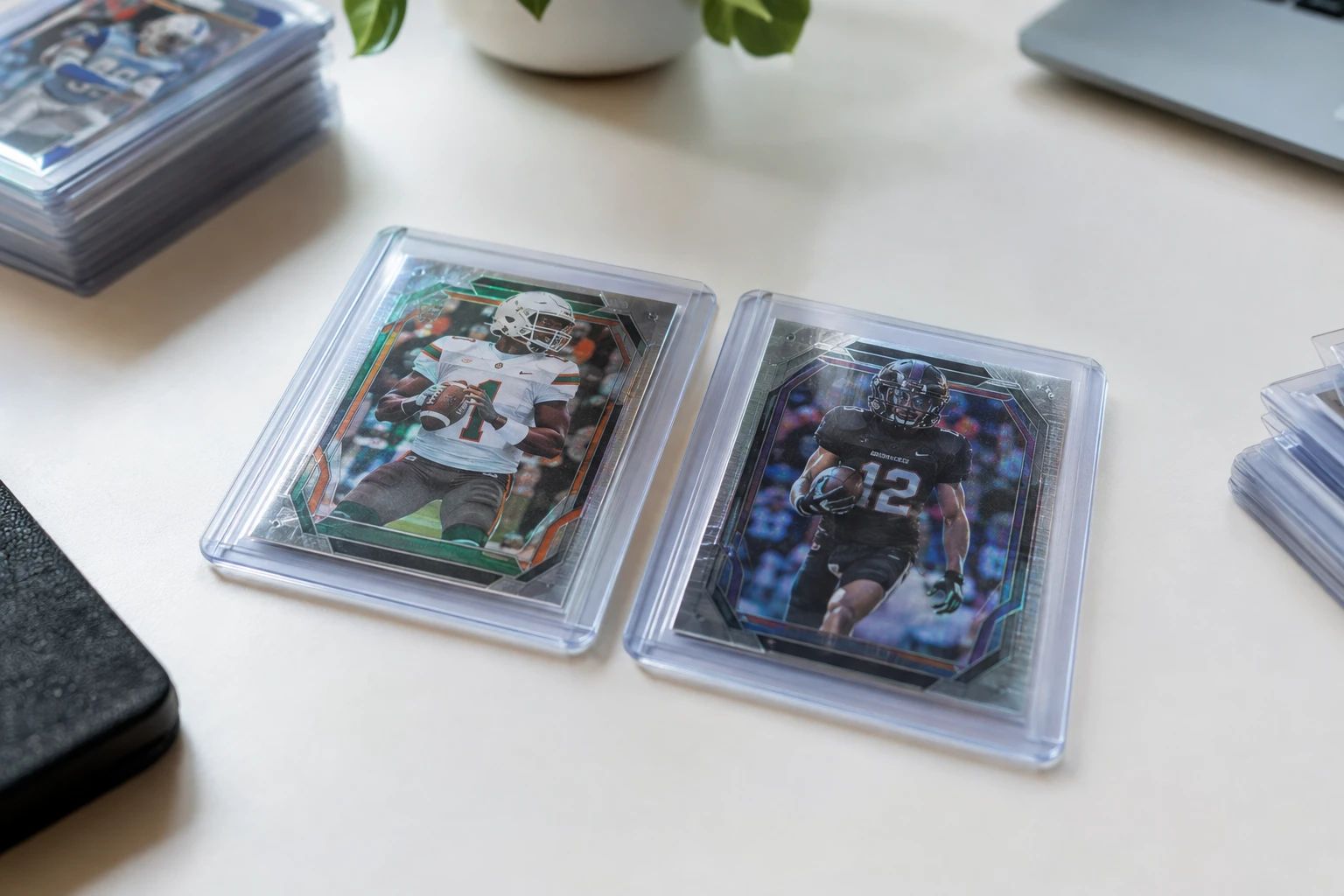
- NIL cards are pre-NFL prospect cards — licensed through players’ name/image/likeness deals rather than NFL team rights, which is why the logos and uniforms look different.
- Arch Manning makes his Topps debut in 2026 Bowman Football — five cards including base, chrome, an Anime NIL SSP, a Garbage Pail Kids NIL card, and chrome prospect autos carrying the 1st Bowman logo.
- Bowman University Best releases October 30 — presale opened October 5 at $239.99 per hobby box, four autographs per box, with Manning, CJ Carr, Dante Moore, Cam Coleman, and Bear Bachmeier among the chases.
- Grading pays on 1st Bowman autos and low-numbered chrome — not on base paper college cards, where the NFL-transition risk swamps any condition premium.
- Thick chrome prospect stock has its own failure modes — edge chipping and surface scratches are the dominant grade-killers on Bowman chromium.
Quick Answer: What Are NIL Football Cards?
NIL cards are licensed college-athlete trading cards — produced under name/image/likeness agreements between card manufacturers and the athletes themselves, rather than through NFL team licenses. The result is a card of a college player in college gear (or generic gear, when school marks aren’t licensed), released while the player is still in college, before they ever appear in an NFL product.
Before 2021, this market essentially didn’t exist — college athletes couldn’t be paid for their likeness, so card companies could only produce cards through bowl-game and all-star-game licenses or unlicensed draft-pick products. NIL changed that overnight, and Topps moved fastest: Bowman University now functions as the football equivalent of what Bowman baseball has been for decades — the place where players’ "first" cards live.
The distinction that matters for grading: an NIL card is not an NFL rookie card. It’s a pre-rookie — the prospect card that exists before the RC-logo cards arrive. That makes them the football version of a 1st Bowman in baseball: the card that real prospecting happens on, where early buyers capture the appreciation that happens when the player reaches the NFL.
How NIL Card Licensing Actually Works
Two separate licensing layers determine what a college card can look like. The player’s NIL rights are owned by the athlete — the card company signs them individually or through a collective. The school’s marks (logos, uniform designs, stadium imagery) are owned by the university or its licensing arm. A card can carry one, both, or neither.
That’s why Bowman University cards show players in gear that often lacks team logos — Topps has the players’ NIL rights, but not always the school marks. It’s also why Panini could sign Arch Manning for its products for two years while Topps couldn’t touch him: the NIL rights are exclusive to whoever signs them, and Manning’s deal ran through Panini until 2026.
The collector consequence: NIL cards from major manufacturers (Topps Bowman U, Panini’s collegiate lines) are legitimate prospect cards; the dozens of small "NIL card" outfits printing cards with no manufacturer pedigree are not. The market pays for the brand and the checklist position — the 1st Bowman logo, the chrome prospect numbering — not for the novelty of a player’s image on cardboard.
The 2026 Bowman University Products
2026 Bowman University Best Football — releases October 30, 2026, with Topps presales opening October 5 at $239.99 per hobby box. The format: four autographs per hobby box on Bowman’s premium "Best" chromium stock. The checklist travels the country for college’s top NIL talent — Arch Manning, CJ Carr (Notre Dame), Dante Moore (Oregon), Cam Coleman, Bear Bachmeier (BYU), Bryce Underwood (Michigan), LaNorris Sellers, Jayden Maiava, Demond Williams Jr., Darian Mensah, and two high-school standouts get cards this year.
Notable insert structure for 2026: the stained-glass Best of the Best series, Send the House, Big Kahuna Autographs, Jumbo Relic Autographs with game-used memorabilia, and — new this year — mascot and stadium cards in the base set for the first time in the product’s history.
2026 Bowman Football — the companion flagship that went to market first. The headline design move is anime-style inserts spanning both NIL college players and NFL talent — a first for Bowman — plus the Chrome Prospect checklist carrying the 1st Bowman logo: CJ Carr, Cam Coleman, Kewan Lacy, Demond Williams Jr., Bear Bachmeier, Kamario Taylor, Bo Jackson (Ohio State — the name is a conversation piece), Jaron-Keawe Sagapolutele, Drew Mestemaker, and Jared Curtis, all with autograph options and Refractor parallels.
The Arch Manning Topps Debut: Why It Matters
Arch Manning’s arrival in 2026 Bowman Football is the NIL card market’s biggest single event of the year — and a genuinely unusual one. Texas’s quarterback spent his first two college seasons as a Panini exclusive, meaning every previous licensed Manning card (including his Bowman U and other collegiate cards) carries Panini marks. The Topps debut adds the family to the product line that made his uncles’ rookie cards famous.
Manning has five cards in 2026 Bowman Football: a base paper card, a base chrome card, an Anime NIL SSP, a Bowman GPK (Garbage Pail Kids) NIL insert, and the chrome prospect autos. The chrome prospect autos are the chase — they carry the 1st Bowman logo, the designation that has become the single most valuable marker in football prospecting since Topps brought the Bowman brand to the college market.
What makes the timing notable: Manning is widely projected as a 2027 NFL Draft candidate — meaning the market gets his Topps cards roughly 18 months before his NFL rookie cards would exist. That’s the NIL value proposition in a single player: the "first" card happens in college, and the hobby gets the prospecting window it used to only have in baseball.
The Names That Matter in the 2026 NIL Class
Beyond Manning, the checklist concentrates where NFL draft projection meets card-market scarcity:
| Player | School | Why the Market Cares |
|---|---|---|
| Arch Manning | Texas | The name. Projected high pick; first Topps card this year |
| CJ Carr | Notre Dame | ND quarterback premium; early chrome cards trading actively |
| Dante Moore | Oregon | Pac-12-turned-Big-Ten signal caller; breakout candidate |
| Bryce Underwood | Michigan | Michigan QB pedigree; was the #1 recruit in his class |
| Bear Bachmeier | BYU | BYU’s starter; the small-school star the hobby loves |
| Cam Coleman | Texas | Texas WR; top-tier skill-position NIL chase |
| LaNorris Sellers | South Carolina | Dual-threat QB with 2027 draft buzz |
| Jayden Maiava | USC | USC quarterback in a Lincoln Riley system |
The honest caveat on every name in that table: the vast majority of college stars never become NFL stars, and their prospect cards re-price accordingly. For every Trevor Lawrence or Caleb Williams whose college chrome appreciated through their NFL transition, there are a dozen D.J. Uiagaleleis — top recruits whose 1st Bowman autos peaked in September of their freshman year and never came back. That base rate should shape how much grading capital goes into this category.
The Grading Economics of College Chrome
Bowman U and Bowman Football cards are printed on the same premium chromium stock as Bowman baseball — thick, coated, and condition-sensitive in specific ways. The grading equation differs from standard football chrome in two ways.
The stock is thicker than flagship. Thick chromium shows edge chipping — small flecks of white at the card edges where the coating separates — far more than thin chrome. Inspect every edge under magnification before submitting; on Bowman products, edge condition is the single most common grade-killer.
The prospect-card premium is asymmetric. A 1st Bowman chrome auto of a college QB who becomes an NFL star is worth multiples of its graded counterpart’s raw price. The same card of a college star who never pans out settles near its raw price — meaning the downside of a failed grading is smaller than in NFL products, but the upside of a successful one is larger. This is the rare category where grading slightly-below-perfect copies can still make sense if the player is a genuine NFL projection.
The math that matters: on NIL cards, you’re grading the player’s projection, not just the card’s condition. A BGS 9.5 1st Bowman auto of a future NFL star outperforms a PSA 10 of a player who never makes it. The card condition is the filter; the player is the bet.
Which NIL Cards Deserve the Grading Fee
The hierarchy for 2026 Bowman University products:
| Card Type | Grade It? | Why |
|---|---|---|
| 1st Bowman chrome autos (any real prospect) | Yes — always | The chase of the product; graded premium compounds with player success |
| Low-numbered chrome parallels (/50 and under) | Yes | Serial scarcity + chrome premium |
| Base chrome of top-10 names | If pack-fresh and clean | Modest 10 premium; only on flawless copies |
| Anime NIL SSPs & GPK inserts | Yes — if centered/clean | SSPs hold value; GPK crossovers have novelty demand |
| Base paper cards | No | Raw supply floods the market; the 10 premium barely covers the fee |
| Base chrome of non-chase players | No | The player risk and low 10 premium compound against you |
The single best grading candidate in the entire 2026 NIL market is the Arch Manning 1st Bowman chrome prospect auto — the combination of the name, the debut-year status, the auto, and the 1st Bowman logo is the card that will define the class if he pans out. Everything below that tier gets progressively more conditional.
Condition Traps Specific to Prospect Chrome
Bowman’s chromium stock fails in predictable places. The checklist to run:
- Edge chipping — the #1 killer on thick chrome. Hold the card edge-on to a light source; any white fleck in the black/colored edge is a cap on the grade.
- Surface scratches — chrome coating scratches under normal handling. Tilt under raking light and look for hairlines, especially on the back.
- Centering — prospect sets have historically run worse centering than flagship; verify L/R and T/B borders before assuming.
- Autograph quality — on-card autos can pool, skip, or smear. Check the auto itself, not just the card.
- Print defects — chrome products occasionally show ink splotches or registration issues that are unfixable.
The product-specific note for Bowman U Best: the Jumbo Relic and thick-memorabilia cards have different tolerances — a jumbo-relic auto of a top name is graded on the auto more than the relic window, which means the auto check (step 4) matters even more there.
The NIL Prospect Risk Profile
Position NIL cards correctly: they’re the highest-variance mainstream card category in the hobby. A college QB’s 1st Bowman auto can 5x on a good sophomore season or lose 70% on a transfer or a bad year — and most outcomes are somewhere in between.
The market has learned this the hard way. The NIL-era cards that hold value share two traits: the player reached the NFL and performed, and the card was a graded premium version (auto, numbered, or 1st Bowman). The ones that don’t are the mass-produced base cards of college stars who were good-not-great — which describes the majority of any NIL checklist.
Concretely: allocate grading capital in this category like venture capital, not index funds. Spread submissions across multiple real prospects rather than going all-in on one, bias toward the autos and numbered cards that retain value through a bust, and keep a clear-eyed view of base rates — most of the names on a Bowman U checklist will not be NFL starters.
When to Buy, Grade, and Sell NIL Cards
October (now): Bowman U Best presales are live at $239.99; the set releases October 30. The opening weeks are the peak of "new product" pricing — raw chase cards sell at their highest point of the year, which means buying raw then grading is the play only if the raw price hasn’t already priced in the gem.
November-December: College regular season wraps; playoff positioning drives weekly price swings. The sell-into-hype window opens for players whose teams make the playoff.
January-February: Draft declaration season — the inflection point where NIL cards either convert to NFL-prospect value or die. The graded copies you want are the ones submitted before the NFL Draft combine hype, because the grading turnaround can miss a hype cycle if you wait.
March-April: The NFL Draft itself is the final re-pricing event. A first-round pick’s NIL cards get their last major run-up before the NFL rookie products arrive and re-define the market around the RC-logo cards.
Pre-Screening NIL Cards with AI Grading
Pre-grading earns its keep hardest in the NIL category because the decision isn’t just "is this card clean" — it’s "is this card clean and worth the upside bet on the player." The workflow:
Photograph the card front and back, run the AI pre-grade, and read the four subgrades. On Bowman chrome, the edges and surface subgrades are the pass/fail — chipping and scratches are the dominant failure modes. A predicted 9.5-10 with clean edges means submit; anything below that on a base chrome is a raw sale, and on a 1st Bowman auto of a real prospect it’s still a submit because the auto premium cushions a 9.
The batch play: if you open a Bowman U Best box and pull four autos, pre-grade all four before choosing submissions. The auto that would grade a 9 sells better raw-unsubmitted than slabbed — and the one that would grade a 10 is worth multiples of its raw price. Let the subgrades sort the pile before you spend the fees.
Frequently Asked Questions
0
1
2
3
4
5
6
Sources & Further Reading
- Checklist Insider — 2026 Bowman University Best checklist & set details
- Sports Illustrated — Arch Manning makes his Topps debut in 2026 Bowman Football
- Steel City Collectibles — 2026 Bowman University Best Football Hobby Box
- The Collector Nation — 2026 Bowman Football checklist & anime inserts
- DiamondCardsOnline — 2026 Bowman University Best checklist
Emily Rodriguez analyzes grading cost, population, and pricing data across PSA, BGS, SGC, CGC, and TAG. She built the PreGradeCards ROI calculator and submission planner, and her market reports on grading backlog, turnaround times, and slab premiums are cited by collectors and dealers worldwide.
Create a free account and get 1 free credit — enough for 1 complete AI grading with market pricing. No credit card required.
Sign Up Free →