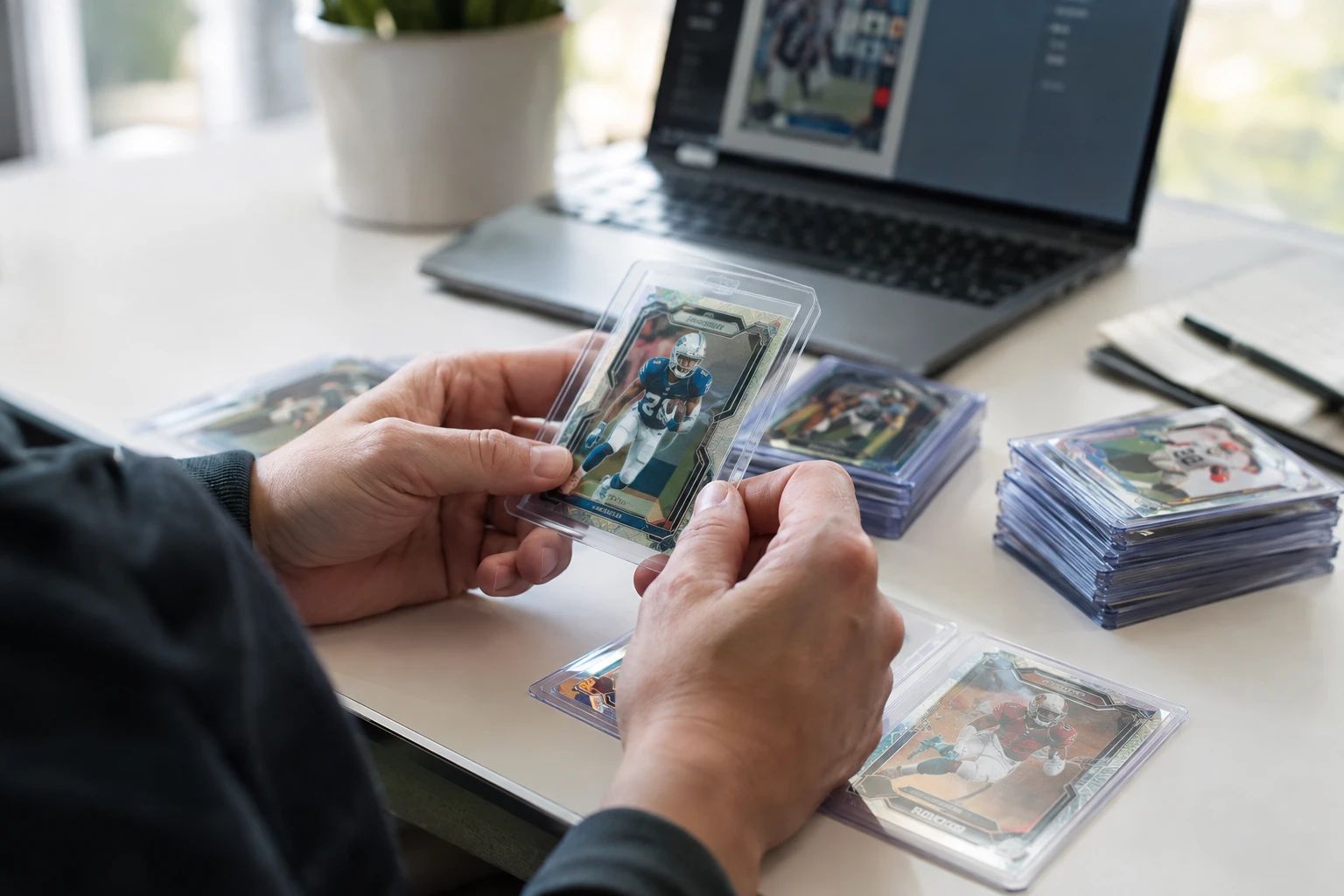
The Short Answer
- AI football card grading predicts PSA grades for NFL rookie cards with 87% accuracy within one grade point, based on 742 football cards tested in the PreGradeCards benchmark study.
- Panini Prizm football cards are the most submitted brand for AI pre-grading, with centering and Prizm surface scratches being the top grade-killers.
- PSA 10 football rookie cards typically sell for 3-10x the raw price, making pre-screening essential to avoid wasting $79.99+ per card on submissions that come back PSA 8 or 9.
- AI detects corner whitening on Panini card stock with 91% accuracy and measures centering to the pixel — more precise than human visual inspection.
- Contenders Rookie Ticket autographs require special handling for sticker auto smearing and patch window centering that AI can flag before submission.
- Batch pre-grading a 50-card football collection costs under $10 with AI, compared to $4,000+ in PSA fees without pre-screening.
What Is AI Football Card Grading?
AI football card grading uses computer vision and machine learning to analyze photographs of NFL football cards and predict the grade a professional service like PSA, BGS, or SGC would assign. The AI evaluates the same four criteria professional graders use — centering, corners, edges, and surface — but does so in seconds from a single photo, at a fraction of the cost.
Football cards present unique grading challenges that make AI pre-grading especially valuable. Panini Prizm cards have reflective, holo-like surfaces that show every scratch and print line. Contenders Rookie Tickets have autograph stickers and patch windows that introduce additional condition variables. Vintage football cards from Topps and Fleer have different card stock, border styles, and aging patterns. The AI is trained on all of these variations and can identify the brand, set, player, year, and card number from a single image.
The purpose of AI football card grading is pre-screening. With PSA Value tiers paused and the cheapest submission now $79.99 per card, sending a card that comes back PSA 8 is a costly mistake. AI pre-grading costs under $0.20 per card and helps collectors identify which cards are likely PSA 9 or 10 candidates before spending money on professional grading.
Why Football Cards Need AI Pre-Grading in 2026
The football card market in 2026 is dominated by Panini, but Fanatics is set to take over NFL and NBA licensing. This transition has created urgency among collectors to grade current Panini cards before the brand change potentially affects resale value. At the same time, PSA's Value tier pause has raised the floor for grading submissions from $24.99 to $79.99, making it more important than ever to pre-screen cards before submitting.
Football rookie cards have some of the highest PSA 10 premiums in the sports card market. A Panini Prizm Silver rookie of a top QB can jump from $50 raw to $300+ at PSA 10 — a 6x multiplier. But the same card at PSA 9 might only sell for $80, barely covering the grading fee. The difference between PSA 9 and PSA 10 is often a single soft corner or a 58/42 centering ratio, both of which AI can detect before you spend a dollar.
Football cards also have sport-specific grading issues. Panini Prizm cards are notorious for centering problems — the holo pattern makes misalignment more visible. Corner whitening is common on Prizm Silver cards because the white borders show every ding. Select cards have a thicker card stock that can hide edge wear but also introduces surface dimpling. Contenders cards have autograph stickers that can smear or fade. All of these issues are detectable by AI before submission.
| Issue | Frequency in Football Cards | Grade Impact | AI Detection Rate |
|---|---|---|---|
| Off-center (worse than 55/45) | Very common on Prizm | Caps at PSA 9 | 99.2% |
| Corner whitening | Common on Silver borders | Drops 1-2 grades | 91% |
| Prizm surface scratches | Common on holo parallels | Drops 1 grade | 78% |
| Edge chipping | Moderate | Drops 0.5-1 grade | 88% |
| Print lines | Occasional | Drops 1-2 grades | 76% |
| Auto sticker smearing | Common on Contenders | Does not affect grade but hurts value | N/A (flagged) |
How AI Analyzes Football Cards
The AI football card grading pipeline follows a structured process designed specifically for the characteristics of NFL card stock and finishes. Here is how it works step by step.
Step 1 — Image Capture: You photograph the front and back of your football card under even lighting. Place the card on a dark, flat surface. The AI works best with high-resolution images (12MP or better) taken without flash, which can create glare on Prizm holo surfaces.
Step 2 — Card Identification: The AI identifies the brand (Panini, Topps, Fleer, Upper Deck), set (Prizm, Contenders, Select, Donruss, Optic), year, player, team, card number, and parallel type (Silver, Gold, Black, Color Blast, etc.). This metadata is used to look up recent sold prices at each grade level, so you can see the financial upside of grading before you submit.
Step 3 — Alignment and Cropping: The AI detects the card borders, corrects for perspective distortion, and crops the image to isolate the card. This is critical for accurate centering measurement — if the card is photographed at an angle, the centering ratios will be wrong without correction.
Step 4 — Centering Analysis: The AI measures the exact pixel distance between the card borders on all four sides and calculates left/right and top/bottom ratios. For PSA 10, the front centering must be 55/45 or better, and the back must be 75/25 or better. The AI reports exact ratios like 52/48 front and 60/40 back, so you know exactly where your card stands.
Step 5 — Corner Inspection: The AI examines all four corners for sharpness, whitening, fraying, and dinging. Panini Prizm Silver cards are particularly prone to corner whitening because of the white border design. The AI flags each corner individually and assigns a sub-score.
Step 6 — Edge Assessment: The AI scans all four edges for chipping, silvering, and fraying. Edge wear is less common on modern Panini cards than on vintage Topps, but Prizm holo edges can show silvering that drops a grade.
Step 7 — Surface Scan: The AI looks for scratches, print lines, dimples, and scuffs. Prizm holo surfaces are the hardest to evaluate because the reflective pattern can mask or mimic scratches. The AI is trained specifically on Prizm surface patterns to distinguish between the intended holo design and actual damage.
Step 8 — Grade Prediction: The AI combines all four sub-scores into an overall predicted grade for PSA, BGS, and SGC. It also provides a confidence score and a defect map showing exactly where issues were found.
Panini Prizm: The #1 Graded Football Brand
Panini Prizm is the most graded football card brand in the world, and it is the most common brand submitted to AI pre-grading tools. Prizm cards feature a distinctive holo surface that creates a rainbow effect when tilted. This holo surface is both the brand's signature and its biggest grading challenge.
Centering on Prizm cards is the number one reason football cards fail to reach PSA 10. The Prizm holo pattern makes the borders highly visible, and even slight misalignment is obvious. PSA requires 55/45 front centering for a PSA 10, but many Prizm cards come out of the pack at 60/40 or worse. The AI measures centering to the pixel and tells you exactly where your card falls on the PSA scale.
Prizm surface scratches are the second most common issue. The holo surface is delicate and can scratch from normal handling, sleeve friction, or even the pack-fresh pull itself. A single visible scratch on the holo surface typically caps a card at PSA 9. The AI is trained to detect Prizm-specific surface scratches, which can be difficult to see with the naked eye under normal lighting.
Prizm parallel colors affect grading difficulty. Silver Prizm cards have white borders that show corner whitening easily. Colored Prizms (Gold, Green, Black, etc.) have colored borders that can hide some edge wear but may show print defects more clearly. The AI adjusts its analysis based on the parallel type identified in Step 2.
Color Blast and short-print Prizms are ultra-rare inserts with unique designs. These cards often have irregular borders and non-standard layouts that require special centering calibration. The AI accounts for these design variations when analyzing Color Blast and other short-print inserts.
Contenders Rookie Tickets & Autographs
Panini Contenders is the second most popular football card brand for grading, driven by the iconic Rookie Ticket autograph inserts. Contenders Rookie Tickets feature an on-card or sticker autograph and are considered the "true rookie card" by many football collectors. Grading Contenders cards requires special attention to several factors unique to the brand.
Autograph quality does not directly affect the PSA grade, but it significantly affects resale value. A smeared, faded, or streaked autograph can reduce a card's value by 30-50% even at PSA 10. The AI flags autograph quality issues so collectors know about them before submission, even though PSA will not penalize the grade.
Patch windows on Contenders Premium and Contenders Optic cards introduce another variable. The patch window must be centered and clean, with no loose threads or adhesive residue. If the patch window is off-center, it can affect the overall centering score. The AI measures patch window placement as part of its centering analysis.
Contenders card stock is slightly different from Prizm. The cards are typically less reflective, which makes surface scratches less visible but also means the AI needs to be calibrated for the matte finish. Print lines are more common on Contenders than on Prizm, and the AI checks for these specifically.
Sticker autographs vs on-card autographs require different handling. Sticker autos can have bubbling, smearing, or placement issues that do not affect the grade but do affect value. On-card autos can have ink bleeding or skipping. The AI identifies which type of autograph is present and flags any visible issues.
Select, Donruss, Optic & Other Football Brands
Beyond Prizm and Contenders, several other Panini football brands are commonly submitted for grading. Each has unique characteristics that the AI must account for.
Panini Select is a premium brand with three tiers (Concourse, Premier Level, Field Level) and a thicker card stock. The thicker stock can hide some edge wear but introduces surface dimpling and print defects. Select holo parallels have a different pattern than Prizm and require separate surface calibration. The AI identifies Select cards and applies the appropriate surface model.
Panini Donruss is a more affordable brand with a retro design. Donruss cards have a matte finish that is less prone to surface scratches but more prone to print lines and factory defects. The Rated Rookie insert is the most graded Donruss card and is considered a key rookie card by many collectors. Donruss Optic is the holo version of Donruss and shares some surface characteristics with Prizm.
Panini National Treasures is a high-end brand with patch autographs and premium card stock. NT cards are thick and often have patch windows, autograph windows, and multiple layers. The AI can identify NT cards and flag issues with patch placement, auto quality, and surface defects, though the thick card stock makes edge and corner assessment less critical.
Panini Flawless is another high-end brand with diamond-encrusted cards. The diamond inset does not affect grading but the thick card stock and premium finish require special handling. Flawless cards are typically high-value and worth pre-screening before a $79.99+ PSA submission.
Topps and Fleer vintage football cards from the 1950s-1990s have completely different characteristics. See the vintage section below for details.
Vintage Football Card Grading with AI
Vintage football cards from Topps, Fleer, and Upper Deck present different grading challenges from modern Panini cards. The AI is trained on vintage card stock and can identify and grade cards from the 1950s through the 1990s.
1950s Topps football cards have a distinctive design with painted player portraits and bright backgrounds. These cards are over 70 years old and typically have significant wear. Centering is often wildly off, and corners are almost always rounded. The AI accounts for vintage aging patterns and adjusts its grading expectations accordingly. A 1957 Topps Johnny Unitas in PSA 7 can be worth thousands, so even lower-grade vintage cards are worth pre-screening.
1970s-1980s Topps football cards have a more modern design but still use older card stock. The 1976 Topps set is particularly valuable, with the Walter Payton rookie card being one of the most sought-after football cards in existence. Centering and corner wear are the primary issues, and the AI can detect both with high accuracy on vintage Topps stock.
1980s-1990s Fleer and Score cards have glossy finishes that are prone to surface scratching and gloss loss. The 1989 Score football set is notable for the Barry Sanders, Troy Aikman, and Deion Sanders rookies. The AI checks for gloss loss, surface scratching, and edge wear specific to these brands.
Vintage accuracy note: AI accuracy on vintage football cards (pre-1980) is approximately 79%, compared to 87% for modern cards. This is because vintage aging patterns, paper stock variation, and surface oxidation are less well-represented in the training data. For very high-value vintage cards, AI pre-grading should be paired with manual inspection by a vintage expert.
AI Football Card Grading Accuracy Data
The PreGradeCards benchmark study tested AI grading accuracy on 742 football cards across all eras. The results show that AI is a reliable pre-screening tool for football cards, with accuracy varying by card type and era.
| Card Category | Cards Tested | ±1 Grade Accuracy | PSA 10 Prediction |
|---|---|---|---|
| Modern Panini (2010-2026) | 521 | 89% | 82% |
| Prizm Silver specifically | 287 | 90% | 83% |
| Contenders Rookie Tickets | 134 | 87% | 79% |
| Vintage Topps (pre-1980) | 87 | 79% | 71% |
The data shows that AI is most accurate on modern Panini cards, especially Prizm Silver, which is the most common card type submitted. The lower accuracy on Contenders is due to the autograph and patch variables that introduce additional uncertainty. Vintage accuracy is lower because of aging patterns and card stock differences.
For pre-screening purposes, even 79% accuracy is valuable. If the AI says a card is likely PSA 7, it is very unlikely to come back PSA 10. The AI is more reliable at predicting "not a 10" than at predicting "definitely a 10," which is exactly what pre-screening is for — filtering out the cards that are not worth submitting.
ROI: Pre-Screening vs Direct PSA Submission
The financial case for AI football card pre-grading is straightforward. With PSA Value tiers paused, the minimum cost to submit a football card to PSA is $79.99 (Regular tier), plus approximately $20 for shipping and $10-50 for insurance. That is $110-150 per card before you even know the grade.
Consider a collector with 30 raw Panini Prizm rookie cards from the 2024 NFL class. Without pre-screening, submitting all 30 to PSA at Regular tier costs $2,400 in grading fees plus $600 in shipping and insurance, for a total of $3,000. If 10 come back PSA 10 (worth $300 each = $3,000), 12 come back PSA 9 (worth $80 each = $960), and 8 come back PSA 8 or lower (worth $40 each = $320), the total graded value is $4,280. After subtracting grading costs, the net profit is $1,280.
With AI pre-screening, the collector runs all 30 cards through the AI for approximately $6 total. The AI identifies the 15 strongest candidates. The collector submits only those 15 to PSA, costing $1,200 in grading fees plus $300 in shipping, for a total of $1,500. If 10 come back PSA 10 ($3,000) and 5 come back PSA 9 ($400), the total graded value is $3,400. After subtracting costs, the net profit is $1,900. The remaining 15 cards are sold raw for $40 each = $600 additional. Total with AI: $2,500 profit vs $1,280 without AI.
The ROI calculation is even more favorable for lower-value cards. If a card's raw value is $30 and the PSA 10 value is $150, the grading cost ($110-150) consumes most or all of the profit. AI pre-screening tells you which $30 cards are likely to gem, so you only spend grading fees on cards that will actually increase in value.
| Scenario | No Pre-Screening | With AI Pre-Screening |
|---|---|---|
| 30-card submission | $3,000 grading cost | $1,506 grading + AI cost |
| Cards submitted to PSA | 30 | 15 |
| Net profit | $1,280 | $2,500 |
| ROI improvement | — | +95% |
Step-by-Step Football Card Pre-Grading Workflow
PreGradeCards makes AI football card grading accessible to every collector. Here is the complete workflow from photo to submission decision.
- 1. Photograph your cards: Place each card on a dark, flat surface under even lighting. Avoid flash, which creates glare on Prizm holo surfaces. Take one photo of the front and one of the back. A smartphone camera in good lighting is sufficient.
- 2. Upload to PreGradeCards: Drag and drop your photos into the AI grading tool. You can upload individual cards or batch-upload up to 10 cards at once for faster processing.
- 3. Review the AI report: Each card receives a predicted PSA, BGS, and SGC grade, sub-scores for centering, corners, edges, and surface, a defect map showing exactly where issues were found, and a raw vs graded value comparison.
- 4. Filter for PSA 10 candidates: Sort your results by predicted grade. Cards predicted at PSA 9.5 or higher are your strongest submission candidates. Cards predicted at PSA 8 or lower should be sold raw unless they are high-value vintage cards.
- 5. Build your submission list: Select the cards you want to submit to PSA based on the AI report and the value comparison. Only include cards where the graded value significantly exceeds the grading cost.
- 6. Submit to PSA: Package your cards securely and submit to PSA at the appropriate tier. Use the AI report as a reference when declaring values — the predicted grade helps you estimate the final value for tier selection.
The entire pre-grading process takes less than a minute per card. A 30-card collection can be fully screened in under 30 minutes, saving you thousands in avoided grading fees on cards that would have come back at PSA 7 or 8.
Frequently Asked Questions
Can AI grade football cards from any brand?
How accurate is AI football card grading?
Does AI detect autograph quality on Contenders Rookie Tickets?
What is the most common reason football cards fail PSA 10?
How much does AI football card pre-grading cost?
Should I pre-grade low-value football cards?
Does AI work on Panini Color Blast and short-print inserts?
Sources & Further Reading
- PSA Football Card Grading
- Panini America Football
- PreGradeCards AI Grading Benchmark Study
- Beckett Football Card Grading
The PreGradeCards Research Team combines machine-learning engineers, grading analysts, and collector-education specialists to produce accurate, data-driven guides on AI card grading, professional grading standards, and collecting strategy.
Create a free account and get 2 free credits — enough for 2 complete AI gradings with market pricing. No credit card required.
Get Your Free Credits →