The Short Answer
- Clark's flagship Prizm and Select rookies are the grading tier — base Donruss/Optic commons don't clear the fee.
- Panini's modern stock is clean on centering but surface print lines are the most common 10-killer.
- Her graded-10 premiums are large — a PSA 10 flagship rookie can sell for 3–5× raw.
- The market is deep enough that comps are reliable — check sold listings before submitting.
- Pre-grade before submitting: her prices punish a 9 that was submitted as a hoped-for 10.
The Caitlin Clark card market in 2026
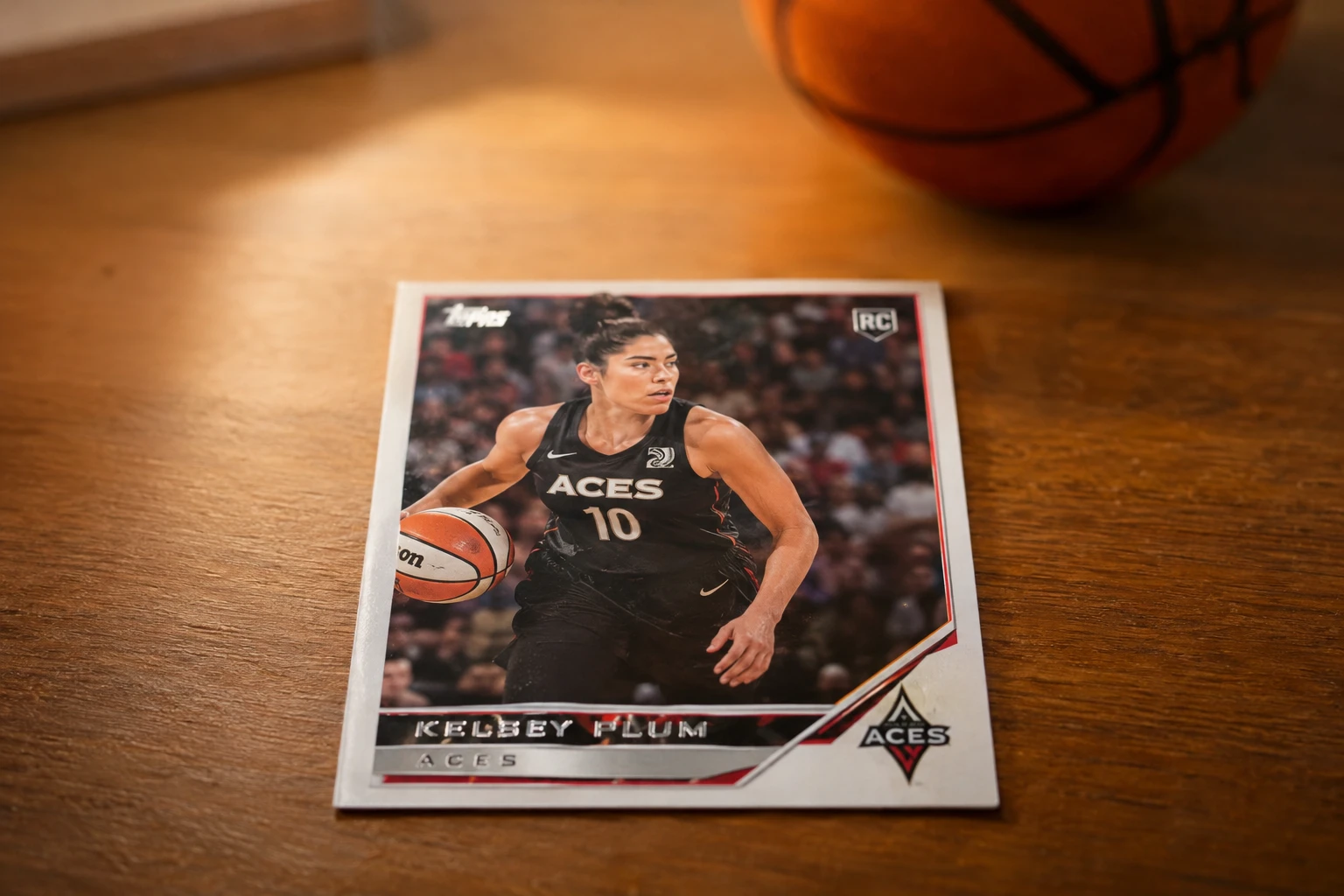
Caitlin Clark is the WNBA's cardboard economy. Her 2024 rookie class — Panini Prizm WNBA, Select, and the flagship Topps Chrome WNBA debut that followed — produced the league's first real graded-card market at scale. A Clark Prizm rookie base raw routinely sells for $100–300; her silvers, color parallels and autographs run $500–2,500+; and the true chase — golds, /10s, 1-of-1s — trades in a different bracket entirely.
What matters for grading is that her market is deep — not a speculative niche. There are enough sold comps on every major parallel that you can run the fee math with real numbers instead of guesses. That changes the calculus: on a liquid card, you submit when the grade premium clears the fee, and you know exactly what that premium is before you ship.
The other thing that makes Clark's market unusual is how structured it is. Panini's WNBA Prizm and Select are the flagship sets — the cards buyers search by name — while the Donruss/Optic tier and the various inserts are the secondary market. That means the grading candidates are easy to identify: flagship rookies and numbered parallels of the sets buyers already want. There's no guessing about which Clark card has a graded market; the market has already decided.
Her collector base also crosses over from mainstream basketball — NBA collectors buy Clark cards the way they buy LeBron rookies, which gives her slabs demand outside the WNBA bubble. That crossover demand is what pushes her graded premiums into territory no other women's sport has reached.
2 free credits — know the likely grade before the fee.
Which Caitlin Clark cards are worth grading
Grade the flagship rookies and numbered parallels; skip the inserts:
- Prizm WNBA rookie (base and silver) — the flagship, the liquid one. Raw $100–300, PSA 10 sells for a real premium.
- Select rookie — the second flagship; graded copies carry comparable premiums to Prizm.
- Numbered color parallels — /99, /49, /25 and below. The lower the serial, the more grading pays.
- Rookie autographs — auto plus grade premium on the same card.
- Topps Chrome WNBA rookies — Topps' first WNBA flagship set; first-of-its-kind premium on early graded copies.
Skip: Donruss/Optic base commons, inserts without serial numbers, and anything where raw is under ~$60. Her graded market concentrates on the flagship rookies and the numbered tier — a clean 10 on a $40 insert is still a fee loss.
A note on her non-rookie cards: Clark's second-year issues can carry premiums too, but the rookie is what the graded market centers on. The buyers collecting Clark cards are overwhelmingly buying the rookie story — the generational-talent narrative — so graded value concentrates on the 2024 rookie issues. Later cards grade on the same standards but the buyer demand is thinner.
Print quality: where Clark rookies lose the 10
Panini's modern basketball stock is generally clean — centering is usually tight and the cards arrive crisp. The defect that actually costs Clark rookies the 10 is different:
- Surface print lines — the most common 10-killer on modern Panini. Faint production lines across the card face, invisible at arm's length but fatal under raking light. On Prizm's glossy surface they hide particularly well.
- Corner softness — Panini corners are slightly softer than Topps'; a corner that looks sharp can still carry the microscopic fraying that costs a grade point.
- Edge whitening — less common than on TCG stock but present, especially on the colored parallels with dark borders.
- Dimples/indentations — small surface marks from pack machinery, more common on the thicker Select cards.
- Centering drift — usually fine, but verify — the occasional Prizm run ships loose centering.
The pattern to internalize: a Clark rookie that fails a 10 is almost always a surface or corner issue, not a print-quality problem. That's exactly what a pre-grade catches — the defect you'd never see holding the card at arm's length.
The graded premium — real numbers
Clark's graded premiums are among the largest in modern basketball because the demand is deep and the supply of true 10s is thin:
- Prizm rookie base: raw ~$150–250; PSA 10 ~$500–800. A 10 pays the fee several times over.
- Prizm silver: raw ~$300–500; PSA 10 ~$1,200–2,000.
- Numbered parallels (/99 and below): raw $500–2,500; a PSA 10 typically sells for 2–4× raw on the popular numbers.
- PSA 9: usually sells for 1.2–1.5× raw — profitable on high-value parallels, marginal on base.
The steep 10-vs-9 curve is why grade accuracy matters more on Clark than on almost any other modern player: submitting a card that comes back a 9 on a base rookie barely clears the fee, while the same card as a 10 is a 3× return. The grade isn't a formality here — it's the entire decision.
Why you pre-grade a Clark card before submitting
Clark's prices are high enough that a wrong submission is expensive and liquid enough that there's no excuse for guessing. The process every profitable submitter runs:
- Check the sold comps for the exact parallel at PSA 10 vs 9 vs raw. The premium curve tells you what a 10 is worth before you ship.
- Pre-grade the card. An AI scan scores centering, corners, edges and surface against grading standards in ~30 seconds — catching the surface print lines and corner softness that decide whether it's a 10 or a 9.
- Submit only the 10-candidates. On Clark's curve, a likely 9 is often a fee wash on base and only marginal on parallels.
The single most expensive mistake in this market is the hoped-for-10 submission: paying $30 to find out your card was a 9 all along, then selling it for $30 more than raw — a wash that took three months. The pre-grade answers the question for a quarter.
Free scan — catch the surface flaw that costs the 10.
The bottom line
Caitlin Clark's market is the most liquid WNBA card market ever, and grading it is genuinely profitable — on the flagship rookies and numbered parallels that carry the premium. But the 10-vs-9 curve is steep enough that the decision lives and dies on grade accuracy, which means the pre-grade isn't optional: it's the step that decides whether the fee is an investment or a loss.
Frequently Asked Questions
0
1
2
3
4
5
6
7
8
9
Sources & Further Reading
Emily Rodriguez analyzes grading cost, population, and pricing data across PSA, BGS, SGC, CGC, and TAG. She built the PreGradeCards ROI calculator and submission planner, and her market reports on grading backlog, turnaround times, and slab premiums are cited by collectors and dealers worldwide.
Create a free account and get 2 free credits — enough for 2 complete AI gradings with market pricing. No credit card required.
Get Your Free Credits →