The Short Answer
- Off-centering causes ~38% of failed PSA 10 attempts on modern cards — AI catches this in seconds.
- PSA 10 requires 60/40 or better left-to-right, 75/25 top-to-bottom centering ratios.
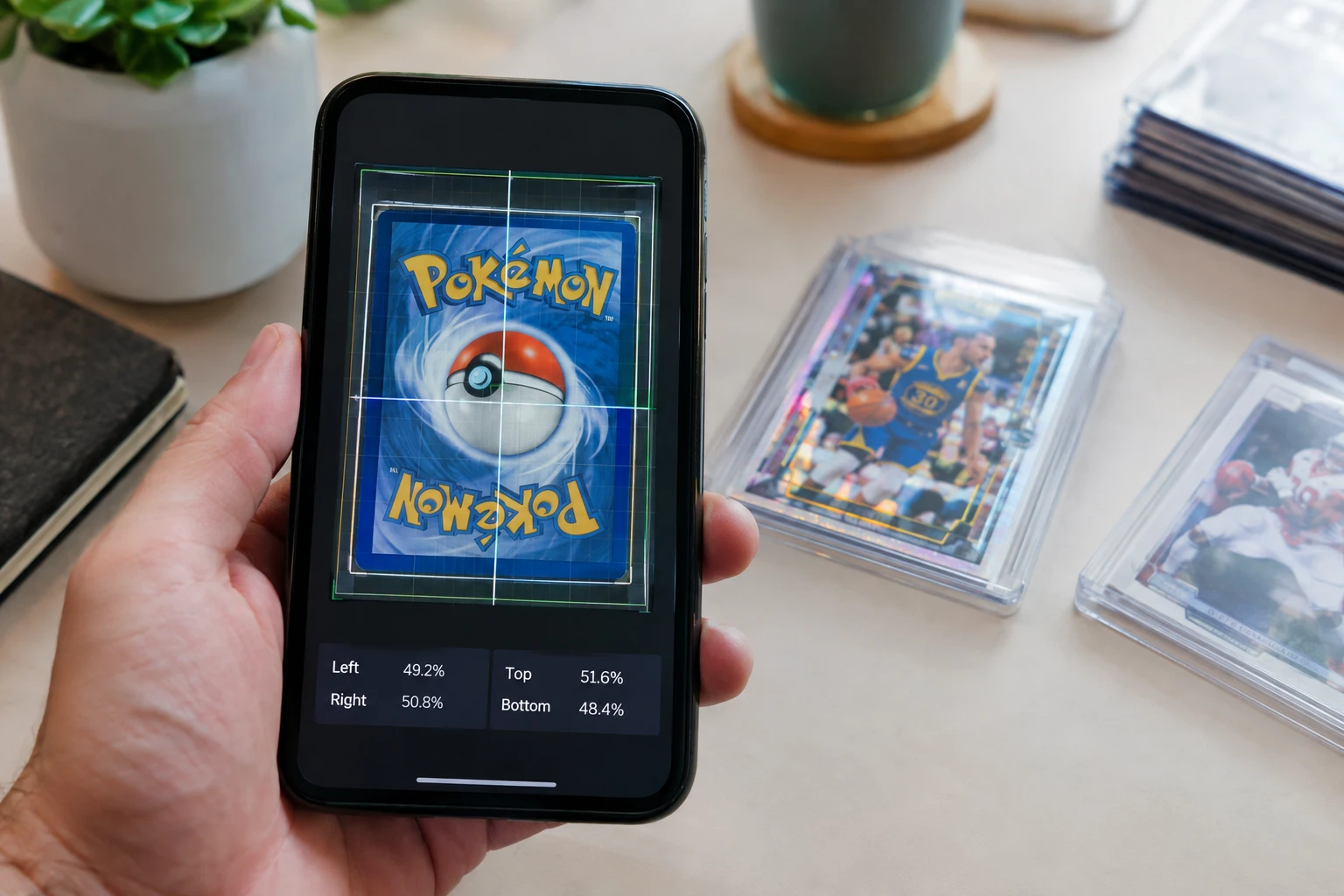
- AI centering tools measure pixel ratios from a photo — more accurate than human eye estimation.
- Different card types (Pokémon, Yu-Gi-Oh, MTG, sports) need calibrated centering algorithms.
- Free AI centering analysis is available on PreGradeCards — no cost to check before submitting.
Why Centering Kills PSA 10 Grades More Than Any Other Factor
Ask any experienced card grader what the single most common reason is that cards fail to reach PSA 10, and the answer is usually the same: centering. Not corners, not surface scratches — centering. A card can be pristine in every other respect and still be denied PSA 10 due to off-centering from the factory print run.
The data supports this. Analysis of PSA 10 rejection patterns on modern Pokémon submissions suggests that approximately 38% of cards that received PSA 9 instead of PSA 10 were downgraded due to centering. On One Piece TCG alt art cards and Leader cards, the centering failure rate is estimated at 35–42% of raw pulls. On MTG modern sets, centering issues are cited in a significant minority of PSA 9 results.
The frustrating reality: centering is entirely outside the collector's control. You can protect your cards from scratches. You can prevent corner wear with proper handling. But you cannot fix centering — it's set at the factory during printing and die-cutting. The only response available to collectors is identification: determining which cards in a batch have acceptable centering and which don't, before submitting.
This is exactly what AI centering tools do. And the difference between checking centering with an AI tool vs estimating it by eye is significant — experienced collectors consistently over-estimate their cards' centering quality when judging by eye, because the brain unconsciously compensates for slight misalignment. An AI measures in pixels; the brain sees what it wants to see.
PSA, CGC, and TAG Centering Standards Explained
Each major grading company has explicit centering standards that determine which cards can receive which grades. Here are the exact standards you need to know:
PSA Centering Standards
| PSA Grade | Left/Right Standard | Top/Bottom Standard |
|---|---|---|
| PSA 10 (Gem Mint) | 60/40 or better | 75/25 or better |
| PSA 9 (Mint) | 65/35 or better | 80/20 or better |
| PSA 8 (NM-MT) | 70/30 or better | 85/15 or better |
| PSA 7 (NM) | 75/25 or better | Mild centering allowed |
Note: PSA does not issue a separate centering sub-grade. Centering is one of four factors (with corners, edges, surface) that determine the overall grade. A card can be PSA 10 on corners/edges/surface but PSA 9 overall due to centering. PSA graders have discretion — a card at exactly 60/40 may pass for 10 or not depending on the overall impression and other factors.
CGC Centering Standards
CGC uses similar centering standards to PSA, with one important difference: CGC uses incremental grades (9.5, 8.5, etc.) that give more nuance to near-borderline centering. A card with 62/38 centering that PSA might grade 9 could receive a CGC 9.5 if all other factors are excellent.
TAG Centering Standards
TAG's computer vision system measures centering on its 1,000-point scale. Centering is one of four sub-categories measured (along with corners, edges, surface). TAG's system measures centering ratios at the pixel level — more precise than PSA's human measurement, but also less forgiving of borderline cases that PSA might pass on overall impression.
TAG's DIG report includes the exact measured centering ratio for every graded card. Collectors who want to understand exactly why a card received its grade can see the precise centering measurement in the report.
How AI Centering Tools Measure Your Card's Centering
AI centering tools like PreGradeCards use computer vision to analyze a card photo and extract precise border measurements. Here is the technical process:
Step 1: Card Edge Detection
The AI identifies the four edges of the physical card in the photo using edge detection algorithms. This separates the card from the background and establishes the card's outer boundary coordinates in pixel space.
Step 2: Print Area Boundary Detection
Within the card edge, the algorithm identifies the boundary of the printed image area. For standard bordered cards, this is the inner edge of the white (or black) border. For full-bleed alt art cards, this is the boundary of the main artwork vs. the card frame elements.
Step 3: Border Width Measurement
The AI measures the pixel width of each of the four borders (left, right, top, bottom). The centering ratio is calculated from these measurements:
- Left/Right ratio = Left border width / Right border width (or expressed as percentages: left% / right%)
- Top/Bottom ratio = Top border width / Bottom border width
Step 4: Calibration for Card Type
Different card types have different border widths by design. A PSA 10-eligible centering for a standard Pokémon card requires different absolute pixel measurements than a Yu-Gi-Oh card due to size differences. PreGradeCards applies card-type-specific calibration to ensure the measurements are compared against the correct PSA standard for each card format.
Step 5: Grade Impact Assessment
The tool cross-references the measured ratios against each grading company's published standards and returns: the exact L/R and T/B ratios, whether the card meets PSA 10 centering requirements, whether it meets PSA 9, and an estimate of how centering will affect the overall grade in combination with other factors.
Centering by Card Type: Pokémon, MTG, Yu-Gi-Oh!, One Piece, Sports Cards
Pokémon Cards
Modern Pokémon sets (Sword & Shield era onward) are known for centering inconsistency. Print runs from the same set can show centering ranging from perfect 50/50 to 70/30 or worse. The problem is particularly acute on sets printed for global simultaneous release due to high-volume print runs. For alt art cards and Special Illustration Rares, the full-bleed borders make off-centering visually obvious — AI centering catches this before submission.
Magic: The Gathering
MTG has generally better centering consistency than modern Pokémon, but collector foils and premium cards show higher variance. Alpha and Beta cards from 1993–1994 have the widest centering tolerance in the entire hobby — partially because PSA applies less strict centering standards to true vintage cards recognizing historical printing standards. AI centering tools for vintage MTG must apply era-appropriate calibration.
Yu-Gi-Oh! Cards
Yu-Gi-Oh cards (59×86mm) require recalculated centering ratios compared to standard 63×88mm cards. AI tools that are not Yu-Gi-Oh-calibrated will produce incorrect centering estimates on these cards. PreGradeCards applies the correct border pixel measurements for the 59mm card width. Yu-Gi-Oh's artwork box is also a useful secondary centering signal — the box position relative to the card frame is a visual centering indicator independent of the outer border measurement.
One Piece TCG
One Piece alt art Leaders and Treasure Rares have the highest centering failure rate of the major TCGs in 2026, estimated at 35–42% of premium pulls. Full-bleed borders on these cards amplify visible centering deviation. AI centering is especially high-value on One Piece premium pulls given the high per-card values at stake.
Sports Cards (Baseball, Basketball, Football)
Sports cards have a wide range of centering variance by manufacturer and era. Topps, Panini Prizm, and Upper Deck all have different typical centering profiles. Vintage sports cards (pre-1980) often have wide borders that mask centering deviations better than modern cards. AI centering tools calibrated for different card manufacturers provide accurate estimates across both modern and vintage sports cards.
How to Photograph Cards for Accurate AI Centering Analysis
The accuracy of AI centering analysis depends entirely on the quality of the input photo. A tilted, glare-heavy, or low-resolution photo produces inaccurate centering measurements. Here's the correct technique:
Camera Angle: Straight Down
Photograph the card from directly above, with the camera lens parallel to the card face. Any angle deviation creates parallax distortion that skews the measured border widths. For smartphone photography, use a card holder or small stand to keep the camera steady and perpendicular.
Background: Neutral Contrast
Use a background that contrasts with the card borders. For white-bordered cards (most modern Pokémon, MTG), use a dark gray or black background. For black-bordered cards (Yu-Gi-Oh!, early MTG), use a light gray or white background. This contrast helps the AI edge detection algorithm identify the card boundary precisely.
Lighting: Even, Diffuse
Even lighting across the entire card surface is critical for centering analysis. Shadows from one-sided lighting can make one border appear darker than the other, interfering with edge detection. Use two lights at equal angles from each side, or a large diffuse overhead softbox.
Resolution: Higher Is Better
Higher resolution photos produce more accurate centering measurements because the pixel measurement is averaging over more data points per millimeter of border width. Use the highest quality photo setting on your smartphone. For critical high-value cards (LOB Blue-Eyes, Luffy alt art), consider a flat-bed scanner or dedicated photo setup at higher DPI.
Avoid Sleeve Glare
Remove the card from its sleeve before photographing. Sleeve material creates glare that interferes with both edge detection and surface analysis. The card should be photographed bare on the background surface.
Common Centering Mistakes That Cost Collectors Money
Here are the most common centering errors collectors make that result in wasted PSA submission fees:
Mistake 1: Trusting the Eye Over AI
Experienced collectors often believe they can assess centering by eye. Research shows this is overconfident — the human brain's perceptual system actively compensates for mild centering deviations, making borderline off-centered cards appear acceptable. AI measurements are objective and unaffected by this perceptual bias. Always verify eye assessment with an AI measurement before submitting.
Mistake 2: Ignoring Top/Bottom Centering
Collectors who check left/right centering often forget to check top/bottom. PSA's top/bottom standard is more lenient (75/25 vs 60/40) but failures still occur — especially on sets with known print variation. AI tools check both axes simultaneously.
Mistake 3: Submitting Before Checking PSA 10 Pop
A perfectly-centered card that passes PSA 10 centering standards is still only worth submitting if the PSA 10 value justifies the fee. Centering check without pop report and value check leads to gem-mint submissions that don't recoup costs. Use PreGradeCards' combined grade prediction + value display to make the full submission decision.
Mistake 4: Discarding Good Cards Due to Visual Off-Centering on Full-Bleed Cards
Alt art and Treasure Rare cards can appear more off-centered than they are because the full-bleed artwork amplifies visual centering perception. AI measurement sometimes reveals that cards that look borderline actually pass the 60/40 standard comfortably. Don't discard premium pulls before getting an AI measurement.
Mistake 5: Photographing Through a Sleeve
Sleeve material creates optical distortion that affects both centering measurements and surface analysis. Always remove from sleeve before photographing for AI analysis.
Centering vs Corners vs Surface vs Edges: Which Factor Matters Most?
Grading is holistic — all four factors contribute to the final grade. But for pre-grading triage purposes, here is how each factor ranks in practical importance:
| Factor | Weight in PSA 10 failures | Can collectors prevent it? | AI detection accuracy |
|---|---|---|---|
| Centering | ~38% of failures | No (factory) | Very high (>95%) |
| Surface | ~35% of failures | Partially (handling, storage) | High (90%+) |
| Corners | ~18% of failures | Yes (careful handling) | High (88%+) |
| Edges | ~9% of failures | Partially (storage, handling) | Moderate (82%+) |
Centering is the highest-priority pre-grading check because: it's the most common failure mode, it cannot be fixed by the collector, and it can be detected with near-perfect accuracy by AI tools. A card that fails the centering check should never be submitted regardless of how pristine its surface, corners, and edges are.
Surface is the second priority — AI surface detection has improved significantly and catches issues that even experienced human graders miss on first examination.
Complete AI Centering Check Workflow: Step by Step
Here is the complete workflow for using AI centering tools effectively before any grading submission:
- Remove card from sleeve. Never photograph through sleeve material.
- Place on neutral background. Dark background for white-bordered cards, light background for black-bordered cards.
- Set up diffuse even lighting. Two lights at equal angles, or diffuse natural window light. No shadows.
- Photograph straight overhead at maximum resolution. Camera lens perfectly parallel to card face. No tilting.
- Upload front photo to PreGradeCards centering tool. Select card type for correct calibration (Pokémon standard/full-art, MTG, Yu-Gi-Oh, One Piece, sports card).
- Read the L/R and T/B ratio results. Compare against PSA 10 standards: L/R must be 60/40 or better; T/B must be 75/25 or better.
- Decision gate: Centering fails PSA 10 standard → do not submit to PSA. Consider CGC (more lenient on incremental grading) or hold raw. Centering passes PSA 10 standard → proceed to full AI grade check for corners, edges, surface.
- Full AI grade confirmed 9–10 → submit. Full AI grade 8.5–9 with good centering → consider CGC or hold. Full AI grade below 8.5 → sell raw.
The centering check alone takes about 30 seconds. For a stack of 100 cards, a batch centering pass on all of them takes under 30 minutes and identifies which cards are PSA 10 centering candidates before any other analysis is needed. This is how professional pre-graders process large collections efficiently.
Frequently Asked Questions
What centering is needed for PSA 10?
How do I check my card centering with AI?
Why does centering matter so much for card grades?
Do all grading companies use the same centering standards?
Can I center-check Yu-Gi-Oh cards with the same AI tool?
Is centering more important than corners for getting PSA 10?
Is the PreGradeCards centering check free?
Sources & Further Reading
- PSA Centering Standards — PreGradeCards Grading Guide
- Card Centering Explained — PreGradeCards Blog
- TAG Grading DIG Report — CardSense AI
- AI vs Human Card Grading 2026 — CardGrade.io
Create a free account and get 1 free credit — enough for 1 complete AI grading with market pricing. No credit card required.
Sign Up Free →