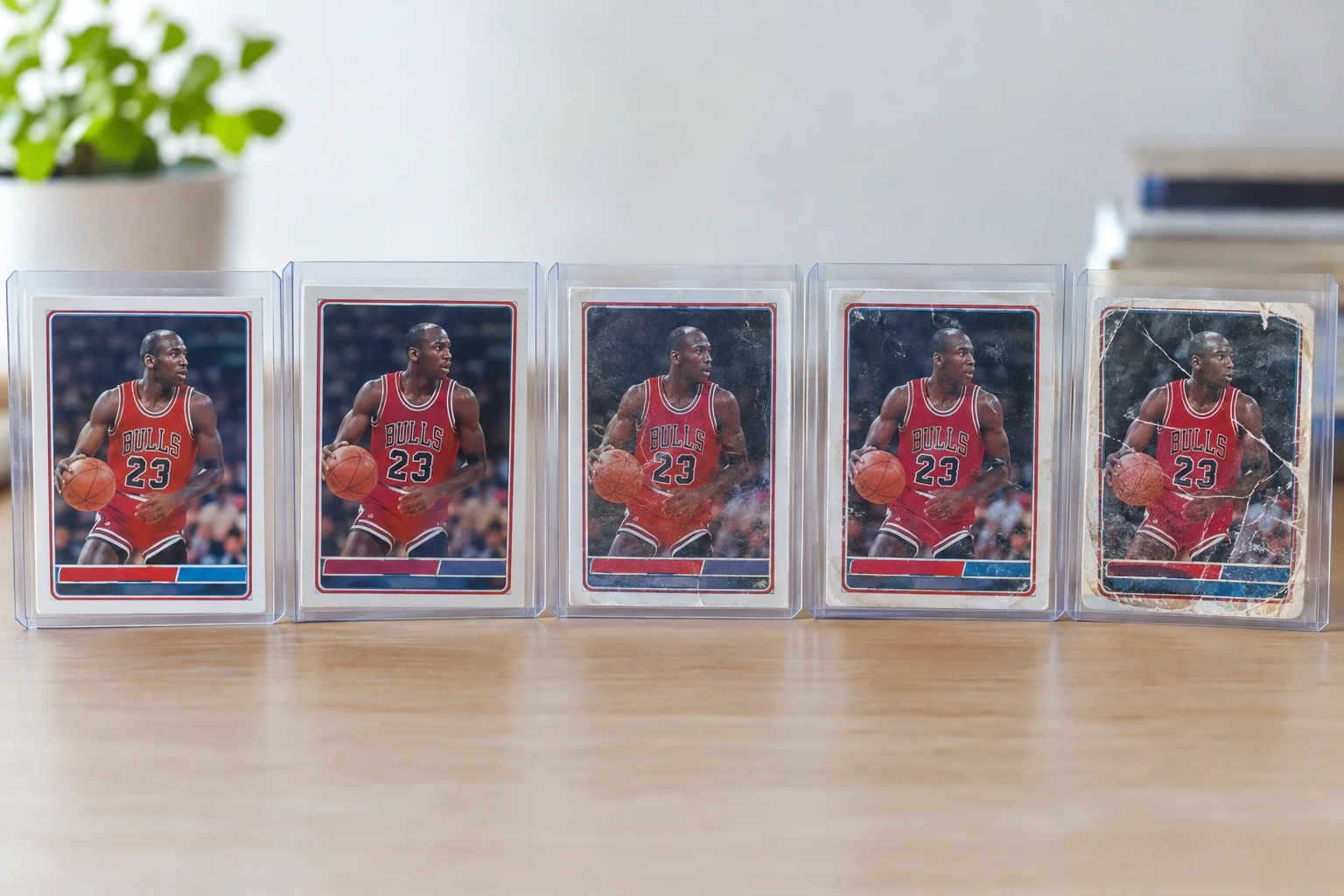
The Short Answer
- Near Mint (NM) is the standard for grading candidates — cards with no visible wear under normal lighting, the baseline for PSA 8-10 submissions.
- Condition directly affects value — a NM card is worth 2-5x a Lightly Played card of the same printing.
- TCGplayer and eBay use different condition terms — TCGplayer uses NM/LP/MP/HP/Damaged; eBay uses Pristine/NM/LP/MP/HP/Poor.
- PSA 10 requires 55/45 centering or better — even perfect surface and corners cannot overcome bad centering.
- Surface defects are the #1 reason modern cards do not grade PSA 10 — scratches, print lines, and marks that are invisible to the naked eye.
- Always evaluate under magnification — a 10x jeweler's loupe reveals corner fuzzing and edge wear invisible to the naked eye.
- Condition is the floor; grading is the ceiling — a card in Damaged condition will never grade above PSA 3-4, no matter how rare.
Why Card Condition Matters
Card condition is the single most important factor in a trading card's value after rarity and demand. A Near Mint Charizard is worth 2-5x a Lightly Played Charizard of the same printing. A PSA 10 is worth 10-50x a PSA 8. Understanding condition is not just for graders — it is essential for every collector who buys, sells, or trades cards.
The condition of a card affects three things: its market value, its eligibility for professional grading, and its desirability to collectors. A card in Damaged condition may still be collectible for rarity or nostalgia reasons, but it will never command the price of the same card in Near Mint condition. And if you are considering professional grading, condition determines whether the grading fee is worth paying.
The standard condition scale used by TCGPlayer, eBay, and most marketplaces runs from Near Mint (best) to Damaged (worst), with Lightly Played, Moderately Played, and Heavily Played in between. Each level has specific criteria that determine where a card falls. This guide walks through each level with the exact criteria you should check.
Near Mint (NM) — The Gold Standard
Near Mint is the condition that every collector wants and every grader hopes to see. A NM card shows no visible wear under normal lighting conditions. It looks like it just came out of the pack, with only the most minor imperfections that are visible only under close inspection or magnification.
Criteria for Near Mint
- Corners: Sharp and crisp. No whitening, fuzzing, or rounding visible to the naked eye. Under 10x magnification, there may be the faintest hint of wear on one corner, but it is not visible without magnification.
- Edges: Clean and smooth. No chipping, fraying, or whitening. Dark-bordered cards (like Pokemon reverse holos or MTG black borders) should show no white edge wear.
- Surface: Clean and glossy. No scratches, scuffs, print lines, or marks. The original gloss is fully intact. Holo patterns are clean and consistent.
- Centering: 60/40 or better on all four sides. The borders are visually balanced. Not perfectly centered, but close enough that the imbalance is not the first thing you notice.
- Overall: The card looks pack-fresh. A casual observer would not identify any flaws. Only careful inspection reveals minor imperfections.
Near Mint is the baseline condition for grading candidates. If your card does not meet NM criteria, it is unlikely to grade PSA 8 or higher, and the grading fee may not be worth paying. Use PreGradeCards AI to scan your NM candidates and get a predicted grade before submitting.
Lightly Played (LP)
Lightly Played cards show minor wear that is visible under normal inspection but does not significantly detract from the card's appearance. These are cards that have been handled, played, or stored without perfect protection but are still in good collectible condition.
Criteria for Lightly Played
- Corners: Slight wear visible on one or more corners. Minor whitening or fuzzing that is visible without magnification but is not severe. The corner is still relatively sharp.
- Edges: Minor edge wear. Light whitening on dark-bordered cards, particularly on the back edges. Small nicks or fraying that does not run along the entire edge.
- Surface: A few light scratches or scuffs visible under angled light. The gloss is mostly intact but may have minor dulling in small areas. No major scratches or print defects.
- Centering: 70/30 or better. The card may be noticeably off-center, but not dramatically so.
- Overall: The card looks handled but cared for. A collector would describe it as "has some wear but still looks good."
LP cards are typically worth 50-70% of NM value. They are still desirable for collectors who want a specific card but cannot afford or find a NM copy. LP cards can still be worth grading if they are rare or vintage — a LP 1999 Base Set Charizard is still a valuable card, even if it would not grade PSA 10.
Moderately Played (MP)
Moderately Played cards show visible wear that is immediately apparent. These are cards that have been played regularly without sleeves or stored in less-than-ideal conditions. They are still collectible but are clearly not in pristine condition.
Criteria for Moderately Played
- Corners: Visible whitening or rounding on multiple corners. The wear is obvious without magnification. Corners may show "touch" damage from being handled.
- Edges: Noticeable whitening along edges, particularly on the back. Fraying or chipping may be present. Edge wear is visible along a significant portion of the card.
- Surface: Multiple scratches or scuffs visible under normal lighting. The gloss is partially worn. May have minor creasing or bending. Print lines or factory defects may be present.
- Centering: 80/20 or worse. The card is noticeably off-center, which may be the first thing a viewer notices.
- Overall: The card shows its age and use. It is not damaged, but it is clearly not fresh from the pack.
MP cards are typically worth 25-40% of NM value. They are appropriate for collectors who want a card for gameplay, nostalgia, or set completion and do not care about condition. MP cards are generally not worth grading unless they are extremely rare or vintage.
Heavily Played (HP)
Heavily Played cards show significant wear and damage. They have been played extensively, stored poorly, or both. The card is still intact and identifiable, but its condition is poor.
Criteria for Heavily Played
- Corners: Significant whitening, rounding, or fraying on all corners. May have visible dents or bends. Corners are clearly worn.
- Edges: Heavy whitening, chipping, or fraying along all edges. The edge wear is severe and immediately visible.
- Surface: Deep scratches, significant scuffing, or multiple creases. Gloss is largely worn away. May have water damage, staining, or discoloration. Holo pattern may be scratched or damaged.
- Centering: May be severely off-center, though centering is usually secondary to the other damage at this condition level.
- Overall: The card is visibly worn and damaged. It would not be displayed in a premium collection without explanation.
HP cards are typically worth 10-20% of NM value. They are mainly for gameplay purposes or for collectors who want a specific card at the lowest possible price. HP cards are not worth grading except in extraordinary cases of extreme rarity.
Damaged
Damaged cards have severe issues that go beyond normal wear. The card may be torn, heavily creased, water-damaged, or otherwise structurally compromised. It is still identifiable as a specific card, but its condition is poor enough that most collectors would not want it.
Criteria for Damaged
- Structural damage: Tears, heavy creases, missing pieces, or water damage that has warped the card
- Surface damage: Severe scratching, peeling, or delamination. The card surface may be separating from the card body.
- Discoloration: Significant fading, yellowing, or staining from water, sun, or chemical exposure
- Writing or marks: Permanent marker, pen, or other markings on the card face
- Overall: The card is in poor enough condition that its primary value is as a placeholder or gameplay token, not as a collectible.
Damaged cards are typically worth 5-10% of NM value, if that. They are generally not worth grading, selling, or trading unless the card is extraordinarily rare (e.g., a 1st Edition Base Set Charizard in Damaged condition still has value due to scarcity).
Condition vs PSA/BGS/CGC Grade Correlation
Understanding how marketplace conditions correlate with professional grades helps you decide which cards are worth submitting for grading. Here is the approximate mapping:
| Marketplace Condition | Likely PSA Range | Likely BGS Range | Likely CGC Range | Worth Grading? |
|---|---|---|---|---|
| Near Mint (NM) | 7-10 | 8-10 | 7-10 | Yes — if valuable enough |
| Lightly Played (LP) | 5-7 | 6-8 | 5-7 | Only if rare/vintage |
| Moderately Played (MP) | 3-5 | 4-6 | 3-5 | Rarely |
| Heavily Played (HP) | 1-3 | 1-4 | 1-3 | No (except extreme rarity) |
| Damaged | 1 or Authentic | 1 or Authentic | 1 or Authentic | No |
Note that these are approximate ranges. A NM card with perfect centering, corners, edges, and surface can grade PSA 10. The same NM card with 60/40 centering might grade PSA 8 or 9. The only way to know for sure is to pre-grade with AI or submit for professional grading.
For a deeper dive into PSA grading standards, read our PSA grading standards guide and our card defects visual guide.
How to Evaluate Your Own Cards
Evaluating card condition requires the right tools and a systematic approach. Here is the step-by-step process that professional graders and experienced collectors use:
Tools You Need
- 10x jeweler's loupe — for inspecting corners and edges under magnification
- Bright, indirect lighting — a window with daylight or two lamps at 45-degree angles
- A dark, matte surface — to place the card on for inspection
- Clean cotton gloves — to avoid adding fingerprints or oils
The 5-Point Inspection
- Centering first: Look at the borders. Compare top-to-bottom and left-to-right. Is the ratio 55/45 or better? 60/40? 70/30? Centering is the first thing to check because it is the most common reason cards do not grade PSA 10.
- Corners under magnification: Examine each of the four corners with your 10x loupe. Look for whitening, fuzzing, or rounding. Even microscopic fuzzing visible only under magnification will drop a card from PSA 10 to PSA 9.
- Edges under angled light: Tilt the card under your light source. Look for whitening, chipping, or fraying along all four edges. Dark-bordered cards show edge wear more clearly.
- Surface under raking light: Hold the card at a low angle to your light source so the light grazes the surface. This reveals scratches, print lines, and marks that are invisible under direct lighting. Surface defects are the #1 reason modern cards do not grade PSA 10.
- Holo pattern/texture: For holo and textured cards, examine the foil pattern under direct light. Look for scratches in the foil, print defects, or inconsistencies in the texture.
If you do not have a loupe or want a faster evaluation, PreGradeCards AI can analyze your card from a photo and provide predicted subgrades across centering, corners, edges, and surface — the same four pillars that PSA, BGS, and CGC evaluate.
Platform-Specific Condition Standards
Different marketplaces use slightly different condition scales. Here is how the major platforms compare:
TCGPlayer
TCGPlayer uses five conditions: Near Mint, Lightly Played, Moderately Played, Heavily Played, and Damaged. This is the standard scale used by most TCG sellers. TCGPlayer provides detailed condition guides for each game they support, with specific criteria for what qualifies as each level.
eBay
eBay uses a slightly different scale: Pristine, Near Mint, Lightly Played, Moderately Played, Heavily Played, and Poor. The "Pristine" category is eBay's equivalent of a grading candidate — a card that appears flawless and would likely grade PSA 9-10. eBay also uses "Poor" instead of "Damaged."
COMC (Check Out My Cards)
COMC uses a similar scale to TCGPlayer but adds numerical condition ratings. Cards are rated on a 1-10 scale that approximates PSA grading standards, with 10 being gem mint and 1 being poor.
Whatnot
Whatnot live auction sellers typically use the TCGPlayer scale. Because sales happen in real-time, buyers should ask the seller to show the card under good lighting before bidding. Condition disputes on Whatnot are common, so clear communication about condition before the sale is essential.
How Condition Affects Value
Condition is the second most important factor in card value after rarity. Here is how condition typically affects the price of a card, using a $100 NM card as an example:
| Condition | Typical Value | % of NM Value | Example ($100 NM card) |
|---|---|---|---|
| Near Mint (NM) | 100% | 100% | $100 |
| Lightly Played (LP) | 50-70% | 50-70% | $50-70 |
| Moderately Played (MP) | 25-40% | 25-40% | $25-40 |
| Heavily Played (HP) | 10-20% | 10-20% | $10-20 |
| Damaged | 5-10% | 5-10% | $5-10 |
For graded cards, the value differential is even more dramatic. A PSA 10 can be worth 10-50x a PSA 8 of the same card. This is why pre-screening before grading is so important — submitting a card that grades PSA 6 when you hoped for PSA 10 means you have spent $80 to potentially reduce the card's value. See our grading ROI guide for the complete break-even analysis.
The bottom line: condition matters at every level of the hobby. Whether you are buying, selling, trading, or grading, understanding condition helps you make better decisions and avoid overpaying. When in doubt, evaluate the card under good lighting with a 10x loupe, or use PreGradeCards AI for a quick condition assessment from your phone.
Frequently Asked Questions
What is the difference between Near Mint and Lightly Played?
How does card condition affect grading?
What is the most common reason a card does not grade PSA 10?
Do TCGPlayer and eBay use the same condition scale?
How can I evaluate my card's condition at home?
Is a Damaged card ever worth grading?
Sources & Further Reading
- PSA Grading Standards
- TCGPlayer Condition Guide
- PSA Grading Scale Explained | Legion Report
- Card Grading Complete Playbook | What The Slab
Marcus Chen has evaluated over 50,000 sports cards and TCG cards across PSA, BGS, SGC, and CGC standards. Before joining PreGradeCards, he worked as a submission specialist for a major grading company and trained collectors and dealers on condition assessment.
Create a free account and get 2 free credits — enough for 2 complete AI gradings with market pricing. No credit card required.
Sign Up Free →