The Short Answer
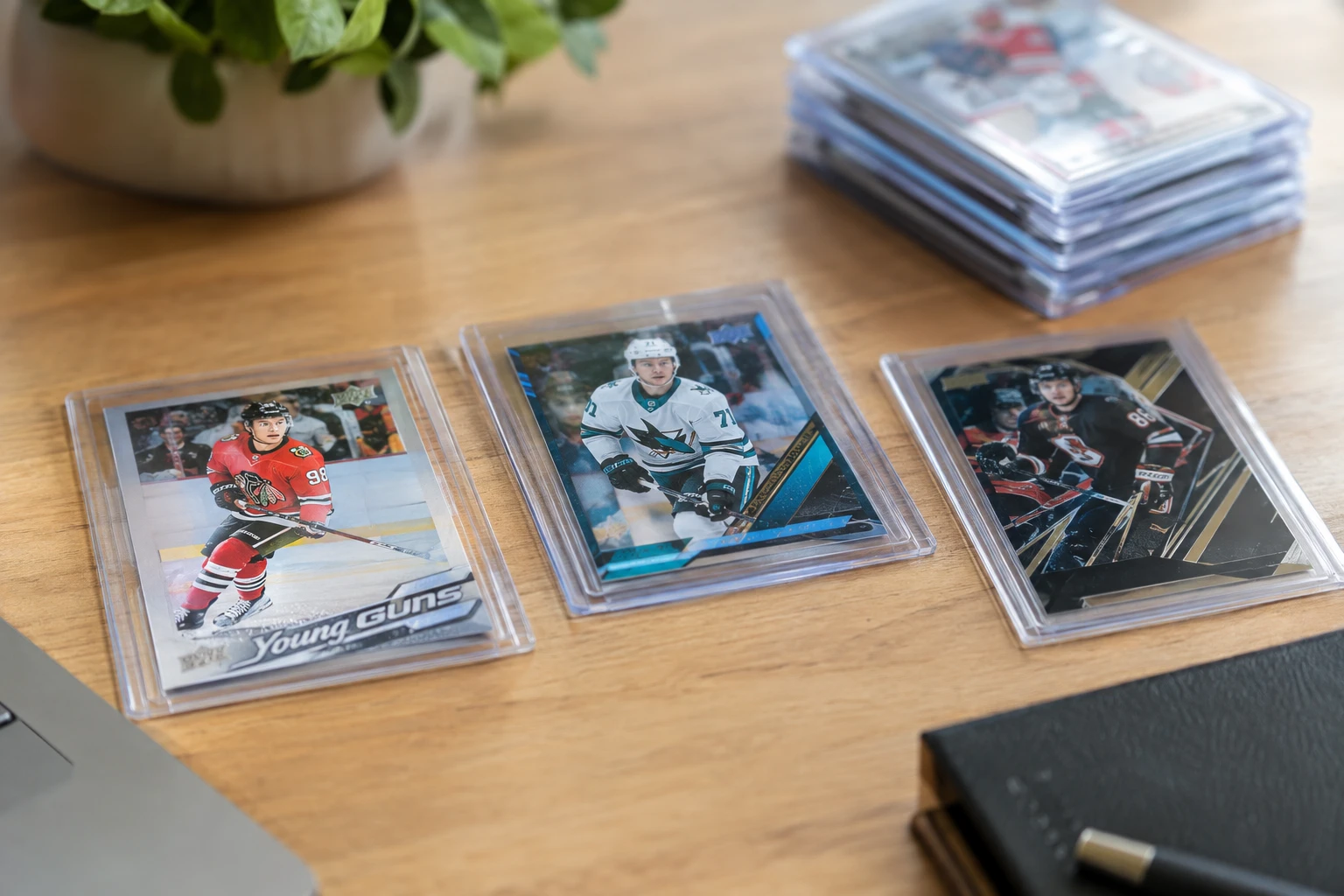
- Connor Bedard Young Guns from 2023-24 Upper Deck Series 1 remains the most valuable modern hockey card — PSA 10 reaching $300+.
- Macklin Celebrini and Matvei Michkov are the top 2025-26 rookie grading targets with growing collector demand.
- Young Guns are the hockey equivalent of rookie cards — the most collected and valuable base-level hockey cards.
- Upper Deck is the sole hockey card manufacturer — their exclusive NHL license creates controlled supply.
- SGC is recommended for vintage hockey while PSA is preferred for modern Young Guns and parallels.
- UD Black /100 and Exclusives /100 are the top serial-numbered parallel grading targets for modern hockey.
Hockey Card Grading in 2026: Young Guns, Bedard, and a Resurgent Market
Hockey card collecting is experiencing a renaissance in 2026. The 2025-26 Upper Deck Series 1 and Series 2 releases have introduced a new wave of Young Guns rookies, including Macklin Celebrini (San Jose Sharks), Matvei Michkov (Philadelphia Flyers), and Connor Bedard (Chicago Blackhawks) in his third-year cards. Upper Deck remains the sole NHL card manufacturer, giving them exclusive control over the hockey card market.
The hockey card grading market is driven by two main factors: the Young Guns rookie card phenomenon and the serial-numbered parallel market. Young Guns are the most collected hockey cards in existence — they are the base rookie cards from Upper Deck Series 1 and 2, and they serve as the foundational rookie cards for NHL players. A PSA 10 Young Guns of a star player can command 10–20x the raw value.
Why Hockey Cards Are a Grading Opportunity in 2026
- Connor Bedard phenomenon: The Chicago Blackhawks superstar is driving hockey card demand similar to Connor McDavid in 2017
- 2025-26 Young Guns class: Celebrini, Michkov, and other top rookies entering the grading market
- Upper Deck exclusive license: Controlled supply environment supports card values
- Growing international demand: European and Canadian collector base expanding
- Young Guns PSA scarcity: Even common Young Guns have low PSA 10 populations
- Vintage hockey appreciation: Gretzky, Lemieux, and Orr vintage cards continuing to appreciate
The Upper Deck Hockey Card System: Young Guns, Series, and Premium Products
Upper Deck's hockey card system is unique in the sports card market. Understanding the product structure is essential for making profitable grading decisions.
Upper Deck Hockey Product Lineup (2025-26)
| Product | Release | Key Feature | Grading Target |
|---|---|---|---|
| UD Series 1 | Nov 2025 | Young Guns rookies | Young Guns + parallels |
| UD Series 2 | Feb 2026 | More Young Guns rookies | Young Guns + parallels |
| UD Black Diamond | Dec 2025 | Premium parallels /100 | Ruby, Diamond parallels |
| UD Artifact | Jan 2026 | Serial-numbered parallels | All parallels of stars |
| UD SP Game Used | Mar 2026 | Memorabilia cards | Patch cards of stars |
| UD The Cup | Jun 2026 | Ultra-premium, RPA rookies | RPA, patch parallels |
| UD Premier | Sep 2026 | Autograph-focused | Auto parallels of stars |
| UD Allure | Oct 2026 | Affordable parallels | Star parallels |
The Young Guns Phenomenon
Young Guns are the rookie cards in Upper Deck Series 1 and Series 2. They are not labeled as "rookies" — they are base cards of first-year players. But the hockey card collecting community has designated Young Guns as the de facto rookie cards for NHL players. A player's Young Guns card is the most collected card of that player's career, and the PSA 10 premium reflects this collector demand.
For example, Connor Bedard's 2023-24 Upper Deck Series 1 Young Guns card has a raw value of approximately $30–$50, but a PSA 10 can reach $300+ — a 6–10x premium. This makes Young Guns one of the most profitable grading targets in the hockey card market.
Hockey Card Parallel Tiers Explained: From Exclusives to Printing Plates
Upper Deck hockey cards have an extensive parallel system. Understanding these tiers is essential for making profitable grading decisions.
Complete Upper Deck Hockey Parallel Hierarchy
| Parallel | Print Run | Typical Raw Value | Grade Worth It? |
|---|---|---|---|
| Base / Young Guns | Unlimited | $1–$50 | Yes — for star YG |
| Young Guns Update | Unlimited | $2–$30 | Yes — for stars |
| Exclusives | /100 | $10–$100 | Yes — if star |
| High Gloss | /10 | $30–$300+ | Yes — always |
| UD Black Diamond Ruby | /100 | $15–$150 | Yes — if star |
| UD Black Diamond Diamond | /50 | $30–$300+ | Yes — always |
| Printing Plates | /1 (4 plates) | $50–$500+ | Yes — always (1/1) |
| UD The Cup RPA | /249 or less | $100–$2,000+ | Yes — always |
The High Gloss /10 and Printing Plates /1 are the rarest and most valuable Upper Deck hockey parallels. The UD The Cup Rookie Patch Autographs (RPA) are the ultra-premium hockey cards — they combine a rookie card, a game-used patch, and an autograph in a single card, and they are the most valuable modern hockey cards in existence.
Top Hockey Cards to Grade: From Bedard to Gretzky
Hockey card grading targets span from modern Young Guns to vintage legends. Here are the top targets by player and era.
Modern Hockey Grading Targets
| Player | Key Cards | Raw Value | Grading Priority |
|---|---|---|---|
| Connor Bedard | 2023-24 UD S1 Young Guns | $30–$50 | ★★★★★ |
| Macklin Celebrini | 2025-26 UD S1 Young Guns | $15–$40 | ★★★★★ |
| Matvei Michkov | 2025-26 UD S1 Young Guns | $10–$30 | ★★★★☆ |
| Connor McDavid | 2015-16 UD YG, The Cup RPA | $50–$5,000+ | ★★★★★ |
| Auston Matthews | 2016-17 UD YG, The Cup RPA | $30–$1,000+ | ★★★★★ |
| Nathan MacKinnon | 2013-14 UD YG | $20–$300+ | ★★★★☆ |
| Sidney Crosby | 2005-06 UD YG, The Cup RPA | $100–$10,000+ | ★★★★★ |
| Cole Caufield | 2021-22 UD YG | $5–$50 | ★★★☆☆ |
Vintage Hockey Grading Targets
| Player | Key Cards | Raw Value | Grading Priority |
|---|---|---|---|
| Wayne Gretzky | 1979 O-Pee-Chee rookie | $1,000–$100,000+ | ★★★★★ |
| Mario Lemieux | 1985 O-Pee-Chee rookie | $200–$20,000+ | ★★★★★ |
| Bobby Orr | 1966 Topps rookie | $300–$30,000+ | ★★★★★ |
| Patrick Roy | 1986 O-Pee-Chee rookie | $50–$2,000+ | ★★★★☆ |
| Mark Messier | 1981 O-Pee-Chee rookie | $30–$1,000+ | ★★★★☆ |
The 1979 O-Pee-Chee Wayne Gretzky rookie card is the holy grail of hockey card collecting — a PSA 10 sold for $3.75 million in 2021. Vintage hockey cards from O-Pee-Chee (the Canadian version of Topps) are the primary vintage grading targets.
PSA vs BGS vs SGC for Hockey Cards: Which Grader Is Best?
The hockey card grading market has some specific preferences that differ from other sports.
PSA for Hockey
PSA commands the highest resale premium for hockey cards, particularly for Young Guns and vintage O-Pee-Chee cards. PSA Regular costs $79.99/card. For vintage hockey (pre-1990), PSA is the only recommended grader — their population report is the industry standard for vintage hockey values.
SGC for Hockey — Recommended for Vintage
SGC is an excellent option for vintage hockey cards (O-Pee-Chee, 1970s–1980s Topps). Their vintage sports expertise is well-suited to the older cardstock used in vintage hockey cards. SGC's slab design is favored by many vintage hockey collectors. SGC is generally more cost-effective than PSA.
BGS for Hockey
BGS is recommended for modern Upper Deck hockey cards where subgrades add value — particularly for UD Black Diamond parallels and The Cup RPA cards. BGS Express costs $79.95/card.
CGC for Hockey
CGC Economy at $15/card is the most affordable option for bulk grading of Young Guns and base parallels of star players.
| Grader | Tier | Cost | Best For |
|---|---|---|---|
| PSA | Regular | $79.99 | Young Guns of stars, vintage, $100+ parallels |
| SGC | Standard | $25–$40 | Vintage hockey — best value |
| BGS | Express | $79.95 | UD Black, The Cup RPA (subgrades) |
| CGC | Economy | $15 | Bulk Young Guns, base parallels |
AI Pre-Grading for Hockey Cards: Upper Deck Calibration
AI pre-grading for hockey cards uses Upper Deck cardstock calibration, shared with Upper Deck golf and other UD sports products. PreGradeCards achieves approximately 86% accuracy within ±1 PSA grade for modern Upper Deck hockey cards.
Upper Deck Hockey Card Characteristics
- Thick cardstock: Upper Deck uses thick, premium cardstock that provides excellent corner and edge protection
- Glossy surface: UD cards have a high-gloss surface that requires diffuse lighting for accurate AI analysis
- Consistent centering: Modern UD hockey cards have good centering (50/50 to 55/45 typical)
- Sharp corners: UD die-cutting produces sharp corners that are prone to dinging if not handled carefully
- Young Guns cardstock: Young Guns use the same cardstock as base UD cards — no special treatment
Cost Savings Example
Consider a collector with 10 Young Guns cards from 2025-26 UD Series 1 (mix of Celebrini, Michkov, and other rookies). Without AI pre-grading, submitting all 10 to PSA Regular ($79.99/card) costs $799.90 plus $25 shipping = $824.90.
With AI pre-grading at $0.19/card, screening all 10 costs $1.90. The AI identifies 6 cards with 60%+ PSA 10 probability. You submit only the 6 strong candidates to PSA: $479.94 + $25 = $504.94. You save $319.96. Net savings: $318.06.
For lower-value Young Guns (non-star rookies), use CGC Economy ($15/card) instead of PSA Regular to keep grading fees proportionate to card value.
Upper Deck Cardstock and Centering: What to Check
Modern Upper Deck hockey cards generally have good centering quality. Vintage O-Pee-Chee and Topps cards have significantly more variation.
Centering Quality by Era
| Era | Typical Centering | Est. PSA 10 Rate |
|---|---|---|
| 1950s-60s Topps | 65/35 to 80/20 | ~10% |
| 1970s-80s O-Pee-Chee | 60/40 to 70/30 | ~20% |
| 1990s Upper Deck | 55/45 to 60/40 | ~45% |
| 2000s-2010s UD | 50/50 to 55/45 | ~60% |
| 2025-26 UD | 50/50 to 55/45 | ~62% |
Vintage hockey cards (1950s-1980s) have extremely poor centering, making PSA 10 copies extraordinarily rare and valuable. A 1979 O-Pee-Chee Gretzky rookie in PSA 10 is one of the rarest and most valuable cards in the entire hobby — only a handful are known to exist.
Common Upper Deck Hockey Card Issues
- Gloss surface scratches: The high-gloss surface is prone to micro-scratches from pack handling
- Corner dinging: Sharp UD corners are fragile and prone to dinging during pack collation
- Print lines: Some UD print runs have visible print lines under direct light
- Serial number clarity: For serial-numbered parallels, verify the serial number is clearly legible
Hockey Card Grading ROI Calculator
Here are worked ROI examples for modern and vintage hockey cards.
Worked Example 1: Connor Bedard Young Guns ($40 raw)
P(10) = 60% (modern UD quality)
P(9) = 30%
P(≤8) = 10%
PSA 10 value = $300 (7.5x raw)
PSA 9 value = $80
PSA 8 value = $45
Grading fee (PSA) = $79.99
Expected Value = (0.60 × $300) + (0.30 × $80) + (0.10 × $45) = $180 + $24 + $4.50 = $208.50
Net ROI = $208.50 − $79.99 − $3 − (13.25% × $208.50) = $208.50 − $82.99 − $27.63 = $97.88
Profit = $97.88 − $40 = $57.88 (145% return)
The Bedard Young Guns is a highly profitable PSA submission. The 7.5x PSA 10 premium for the most collected hockey rookie card of the current era justifies the $79.99 PSA fee. For lower-value Young Guns, use CGC Economy ($15) instead.
Worked Example 2: Macklin Celebrini Young Guns ($25 raw, CGC)
P(10) = 60%
PSA 10 value = $125 (5x raw)
Grading fee (CGC) = $15
Expected Value = (0.60 × $125) + (0.30 × $40) + (0.10 × $28) = $75 + $12 + $2.80 = $89.80
Net ROI = $89.80 − $15 − $3 − (13.25% × $89.80) = $89.80 − $18 − $11.90 = $59.90
Profit = $59.90 − $25 = $34.90 (140% return)
Using CGC Economy for the Celebrini Young Guns is also highly profitable. The 5x PSA 10 premium and the low $15 CGC fee create strong ROI. As Celebrini's career develops, the PSA 10 value of his Young Guns will increase.
Complete AI Pre-Grading Workflow for Hockey Cards
Follow this step-by-step workflow to maximize your hockey card grading ROI.
Step 1: Sort by Player Significance and Card Type
Pull all Young Guns of star players (Bedard, Celebrini, Michkov, McDavid, Matthews, Crosby), serial-numbered parallels of stars, and vintage rookie cards of legends (Gretzky, Lemieux, Orr). Set aside base cards of non-star players.
Step 2: For Vintage Cards — Careful Condition Assessment
Vintage O-Pee-Chee and Topps cards require especially careful pre-grading:
- Check centering — vintage centering is often 60/40 or worse
- Check for creasing — vintage cards are prone to creasing
- Check for paper loss — vintage cardstock can lose surface paper from handling
- For Gretzky/Lemieux/Orr rookies, submit even at 15% PSA 10 probability — the potential value justifies the risk
Step 3: For Modern Cards — Standard Pre-Grading
- Check centering (typically 50/50 to 55/45)
- Check gloss surface for micro-scratches under raking light
- Check corners for dinging
- Check serial number clarity on parallel cards
Step 4: Photograph for AI Analysis
Take front and back photos: diffuse lighting (essential for UD glossy surface), 90-degree overhead angle, dark background, 300+ DPI. For vintage cards, use 400+ DPI.
Step 5: Upload to PreGradeCards AI
Upload each card to PreGradeCards AI grading and receive your pre-grade report.
Step 6: Match Grader to Card Era and Value
- PSA Regular ($79.99): Star Young Guns, vintage rookies, $100+ parallels
- SGC Standard ($25–$40): Vintage hockey — best value
- BGS Express ($79.95): UD Black Diamond, The Cup RPA (subgrades)
- CGC Economy ($15): Young Guns of mid-tier rookies, base parallels
Step 7: Package, Ship, Track, and Sell
Package in penny sleeves and semi-rigid holders. Ship via USPS Priority Mail with insurance. Vintage Gretzky/Lemieux/Orr PSA 10s should be held for long-term appreciation. Modern star Young Guns PSA 10s can be sold immediately or held depending on the player's career trajectory. Bedard and Celebrini Young Guns PSA 10s are likely to appreciate as these players build their legacies.
Frequently Asked Questions
Are hockey cards worth grading?
What are Young Guns in hockey cards?
What is the most valuable hockey card to grade?
Should I use PSA or SGC for hockey cards?
How does AI grading work for hockey cards?
Who are the best modern hockey players to collect and grade?
Sources & Further Reading
- Connor Bedard Young Guns Values — Sports Cards Pro
- 2025-26 Upper Deck Series 1 Checklist — Cardboard Connection
- Vintage Hockey Card Price Guide — PSA Card Facts
- Hockey Card Market Trends 2026 — Sports Card Investor
- AI Hockey Card Grading — PreGradeCards
Marcus Chen has evaluated over 50,000 sports cards and TCG cards across PSA, BGS, SGC, and CGC standards. Before joining PreGradeCards, he worked as a submission specialist for a major grading company and trained collectors and dealers on condition assessment.
Create a free account and get 1 free credit — enough for 1 complete AI grading with market pricing. No credit card required.
Sign Up Free →