The Short Answer
- Tiger Woods Deluxe /250 PSA 10 reaches $155 — the highest-value modern golf card in 2026.
- 2026 Upper Deck Golf has 1,394 cards across 88 players including Tiger Woods, Annika Sorenstam, Nelly Korda, and Rose Zhang.
- Parallel tiers matter enormously — Tiger Woods base PSA 10 is $39, Deluxe /250 PSA 10 is $155, Exclusive /100 PSA 10 is $261.
- SGC is a strong option for golf cards — their vintage sports expertise translates well to golf, and SGC 10s carry respectable premiums.
- Golf card PSA populations are very low — most 2026 Upper Deck cards have zero PSA 10s, creating ground-floor grading opportunity.
- Women's golf cards are undervalued — Annika Sorenstam, Nelly Korda, and Rose Zhang cards have growing collector demand but minimal grading competition.
Golf Card Grading in 2026: A Surging Sport With Zero Grading Coverage
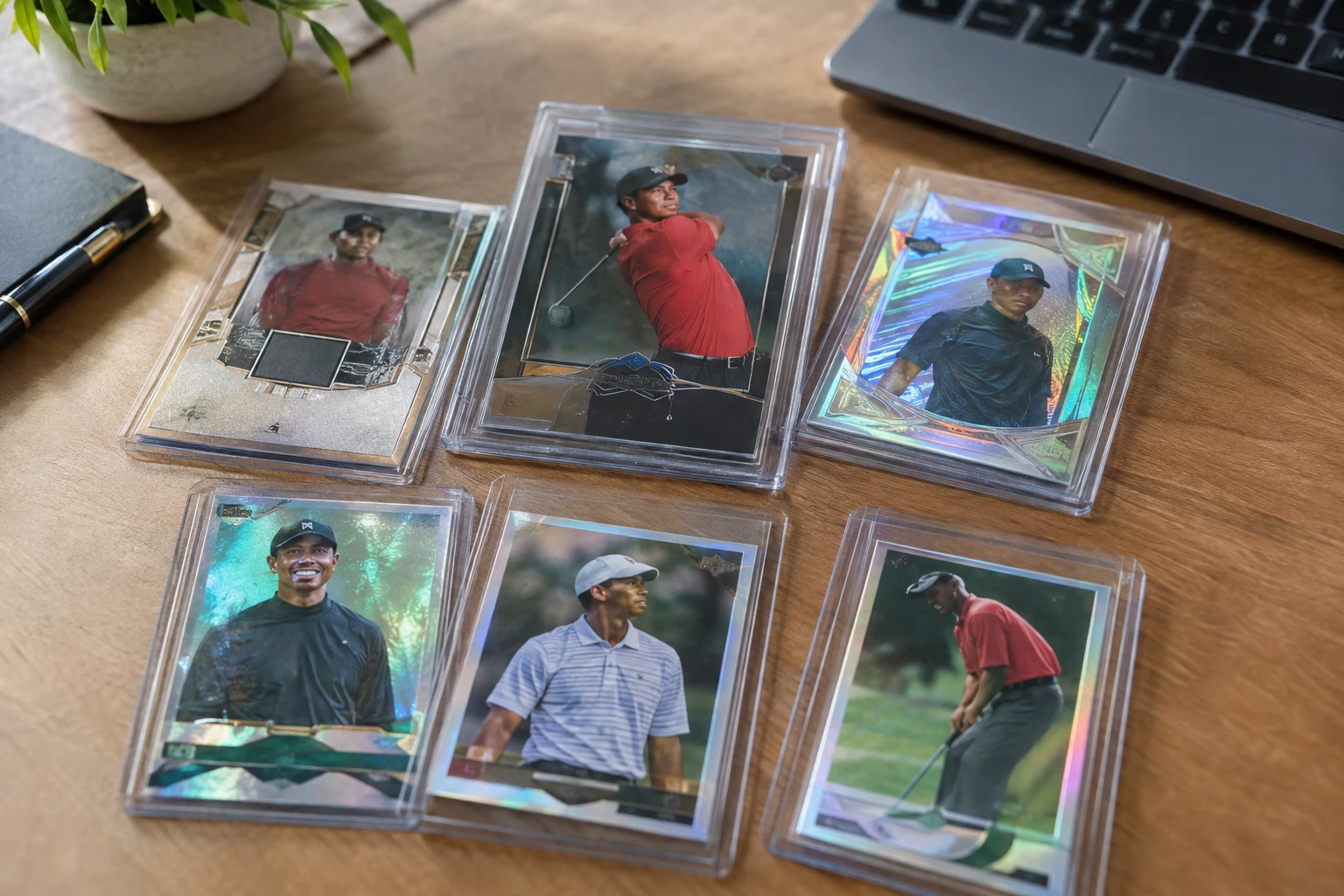
Golf card collecting is experiencing a renaissance in 2026. Upper Deck, the primary golf card manufacturer, has expanded its 2026 Golf release to include 1,394 cards across 88 players — including legends like Tiger Woods and Annika Sorenstam, current stars like Collin Morikawa and Nelly Korda, and rising talents like Rose Zhang. The 2026 Upper Deck Allure subset adds premium parallel treatments that are driving new collector interest.
Despite this growth, golf card grading has almost no dedicated coverage from grading guides or AI pre-grading services. The golf card market is small compared to baseball or basketball, but it is growing rapidly — and the PSA 10 populations for most golf cards are extremely low. This creates a ground-floor opportunity for collectors who grade golf cards now.
Sports Cards Pro tracks Tiger Woods cards from 2026 Upper Deck with the following PSA 10 values: Tiger Woods base #1 PSA 10 at $39, Tiger Woods Green PSA 10 at $46, Tiger Woods Deluxe /250 PSA 10 at $155, and Tiger Woods Exclusive /100 PSA 10 at $261. The PSA population for most of these cards shows zero or near-zero graded copies.
Why Golf Cards Are a Grading Opportunity
- Extremely low PSA populations: Most 2026 Upper Deck golf cards have zero PSA 10s — the first graded copies will command scarcity premiums
- Tiger Woods retirement speculation: As Woods' career winds down, demand for his cards is increasing among sports card investors
- Growing women's golf interest: Nelly Korda, Rose Zhang, and Annika Sorenstam cards are gaining collector attention
- Upper Deck exclusive license: Upper Deck is the sole golf card manufacturer, creating a controlled supply environment
- Cross-sport collector migration: Baseball and basketball collectors are diversifying into golf, bringing grading culture with them
- 2026 Upper Deck Allure: New premium parallel treatments create fresh grading targets with higher raw values
Golf Card Parallel Tiers Explained: From Base to High Gloss /10
Upper Deck golf cards use a parallel tier system similar to their hockey products. Understanding these tiers is essential for making profitable grading decisions, as the parallel tier directly determines raw value and PSA 10 premium potential.
Complete Upper Deck Golf Parallel Hierarchy (2026)
| Parallel | Print Run | TW Raw Value | TW PSA 10 | Grade Worth It? |
|---|---|---|---|---|
| Base | Unlimited | $1.75 | $39 | Only for star rookies |
| Green | Unlimited | $3.59 | $46 | Only for star rookies |
| Deluxe | /250 | $27.63 | $155 | Yes — if star player |
| Exclusive | /100 | $51.50 | $261 | Yes — always for stars |
| High Gloss | /10 | $0.99+ | Unknown | Yes — extreme scarcity |
| Retrospective Rookie | Varies | TBD | TBD | Yes — if star rookie |
| Outburst RR | Varies | TBD | TBD | Yes — if star rookie |
| Acclaimed Alumni | Varies | TBD | TBD | Yes — for legends |
The parallel tier has an enormous impact on PSA 10 value. Tiger Woods base PSA 10 is $39, but the Deluxe /250 PSA 10 jumps to $155 — a 4x premium for the same card in a serial-numbered parallel. The Exclusive /100 PSA 10 reaches $261, a 6.7x premium over base. This means grading decisions should prioritize serial-numbered parallels over base cards.
The High Gloss /10 Tier
The High Gloss /10 is the rarest parallel in 2026 Upper Deck Golf. With only 10 copies of each card in existence, the scarcity is extreme. The current raw value for Tiger Woods High Gloss /10 is listed at $0.99 — but this is almost certainly due to lack of recent sales data rather than actual market value. A High Gloss /10 Tiger Woods in PSA 10 could easily command $500–$1,000+ given the extreme scarcity. If you pull one, grade it immediately.
Top Golf Cards to Grade: Tiger Woods, Legends, and Rising Stars
Based on Sports Cards Pro market data and eBay sold comps, these are the highest-value golf cards that warrant professional grading in 2026.
Tiger Woods — The Grading King of Golf
Tiger Woods is the single most valuable player in golf card collecting. His 2026 Upper Deck cards span multiple parallel tiers, each with different grading ROI:
| Card | Raw | PSA 9 | PSA 10 | BGS 10 | ROI |
|---|---|---|---|---|---|
| TW Base #1 | $1.75 | $13 | $39 | $51 | ★★☆☆☆ |
| TW Green #1 | $3.59 | $16 | $46 | N/A | ★★☆☆☆ |
| TW Deluxe /250 | $27.63 | $53 | $155 | $255 | ★★★★☆ |
| TW Exclusive /100 | $51.50 | $91 | $261 | N/A | ★★★★★ |
| TW High Gloss /10 | $0.99+ | N/A | $500+ (est.) | N/A | ★★★★★ |
| TW Allure #1 | $1.75 | $13 | $39 | N/A | ★★☆☆☆ |
The Deluxe /250 and Exclusive /100 are the strongest grading targets for Tiger Woods. The 5.6x PSA 10 premium on the Deluxe /250 ($27.63 → $155) and the 5.1x premium on the Exclusive /100 ($51.50 → $261) make these highly profitable grading submissions.
Other Players Worth Grading
- Annika Sorenstam: Women's golf legend. Her Deluxe and Exclusive parallels are undervalued and have minimal PSA competition.
- Nelly Korda: Current women's golf star. Growing collector demand, especially for serial-numbered parallels.
- Rose Zhang: Rising star with strong rookie card demand. Her Retrospective Rookie cards are prime grading targets.
- Collin Morikawa: Major champion with consistent collector interest. Deluxe /250 and above are worth grading.
- Hideki Matsuyama: Japanese golf star with strong international collector base. Serial-numbered parallels have cross-market demand.
- Tony Finau: Popular PGA Tour player. Deluxe parallels above $20 raw are worth grading.
- Lexi Thompson: Women's golf star with dedicated collector following.
- Charley Hull: Rising women's golf star with growing card demand.
- John Daly: Cult figure with nostalgic collector appeal. His Acclaimed Alumni cards are worth grading.
PSA vs BGS vs SGC for Golf Cards: Which Grader Is Best?
Golf cards have some unique grading considerations compared to other sports cards. The choice of grading company depends on the card value and the collector's priorities.
PSA for Golf Cards
PSA is the market leader for sports card grading and commands the highest resale premium for golf cards. A PSA 10 Tiger Woods Deluxe /250 sells for $155, compared to $23 for SGC 10 and $23 for CGC 10. PSA's dominance in the sports card market makes it the safest choice for maximizing resale value. PSA Regular costs $79.99/card.
BGS for Golf Cards
Beckett (BGS) is particularly strong for golf cards because BGS 10 Black labels (perfect 10 subgrades) command extraordinary premiums. Tiger Woods Base #1 BGS 10 Black is valued at $255 — 6.5x the PSA 10 value of $39. For collectors who believe their card has perfect subgrades, BGS offers the highest potential upside. BGS Express costs $79.95/card.
SGC for Golf Cards
SGC has deep expertise in vintage sports cards and their grading translates well to golf. SGC 10 Tiger Woods Base is $23 — lower than PSA 10 ($39) but still respectable. SGC is the most cost-effective option for lower-value golf cards where the grading fee needs to stay low. SGC's turnaround times are also generally faster than PSA.
CGC for Golf Cards
CGC 10 Tiger Woods Base is $23, similar to SGC. CGC Economy at $15/card is the most affordable option. CGC 10 Pristine is slightly higher at $41, approaching PSA 10 levels.
| Grader | Tier | Cost | TW Base 10 Value | Best For |
|---|---|---|---|---|
| PSA | Regular | $79.99 | $39 | Max resale — all star cards |
| BGS | Express | $79.95 | $51 (10 Black: $255) | Perfect subgrade potential |
| SGC | Standard | $25–$40 | $23 | Cost-effective for mid-value |
| CGC | Economy | $15 | $23 (Pristine: $41) | Budget option |
The BGS 10 Black Opportunity
The BGS 10 Black label (all four subgrades at 10) is the rarest and most valuable grade in the card collecting hobby. For Tiger Woods Base #1, a BGS 10 Black is worth $255 — compared to $51 for a standard BGS 10 and $39 for a PSA 10. If you have a pack-fresh Tiger Woods card that appears flawless in all four subgrade categories (centering, corners, edges, surface), submitting to BGS for the chance at a 10 Black label offers the highest potential return.
AI Pre-Grading for Golf Cards: Upper Deck Calibration
AI pre-grading for golf cards uses Upper Deck cardstock calibration, which is shared with Upper Deck hockey and other Upper Deck sports products. PreGradeCards achieves approximately 86% accuracy within ±1 PSA grade for Upper Deck golf cards.
Upper Deck Cardstock Characteristics
Upper Deck uses a distinctive cardstock that is slightly different from Topps and Panini products:
- Thicker stock: Upper Deck cards tend to be on thicker stock than Topps, providing better corner protection
- Glossy surface: Upper Deck cards have a high-gloss surface that can create reflection artifacts in photography — use diffuse lighting
- Consistent centering: Upper Deck has generally good centering quality (50/50 to 55/45 typical for 2026 Golf)
- Sharp corner cuts: Upper Deck die-cutting produces sharp corners that are prone to dinging if not handled carefully
How AI Analyzes Golf Cards
The AI grading process for golf cards follows the standard four-criteria framework:
- Centering: Measures all four border widths and calculates centering ratios. For PSA 10, front centering must be 55/45 or better.
- Corners: Inspects all four corners for whitening, dinging, or rounding. Upper Deck's sharp corner cuts make this check especially important.
- Edges: Examines all four edges for chipping and whitening. The high-gloss surface can make edge whitening more visible.
- Surface: Detects scratches, print lines, and gloss defects. The glossy surface requires diffuse lighting for accurate analysis.
Cost Savings Example
Consider a collector with 8 Tiger Woods cards from various 2026 Upper Deck parallels (base, Green, Deluxe, Exclusive). Without AI pre-grading, submitting all 8 to PSA Regular ($79.99/card) costs $639.92 plus $25 shipping = $664.92. If 3 come back PSA 9 instead of PSA 10, the grading premium on those 3 may not cover fees.
With AI pre-grading at $0.19/card, screening all 8 costs $1.52. The AI identifies 5 cards with 65%+ PSA 10 probability. You submit only the 5 strong candidates: $399.95 + $25 = $424.95. You save $239.97 and avoid 3 likely sub-10 returns. Net savings: $238.45.
For lower-value cards (base and Green parallels), consider CGC Economy ($15/card) or SGC instead of PSA Regular to keep grading fees proportionate to card value.
Upper Deck Cardstock and Centering: What to Check Before Grading
Upper Deck 2026 Golf cards generally have good centering quality, with typical centering of 50/50 to 55/45. However, there are some specific issues to watch for.
Common Upper Deck Golf Card Issues
- Gloss surface scratches: The high-gloss surface on Upper Deck cards is prone to micro-scratches from handling. Even pack-fresh cards can have surface scratches from the card rubbing against the pack wrapper.
- Corner dinging: Upper Deck's sharp corner cuts look beautiful but are fragile. Cards that shift inside packs during shipping can develop corner dings.
- Print lines: Some Upper Deck print runs have visible print lines that are only visible under direct light. Always check under raking light before submitting.
- Serial number clarity: For serial-numbered parallels (Deluxe /250, Exclusive /100, High Gloss /10), the serial number must be clearly legible. A faded or smudged serial number can reduce the card's value and the grading premium.
How to Check Golf Card Surface at Home
- Hold the card under direct overhead light at arm's length
- Tilt the card slowly to check for surface scratches catching the light
- Look for print lines running across the card surface
- Check the serial number (if applicable) for clarity and completeness
- Examine all four corners under magnification for whitening
- If any issues are found, AI pre-grade to get a professional-grade assessment before committing to grading fees
Women's Golf Cards: The Undervalued Grading Opportunity
Women's golf cards represent one of the most undervalued segments in the sports card market. Players like Annika Sorenstam (legend), Nelly Korda (current star), Rose Zhang (rising talent), Lexi Thompson, and Charley Hull all have cards in 2026 Upper Deck Golf — but their PSA populations are even lower than the men's cards, and their collector demand is growing.
Why Women's Golf Cards Are a Grading Opportunity
- Extremely low PSA populations: Most women's golf cards have zero PSA 10s — the first graded copies will be population-1
- Growing women's sports card market: Women's basketball (Caitlin Clark, Angel Reese) has shown that women's sports cards can command premium values
- International collector demand: Players like Nelly Korda and Rose Zhang have global recognition, driving international collector interest
- Lower raw prices = higher grading ROI: Women's golf cards often have lower raw prices than men's, meaning the PSA 10 premium as a percentage is higher
- Annika Sorenstam legend status: As one of the greatest female golfers ever, her cards have long-term collector value
Top Women's Golf Cards to Grade
- Annika Sorenstam Deluxe /250: Legend status + serial number = strong grading target
- Nelly Korda Exclusive /100: Current star with growing collector base
- Rose Zhang Retrospective Rookie: Rising star with rookie card premium potential
- Lexi Thompson Deluxe /250: Established LPGA star
- Charley Hull Deluxe /250: European star with international demand
The strategy for women's golf cards is to grade serial-numbered parallels of established stars and rookies. The lower raw prices mean you can afford to use PSA Regular ($79.99) for Exclusive /100 cards or CGC Economy ($15) for Deluxe /250 cards, with strong ROI potential as the women's sports card market continues to grow.
Golf Card Grading ROI Calculator: The Math Behind Profitable Submissions
Here is the ROI formula with a worked example for a Tiger Woods Deluxe /250.
Worked Example: Tiger Woods Deluxe /250 ($27.63 raw)
| Variable | Value |
|---|---|
| Raw card cost | $27.63 |
| P(10) from AI | 60% |
| P(9) from AI | 30% |
| P(≤8) | 10% |
| PSA 10 value | $155 |
| PSA 9 value | $53 |
| PSA 8 value | $30 |
| Grading fee (PSA) | $79.99 |
| Shipping | $3 |
| Selling fee | 13.25% |
Expected Value = (0.60 × $155) + (0.30 × $53) + (0.10 × $30) = $93 + $15.90 + $3 = $111.90
Net ROI = $111.90 − $79.99 − $3 − (13.25% × $111.90) = $111.90 − $82.99 − $14.83 = $14.08
Profit = $14.08 − $27.63 = -$13.55 (LOSS with PSA Regular)
At $27.63 raw, PSA Regular at $79.99 is too expensive — the grading fee eats all the premium. Instead, use CGC Economy at $15/card:
Net ROI (CGC) = $111.90 − $15 − $3 − (13.25% × $111.90) = $111.90 − $18 − $14.83 = $79.07
Profit = $79.07 − $27.63 = $51.44 (186% return with CGC Economy)
The lesson: match the grading tier to the card value. For Tiger Woods Deluxe /250 ($27.63 raw), CGC Economy at $15/card is highly profitable. PSA Regular at $79.99 is not. For the Exclusive /100 ($51.50 raw, PSA 10 $261), PSA Regular becomes profitable due to the higher PSA 10 value.
Worked Example: Tiger Woods Exclusive /100 ($51.50 raw, PSA Regular)
Expected Value = (0.60 × $261) + (0.30 × $91) + (0.10 × $55) = $156.60 + $27.30 + $5.50 = $189.40
Net ROI = $189.40 − $79.99 − $3 − (13.25% × $189.40) = $189.40 − $82.99 − $25.10 = $81.31
Profit = $81.31 − $51.50 = $29.81 (58% return with PSA Regular)
At $51.50 raw and $261 PSA 10 value, PSA Regular is profitable. The 5.1x PSA 10 premium justifies the higher grading fee.
Complete AI Pre-Grading Workflow for Golf Cards
Follow this step-by-step workflow to maximize your golf card grading ROI.
Step 1: Sort by Player and Parallel Tier
Pull all Tiger Woods cards, star player cards (Sorenstam, Korda, Zhang, Morikawa), and serial-numbered parallels (/250, /100, /10) from your 2026 Upper Deck Golf collection. Set aside base and Green parallels of non-star players — these are rarely worth grading.
Step 2: Check Serial Number Clarity
For serial-numbered parallels, verify the serial number is clearly legible and undamaged. A smudged or faded serial number reduces both the card's value and the grading premium.
Step 3: Home Surface Check
Perform the home surface check: hold under direct overhead light, tilt to check for scratches, look for print lines. Upper Deck's glossy surface makes scratches particularly visible under raking light.
Step 4: Photograph for AI Analysis
Take front and back photos: diffuse lighting (ring light or softbox — essential for Upper Deck's glossy surface), 90-degree overhead angle, dark background, 300+ DPI.
Step 5: Upload to PreGradeCards AI
Upload each card to PreGradeCards AI grading and receive your pre-grade report with PSA 10 probability, subgrades, and defect identification.
Step 6: Match Grader to Card Value
- CGC Economy ($15/card): Cards $5–$50 raw (Deluxe /250, star base cards)
- PSA Regular ($79.99/card): Cards $50+ raw (Exclusive /100, High Gloss /10)
- BGS Express ($79.95/card): Cards you believe have perfect subgrades (BGS 10 Black potential)
- SGC Standard ($25–$40/card): Mid-value cards where PSA is too expensive but CGC is too budget
Step 7: Package, Ship, Track, and Sell
Package in penny sleeves and semi-rigid holders. Ship via USPS Priority Mail with insurance. Once graded cards return, check PSA/CGC population reports. With golf card PSA populations at near-zero for most 2026 Upper Deck cards, your PSA 10 may be population-1 — consider holding for appreciation as golf card collecting continues to grow.
The Ground-Floor Opportunity
Golf card grading in 2026 is where basketball card grading was in 2010 — a small but growing market with extremely low PSA populations and increasing collector interest. Collectors who grade golf cards now will own some of the first gem-mint golf slabs in existence. As the sport's card collecting market matures, these low-population PSA 10s will become increasingly valuable.
Frequently Asked Questions
Are golf cards worth grading?
What is the most valuable golf card to grade?
Should I use PSA or BGS for golf cards?
Are women's golf cards worth grading?
How does AI grading work for golf cards?
What is the best golf card set for grading in 2026?
Sources & Further Reading
- Tiger Woods #1 Prices — 2026 Upper Deck Allure — Sports Cards Pro
- Tiger Woods Deluxe #1 Prices — 2026 Upper Deck — Sports Cards Pro
- 2026 Upper Deck Golf Cards Checklist — Sports Cards Pro
- 2026 Upper Deck Golf Price Guide — Sports Card Investor
- PSA/CGC Population Report — 2026 Upper Deck — Sports Cards Pro

Marcus Chen has evaluated over 50,000 sports cards and TCG cards across PSA, BGS, SGC, and CGC standards. Before joining PreGradeCards, he worked as a submission specialist for a major grading company and trained collectors and dealers on condition assessment.
Create a free account and get 1 free credit — enough for 1 complete AI grading with market pricing. No credit card required.
Sign Up Free →