The Short Answer
- Most Pokémon cards are worth $0.10 to $5, but valuable cards share four traits: rarity (holos, full arts, secret rares), condition (near-mint or better), era (WOTC vintage 1999-2003 commands premiums), and character demand (Charizard, Pikachu, Umbreon, and Eeveelutions lead the market).
- PSA 10 grading multiplies value 3-25x. A raw $50 Charizard can become a $500+ PSA 10. The grading premium is the single biggest value lever for Pokémon cards.
- Always check sold prices, not asking prices. eBay sold listings, TCGPlayer market price, and PriceCharting provide real market data. Listed prices can be 2-10x higher than actual sale prices.
- Free AI card grading tools like PreGradeCards let you appraise your entire collection in minutes — upload photos, get predicted PSA grades, and identify which cards are worth grading for maximum profit.
- The Pokémon card market hit $2.2 billion in 2026, with the PSA 10 Pikachu Illustrator selling for $16.49 million. The 30th Anniversary celebration in October 2026 is driving unprecedented collector demand.
Short Answer: How Much Are My Pokémon Cards Worth?
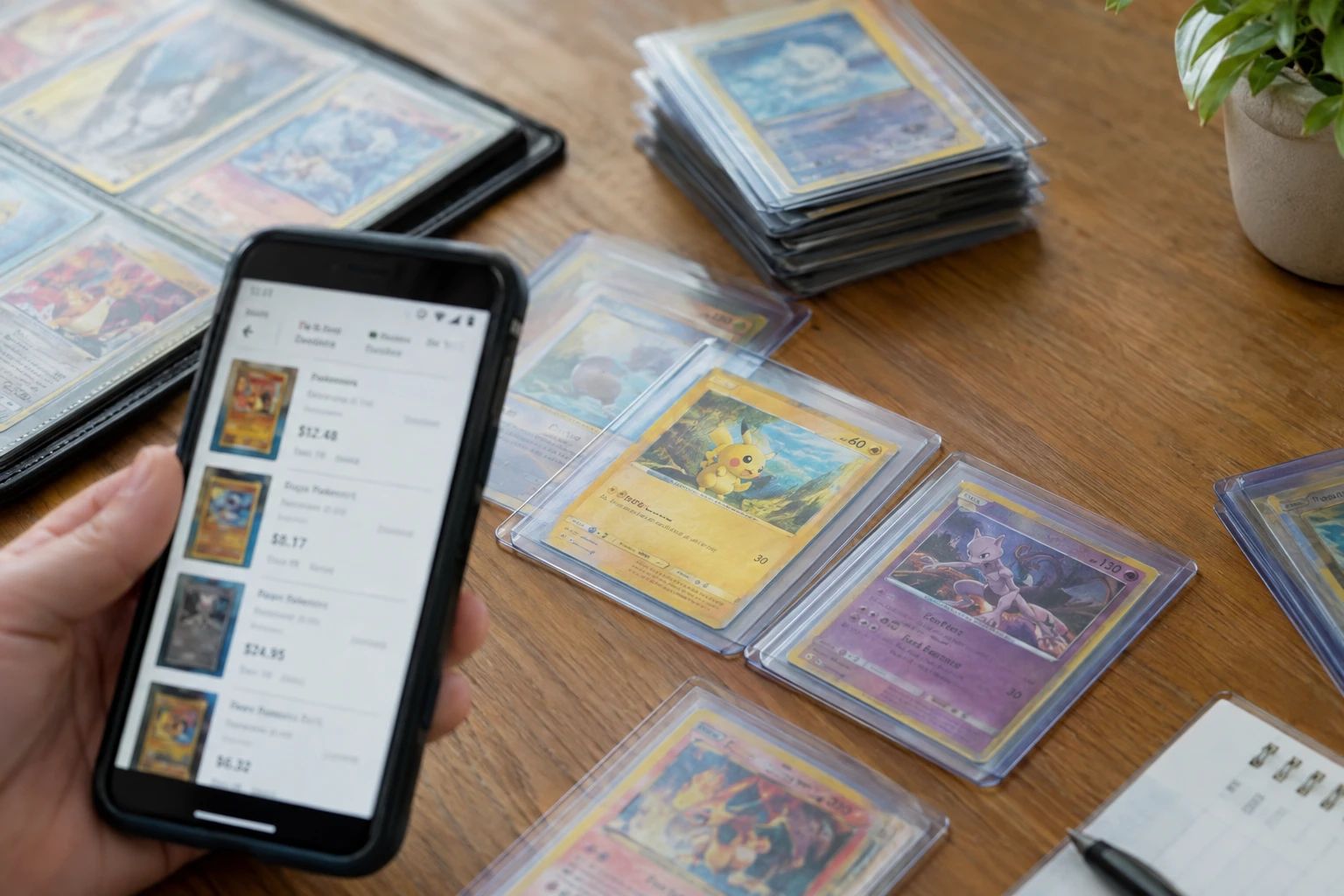
The value of your Pokémon cards depends on four factors: rarity, condition, era, and character demand. Most common cards from modern sets are worth $0.10 to $5. Rare holos and full arts range from $5 to $500. Vintage WOTC-era cards (1999-2003) in near-mint condition can be worth $50 to $50,000+. PSA 10 graded cards sell for 3-25x their raw value.
To find out what your cards are worth: identify each card by set symbol and collector number, look up recent sold prices on eBay or TCGPlayer, assess the condition (near-mint, lightly played, moderately played), and check if grading would multiply the value. Free AI tools like PreGradeCards can predict PSA grades from photos, helping you identify which cards are worth the $79.99 grading fee.
The Pokémon TCG market reached $2.2 billion in 2026, driven by the 30th Anniversary celebration, the record $16.49 million Pikachu Illustrator sale, and a 145% year-over-year increase in Card Ladder's Pokémon index. Whether you have a childhood binder or a modern collection, understanding card values is the first step to making informed decisions about selling, grading, or holding.
What Makes a Pokémon Card Valuable?
Not all Pokémon cards are worth money. The cards that command real value share specific characteristics that collectors and investors look for. Here are the four pillars of Pokémon card value:
1. Rarity — The rarity symbol on the card tells you how scarce it is. A circle means common, a diamond means uncommon, and a star means rare. Beyond basic rarity, there are ultra rares (full arts, secret rares, special illustration rares), which are the most valuable modern cards. Secret rares have a card number higher than the set total (e.g., 199/165). The rarer the pull rate, the higher the value.
2. Condition — A near-mint card is worth 3-10x more than a heavily played copy of the same card. Centering, corner sharpness, edge quality, and surface condition all affect value. A PSA 10 Gem Mint card commands the highest premium — often 5-25x the raw near-mint price. Even a PSA 9 typically sells for 2-3x raw value on desirable cards.
3. Era — Vintage WOTC-era cards (1999-2003) carry the strongest premiums because they are the hardest to find in high grade. Base Set, Jungle, Fossil, Neo Genesis, and the e-Series cards have low PSA 10 populations and high collector demand. Modern cards (2016-present) have much larger populations but can still be valuable if the character and rarity are right.
4. Character Demand — Charizard, Pikachu, Umbreon, Mew, Lugia, and the Eeveelutions consistently outperform other Pokémon by 50-200%. A Charizard card from the same set and rarity as a generic Pokémon will be worth 5-10x more. This "character premium" is driven by cultural recognition, nostalgia, and collector preference.
How to Check Pokémon Card Prices
Once you have identified your card, you need to find its current market value. The key rule: always check sold prices, never asking prices. Anyone can list a card for $1,000 — that does not mean anyone bought it. Here are the best free resources for checking real Pokémon card prices:
eBay Sold Listings: Go to eBay, search your card by name and set number, click "Sold Items" under the filter options. This shows actual completed sales from the past 90 days. Look at the most recent 5-10 sales and ignore outliers (auctions with single bidders or BIN sales that sat for months). This is the most reliable price source for vintage and graded cards.
TCGPlayer Market Price: TCGPlayer.com shows the "Market Price" for each card, which is based on recent completed sales through their marketplace. This is the best source for modern raw singles in the $1-$100 range. The Market Price is more accurate than the TCGPlayer "Listed Median" because it reflects actual sales, not asking prices.
PriceCharting: PriceCharting.com aggregates eBay sold data and displays it in a clean chart format with historical trends. It shows raw prices and graded prices separately, making it easy to see the grading premium. Updated nightly from real sold listings.
PSA Population Report: The PSA population report at psacard.com/pop shows how many copies of each card have been graded at each grade level. This is essential for understanding scarcity. If only 50 PSA 10s exist for your card, that scarcity drives the price. If 15,000 PSA 10s exist, the grading premium will be lower.
Card Ladder: Card Ladder tracks card prices over time with detailed charts and indices. Their Pokémon index showed 3,821% cumulative returns since 2004 vs 483% for the S&P 500. While some features require a subscription, the free tier provides basic price tracking.
When checking prices, always match the condition of your card to the sold comps. A near-mint raw card should be compared to near-mint raw sold prices, not to PSA 10 prices. If your card has whitening on edges, soft corners, or surface scratches, its value will be closer to the "lightly played" or "moderately played" range, which is typically 30-60% below near-mint.
The PSA 10 Grading Premium
The single biggest value multiplier for Pokémon cards is professional grading. A PSA 10 Gem Mint grade can increase a card's value by 3-25x compared to its raw near-mint price. Understanding the grading premium is essential for anyone asking "how much are my Pokémon cards worth."
Here are real 2026 examples of the PSA 10 grading premium:
| Card | Raw NM Price | PSA 10 Price | Premium |
|---|---|---|---|
| 1st Ed Base Charizard | $6,500 | $504,000 | 77x |
| Umbreon VMAX Alt Art (Moonbreon) | $700 | $3,025 | 4.3x |
| Charizard ex SIR (Obsidian Flames) | $80 | $400 | 5x |
| Mew Gold Star (Dragon Frontiers) | $1,941 | $192,000 | 99x |
| Lugia V Alt Art (Silver Tempest) | $60 | $650 | 10.8x |
The grading premium varies by card. Vintage cards with low PSA 10 populations have the highest premiums because gem-mint copies are genuinely rare. Modern cards with high populations (5,000+ PSA 10s) have lower premiums because supply is abundant. The key question is: will the grading premium exceed the cost of grading?
With PSA Regular at $79.99/card in 2026 (Value tiers paused), you need the PSA 10 premium to exceed roughly $120 (grading fee plus shipping and insurance). For a card worth $50 raw, a 3x PSA 10 premium ($150) barely breaks even. For a card worth $100 raw with a 5x premium ($500), grading is clearly profitable.
Use free AI pre-grading from PreGradeCards to predict your card's PSA grade before spending money. If the AI predicts PSA 9.5-10 and the grading premium is profitable, submit. If the AI predicts PSA 7-8, sell raw instead.
Most Valuable Pokémon Cards in 2026
The Pokémon card market in 2026 is defined by record-breaking sales and a repricing of the entire vintage and Gold Star market. Here are the most valuable Pokémon cards and their 2026 PSA 10 values:
The Trophy Tier ($100,000+):
- Pikachu Illustrator (PSA 10): $16.49 million — the most valuable trading card of any kind ever sold. Only 39 copies exist, with just one PSA 10.
- 1st Edition Base Charizard (PSA 10): $456,000-$528,000 — the hobby's bellwether. Approximately 120 PSA 10s exist.
- Mew Gold Star (PSA 10): $192,000 — set a record in July 2026 as the Gold Star class repriced.
- Umbreon Gold Star (PSA 10): $168,000 — set a record in June 2026.
- Pikachu Gold Star (PSA 10): $114,000 — set a record in May 2026.
The Blue-Chip Tier ($10,000-$100,000):
- 1st Ed Base Blastoise (PSA 10): $84,000 — the other Base Set grail.
- 1st Ed Neo Genesis Lugia (PSA 10): $45,000 — thin float makes this the Neo-era grail.
- 1st Ed Fossil Gengar (PSA 10): $48,000 — the cult favorite that ran from $6,000 to $48,000 in a year.
- Crystal Charizard (Skyridge, PSA 10): $65,000 — the e-Series trophy.
The Modern Blue-Chip Tier ($500-$5,000):
- Umbreon VMAX Alt Art "Moonbreon" (Evolving Skies, PSA 10): $3,025 — the modern king with 129 real comps.
- Umbreon ex SIR "Sunbreon" (Prismatic Evolutions, PSA 10): $3,000-$3,850 — the 2025 phenomenon.
- Giratina V Alt Art (Lost Origin, PSA 10): $900-$1,200 — low pop vs demand.
- Lugia V Alt Art (Silver Tempest, PSA 10): $650-$850 — 200% appreciation since release.
If you own any of these cards, even in raw condition, they are worth real money. Get them appraised and consider professional grading to maximize value.
Vintage vs Modern Card Values
The Pokémon card market is divided into two distinct segments with very different value dynamics. Understanding which era your cards come from is critical for accurate valuation.
Vintage WOTC Era (1999-2003): These are the most valuable Pokémon cards. Base Set, Jungle, Fossil, Neo Genesis, Neo Discovery, Neo Revelation, Neo Destiny, Legendary Collection, and the e-Series (Expedition, Aquapolis, Skyridge). Vintage cards have low PSA 10 populations because they were printed 23+ years ago, handled by children, and manufactured with less consistent quality control. Even moderately played vintage holos sell for double-digit prices. Key vintage value drivers: 1st Edition stamps, Shadowless prints, error cards (Red Cheeks Pikachu, No Symbol), and character demand (Charizard, Blastoise, Venusaur, Lugia, Gengar).
Modern Era (2016-present): Modern Pokémon cards are printed in much larger quantities with better quality control, meaning PSA 10 populations are higher and grading premiums are lower. However, certain modern cards are extremely valuable due to character demand and low pull rates. The key modern value drivers are: Special Illustration Rares (SIRs), alternate arts, full art trainer cards, and cards featuring Charizard, Umbreon, Pikachu, and the Eeveelutions. Sets like Evolving Skies, Prismatic Evolutions, and Pokémon 151 have established themselves as modern blue-chips with proven price appreciation.
Sealed Product: Sealed booster boxes and ETBs are a separate asset class. Sealed Evolving Skies booster boxes have climbed from $140 MSRP to $800+ in 2026. Sealed Japanese Terastal Festival ex boxes are up 22% since Q1 2025. Sealed product almost always appreciates because supply only decreases — once a set goes out of print, no new boxes enter the market.
The general rule: vintage cards are worth more per card but harder to find in high grade. Modern cards are more accessible but require careful selection to find the ones with real upside. Use free AI grading to screen both vintage and modern cards before deciding which to submit for professional grading.
How to Appraise Your Collection for Free
You do not need to pay for a professional appraisal to find out what your Pokémon cards are worth. Free tools and resources let you appraise your entire collection from your phone in minutes. Here is the step-by-step process:
Step 1: Sort your collection. Separate your cards by era (vintage 1999-2003 vs modern), rarity (commons/uncommons vs holos/full arts/secret rares), and character (pull out Charizards, Pikachus, Umbreons, Mews, Lugias). This helps you focus on the cards most likely to have value.
Step 2: Identify each card. Look at the set symbol (bottom right corner) and collector number (bottom right next to the set symbol). Use the Pokémon TCG card database at pokemon.com or TCGPlayer to look up the exact card. Write down the set name, card number, and rarity.
Step 3: Check sold prices. Search eBay for the card name and set, filter to "Sold Items." Write down the average of the last 5 sales. For raw cards, look at raw sold prices. For graded cards, look at PSA 9 and PSA 10 sold prices to see the grading premium.
Step 4: Use free AI grading. PreGradeCards offers 30 free credits on signup — enough to grade 30 cards at no cost. Upload a clear photo of each card front and back. The AI will predict a PSA-style grade with subgrades for centering, corners, edges, and surface. This tells you which cards are PSA 10 candidates worth grading and which should be sold raw.
Step 5: Calculate grading ROI. For each card the AI predicts as PSA 9.5-10, check if the PSA 10 sold price exceeds the raw price plus $120 (grading fee + shipping + insurance). If yes, the card is worth grading. If no, sell it raw.
Step 6: Build a spreadsheet. List each card with its set, number, condition, raw value, predicted PSA grade, PSA 10 value, and grading decision (grade/sell/hold). This gives you a complete picture of your collection's value and helps you make informed decisions.
Should You Sell or Grade?
Once you know what your cards are worth, the next question is whether to sell them raw or invest in grading first. The decision comes down to simple math:
Grade the card if: The PSA 10 sold price is at least 3x the raw price plus the grading cost ($79.99 + $20 shipping = ~$100). For example, if a raw card is worth $50 and the PSA 10 sells for $400, grading is clearly profitable — you spend $100 to make $300+ in additional value.
Sell raw if: The grading premium is less than 2x or the card's raw value is under $25. Grading a $10 card that becomes a $25 PSA 10 loses money after the $100 grading cost. Sell it raw and use the proceeds to buy cards worth grading.
Hold if: The card is from a set that is still in print or recently released. Prices often dip after release as supply floods the market, then rise once the set goes out of print. If you believe in the card's long-term potential, hold it in a safe and revisit in 12-24 months.
Always pre-grade before submitting. Use PreGradeCards free AI grading to predict the PSA grade before spending money. If the AI predicts PSA 7-8, do not grade — the premium will not cover the cost. If the AI predicts PSA 9.5-10, grading is likely profitable. This simple step saves the average collector 40-60% on wasted grading fees.
For vintage cards (1999-2003), grading is almost always worth it if the card is in near-mint or better condition. Vintage cards have the strongest grading premiums (10-100x) and authentication adds significant buyer confidence. Even a PSA 5 vintage Charizard is worth more than a raw one because buyers trust the grade.
Common Pokémon Card Valuation Mistakes
Many collectors make expensive mistakes when valuing their Pokémon cards. Here are the most common errors and how to avoid them:
- Using asking prices instead of sold prices: eBay listings show what sellers hope to get, not what buyers actually pay. Always filter to "Sold Items" to see real market value. A card listed for $500 may have last sold for $50.
- Assuming all old cards are valuable: Age alone does not make a card valuable. A common non-holo from Base Set is worth $1-5. Value comes from rarity, condition, and character demand — not just age.
- Overestimating condition: Most collectors rate their cards higher than they actually are. A card with edge whitening, soft corners, or surface scratches is not near-mint — it is lightly or moderately played, which reduces value by 30-60%. Use AI grading for an objective condition assessment.
- Ignoring the grading premium: Selling a $50 raw card that could grade PSA 10 for $400 means leaving $300+ on the table. Always check the PSA 10 sold price before selling raw.
- Grading worthless cards: Spending $100 to grade a $5 card that becomes a $15 PSA 10 is a guaranteed loss. Only grade cards where the PSA 10 premium exceeds the grading cost by at least 2x.
- Mixing up card variants: The same Pokémon can have dozens of different cards. A Base Set Charizard is worth $6,500+ raw while a Burning Shadows Charizard is worth $40. Always identify the exact set and card number before checking prices.
- Not checking PSA population: If there are already 15,000 PSA 10s of your card, the grading premium will be minimal. Low PSA 10 populations (under 500) drive the highest premiums.
Frequently Asked Questions
How do I find out how much my Pokémon cards are worth?
Are my old Pokémon cards from 1999-2000 worth anything?
What is the most valuable Pokémon card?
How much does PSA grading increase Pokémon card value?
Is it worth grading my Pokémon cards in 2026?
Where can I sell my Pokémon cards?
What Pokémon cards are worth money in 2026?
Sources & Further Reading
- eBay Sold Listings — Pokémon TCG
- TCGPlayer Pokémon Card Prices
- PriceCharting Pokémon Card Prices
- PSA Population Report
- PreGradeCards Free AI Card Grading

The PreGradeCards Research Team combines machine-learning engineers, grading analysts, and collector-education specialists to produce accurate, data-driven guides on AI card grading, professional grading standards, and collecting strategy.
Create a free account and get 1 free credit — enough for 1 complete AI grading with market pricing. No credit card required.
Sign Up Free →