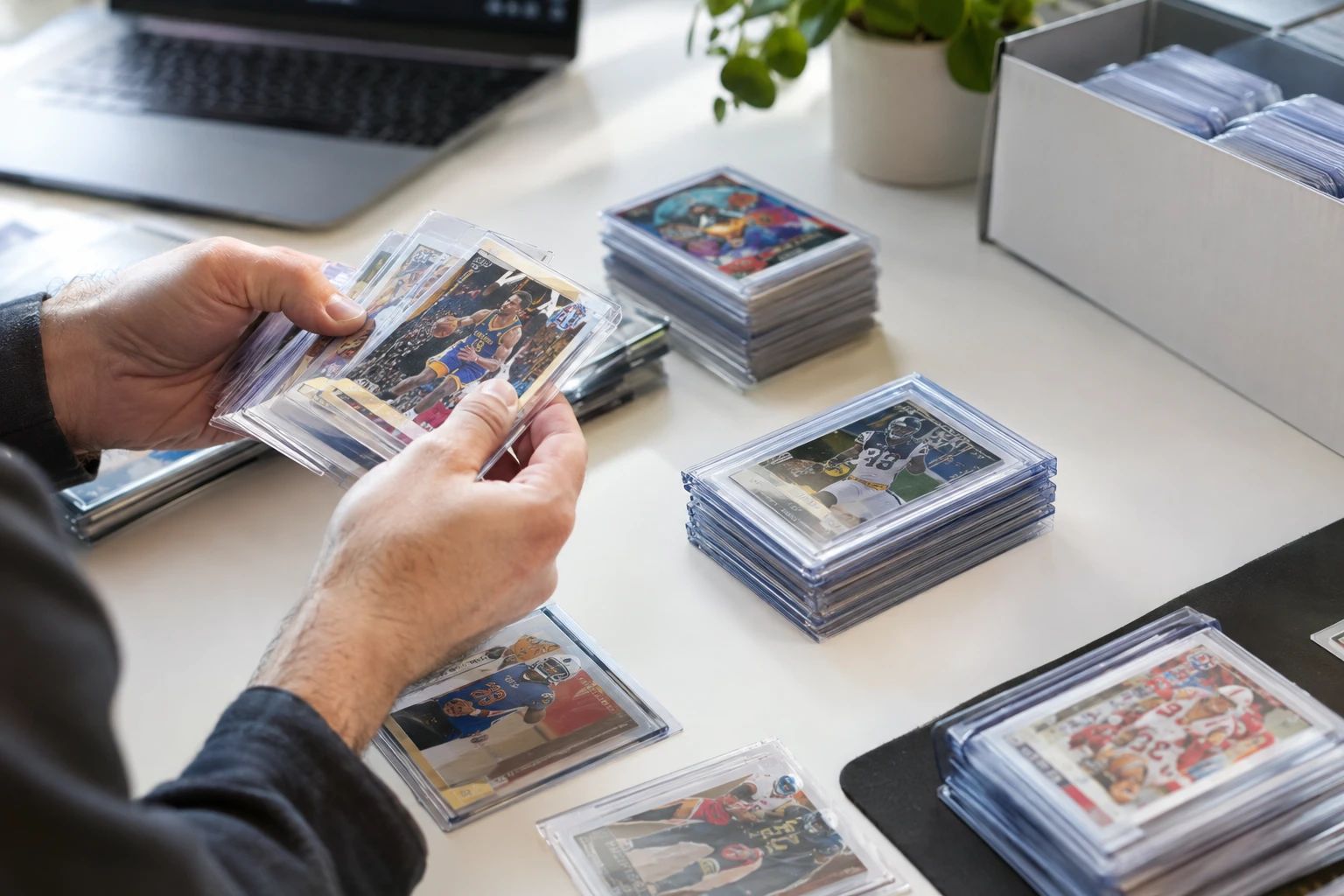
The Short Answer
- The grading spread is the profit — the gap between raw card price and PSA 10 slab price is where every dollar of profit comes from.
- AI pre-grading costs $0.10–$0.25 per card and filters out 60–80% of cards that would waste $80+ in PSA fees.
- Only 8.88% of PSA submissions earn Gem Mint 10 — pre-screening is not optional, it is the difference between profit and loss.
- Sourcing is the hardest part — estate sales, card shows, and eBay auction sniping produce the best raw card margins.
- Target 4x raw-to-PSA-10 multiplier minimum — below that, grading fees and selling fees consume all profit.
- Diversify across sports and TCG — Pokémon, football, basketball, and MTG each have different grading economics.
Why Card Grading Is a Real Side Hustle in 2026
Card grading as a side hustle sits at the intersection of three trends: a mature grading infrastructure (PSA, BGS, CGC, SGC, TAG), accessible AI pre-grading tools that cost pennies per card, and a global resale market on eBay, TCGplayer, Goldin, and Whatnot that moves graded inventory 24 hours a day. The barrier to entry is low — you can start with $100 in raw cards and $15 in AI pre-grading credits. The ceiling is high — full-time graders and dealers process thousands of cards per month through batch grading workflows.
But the hobby is littered with people who lost money because they treated grading like a lottery ticket. They bought raw cards, sent them to PSA without pre-screening, and got back PSA 8s and 9s that sold for less than the grading fee. The difference between profit and loss is not luck — it is process. This guide is that process.
Who This Guide Is For
- Collectors who want to monetize their hobby — you already know cards, now learn the business side
- Side hustlers looking for a low-capital entry point — card grading requires less startup capital than almost any e-commerce niche
- Dealers who want to scale — AI batch pre-grading changes the economics of volume submissions
- Estate sale and collection buyers — grading is how you extract maximum value from inherited or purchased collections
What Has Changed in 2026
The 2026 card grading landscape is defined by several shifts that change the profit math:
- PSA Value tiers are paused — the cheapest PSA tier is now Regular at $79.99/card, up from $24.99 Value Bulk. This makes pre-screening more critical than ever.
- BGS Base/Standard paused August 5 — Express at $79.95 is the cheapest active BGS tier.
- CGC is the value play — CGC Bulk at $17/card (25-card minimum, ~5 month turnaround) is the cheapest professional grading available.
- AI pre-grading accuracy is now 89% within ±1 grade point — good enough to make submission decisions with confidence.
- The PSA backlog is 11.85 million cards — turnaround times of 65+ business days mean capital is locked up longer, making pre-screening essential to avoid tying up money in cards that come back 8 or 9.
The Grading Profit Math: Break-Even Formulas
Every profitable grading flip comes down to one equation:
Net Profit = (Graded Sale Price × 0.87) − Raw Card Cost − Grading Fee − Shipping − Insurance
The 0.87 accounts for eBay's 13% final value fee (the most common selling channel). If you sell on a different platform, adjust accordingly — TCGplayer charges ~13% for Pokémon/TCG, Goldin charges 5–10% seller premium, Whatnot charges ~8%.
The Break-Even Table
Here is the break-even graded sale price needed at different raw card costs and grading fee levels. This is the minimum price your graded card must sell for just to break even:
| Raw Card Cost | PSA Regular ($79.99) | CGC Economy ($20) | SGC Economy ($25) |
|---|---|---|---|
| $10 | $110 | $50 | $55 |
| $25 | $125 | $65 | $70 |
| $50 | $150 | $90 | $95 |
| $100 | $200 | $140 | $145 |
| $250 | $350 | $290 | $295 |
Assumes $20 shipping/insurance per submission. eBay 13% fee. Does not include supplies ($0.50/card) or your time.
The Multiplier Rule
The single most important number in card grading profitability is the raw-to-graded multiplier. This is how many times more a graded card sells for compared to its raw value:
Minimum multiplier = (Raw Cost + Grading Fee + Shipping) / Raw Cost
For a $50 raw card graded at PSA Regular ($79.99 + $20 shipping):
Minimum multiplier = ($50 + $79.99 + $20) / $50 = 3.0x
But that is just break-even. To account for the risk of getting a PSA 9 instead of 10 (which typically sells for 1.5–3x raw, not 5–10x), you need a buffer. The industry rule of thumb:
- 4x multiplier minimum for PSA submissions at $79.99
- 3x multiplier minimum for CGC Economy at $20
- 2.5x multiplier minimum for CGC Bulk at $17 (25+ card minimums)
Below these thresholds, the math simply does not work. You are paying $80 in grading fees to add $40 in value.
The PSA 10 Hit Rate Reality
Only 8.88% of all PSA submissions earn Gem Mint 10. For modern pack-fresh cards in visible condition, the hit rate runs 30–60% depending on the product. For raw cards bought on eBay without inspection, the hit rate drops to 15–25%. This means:
- 1 in 3 pack-fresh cards with clean centering will grade PSA 10
- 1 in 5 eBay raw purchases will grade PSA 10
- 1 in 11 random PSA submissions across all card types grade PSA 10
If you submit 10 cards at $79.99 each ($799.90) and 3 grade PSA 10, those 3 slabs need to sell for a combined $920+ just to break even. If only 1 grades 10, that single slab needs to sell for $920+. This is why pre-screening is not optional.
Where to Source Raw Cards for Grading
Sourcing is where most of the profit is made or lost. If you overpay for raw cards, no amount of grading skill will save you. The goal is to acquire cards below market price from sources where the seller does not know (or does not care about) the grading potential.
1. Estate Sales and Collection Liquidations
Estate sales are the highest-margin sourcing channel. Families liquidating inherited collections typically price by bulk, not by card. A collection of 500 cards might be priced at $200 ($0.40/card) when it contains 10 cards worth $50+ each in PSA 10. The strategy:
- Search EstateSales.net and local estate sale companies for "sports cards," "trading cards," "Pokémon," "baseball cards"
- Arrive early on the first day — card collections sell within the first hour
- Bring a 10x loupe and a centering gauge — inspect the highest-value cards on site
- Offer to buy the entire collection — bulk offers get better per-card pricing
- Half-price day (usually day 3) can produce deals on remaining inventory
2. Card Shows
Card shows are where you find deals through in-person inspection. The advantage over eBay: you can hold the card, check centering with a loupe, and negotiate face-to-face. The disadvantage: dealers know what they have, so margins are thinner. Focus on:
- Dollar boxes and discount bins — dealers put cards they do not want to research in $1–$5 boxes. Some are grading candidates.
- End-of-show negotiation — dealers do not want to pack up inventory. Sunday afternoon offers of 30–40% below asking price often succeed.
- Player collections from set builders — set builders often sell duplicate star rookies cheaply because they are focused on completing sets, not grading.
3. eBay Auction Sniping
eBay 7-day auctions that end at off-hours (Sunday 2 AM Pacific, Tuesday 9 AM Pacific) often clear 10–20% below Buy-It-Now retail. Set maximum bids at 10–15% below comp price and run them across 20+ auctions per week. Expect a 5–10% hit rate. The key rules:
- Only bid on listings with 6+ high-resolution photos
- Only bid on sellers with 99%+ feedback
- Request angled photos to check for surface scratches on Chrome/Prizm cards
- Check centering in the photos — if borders look visibly uneven, skip it
- Use a snipe tool (BidSlammer, Gixen) to avoid bidding wars
4. Facebook Marketplace and Local Buy/Sell Groups
Local Facebook groups often have collectors selling collections below eBay prices because they want a quick, local, no-shipping sale. Search for "sports cards lot," "Pokémon collection," "card collection." Meet in person, bring a loupe, and inspect before buying. The advantage: no shipping costs, no eBay premium, and you can negotiate in person.
5. Card Shops (Local Game Stores)
Local card shops (LCS) are not typically the best source for grading flips — dealers know card values. But they can be useful for:
- Commons and uncommons in bulk bins — some shops do not bother pricing low-end cards that still have PSA 10 potential
- Trade-in credit deals — if you have cards the shop wants, trade for cards they have underpriced
- Relationship building — shop owners often call regulars when collections come in for sale
6. Whatnot Live Breaks
Whatnot has become a major sourcing channel. You can buy singles from breakers at below-market prices, especially if you are patient and bid on cards that other viewers are not chasing. The strategy is different from eBay — you are buying in real-time against other bidders, so discipline is critical. Set a maximum bid before the card comes up and do not exceed it.
AI Pre-Grading: The Profit Multiplier
AI pre-grading is the single most important tool for anyone trying to make money grading cards. It costs $0.10–$0.25 per card and prevents you from spending $80+ on PSA fees for cards that will come back PSA 8 or 9. The math is simple: if AI pre-grading filters out even one card that would have cost $80 in PSA fees and come back PSA 9 (selling for less than the grading fee), it has paid for itself 320x over.
How AI Pre-Grading Works
Upload front and back photos of your card to PreGradeCards AI grading. The AI analyzes the same four pillars PSA uses:
- Centering — measures left/right and top/bottom border ratios with 95%+ accuracy. PSA 10 requires 55/45 front, 75/25 back.
- Corners — detects whitening, softening, and fuzzing with 90%+ accuracy. Even microscopic touch-cap damage is flagged.
- Edges — identifies chipping, fraying, and whitening with 85%+ accuracy. Critical for dark-bordered cards.
- Surface — detects print lines, scratches, dimples, and residue with 80%+ accuracy. The hardest pillar but the most common grade killer.
The AI returns a predicted grade (e.g., "PSA 9.2") with sub-grade breakdowns and a confidence score. Cards predicted at 9.5+ are strong PSA 10 candidates. Cards predicted at 8.5 or below should be sold raw, not submitted.
The Batch Pre-Grading Workflow
For side hustlers processing 20–100 cards at a time, the batch grading workflow is essential:
- Sort cards by type — separate Chrome/Prizm refractors, vintage cards, base cards, and patch autos. Each requires different lighting.
- Photograph all cards — use a consistent setup: two softbox lights at 45 degrees, card on a dark matte surface, camera directly overhead.
- Upload in batch — PreGradeCards batch mode processes up to 100 cards in a single submission.
- Filter by predicted grade — only submit cards predicted 9.0+ to PSA. Sell the rest raw or hold them.
- Track results — when PSA grades come back, compare to AI predictions. This builds your personal accuracy baseline.
ROI Impact of Pre-Grading
Consider a 20-card submission batch. Without pre-grading, you submit all 20 to PSA Regular at $79.99 each = $1,599.80. With AI pre-grading at $0.20/card = $4.00 total, you filter out 12 cards that would have come back PSA 8–9. You submit only the 8 cards predicted 9.5+:
| Scenario | Cards Submitted | Grading Fees | AI Cost | Total Cost |
|---|---|---|---|---|
| No pre-grading | 20 | $1,599.80 | $0 | $1,599.80 |
| With AI pre-grading | 8 | $639.92 | $4.00 | $643.92 |
| Savings | 12 cards filtered | $959.88 | $4.00 | $955.88 |
You saved $955.88 in grading fees by spending $4.00 on AI pre-grading. That is a 239x return on the AI cost. Even if 2 of the filtered cards would have graded PSA 10, the fees saved on the other 10 more than compensate.
Choosing the Right Grading Company for Profit
Not every card should go to PSA. The grading company you choose directly impacts your profit per card. Here is the 2026 decision framework:
| Card Type | Best Grader | Cost | Why |
|---|---|---|---|
| Modern sports rookie (high value, $200+ raw) | PSA Regular | $79.99 | Maximum resale premium; PSA 10 commands 5–20x raw |
| Modern sports rookie (mid value, $50–200 raw) | CGC Economy | $20 | CGC 10 trades at 2–5x raw; lower fee preserves margin |
| Vintage sports (pre-1980) | PSA or SGC | $79.99 / $25 | PSA for max resale; SGC for vintage authenticity and lower cost |
| Pokémon/TCG (high value chase cards) | PSA Regular | $79.99 | PSA 10 Pokémon premium is 5–10x raw |
| Pokémon/TCG (bulk, 25+ cards) | CGC Bulk | $17 | Cheapest professional grading; 5-month turnaround but lowest per-card cost |
| Patch autos / RPAs | BGS Express | $79.95 | Subgrades document each condition element; BGS trusted for premium autos |
| Cards needing fast turnaround | SGC Standard | $40 | 10–20 day turnaround; good for time-sensitive flips |
The PSA Premium
PSA 10 slabs consistently sell for 20–50% more than equivalent BGS 9.5 or CGC 10 slabs. This is not because PSA is a better grader — it is because PSA's population report is the reference standard used by every major auction house and price tracker. Collectors pay for that liquidity. For high-value cards ($500+ raw), the PSA premium justifies the $79.99 fee. For mid-value cards ($50–200 raw), the CGC Economy fee at $20 often produces better net profit despite the lower resale price.
Turnaround Time and Capital Lockup
Every day your cards are at PSA is a day your capital is locked up. At 65 business days PSA Regular turnaround, a $100 raw card submitted in January does not come back until April. If you are running a side hustle with limited capital, this matters. CGC Economy at 30–45 days and SGC at 20–30 days free up capital faster, allowing more grading cycles per year.
Six Repeatable Profit Strategies
Strategy 1: The Grading Flip
Buy a quality raw card, AI pre-grade it, submit to PSA, sell the slab. This is the bread-and-butter play. Profitable when the PSA 10 multiplier is 4x+ and you can spot clean centering before purchase. Timeline: 65–90 days from submission to sale.
Best cards for this strategy:
- Current-year Prizm rookies of breakout NBA/NFL players
- Topps Chrome baseball rookie refractors
- Pokémon alt-art and SIR chase cards from new sets
- One Piece TCG manga rares and alt-art leaders
Strategy 2: The Crossover Crack
Buy a BGS 9.5 or CGC 10 slab that would likely grade PSA 10, crack it out, and resubmit to PSA. The PSA 10 premium over BGS 9.5 can be 20–50%. This is an advanced play — if the card grades PSA 9, you lose money. Only viable when:
- BGS 9.5 to PSA 10 price gap exceeds $200
- All four BGS sub-grades are 9.5 or 10 (lowers PSA 9 risk)
- You can inspect the card in person before buying the slab
Strategy 3: The Catalyst Play
Buy cards that have a scheduled price catalyst in the next 30–90 days:
- Hall of Fame inductions — first-ballot HOFers see rookie card spikes
- Championship wins — Super Bowl MVP, NBA Finals MVP, World Series MVP
- Rookie debuts — first NFL start, NBA opening night, MLB call-up
- Set anniversaries — Pokémon 30th Celebration in September 2026
- Trade deadline moves — star player to bigger market = card price spike
Buy before the catalyst, grade during the hype, sell at the peak. Timing is everything.
Strategy 4: The Estate Sale Arbitrage
Buy collections at estate sales for $0.10–$0.50/card, AI pre-grade everything, submit the 10 candidates, sell the rest as raw lots. The profit comes from the spread between bulk purchase price and individual graded card sale price. A $200 collection purchase that yields 5 PSA 10 slabs worth $150 each = $750 gross, $400 in grading fees, $150 net profit on a $200 investment. That is a 75% return on a 90-day cycle.
Strategy 5: The Sealed Product Flip
Buy sealed product at MSRP from retail (Target, Walmart, Pokémon Center) on release day. Resell within 30 days as MSRP inventory sells out. Typical markup: 30–80% over MSRP. This does not involve grading directly, but the best flippers open product, grade the hits, and sell both sealed and graded inventory simultaneously.
Strategy 6: The Bulk CGC Play
For volume side hustlers: source 25+ mid-value cards ($20–50 raw), AI pre-grade all of them, submit the cleanest 25 to CGC Bulk at $17/card. CGC 10 premium on mid-value cards is typically 2–3x raw. Total cost per card: $17 grading + $0.20 AI + $20 raw = $37.20. CGC 10 sale at $60–100 = $23–63 profit per card. At 25 cards, that is $575–$1,575 per submission cycle.
Where to Sell Graded Cards for Maximum Profit
Where you sell matters as much as where you grade. Each platform has different fees, audiences, and sale velocity.
eBay — The Default Channel
eBay remains the highest-traffic venue for individual graded card sales. 13% final value fee. Best for: individual high-value slabs, vintage cards, cross-sport inventory. Use the eBay listing generator built into PreGradeCards grade reports to auto-generate optimized titles and descriptions.
TCGplayer — Best for Pokémon and TCG
TCGplayer charges ~13% but has the deepest TCG buyer pool. Best for: Pokémon slabs, MTG graded cards, Yu-Gi-Oh! graded cards. TCGplayer Direct (if you qualify) offers even better margins by consolidating shipping.
Goldin Auctions — Best for High-End
Goldin charges 5–10% seller premium but reaches serious collectors with high budgets. Best for: PSA 10 slabs worth $500+, vintage high-grade cards, premium patch autos. Auction format means you might get less than eBay BIN, but the buyer pool is wealthier.
Whatnot — Best for Velocity
Whatnot charges ~8% and sells through live auctions. Best for: volume selling, mid-value slabs ($50–300), building a following. The live format creates urgency that can push prices above eBay comps.
Facebook Groups — Best for Zero Fees
Card-specific Facebook groups (Sports Card Collectors, Pokémon Card Collectors, etc.) allow direct sales with no platform fees. Best for: established sellers with group reputation. Risk: no buyer protection, chargeback risk, scam exposure.
COMC (Check Out My Cards) — Hands-Off Selling
COMC takes a higher cut (20%+) but handles all photography, listing, shipping, and customer service. Best for: volume sellers who do not want to manage individual listings. Note: COMC had shipping delays and rate increases in 2026 — check current terms before committing.
Common Mistakes That Kill Grading Profits
1. Submitting Cards Without Pre-Grading
This is the #1 profit killer. Without AI pre-grading, you are gambling $80 per card that every submission will grade 10. Only 8.88% do. Pre-grading costs $0.20 and saves $80 per filtered card. There is no rational argument against pre-grading.
2. Grading Cards Worth Less Than $50 Raw
At $79.99 PSA Regular, a $50 raw card needs to sell for $150+ graded just to break even. Most $50 raw cards do not have a 3x PSA 10 premium. The math does not work. Wait for CGC Bulk or PSA Value tiers to reopen.
3. Ignoring Centering
Centering is the #1 reason cards do not grade PSA 10. 40–50% of modern Prizm and Chrome cards fail the 55/45 front centering standard. If you can see uneven borders with the naked eye, the card is already a PSA 9 at best. Always run an AI centering check before buying or submitting.
4. Buying Hyped Prospects at Peak
When a player gets drafted #1 overall, their card prices spike 50–200% in the first week. Buying at peak means your raw cost is so high that even a PSA 10 does not produce profit. Buy during the offseason or after a slump — that is when the multiplier is highest.
5. Not Tracking Results
Every flip should be logged: card, raw cost, grading fee, AI prediction, actual grade, sale price, net profit. Without this data, you are guessing. With it, you learn which card types, players, and products produce the best ROI for your specific workflow.
6. Overgrading Low-Demand Cards
A PSA 10 of a player nobody collects is worth less than the grading fee. Before submitting, check eBay sold listings for graded copies of that specific card. If there are fewer than 3 sales in 90 days, there is no liquid market — do not grade it.
7. Choosing the Wrong Grader
Sending a $60 raw Pokémon card to PSA Regular ($79.99) when CGC Economy ($20) would produce similar net profit is a $60 mistake per card. Always calculate net profit for each grader option before submitting.
Tax Implications of Card Flipping
Card grading profits are taxable income. The IRS treats card flipping as a business or hobby depending on your intent and volume:
- Hobby status: If you grade cards recreationally and occasionally sell, profits are reported as "other income" on Schedule 1. You can deduct expenses up to the amount of income (hobby expense rules changed with TCJA).
- Business status: If you grade cards regularly with profit intent, you should file Schedule C. This allows full expense deduction (grading fees, shipping, supplies, AI pre-grading costs, eBay fees, mileage to card shows). Net profit is subject to self-employment tax (15.3%) plus income tax.
- Inventory accounting: Raw cards purchased for grading are inventory. You can use FIFO or specific identification. Grading fees are added to the cost basis of each card.
- Sales threshold: eBay and other platforms issue 1099-K forms if you exceed $5,000 in gross sales (2026 threshold). Track all sales and expenses from day one.
Disclaimer: This is general information, not tax advice. Consult a CPA who understands collectibles businesses for your specific situation.
Scaling From Side Hustle to Business
Once you are consistently profitable on 20–50 card submissions, scaling requires systems:
1. Build a Sourcing Pipeline
Develop relationships with estate sale companies, card shop owners, and collection brokers. When they get inventory, they call you first. This is how full-time dealers source 500+ cards per month.
2. Use Batch AI Pre-Grading
PreGradeCards batch grading processes up to 100 cards in a single submission. At $0.15/card (Collector plan), pre-grading 100 cards costs $15. Filter to the top 30–40 candidates and submit those. This workflow scales to thousands of cards per month.
3. Open a PSA Collectors Club Membership
PSA Collectors Club gives access to Value tiers when they reopen ($24.99–$49.99/card vs $79.99 Regular). The $199/year membership pays for itself on your first 5-card submission. Even with Value tiers paused, membership gives submission priority and tracking tools.
4. Diversify Across Card Categories
Pokémon, football, basketball, baseball, and MTG each have different grading economics and seasonal demand cycles. Diversifying smooths your income and reduces risk from any single market downturn.
5. Build a Selling Audience
Whatnot streams, Instagram card accounts, and YouTube grading content build an audience that buys your slabs directly. An engaged audience of 1,000 collectors is worth more than any eBay algorithm change.
6. Track Everything
Use a spreadsheet or inventory management system to track: card, purchase date, purchase price, source, AI prediction, grading company, submission date, return date, actual grade, listing date, sale price, platform fees, net profit, ROI %, cycle time (days). This data is your business intelligence.
Realistic Income Expectations
A disciplined side hustler processing 20 cards per month with a 40% PSA 10 hit rate and $30 average net profit per PSA 10 slab generates $240/month in profit. At 100 cards per month with the same hit rate and profit, that is $1,200/month. Full-time dealers processing 500+ cards per month across multiple grading companies can generate $5,000–$15,000/month, but this requires significant capital ($10,000+ in inventory and grading fees), sourcing infrastructure, and 40+ hours per week.
The key insight: card grading is not passive income. Every dollar of profit comes from your ability to source below market, pre-grade accurately, choose the right grader, and sell at the right time. The tools exist — AI pre-grading, batch processing, centering analysis, ROI calculators. The discipline is on you.
Frequently Asked Questions
How much money do I need to start grading cards for profit?
Can I make a full-time income grading cards?
Is AI pre-grading accurate enough to trust for submission decisions?
What is the best grading company for making money?
What cards should I avoid grading?
How long does it take to get cards back from grading?
Do I need a business license to sell graded cards?
Sources & Further Reading
- Card Grading ROI 2026: When Is It Worth Grading? — PreGradeCards
- Pre-Grading ROI Playbook: Save Money on PSA Submissions 2026 — PreGradeCards
- Card Grading for Profit: Business Guide 2026 — PreGradeCards
- How to Buy Raw Cards for Grading: Sourcing Guide 2026 — PreGradeCards
- Card Flipping Guide 2026 — CardMarks
Marcus Chen has evaluated over 50,000 sports cards and TCG cards across PSA, BGS, SGC, and CGC standards. Before joining PreGradeCards, he worked as a submission specialist for a major grading company and trained collectors and dealers on condition assessment.
Create a free account and get 1 free credit — enough for 1 complete AI grading with market pricing. No credit card required.
Sign Up Free →