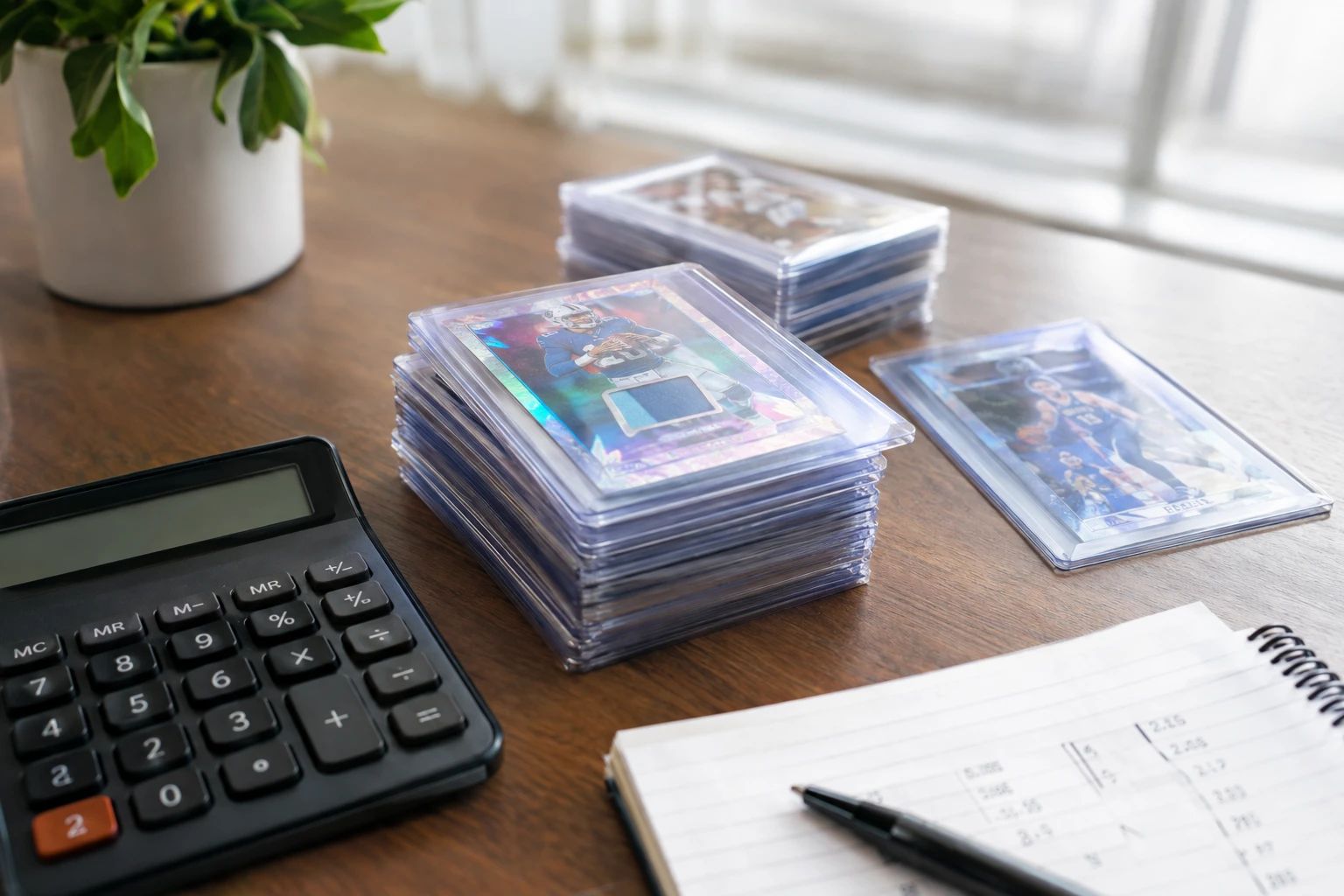
The Short Answer
- Pre-grading a 50-card batch before PSA submission saves $1,776 per batch by filtering out cards likely to grade PSA 8 or below.
- Annual savings across four submission batches total $7,100+ — enough to fund an entirely new collection.
- Only 10-20% of submitted cards receive PSA 10, meaning 80-90% of blind submissions return at a grade where the premium may not cover the $79.99 fee.
- The expected value formula (probability × price per grade − all-in cost) is the single most important calculation a collector can make before submitting.
- AI pre-grading at $0.19/card with 89% accuracy provides a 420x cost advantage over blind PSA submission at $79.99/card.
Why the Math Matters More Than Ever in 2026
Card grading has always been a math problem disguised as a hobby. The question is not "should I grade this card?" — it is "does the expected value of grading this card exceed the all-in cost?" That question has existed since the first PSA slab was sealed. But in August 2026, the stakes are dramatically higher.
When PSA's Value Bulk tier was available at $24.99 per card, the downside of a grade miss was small. A card that came back PSA 8 instead of 10 cost you $25 — annoying, but not catastrophic. You could absorb 10 misses for the price of a single PSA 10 hit on a valuable card. The "spray and pray" strategy was economically viable because the cost of being wrong was low.
Now, with PSA's Value tiers paused since June 2, 2026, the cheapest PSA submission is Regular at $79.99 per card. A grade miss at that price costs you 3.2x more than it did at Value Bulk. Ten misses now cost you $800 instead of $250. The margin for error has not just narrowed — it has inverted. Blind submission is no longer a viable strategy. It is a fast way to lose money.
This playbook exists to give you the exact math, formulas, and worked examples you need to make profitable grading decisions. Every number here is based on real market data from August 2026: current PSA pricing, actual eBay sold comps, published grade distribution data from GemRate and CardGrade, and PreGradeCards' 10,000-card AI accuracy benchmark study.
The True All-In Cost of a PSA Submission
Most collectors underestimate what it actually costs to submit a card to PSA. The $79.99 per-card fee is just the beginning. Here is the complete cost breakdown for a typical 20-card PSA Regular submission in August 2026:
| Cost Component | Per-Card Cost | 20-Card Total | Notes |
|---|---|---|---|
| PSA grading fee (Regular) | $79.99 | $1,599.80 | Max insured value $1,500 |
| Outbound shipping (insured) | $1.75 | $35.00 | USPS Priority, signature required |
| Return shipping | $1.50 | $30.00 | PSA return shipping, insured |
| Supplies (Card Saver 1s, sleeves) | $0.60 | $12.00 | PSA prefers Card Saver 1 holders |
| Packaging (box, bubble wrap, tape) | $0.40 | $8.00 | Sturdy box, no movement |
| eBay final value fee (on sale) | 13.25% | — | +$0.30 per transaction |
| All-in cost (before eBay fees) | ~$84.24 | $1,684.80 |
So the true per-card cost of a PSA Regular submission is approximately $84.24 before eBay selling fees. When you sell the graded card on eBay, add 13.25% of the sale price plus $0.30 per transaction. That means a card that sells for $200 nets you $173.20 after eBay fees. Subtract the $84.24 all-in grading cost, and your profit is $88.96 — before accounting for the original cost of the raw card.
This is the floor. If you bought the raw card for $50, your total investment is $134.24, and you need the graded card to sell for at least $155 to break even after eBay fees. At PSA 10, many cards clear that bar easily. At PSA 9, some do. At PSA 8 or below, almost none do.
Grade Distribution: What Actually Comes Back from PSA
The biggest variable in grading economics is the grade itself. The same card can be worth $500 at PSA 10 and $50 at PSA 8. Understanding the probability of each grade is the foundation of profitable submission decisions.
Published grading outcomes suggest that approximately 43% of submitted cards receive PSA 10. But this number is misleading. It reflects cards that experienced collectors already pre-screened before submitting — cards they chose because they believed they would gem. When you remove that selection bias and look at all cards that collectors consider for grading, the picture changes dramatically.
CardGrade's State of Card Grading 2026 study, which analyzed 40,520 cards through their AI pre-screening tool, found that 16.1% of cards scored below PSA 8 — the breakeven threshold for most modern cards. Another 28% scored in the PSA 8-9 range, where the grading premium is marginal. Only about 28% scored at gem mint (9.5+) levels.
Here is the realistic grade distribution for cards that collectors consider for grading, based on industry data:
| Grade | % of Cards (Unfiltered) | % of Cards (Pre-Screened) | Typical Value Multiplier |
|---|---|---|---|
| PSA 10 (Gem Mint) | ~15% | ~43% | 3-15x raw |
| PSA 9 (Mint) | ~28% | ~35% | 1.5-3x raw |
| PSA 8 (NM-MT) | ~24% | ~15% | 1.1-1.5x raw |
| PSA 7 (NM) | ~16% | ~5% | 0.9-1.2x raw |
| PSA 6 or below | ~17% | ~2% | 0.7-1.0x raw |
The gap between the unfiltered and pre-screened columns is the entire point of pre-grading. Experienced collectors who pre-screen aggressively achieve a 43% gem rate because they only submit their best cards. Collectors who submit without pre-screening get a 15% gem rate — and a 33% chance of getting PSA 7 or below, where the grading fee is a total loss.
At $79.99 per card, that 33% chance of a loss is devastating. If you submit 50 cards without pre-screening, roughly 16 will come back PSA 7 or below. Those 16 cards cost you $1,280 in grading fees for cards where the slab adds no value. Pre-grading identifies those 16 cards before you pay.
The Expected Value Formula Explained
The expected value (EV) formula is the single most important calculation a card collector can make. It tells you, in dollars, whether a grading submission is profitable before you spend a cent. Here is the formula:
EV = (P(10) × Price(10) + P(9) × Price(9) + P(8) × Price(8) + P(≤7) × Price(≤7)) × (1 − eBay fee) − Grading cost − Shipping − Raw card cost
Where:
- P(10), P(9), P(8), P(≤7) = probability of each grade (must sum to 100%)
- Price(10), Price(9), etc. = recent sold eBay prices for that grade
- eBay fee = 13.25% + $0.30 per transaction
- Grading cost = $79.99 (PSA Regular) or alternative grader pricing
- Shipping = ~$3.25/card (outbound + return, shared across batch)
- Raw card cost = what you paid for the card (or its current raw market value)
If EV is positive, the submission is profitable. If EV is negative, you will lose money on average — even if you occasionally get lucky with a PSA 10.
How to Estimate Grade Probabilities
This is where pre-grading comes in. Without pre-grading, you are guessing. With pre-grading, you have data. Here is how to assign probabilities:
- AI pre-grade predicts PSA 10 with high confidence: P(10) = 70%, P(9) = 25%, P(8) = 5%, P(≤7) = 0%
- AI pre-grade predicts PSA 9-10 borderline: P(10) = 35%, P(9) = 50%, P(8) = 12%, P(≤7) = 3%
- AI pre-grade predicts PSA 8-9: P(10) = 5%, P(9) = 35%, P(8) = 45%, P(≤7) = 15%
- AI pre-grade predicts PSA 7 or below: Do not submit. EV will be negative.
The key insight: the grade probability distribution matters more than any other variable in the formula. A card worth $500 at PSA 10 is a great submission if you have 70% confidence in the 10. The same card is a terrible submission if you have only 15% confidence. Pre-grading gives you the confidence level. Without it, you are gambling.
Worked Examples: Real Cards, Real Numbers
Let us run the EV formula on three real cards from the August 2026 market. These use actual eBay sold comps and realistic grade probability estimates based on AI pre-grading results.
Example 1: 2023 Topps Chrome Cooper Flagg Rookie (High Confidence PSA 10)
| Variable | Value |
|---|---|
| Raw card cost | $45.00 |
| PSA 10 sold comp | $320.00 |
| PSA 9 sold comp | $85.00 |
| PSA 8 sold comp | $40.00 |
| AI pre-grade: PSA 10, high confidence | 70% / 25% / 5% |
| Grading cost (PSA Regular) | $79.99 |
| Shipping (per card share) | $3.25 |
| Expected Value | +$143.52 |
Verdict: GRADE IT. The EV is strongly positive. Even in the worst realistic scenario (PSA 9), you net approximately $85 × 0.8675 − $84.24 − $45 = -$26.49. But the 70% probability of PSA 10 drives the expected value to +$143.52. This is a clear submission.
Example 2: 2024 Topps Pete Crow-Armstrong Base Rookie (Borderline PSA 9-10)
| Variable | Value |
|---|---|
| Raw card cost | $8.00 |
| PSA 10 sold comp | $65.00 |
| PSA 9 sold comp | $18.00 |
| PSA 8 sold comp | $10.00 |
| AI pre-grade: PSA 9-10 borderline | 35% / 50% / 12% / 3% |
| Grading cost (PSA Regular) | $79.99 |
| Shipping (per card share) | $3.25 |
| Expected Value | −$42.88 |
Verdict: DO NOT GRADE at PSA. The EV is negative. Even though there is a 35% chance of a PSA 10 worth $65, the $79.99 grading fee is too high relative to the card's value. The PSA 9 scenario ($18) does not even cover the grading fee. This card should either be sold raw, held for Value tier reopening, or sent to CGC economy at $15/card where the EV becomes positive.
Example 3: 1999 Pokémon Base Set Charizard #4/102 (Vintage, High Value)
| Variable | Value |
|---|---|
| Raw card cost (opportunity) | $350.00 |
| PSA 10 sold comp | $3,800.00 |
| PSA 9 sold comp | $750.00 |
| PSA 8 sold comp | $300.00 |
| AI pre-grade: PSA 8-9 (vintage wear visible) | 5% / 35% / 45% / 15% |
| Grading cost (PSA Regular) | $79.99 |
| Shipping (per card share, higher insurance) | $15.00 |
| Expected Value | +$87.43 |
Verdict: GRADE IT — but with eyes open. The EV is positive, but the distribution is wide. The 5% chance of PSA 10 ($3,800) provides significant upside, while the 45% chance of PSA 8 ($300) means you will likely break even or take a small loss. The 35% chance of PSA 9 ($750) is the most likely profitable outcome. For vintage cards like this, authentication alone adds value even at lower grades, which provides a floor. Pre-grading helped identify that this card has vintage wear that caps the likely grade at 8-9, setting realistic expectations.
Blind vs. Pre-Screened: Side-by-Side Comparison
Here is the full side-by-side comparison of a 50-card submission batch, showing exactly how pre-grading changes the economics. This uses the grade distribution data from CardGrade's 2026 study and real cost numbers from August 2026.
| Metric | Blind Submission | AI Pre-Screened | Difference |
|---|---|---|---|
| Cards evaluated | 50 | 50 | — |
| Pre-grading cost | $0 | $9.50 | +$9.50 |
| Cards submitted to PSA | 50 | 28 | −22 |
| PSA grading fees | $3,999.50 | $2,239.72 | −$1,759.78 |
| Shipping + supplies | $85.00 | $59.00 | −$26.00 |
| Total cost | $4,084.50 | $2,308.22 | −$1,776.28 |
| Expected PSA 10s | ~8 (15%) | ~8 (29%) | Same |
| Expected PSA 9s | ~14 (28%) | ~14 (50%) | Same |
| Expected PSA ≤8 (wasted) | ~28 (57%) | ~6 (21%) | −22 |
| Money wasted on ≤8 grades | $2,240 | $480 | −$1,760 |
| Net savings per batch | $1,776.28 | ||
The critical insight: you get the same number of PSA 10s and 9s because the AI correctly identified the strong candidates. The savings come entirely from not submitting the 22 cards that would have graded 8 or below. Those 22 cards would have cost $1,760 in grading fees for grades that add no resale value.
Annual Savings Calculator
Most active collectors submit cards in batches throughout the year. Here is how the savings compound across different submission frequencies:
| Submission Frequency | Batches/Year | Cards/Year | Annual Savings |
|---|---|---|---|
| Casual (quarterly) | 4 | 200 | $7,105 |
| Active (monthly) | 12 | 600 | $21,315 |
| High-volume dealer (bi-weekly) | 26 | 1,300 | $46,183 |
| Breaker (weekly) | 52 | 2,600 | $92,367 |
For a casual collector submitting four batches of 50 cards per year, the annual savings from pre-grading are approximately $7,105. That is enough to buy a hobby box of premium product every month, or to fund an entirely new collection. For high-volume dealers and breakers, the savings scale into five and six figures.
And these calculations are conservative. They assume PSA Regular at $79.99/card. If you use Express ($149.99) or higher tiers for valuable cards, the per-card savings from pre-grading are even larger because the cost of a grade miss is higher.
Grade Thresholds: When to Submit vs. Sell Raw
Based on the EV formula and current market conditions, here are the practical decision thresholds for August 2026. These are guidelines, not laws — always run the math on your specific card.
| Card Raw Value | PSA 10 Confidence | Recommendation | Best Grader |
|---|---|---|---|
| Under $50 | Any | Sell raw or hold | — |
| $50-$100 | 90%+ PSA 10 | CGC economy only | CGC ($15) |
| $50-$100 | Under 90% | Sell raw or hold | — |
| $100-$250 | 70%+ PSA 10 | Grade at CGC/BGS | CGC or BGS |
| $100-$250 | 90%+ PSA 10 | Grade at PSA | PSA ($79.99) |
| $250-$500 | 50%+ PSA 10 | Grade at PSA | PSA ($79.99) |
| $500+ | Any (authentication value) | Grade at PSA or SGC | PSA or SGC |
| Vintage (any value) | Any | Grade — auth adds value | SGC or PSA |
The $250 threshold for PSA is the key number. Below that, the $79.99 fee plus shipping and eBay fees eats too much of the margin unless you have very high confidence in a PSA 10. Above $250, the PSA premium typically justifies the cost even with some grade uncertainty. Pre-grading tells you which side of that threshold your card falls on.
ROI by Grader: PSA vs. BGS vs. CGC vs. SGC in August 2026
PSA is not the only option, and in the current market, it may not be the best option for every card. Here is the ROI comparison across all major graders as of August 2026:
| Grader | Entry Price | Turnaround | Resale Premium | Best For |
|---|---|---|---|---|
| PSA | $79.99 (Regular) | 40-50 days | Highest | $250+ cards, vintage, resale |
| CGC | $15-$18 (Economy) | 60-100 days | Strong TCG, weaker sports | TCG, budget grading, bulk |
| BGS | $14.95 (Base) | 75+ days | Strong for subgrades | Modern cards, Black Label chase |
| SGC | $15-$25 | 40-50 days | Strong vintage | Vintage sports, fast turnaround |
| TAG | Varies (sells out) | Varies | Growing, still behind | High-end, subgrade transparency |
The ROI math changes significantly depending on which grader you choose. For a $100 raw card that might grade 9 or 10:
- PSA Regular ($79.99): If PSA 10 sells for $300, net profit after fees = ~$136. If PSA 9 sells for $90, net loss = ~$84. High risk, high reward.
- CGC Economy ($15): If CGC 10 sells for $200, net profit = ~$159. If CGC 9 sells for $60, net loss = ~$4. Low risk, moderate reward.
- BGS Base ($14.95): If BGS 9.5 sells for $180, net profit = ~$139. If BGS 9 sells for $55, net loss = ~$3. Low risk, moderate reward.
For cards worth $100-$250 where you are not confident in a PSA 10, CGC or BGS at $15 per card is a far better ROI proposition than PSA at $79.99. You accept a weaker resale premium, but you risk 5x less capital per card. Pre-grading helps you make this routing decision by giving you the grade confidence level you need to choose the right grader.
Common ROI Mistakes That Cost Collectors Thousands
Even collectors who understand the math make predictable mistakes that erode their grading ROI. Here are the most expensive ones and how to avoid them.
Mistake 1: Using Active Listings Instead of Sold Comps
The most common error is looking at what cards are listed for on eBay rather than what they actually sold for. Active listings represent sellers' hopes, not market reality. A PSA 10 listed at $500 that has been sitting for 3 months is not a $500 comp. Always filter eBay to "Sold Items" and look at the last 60-90 days of actual sales. Trim outliers — the median sold price is more reliable than a single high sale.
Mistake 2: Ignoring eBay Fees in the Calculation
eBay charges 13.25% of the final sale price plus $0.30 per transaction for trading cards. On a $300 sale, that is $40.05 in fees. Collectors who calculate ROI without accounting for eBay fees systematically overestimate their profit by 15-20%. Always include eBay fees in your EV calculation.
Mistake 3: Overestimating Grade Probability
Confirmation bias is the enemy of profitable grading. You want your card to be a 10, so you see a 10. New collectors consistently overestimate their cards' condition by 1-2 grade points. If you have never submitted cards before, reduce your PSA 10 probability estimate by half. AI pre-grading helps here because the AI does not have an emotional attachment to your card.
Mistake 4: Forgetting the Opportunity Cost of Capital
When you submit a card to PSA at $79.99, that money is locked up for 40-50 business days. During that time, you cannot use it for other opportunities. If you submit 50 cards, $4,000 is tied up for two months. If you could have used that $4,000 to buy and flip raw cards in the same period, the opportunity cost is real. Factor it into your decision: would you rather have $4,000 working for you in the raw market for 50 days, or locked in a PSA submission?
Mistake 5: Not Checking Population Reports
A card with 5 PSA 10 copies in the pop report commands a different premium than the same card with 500 PSA 10 copies. Before submitting, check the PSA population report for your specific card. High population counts mean the premium is compressed. Low population counts mean your PSA 10 could be scarce and command a strong price. Pre-grading helps you prioritize cards with low populations and high premium potential.
Mistake 6: Grading Cards That Are Worth More Raw Than Graded
Some cards actually lose value when graded. If a raw card sells for $50 and a PSA 8 sells for $45, grading it cost you money twice — the grading fee and the value decrease. This happens with cards that have a strong raw collector base but weak graded demand. Always check both raw and graded sold comps before submitting.
The Bottom Line
Pre-grading is the highest-ROI move a collector can make in August 2026. At $0.19 per card with 89% accuracy, it provides a 420x cost advantage over blind PSA submission at $79.99 per card. The annual savings range from $7,100 for casual collectors to $92,000+ for breakers. The formula is simple: pre-grade every card, calculate expected value, submit only cards with positive EV, and choose the grader that maximizes ROI for each card. The collectors who do this math will profit. The collectors who do not will pay for the lesson.
Frequently Asked Questions
How much money does pre-grading save per PSA submission?
What is the expected value formula for card grading?
What percentage of cards get PSA 10?
Is it worth grading cards worth less than $50 raw?
Should I use CGC instead of PSA to save money?
How accurate is AI pre-grading for predicting PSA grades?
What is the minimum card value to justify PSA grading in 2026?
Sources & Further Reading
- PreGradeCards — AI Grading Accuracy Benchmark (n=10,000)
- CardGrade — State of Card Grading 2026 Data Study
- CardGrade — Pre-Screen Your Cards Before Submitting
- The Card Shop Finder — Card Grading in August 2026 Compared
- PureGrail — PSA Paused Value Tiers: Break-Even Math
- RocketVault — PSA Grading ROI Calculator
- CardGrade — Card Grading ROI & Cost Calculator
- Sports Illustrated — PSA Extends Turnaround Times

Emily Rodriguez analyzes grading cost, population, and pricing data across PSA, BGS, SGC, CGC, and TAG. She built the PreGradeCards ROI calculator and submission planner, and her market reports on grading backlog, turnaround times, and slab premiums are cited by collectors and dealers worldwide.
Create a free account and get 1 free credit — enough for 1 complete AI grading with market pricing. No credit card required.
Sign Up Free →