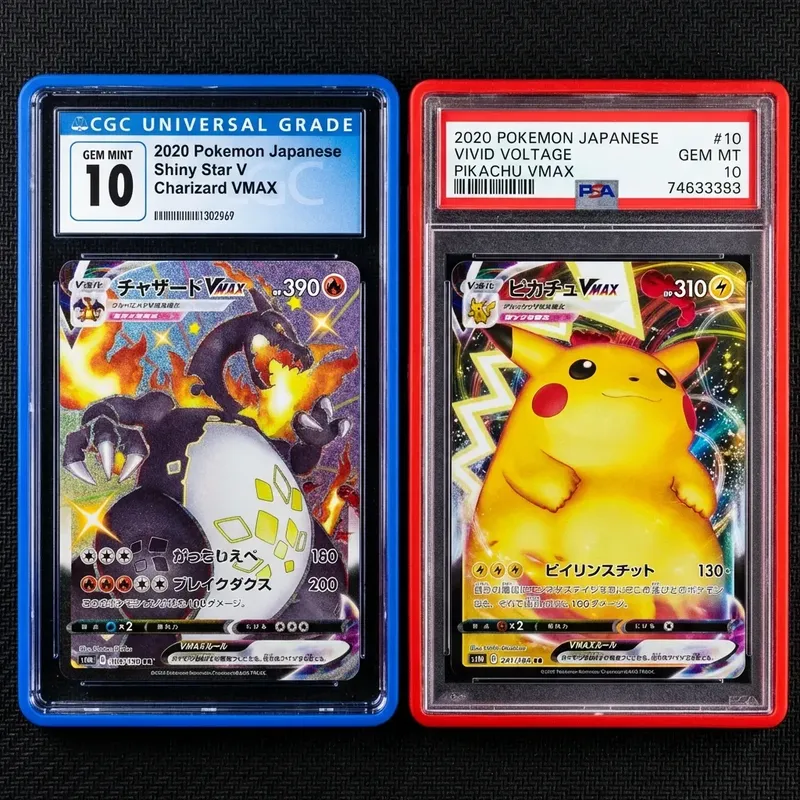
The Short Answer
- Pokémon TCG Pocket: Everyday Wonders launched June 29, 2026, with a Community Week event in mid-July that introduces trading missions and rewards.
- Trading is coming to Pokémon TCG Pocket in mid-July 2026, creating new demand for both digital and physical cards.
- Physical Pokémon records continue to fall: Logan Paul’s Pikachu Illustrator sold for $16.49M in February 2026, and a Japanese Base Set Charizard PSA 10 sold for $1.7M in March 2026.
- The digital and physical markets are converging as mobile players discover collecting and seek physical versions of their favorite cards.
- AI pre-grading helps collectors identify PSA 10 candidates before paying $79.99 per card, whether the cards come from new sets, vintage collections, or mobile-driven rediscoveries.
Pokémon TCG Pocket Everyday Wonders Overview
Pokémon TCG Pocket, the mobile adaptation of the Pokémon Trading Card Game, has become one of the most important gateways for new collectors. The app’s next expansion, Everyday Wonders, launched on June 29, 2026, at 6:00 p.m. local time. The expansion adds new cards, new mechanics, and new collecting goals to the digital platform, while a broader July event schedule keeps players engaged through the summer.
Everyday Wonders is the latest in a rapid release cadence that has made Pokémon TCG Pocket one of the fastest-growing digital card experiences. The app simplifies the collecting experience with instant pack openings, wonder picks, and trading-card displays that appeal to players who may never have bought a physical pack. For the physical card market, this is a powerful on-ramp: players who fall in love with a card on their phone often want to own the real version.
The expansion arrives at a time when the physical Pokémon market is setting historic records. The combination of a thriving digital audience and a red-hot physical market creates a unique environment where demand for Pokémon cards is coming from more directions than ever. Collectors and investors who understand both markets can use AI pre-grading to capture value across the digital-to-physical bridge.
For grading purposes, the most important thing about Everyday Wonders is not the digital cards themselves — they cannot be graded — but the new collectors it brings into the physical hobby. Each player who discovers Pikachu, Charizard, or Mewtwo in the app becomes a potential buyer of physical cards, graded slabs, and sealed product. That demand wave supports prices for the physical cards that correspond to the most popular digital artwork.
Trading Arrives in Mid-July 2026
The biggest structural change for Pokémon TCG Pocket in July 2026 is the arrival of trading. According to Pokémon.com, a Community Week event in mid-July will introduce special missions where players can trade and share cards to obtain trade hourglasses, special accessories, and other rewards. Trading is the feature players have requested most since the app launched, and its arrival is expected to increase engagement significantly.
Trading in a digital card game changes collecting behavior. Players will begin to think about scarcity, condition, and value in the same way physical collectors do. Cards that are hard to pull will become digital status symbols, and the prestige of owning rare cards may push some players toward physical collecting as a way to display their fandom more permanently. The psychological step from “I want this digital card” to “I want the real thing” is shorter than many observers assume.
For the physical market, the trading launch is an opportunity to market graded cards to Pocket players. A player who trades for a beautiful Charizard in the app may then search for a PSA 10 Charizard online. Sellers who understand the digital card pool can list physical cards that match the artwork and characters highlighted in Pocket, and they can use AI pre-grade reports to reassure new buyers who are unfamiliar with raw card condition.
The Community Week event also provides rewards that may include exclusive digital cards or accessories. While these cannot be graded, they create conversation and demand around the corresponding physical cards. Sellers should watch the app’s featured cards each week and align their inventory with the characters that are trending.
Record Physical Pokémon Sales in 2026
While Pokémon TCG Pocket grows its digital audience, the physical card market is setting records that confirm Pokémon as a serious alternative asset class. The two most significant sales of early 2026 are:
Logan Paul’s Pikachu Illustrator — $16.49 Million
In February 2026, Goldin Auctions sold the only PSA 10 copy of the 1998 Pokémon Illustrator Pikachu for $16,492,000. The card, originally owned by influencer Logan Paul, became the most expensive trading card ever sold at public auction. According to Polygon and The Japan Times, the final hammer price was $13.3 million plus a 24% buyer’s premium. Only 39 to 41 copies of the Pikachu Illustrator are known to exist, and Paul’s copy is the only one graded PSA 10.
The sale matters beyond the headline price. It demonstrated that ultra-high-net-worth collectors are willing to pay eight figures for Pokémon cards with perfect condition and proven rarity. It also brought mainstream media attention to the hobby, introducing a new wave of potential collectors who may enter through apps like Pokémon TCG Pocket and then graduate to physical cards.
Japanese Base Set Charizard — $1.7 Million
In March 2026, a Japanese Base Set Holo Charizard with no rarity symbol, graded PSA 10, sold for $1,700,000. Sports Illustrated Collectibles reported that this became the most expensive Charizard of all time and the first Charizard to breach the $1 million mark. A similar card signed by artist Mitsuhiro Arita sold five days later for $1,232,200.
The Charizard sale showed that the market is not limited to trophy cards like Pikachu Illustrator. Iconic cards from the Base Set era, especially in gem-mint condition, have enough demand to support seven-figure prices. For collectors, this reinforces the message that condition is everything: the same Charizard in a lower grade is worth a fraction of the PSA 10 price.
Other Notable Auction Results
The Goldin auction that sold the Pikachu Illustrator also set records for several other categories. A PSA 10 First Edition Holo Base Set Charizard from the Logan Paul break set sold for $954,800. A 1996 Japanese Base Set holo uncut sheet sold for $613,801. A factory-sealed 1999 Base Set booster box sold for $496,000. These results show strength across vintage sealed, graded singles, and memorabilia.
Digital-to-Physical Crossover Demand
The convergence of Pokémon TCG Pocket and the physical market is one of the most important trends in 2026 collecting. Digital players are not replacing physical collectors; they are becoming the next generation of physical buyers. The apps serve as discovery tools, and the physical cards serve as permanent, displayable assets.
Several factors drive the crossover:
- Nostalgia acceleration. Players in their twenties and thirties who played Pokémon as children now have disposable income. The app reawakens that nostalgia and channels it toward physical collecting.
- Visual education. The app teaches players what rare cards look like, which characters are iconic, and which artwork is desirable. That education makes them more confident physical buyers.
- Social proof. Players who pull rare digital cards share screenshots on social media. That sharing creates desire among their followers, some of whom will seek physical versions.
- Completionism. The app’s collection mechanics encourage players to complete sets. The same completionist instinct drives physical set collecting and graded master-set projects.
For sellers, the crossover means that demand is increasingly broad. A card that is popular in Pokémon TCG Pocket may see a physical price bump even if it is not particularly rare in the physical set. Charizard, Pikachu, Mew, Mewtwo, and Umbreon are perennial crossover favorites, but any card that becomes a featured digital chase can benefit.
AI pre-grading is especially valuable for new buyers because it removes the condition-learning curve. A new collector who wants a PSA 10 Charizard may not know how to inspect a raw card for centering or print lines. The AI report provides an objective condition assessment that the buyer can trust without years of experience.
What to Grade in the New Landscape
The current market has four distinct grading opportunities. A smart collector builds a portfolio across all four rather than concentrating in one area.
1. New Set Chases
Mega Evolution—Pitch Black and the upcoming 30th Celebration set are the immediate new-product opportunities. Focus on Mega Darkrai ex, Futuristic Rare Mew and Mewtwo ex, and the 30 Pikachu inserts. These cards have high demand from both players and collectors, and early PSA 10 slabs should command premiums.
2. Modern Alt Arts and SIRs
Scarlet & Violet era Special Illustration Rares and alt arts remain strong grading targets. Cards like Charizard ex SIR from Obsidian Flames, Umbreon VMAX alt art, and Lugia V alt art have crossover appeal that extends beyond hardcore Pokémon collectors. AI pre-grading is critical here because full-bleed artwork makes edge condition paramount.
3. Vintage Entry Points
The record Charizard sale may price most collectors out of a PSA 10 Base Set Charizard, but lower grades and other vintage holos remain accessible. PSA 9 Base Set Charizard, unlimited Base Set holos, and Neo-era cards offer vintage exposure without seven-figure prices. AI pre-grading for vintage cards is less reliable than for modern cards due to cardstock differences, but it is still a useful first screen.
4. Sealed Product
Sealed booster boxes and ETBs from popular sets appreciate once the print run ends. While sealed product is not graded, the cards inside are. Pre-grading the best pulls from sealed boxes is a common strategy for breakers and collectors who want to capture both the sealed premium and the graded singles premium.
AI Pre-Grading for Pokémon Investors
Investing in Pokémon cards in 2026 requires the same discipline as any other asset class: due diligence, risk management, and data-driven decision-making. AI pre-grading provides the data layer that was previously available only to professional dealers.
The core investment workflow is:
- Identify the target card. Use market data, pop reports, and digital trends to find cards with strong demand and limited supply.
- Acquire the raw card. Buy from reputable sellers, preferably with return privileges. Request high-resolution photos before purchase.
- Upload to PreGradeCards. Receive an AI grade prediction plus sub-grades for centering, corners, edges, and surface.
- Run the expected-value model. Compare the probability-weighted PSA 10 and PSA 9 values against the $79.99 PSA fee, shipping, insurance, and selling fees.
- Submit only positive-EV cards. If the math is not favorable, sell the card raw or hold it ungraded.
- Track results. Use the Verified Accuracy Log to compare AI predictions against actual PSA grades and refine your strategy over time.
This workflow removes emotion from the grading decision. Instead of hoping a card will gem, you have a predicted probability and a clear financial threshold. For investors managing a portfolio of dozens or hundreds of cards, batch processing and CSV exports make the workflow scalable.
The 89% accuracy claim for PreGradeCards AI is based on an internal benchmark of 10,000 cards within one grade point. That accuracy is not a guarantee of any individual grade, but it is a powerful filter for separating obvious PSA 10 candidates from obvious rejects. The value of the filter is highest when PSA fees are also high, which is exactly the situation in 2026.
Pre-Grade Strategy for High-Value Cards
Cards worth thousands or millions of dollars require a different pre-grading approach than $50 modern cards. For high-value cards, AI pre-grading is a screening tool, not the final word. The goal is to identify whether the card is worth submitting for professional authentication and grading, and to document its condition before any expensive process begins.
For cards like Base Set Charizard, Pikachu Illustrator, or trophy cards, the workflow is:
- Initial AI screen. Upload high-resolution photos to PreGradeCards to check for obvious centering, corner, edge, or surface issues. The AI prediction gives you a rough baseline.
- Human expert review. For five- and six-figure cards, hire a professional authenticator or experienced grader to inspect the card in person. AI cannot authenticate the card, and vintage cardstock requires human judgment.
- Authentication first. Before submitting to PSA, ensure the card is authentic and has not been altered, trimmed, or rebacked. Use the AI report as part of the documentation package.
- Submit with insurance and tracking. High-value cards should be submitted through a trusted dealer or with full insurance coverage. The cost of professional handling is small compared to the value of the card.
For most collectors, the highest-value cards they will handle are not million-dollar trophies but four- and five-figure modern chase cards. The same principles apply: AI screen, human verify if needed, and submit only when the expected return justifies the cost and risk.
Using AI Reports for Online Listings
One of the most practical benefits of AI pre-grading is the ability to create better online listings. Whether you sell on eBay, TCGplayer, Facebook, or Whatnot, a PreGradeCards report gives buyers more information than a typical photo and description.
The report includes:
- Predicted PSA grade: A headline number that buyers can use to compare the card against graded listings.
- Sub-grades: Centering, corners, edges, and surface scores that explain why the AI assigned the predicted grade.
- Visual overlays: Centering measurements and flagged areas that show buyers exactly what the AI detected.
- Public shareable URL: A link that buyers can click to view the full report independently.
Sellers can use this information to write listings that reduce buyer uncertainty. Instead of describing a card as “NM-MT,” you can state “PreGradeCards AI predicts PSA 10 with 60/40 centering and clean surface.” That level of specificity attracts serious buyers and reduces returns and disputes.
The PreGradeCards eBay listing generator creates a title, description, and suggested price based on the AI report. This saves time and ensures that listings are consistent and optimized. For new collectors coming from Pokémon TCG Pocket, seeing an AI condition report may be the difference between buying and passing on a raw card.
Market Outlook for 2026 and Beyond
The Pokémon card market in 2026 is supported by three major tailwinds: a landmark 30th anniversary, record-breaking auction prices, and a growing digital audience. These forces are not temporary. The 30th anniversary is a one-year event, but it will introduce lapsed collectors who may stay active for years. The auction records reset price expectations for the top end of the market. The digital app creates a continuous pipeline of new collectors.
The risks are equally real. Overprinting of anniversary sets could suppress prices. A prolonged PSA backlog could frustrate collectors and slow slab turnover. Economic conditions could reduce discretionary spending on collectible cards. The most successful collectors in 2026 will be the ones who use data to manage these risks rather than relying on hype alone.
AI pre-grading is the most important risk-management tool available. It reduces wasted grading fees, improves submission timing, and gives buyers the confidence to purchase raw cards. In a market where PSA fees have risen to $79.99 and the backlog remains near 12 million cards, the ability to filter submissions is not a luxury — it is a necessity.
Looking ahead, the key dates for the rest of 2026 are: July 17 for Mega Evolution—Pitch Black, August 28 for PokémonXP and Worlds in San Francisco, September 16 for 30th Celebration, and November 6 for Delta Reign. Collectors who pre-grade their cards around each of these milestones will be better positioned to buy, sell, and trade than those who wait for the market to move first.
Frequently Asked Questions
When did Pokémon TCG Pocket Everyday Wonders launch?
When is trading coming to Pokémon TCG Pocket?
What was the most expensive Pokémon card sold in 2026?
What was the most expensive Charizard sold in 2026?
How does Pokémon TCG Pocket affect the physical market?
What should I pre-grade in 2026?
Can AI pre-grade a million-dollar card?
Sources & Further Reading
- Pokémon.com: Pokémon TCG Pocket Everyday Wonders Expansion
- Polygon: Logan Paul Pikachu Illustrator $16.49M Sale
- The Japan Times: Rare Pokémon Card $16.49M Record
- Sports Illustrated Collectibles: World Record Charizard March 2026
- Auction Report: Goldin Record-Breaking Pokémon & TCG Auction
- IGN: Pokémon TCG 2026 Release Calendar
Create a free account and get 1 free credit — enough for 1 complete AI grading with market pricing. No credit card required.
Sign Up Free →