The Short Answer
- PSA pre-grading predicts your grade before you pay — 89% accuracy within one grade point on 10,000 verified cards means you can confidently decide which cards to submit.
- PSA 10 binary prediction is 82% accurate — the AI correctly identifies PSA 10 candidates 82% of the time, with an 11% false positive rate.
- The ROI math is compelling — pre-grading 50 cards costs $5-$50 and saves $750-$2,800 in wasted PSA submission fees.
- PSA 10 requires 60/40 centering or better on the front — AI centering tools measure this with 99.2% accuracy.
- Only 8.88% of PSA submissions earn Gem Mint 10 — pre-grading identifies that elite subset before you spend.
- PSA Regular costs $79.99/card as of February 2026 with an 11.85M card backlog — you cannot afford to guess.
- The pre-grade-to-submit workflow is: photograph, AI analyze, sort by predicted grade, submit only PSA 9+ candidates.
What Is a PSA Pre-Grader?
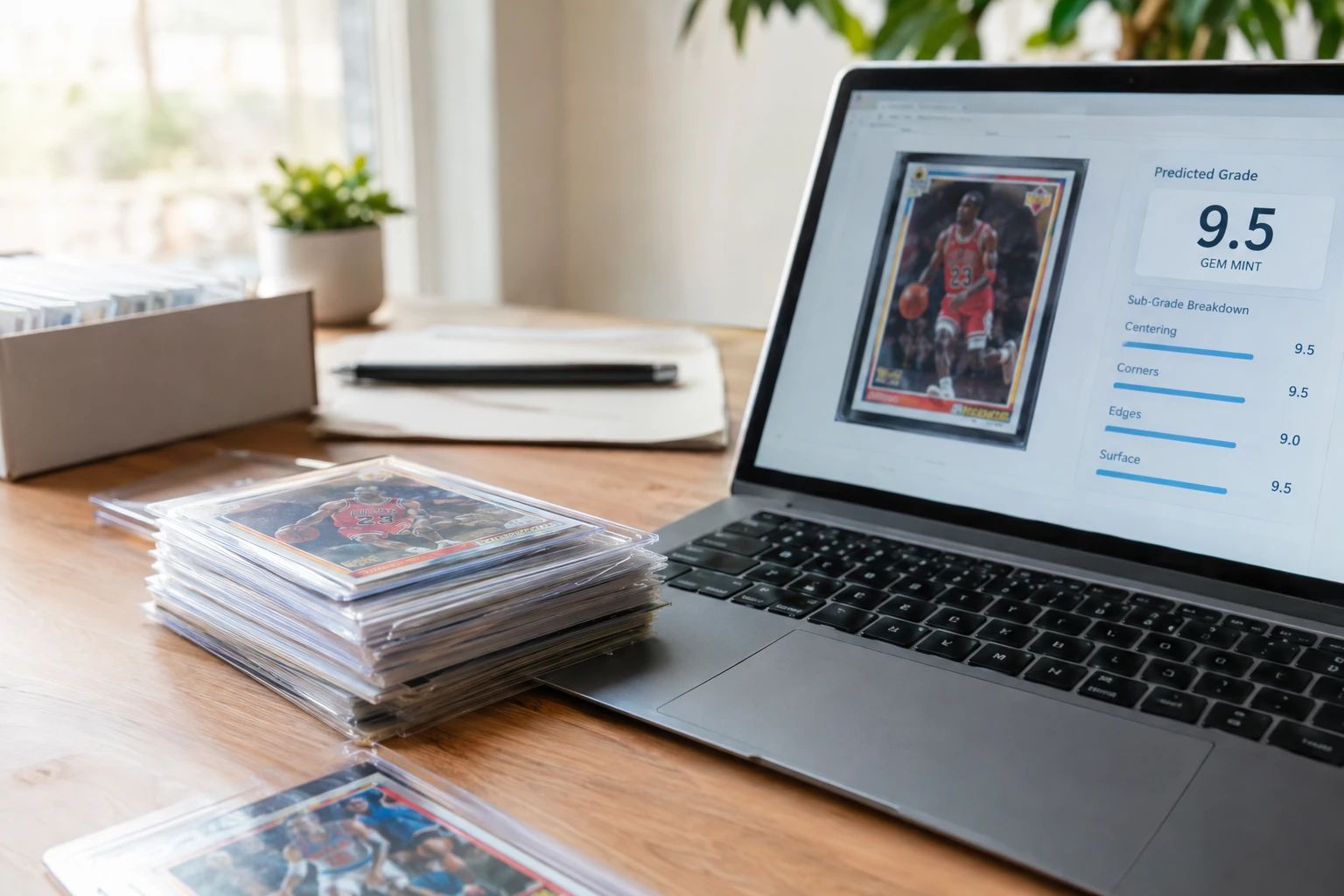
A PSA pre-grader is a tool — typically AI-powered — that predicts the grade PSA will assign to your card before you submit it. You photograph your card, upload it to the tool, and receive a predicted PSA grade (e.g., "PSA 9.2") along with sub-grade breakdowns for centering, corners, edges, and surface. The entire process takes 30-90 seconds and costs $0-$2 per card.
The purpose is simple: know what you have before you spend money. PSA Regular submissions cost $79.99 per card as of February 2026. The PSA backlog sits at 11.85 million cards. Turnaround times range from 45 working days (Express at $150) to 150+ working days (Economy at $25). If you submit a card expecting PSA 10 and it comes back PSA 8, you have lost the grading fee, shipping, insurance, and months of opportunity cost.
PSA pre-grading eliminates the guesswork. Instead of submitting 50 cards and hoping for the best, you pre-grade all 50, identify the 15-20 with genuine PSA 9+ potential, and submit only those. The rest you sell raw with an AI condition report or hold in your collection. The result: fewer submissions, higher average grades on submitted cards, and thousands of dollars in saved fees.
In 2026, multiple platforms offer PSA pre-grading: PreGradeCards, CardGrade.io, CardSense AI, TCGrader, ZeroPop, SnapGradeAI, and others. This guide covers how pre-grading works, what accuracy to expect, and how to use it to make profitable submission decisions.
How AI Predicts Your PSA Grade
AI PSA pre-graders use computer vision — the same technology behind self-driving cars and facial recognition — to analyze your card photo and predict the grade a professional PSA grader would assign. Here is what happens in those 30-90 seconds:
Step 1: Image Capture and Preprocessing
You upload a photo of your card (front and back). The AI finds the card edges, removes the background, and straightens the image. This is called segmentation — isolating the card from the photo so only the card itself is analyzed.
Step 2: Zone Analysis
The AI divides the card into zones and analyzes each one. PreGradeCards evaluates centering, all four corners, every edge, and surface across both front and back. CardGrade.io scans 47 inspection points across 16 zones. The AI measures:
- Centering: Pixel-level measurement of left/right and top/bottom border ratios
- Corners: Detection of whitening, fraying, softening, and dinging at each corner
- Edges: Perimeter scan for chipping, silvering, whitening, and rough cuts
- Surface: Detection of print lines, scratches, stains, dents, and gloss disruptions
Step 3: Grade Prediction
The AI model — trained on thousands or millions of professionally graded cards — outputs a predicted grade on the PSA 1-10 scale. It also generates sub-grade scores for each pillar and a confidence score indicating how certain the prediction is.
Step 4: Multi-Company Predictions
Some tools, including PreGradeCards and CardGrade, generate predictions for PSA, BGS, and CGC simultaneously. This is valuable because the three companies have different standards — a card that maxes at PSA 9 might earn BGS 9.5 with a 10 sub-grade in centering.
PSA Pre-Grader Accuracy: What the Data Shows
Accuracy is the question every collector asks: "Can I trust the AI's prediction?" The answer depends on which tool you use and what type of cards you collect. Here is the published data:
PreGradeCards: 10,000-Card Benchmark
The PreGradeCards accuracy benchmark is the largest published study: 10,000 cards compared to final PSA certification grades. Results: 89% within one grade point, 68.4% exact match, 99.2% centering accuracy, 82% PSA 10 binary prediction accuracy.
SnapGradeAI: 412 Verified Returns
SnapGradeAI publishes a 412-card verified log where predictions were recorded before PSA submission and actual grades after. Results: 87% within plus or minus 0.5, 96% within plus or minus 1.0. Pokemon-specific: 89% within plus or minus 0.5 on 218 cards.
CardGrade.io: 92.8% Claimed
CardGrade claims 92.8% within one grade point. However, their methodology note states this is based on "model outputs from user-supplied images, not matched professional grading returns." This is a model confidence metric, not a verified PSA return comparison.
What This Means for You
For modern cards (2010+), AI pre-grading is highly reliable at 91-93% accuracy. You can confidently submit cards the AI predicts PSA 9 or above. For vintage cards (pre-1980), accuracy drops to 71-79% — use AI as a first filter only and rely more on manual inspection.
The most important metric for submission decisions is PSA 10 binary prediction: 82% accuracy with an 11% false positive rate. This means if you submit every card the AI says will get PSA 10, about 1 in 9 will come back lower. That is a known, manageable cost — far better than submitting blindly.
For a deeper dive into all accuracy data, see our AI Card Grading Accuracy Benchmark guide.
PSA Grading Standards Explained
To use a PSA pre-grader effectively, you need to understand what PSA actually evaluates. PSA grades on a 1-10 scale with half-point increments (8.5, 9.5, etc.). The grade is determined by four sub-criteria:
| Grade | Centering (Front) | Corners | Edges | Surface |
|---|---|---|---|---|
| PSA 10 (Gem Mint) | 60/40 or better | No wear visible at 10x | Clean, no chipping | No print defects, full gloss |
| PSA 9 (Mint) | 70/30 or better | One minor flaw at 10x | Minimal wear | One minor imperfection |
| PSA 8 (NM-MT) | 75/25 or better | Light wear on 1-2 corners | Slight wear or chipping | Minor surface defect |
| PSA 7 (NM) | 80/20 or better | Visible wear on multiple corners | Moderate wear | Visible surface defect |
Simplified for clarity. PSA's full standards are more nuanced and consider eye appeal, back condition, and card-type-specific factors.
The key insight: PSA 10 is not "perfect." It allows 60/40 centering and one very minor flaw that is nearly invisible at 10x magnification. But the margin between PSA 9 and PSA 10 is razor-thin. A single corner with faint whitening under 10x loupe, or centering at 62/38 instead of 60/40, drops a card from 10 to 9. The value gap can be enormous — a PSA 10 LeBron rookie can sell for 5x the PSA 9.
The Submission ROI Math
Pre-grading is not just about accuracy — it is about money. Here is the ROI math that makes the case:
Scenario: 50 Cards to Evaluate
| Approach | Cards Submitted | Grading Cost | AI Cost | Total Cost | Avg Grade |
|---|---|---|---|---|---|
| No pre-screening | 50 | $3,999.50 | $0 | $3,999.50 | PSA 7.8 |
| AI pre-screening (PSA 9+ threshold) | 18 | $1,439.82 | $10 | $1,449.82 | PSA 9.1 |
Assumes PSA Regular at $79.99/card. AI pre-grading at $0.20/card for 50 cards. Net savings: $2,549.68 in grading fees alone.
The Per-Card Decision
For each card, the decision is: (Expected graded value x probability of target grade) - grading cost - shipping - insurance > raw value?
Example: A card worth $50 raw. PSA 9 value: $120. PSA 10 value: $400. AI predicts PSA 9 with 85% confidence. PSA Regular: $79.99. Shipping: $15. Insurance: $5.
- Expected value if submitted: ($120 x 0.85) + ($400 x 0.10) + ($80 x 0.05) = $102 + $40 + $4 = $146
- Total cost: $79.99 + $15 + $5 = $99.99
- Net: $146 - $99.99 = $46.01 profit
- Raw sale value: $50
- Decision: Sell raw. The expected profit from grading ($46.01) is less than selling raw ($50).
Now change the AI prediction to PSA 9.5 with 80% confidence:
- Expected value: ($120 x 0.15) + ($400 x 0.80) + ($80 x 0.05) = $18 + $320 + $4 = $342
- Net: $342 - $99.99 = $242.01 profit
- Decision: Submit. The expected profit ($242.01) far exceeds selling raw ($50).
This is the power of pre-grading: it turns a guess into a calculation.
The Complete Pre-Grade-to-Submit Workflow
Here is the step-by-step workflow that maximizes your PSA submission ROI:
Step 1: Photograph Your Cards
Take high-resolution photos of the front and back of each card under even, daylight-balanced lighting. Use a neutral background. Fill the frame with the card, leaving a small margin. No flash. For best results, use a phone stand for consistency.
Step 2: Run AI Pre-Grading
Upload front and back photos to PreGradeCards Complete Card Grading. The AI returns sub-grades for centering, corners, edges, and surface, plus predicted PSA/BGS/CGC grades and a confidence score. For bulk, use the Batch Grading tool to process 20 cards at once.
Step 3: Sort by Predicted Grade
Sort your cards into three piles based on the AI prediction:
- Submit pile: Cards predicted PSA 9+ with 80%+ confidence. These are your professional grading candidates.
- Sell raw pile: Cards predicted PSA 7-8. Sell these raw with an AI condition report to justify your asking price.
- Hold pile: Cards predicted PSA 6 or below. Not worth grading or selling individually.
Step 4: Manual Verification
For the submit pile, do a quick manual check with a 10x loupe (corners) and raking light (surface). This catches the 11% of PSA 10 false positives. If the manual check confirms the AI prediction, proceed.
Step 5: Check Population Reports
Before submitting, check the PSA population report for each card. A card that will grade PSA 10 but already has 5,000 PSA 10s in the pop report may not be worth the grading cost. Focus on cards with low existing populations at the target grade.
Step 6: Calculate ROI
For each submit candidate, calculate: (Expected graded value x probability) - grading cost - shipping - insurance > raw value? If yes, submit. If no, sell raw.
Step 7: Choose Submission Tier
Select the PSA tier based on card value and urgency. See the tier comparison below.
Step 8: Package and Ship
Use card savers (not toploaders — PSA requires card savers for submission). Package securely with insurance. Ship via tracked, insured mail.
Choosing the Right PSA Submission Tier
PSA offers multiple submission tiers. The right tier depends on your card's value and how quickly you need it back:
| Tier | Cost | Max Value | Turnaround | Best For |
|---|---|---|---|---|
| Value Bulk | $15/card | $199 | 65 days | Low-value cards ($50-$199) |
| Value | $25/card | $499 | 45 days | Mid-value cards ($100-$499) |
| Regular | $79.99/card | $1,499 | 20 days | Standard value cards |
| Express | $150/card | $2,999 | 10 days | High-value, time-sensitive |
| Super Express | $300/card | $4,999 | 5 days | Premium cards, fast flip |
PSA pricing as of February 2026. Check psacard.com for current rates.
The key decision: do not over-tier. If your card is worth $200 and the AI predicts PSA 9, use Value Bulk at $15/card, not Regular at $79.99. The grade will be the same regardless of tier — you are paying for speed and higher declared value, not a better grade.
PSA vs BGS vs CGC: Which to Submit To
Pre-grading tools predict grades for PSA, BGS, and CGC simultaneously. But which company should you submit to? The answer depends on the card type, your goals, and market liquidity:
PSA (Professional Sports Authenticator)
- Best for: Sports cards, modern rookies, cards where resale liquidity matters most
- Strength: Highest market recognition and resale value. PSA 10 carries the strongest premium.
- Weakness: Most expensive, longest backlog (11.85M cards), strictest centering standards
- Scale: 1-10 with half-points
BGS (Beckett Grading Services)
- Best for: Cards where sub-grades matter, premium black-label outcomes, TCG cards
- Strength: Sub-grade transparency (4 individual scores), Black Label 10 (perfect) carries massive premium
- Weakness: Base and Standard tiers paused as of 2026, less liquid than PSA for sports cards
- Scale: 1-10 with sub-grades (centering, corners, edges, surface)
CGC (Certified Guaranty Company)
- Best for: TCG cards (Pokemon, MTG, Yu-Gi-Oh!), budget submissions
- Strength: Cheapest economy tier ($17/card), fastest turnaround for TCG, Pristine 10 label
- Weakness: Lower resale premium than PSA for sports cards
- Scale: 1-10 with Pristine 10 (perfect sub-grades)
The general rule: PSA for sports cards (highest resale), CGC for TCG cards (best value), BGS when sub-grades add value or when chasing a Black Label. Use your AI pre-grade predictions for all three companies to compare expected values before choosing.
Common Pre-Grading Mistakes
1. Submitting Every Card the AI Says PSA 10
The 11% false positive rate means 1 in 9 PSA 10 predictions will be wrong. For high-value cards, do a manual verification with a loupe before submitting. The manual check takes 30 seconds and saves $80 on a bad submission.
2. Ignoring Confidence Scores
A PSA 9 prediction with 95% confidence is a strong submit signal. A PSA 9 with 60% confidence is a coin flip. Always factor confidence into your decision. Set a threshold: only submit cards with 80%+ confidence.
3. Not Checking Population Reports
A PSA 10 card with 5,000 existing PSA 10s in the pop report may not be worth grading. The slab premium is driven by scarcity. Always check the pop report before submitting.
4. Over-Tiering Submissions
Do not submit a $200 card at PSA Regular ($79.99) when Value Bulk ($15) would work. The grade is the same regardless of tier. You are paying for speed and declared value, not a better grade.
5. Bad Photos Leading to Bad Predictions
AI accuracy depends on photo quality. Dim, uneven lighting with a shaky hand produces inaccurate predictions. Invest 5 minutes in a proper photo station for reliable results.
6. Forgetting Back-Corner Whitening
On Pokemon cards, back-corner whitening is the #1 grade-killer. If you only photograph the front, the AI cannot detect it. Always upload both front and back photos.
Best PSA Pre-Grader Tools in 2026
Based on our complete app comparison, here are the best PSA pre-graders by use case:
- Best overall: PreGradeCards — 10,000-card accuracy study, 50 free credits, broadest card type support, batch processing.
- Best for Pokemon: SnapGradeAI — 89% within plus or minus 0.5 on 218 verified Pokemon returns, full transparency.
- Best free iOS: CardSense AI — free app with unlimited basic scanning, PSA/BGS/SGC predictions.
- Best for ROI decisions: ZeroPop — built-in ROI calculator showing break-even grade and expected profit at every PSA tier.
- Best for eBay buyers: CardGrade.io — Chrome extension grades cards directly from eBay listings.
- Best free no-account: MasterGrade.ai — 3 free grades per day, no signup required.
Ready to predict your PSA grade? Start with PreGradeCards Complete Card Grading — 50 free credits, no credit card required.
Sources & Further Reading
- PreGradeCards — AI Grading Accuracy Benchmark (10,000 Cards)
- SnapGradeAI — 412 Verified PSA Returns
- CardGrade.io — AI Card Grading Accuracy Benchmark
- TCGrader — AI vs PSA Grading Accuracy
- CardSense AI — PSA Pre-Grader
- PSA — Official Grading Standards and Pricing
Marcus Chen has evaluated over 50,000 sports cards and TCG cards across PSA, BGS, SGC, and CGC standards. Before joining PreGradeCards, he worked as a submission specialist for a major grading company and trained collectors and dealers on condition assessment.
Create a free account and get 1 free credit — enough for 1 complete AI grading with market pricing. No credit card required.
Sign Up Free →