The Short Answer
- The sports card industry graded a record 3.5 million cards in June 2026 — PSA alone graded 2.5 million, up 74% year-over-year, with Value tiers closed the entire time.
- PSA Value tier reopening has slipped from October 2026 toward winter 2026-2027. The backlog has dropped from 14 million to ~11 million, but record output keeps absorbing capacity gains.
- The pending Collectors Holdings acquisition of Beckett means PSA, SGC, and Beckett would all sit under one roof — the biggest structural change in grading industry history.
- Topps returned to NBA licensing after 16 years, creating the first real competition with Panini Prizm. Topps Chrome has higher PSA 10 gem rates (15-20% vs 8-12%), while Prizm has deeper liquidity.
- AI pre-grading tools like PreGradeCards are transforming collector behavior — 89% accuracy within ±1 PSA grade means collectors can screen cards before spending $79.99+ on grading fees, saving 40-60% on wasted submissions.
Short Answer: Sports Card Market Outlook 2026
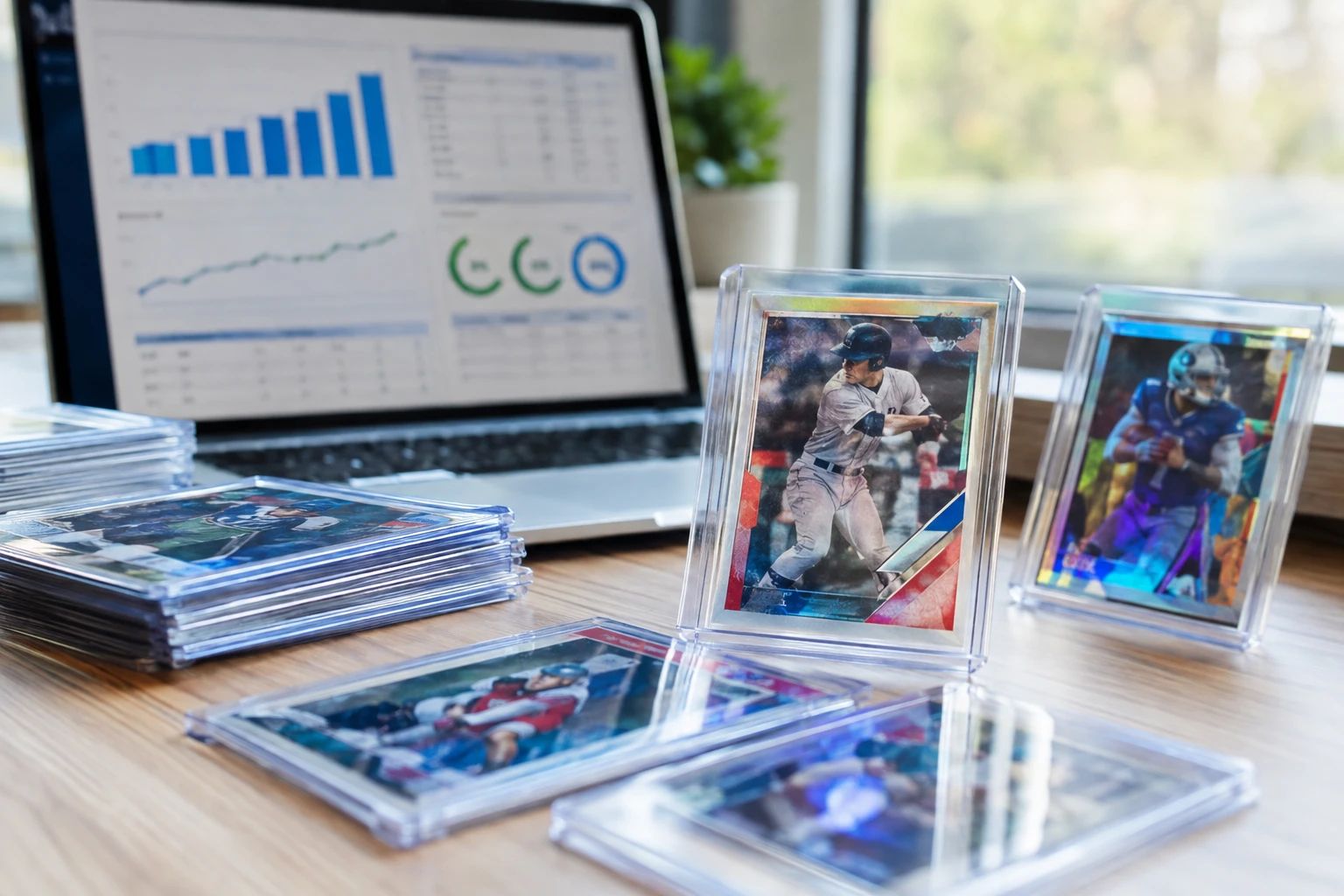
The sports card market in 2026 is healthier than ever by volume but structurally changing in ways that affect every collector and investor. Record grading volume (3.5M cards in June), PSA Value tier closure, the pending Beckett acquisition, and Topps returning to NBA licensing are reshaping the landscape. AI pre-grading tools are transforming how collectors decide which cards to submit.
For collectors: the cost of grading has increased (PSA Regular at $79.99 with Value tiers paused), making pre-screening more important than ever. Free AI grading from PreGradeCards lets you screen cards before spending money, saving 40-60% on wasted submission fees. CGC at $15/card and SGC at $25/card are the most affordable alternatives.
For investors: the market is bifurcating. Vintage blue-chips and high-grade modern rookies are appreciating, while overproduced modern commons are losing value. The key is selective buying — focus on rookie cards of Hall of Fame-caliber players with low PSA 10 populations, and use AI pre-grading to identify PSA 10 candidates before buying raw.
Record Grading Volume in 2026
The sports card industry is grading cards at a pace never seen before. According to GemRate data, the industry graded a record 3.5 million cards in June 2026, obliterating the previous record of 3.1 million set in April. A recent single-day figure came in at 107,073 cards graded across all major graders, with 525,792 in a seven-day window.
PSA: 2.50 million cards in June 2026 — up 21% from May and up 74% year-over-year. This record was set with the Value tier closed, meaning all volume came through Regular ($79.99) and higher tiers. The backlog has come down from 14 million to ~11 million, but record output keeps absorbing capacity gains.
CGC: 763,000 cards in 2026 to date, representing 78% growth year-over-year. CGC economy pricing at $15-$18/card makes it the most accessible option for bulk grading. However, heavy submission volume has pushed economy turnaround to 60-100 business days.
Beckett: 146,000 cards in 2026, a 132% year-over-year jump. Beckett paused Base and Standard card grading on August 5, 2026, citing 102% YoY submission growth and 159% TCG growth. Reopening estimated September 15.
TAG: Continued strong growth, roughly 40% higher volume, with tiers repeatedly selling out. TAG's computer-vision grading with subgrade transparency has won over a growing audience. Resale still lags the established graders, though the gap has narrowed.
The volume records tell a clear story: demand for grading has never been higher. The behavioral shift from "grade to sell" to "grade to protect and authenticate" means capacity expansions keep getting absorbed rather than clearing backlogs. This is a structural change, not a temporary spike.
PSA Value Tier Closure: Impact on the Market
PSA's Value tier has been halted since June 2, 2026, fundamentally changing the economics of card grading. The Value tier was the most popular entry point for collectors, offering grading at $19.99-$24.99 per card for cards valued under $999. Without it, the baseline PSA entry point is Regular at $79.99/card with a 40-50 business day turnaround.
Timeline for reopening: The backlog has been coming down steadily — from 14 million at peak to ~11 million on record output. At roughly 1 million cards cleared per bi-weekly period, PSA could reopen Value tiers by mid-October 2026. However, projections have slipped from October toward winter 2026-2027 as record output keeps absorbing capacity gains.
Impact on collectors: With no budget PSA option, collectors are forced to either: (1) pay $79.99/card at PSA Regular, (2) switch to CGC Economy at $15-$18/card, (3) use SGC Economy at $25/card, or (4) wait for Value tiers to reopen. This has driven significant volume to CGC and SGC.
Impact on the market: The Value tier closure has reduced the number of low-value cards being graded. Cards worth under $50 are no longer worth grading at $79.99/card, which means fewer PSA slabs entering the market for modern commons and low-end rookies. This could eventually create scarcity for even mid-tier PSA slabs if the closure extends into 2027.
The AI grading silver lining: The Value tier closure has made pre-grading more valuable than ever. With PSA at $79.99/card, collectors cannot afford to submit cards that come back PSA 7-9. Free AI pre-grading from PreGradeCards (30 free credits, 89% accuracy) lets collectors screen their entire collection before spending money, ensuring that only PSA 10 candidates are submitted.
Industry Consolidation: The Beckett Acquisition
The pending Collectors Holdings acquisition of Beckett is the single biggest structural story in the grading industry right now. If the acquisition closes, PSA, SGC, and Beckett would all sit under one corporate roof — three of the five major graders under one owner.
What this means for collectors:
- Pricing power: Three major graders under one owner could lead to coordinated pricing, potentially keeping grading fees high even after backlogs clear.
- Reduced competition: With PSA, SGC, and BGS all owned by the same company, the only independent alternatives are CGC and TAG. This could stifle innovation and keep turnaround times longer.
- Slab standardization: The new owner could standardize slab designs, label formats, and grading standards across all three brands, potentially simplifying the market but reducing brand differentiation.
- Resale premium implications: If PSA, SGC, and BGS are all under one roof, the resale premium differences between them could narrow. SGC's vintage premium and BGS's sub-grade premium could converge with PSA's overall premium.
Regulatory risk: A three-brand acquisition could face antitrust scrutiny, particularly given the grading industry's already concentrated structure. The FTC or DOJ may review whether the acquisition substantially lessens competition in the card grading market.
Timeline: The acquisition was announced in December 2025. Closing was expected in mid-2026 but has faced regulatory review. Collectors should watch for closing announcements in Q3-Q4 2026, as this will reshape the grading landscape for years to come.
Topps vs Panini: The NBA Licensing Battle
Topps returned to NBA licensing in 2025 after 16 years, creating the first real competition with Panini Prizm in the basketball card market. This is reshaping the modern basketball card landscape:
Topps Chrome advantages: Sturdier cardstock that resists corner and edge damage during production and packaging. Higher PSA 10 gem rates — 15-20% of Topps Chrome submissions earn PSA 10 vs only 8-12% for Panini Prizm. This means more PSA 10s per submission, which translates to better grading ROI for collectors.
Panini Prizm advantages: 13+ years of comp history and price data. Deeper liquidity — more buyers and sellers actively trading Prizm cards. Established brand recognition among collectors. The Prizm Silver parallel is the most traded modern basketball card in existence.
Cooper Flagg as the battleground: Flagg is the first true test of Topps Chrome vs Prizm for a generational rookie. His Topps Chrome PSA 10 base runs $700, and the Superfractor 1/1 set a record at $180,000. When Panini releases their Flagg Prizm cards (expected late 2026 or early 2027), the market will have its first direct comparison. If Topps Chrome maintains a premium, it signals a permanent shift in brand preference.
Collector strategy: Diversify across both brands. Topps Chrome may grade better (higher gem rates), while Prizm may sell faster (deeper liquidity). For investment-grade rookies like Flagg, owning both the Topps Chrome and Panini Prizm PSA 10s provides exposure to whichever brand wins the long-term brand battle.
AI Grading: Transforming Collector Behavior
AI pre-grading tools are fundamentally changing how collectors approach card grading. PreGradeCards, TCGrader, CardGrade.io, and other AI tools now predict PSA grades with 85-93% accuracy from a single photo, and the technology is improving rapidly.
How AI grading changes the market:
- Reduces wasted submissions: The average collector saves 40-60% on wasted grading fees by pre-screening with AI before submitting to PSA. A single avoided PSA Regular submission saves $79.99.
- Democratizes grading knowledge: Previously, only experienced collectors could assess whether a card was a PSA 10 candidate. Now, anyone with a phone can get an objective condition assessment in seconds.
- Increases PSA 10 hit rate: Collectors who pre-screen with AI submit only their best candidates, which means a higher percentage of their submissions earn PSA 10. This could gradually increase the PSA 10 population for modern cards.
- Creates market efficiency: When collectors can instantly assess a card's grade, raw card pricing becomes more efficient. Cards that are clearly PSA 10 candidates command higher raw prices, while cards with visible defects trade at appropriate discounts.
PreGradeCards specifically: Offers 30 free credits on signup (enough to grade 30 cards), 89% accuracy within ±1 PSA grade, full subgrades for centering, corners, edges, and surface, and support for 21 TCGs, 6 sports, and 4 additional collectible categories. The AI uses computer vision and neural networks trained on 10,000+ benchmarked cards that were both AI-graded and professionally graded.
Limitations: AI grading is photo-dependent — poor lighting or blurry images reduce accuracy. It cannot detect alterations like trimming or recoloring that a physical grader would catch. And it does not produce a physical slab — you still need PSA, BGS, CGC, or SGC for resale authentication. AI grading is a screening tool, not a replacement for professional grading.
Key Events to Watch in 2026-2027
Several upcoming events will shape the sports card market through the end of 2026 and into 2027:
1. PSA Value Tier Reopening: The single most consequential event for anyone with bulk cards to grade. Estimates have moved from October 2026 toward winter 2026-2027. When Value reopens at $19.99-$24.99/card, expect a massive surge in submissions and a temporary backlog increase. Collectors with 50+ cards waiting to grade should prepare their submission lists now using AI pre-grading.
2. Beckett Acquisition Closing: Three of the five major graders under one owner will reshape pricing across the board. Watch for closing announcements in Q3-Q4 2026. If the acquisition faces antitrust challenges, the timeline could extend into 2027.
3. Fall Product Wave: The 30th Pokémon Celebration on October 2 and the Mega Evolution sets (Phantasmal Flames, Reality Fracture) will generate submission surges. For sports, the 2026 NFL season and NBA season tip-off will drive rookie card demand for Flagg, Daniels, Williams, and the 2026 draft class.
4. CGC Turnaround Stabilization: If CGC economy pushes past 100 business days, the accessible tier stops being accessible. CGC needs to stabilize turnaround times to maintain its position as the budget alternative to PSA.
5. Panini NBA Exit: Panini's NBA license expires after 2025-26 products. Topps/Fanatics takes over exclusively. This means Panini Prizm basketball cards from 2025-26 and earlier will become "last of an era" products, potentially appreciating as collectors recognize their historical significance.
6. 2026 NFL Draft Class: The 2026 QB class (Cam Ward, Nico Iamaleava, and others) will drive the next wave of football card speculation. Bowman University Chrome 1st Autos are the current liquidity point before NFL-licensed Prizm cards arrive.
How Collectors Should Position in 2026
Based on the market outlook, here is how collectors and investors should position themselves:
For budget collectors ($50-$500): Use free AI pre-grading to identify PSA 10 candidates from your existing collection. Submit only the best 2-3 candidates to PSA or CGC. Buy raw rookie cards of confirmed stars (Wembanyama Prizm Silver, Flagg Topps Chrome base) and grade them. Avoid speculative prospects — stick to players with proven performance.
For mid-tier collectors ($500-$5,000): Build a diversified portfolio: 40% blue-chip PSA 10s (Wembanyama, Flagg, Mahomes), 30% vintage graded (SGC vintage, PSA 9 modern stars), 20% sealed product (Evolving Skies, 30th Celebration), 10% speculation. Use AI grading on every raw card purchase before buying.
For high-end collectors ($5,000+): Focus on trophy assets: 1986 Fleer Jordan PSA 9, 1952 Topps Mantle PSA 4-7, 2000 Contenders Brady RC Auto PSA 8-9. These have decades of proven demand and the lowest downside risk. Consider PWCC Premier Auctions for buying and selling high-end cards — consigned cards routinely realize 10-15% higher prices than eBay.
For all collectors:
- Always pre-grade with AI before submitting to PSA — it saves 40-60% on wasted fees.
- Wait for PSA Value tier reopening if you have 50+ cards to grade — the savings will be substantial.
- Diversify across sports — do not over-concentrate in one sport or one player.
- Buy vintage graded only — never buy raw vintage due to counterfeit risk.
- Watch the Beckett acquisition — it will reshape grading pricing and competition.
- Position for the Panini NBA exit — 2025-26 Prizm basketball could become "last of an era" products.
2026-2027 Market Predictions
Based on current data and trends, here are the key predictions for the sports card market through 2026-2027:
1. PSA Value tier reopens Q1 2027: The backlog will continue declining through Q4 2026 as record output persists. Value tier reopening in January-March 2027 will trigger a massive submission surge, temporarily increasing backlogs but providing budget grading access for the first time in 8+ months.
2. Beckett acquisition closes Q4 2026: Regulatory review will conclude by late 2026, allowing the acquisition to close. Expect pricing alignment across PSA, SGC, and BGS within 6-12 months of closing, with potential for bundled grading packages across brands.
3. Topps Chrome overtakes Prizm for NBA rookies: Higher gem rates and sturdier cardstock will drive collector preference toward Topps Chrome for NBA rookies. Prizm will maintain a liquidity advantage for 2-3 years but will gradually lose market share for new rookie cards.
4. AI grading becomes standard practice: By end of 2026, pre-grading with AI tools before submitting to PSA will be standard practice for 70%+ of serious collectors. This will increase PSA 10 hit rates on submissions and reduce the total number of cards submitted (as collectors skip low-grade candidates).
5. Vintage continues to outperform modern: The bifurcation between vintage blue-chips and modern commons will widen. Vintage PSA 9-10 cards will appreciate 15-30% annually, while modern commons and overproduced parallels will stagnate or decline.
6. CGC becomes the default budget grader: With PSA Value closed and Beckett pausing, CGC at $15-$18/card will capture the budget grading market. CGC's turnaround times will stabilize in Q4 2026 as they expand capacity to meet demand.
7. Cooper Flagg becomes the new Wembanyama: Flagg's Topps Chrome rookies will appreciate 50-100% over 2026-2027 as he establishes himself as an NBA superstar. The American market connects more deeply with American stars, driving deeper domestic collector demand.
Frequently Asked Questions
Is the sports card market growing or declining in 2026?
When will PSA Value tiers reopen?
What is the Beckett acquisition and why does it matter?
Should I grade cards now or wait for PSA Value to reopen?
Will Topps Chrome or Panini Prizm be better for basketball cards?
How is AI grading changing the sports card market?
What sports cards will go up in value in 2026-2027?
Sources & Further Reading
- GemRate Grading Industry Volume Data
- TheCardShopFinder: Card Grading August 2026
- CardGrade: State of Card Grading 2026
- PSA Grading Services & Pricing
- PreGradeCards Free AI Card Grading
The PreGradeCards Research Team combines machine-learning engineers, grading analysts, and collector-education specialists to produce accurate, data-driven guides on AI card grading, professional grading standards, and collecting strategy.
Create a free account and get 1 free credit — enough for 1 complete AI grading with market pricing. No credit card required.
Sign Up Free →