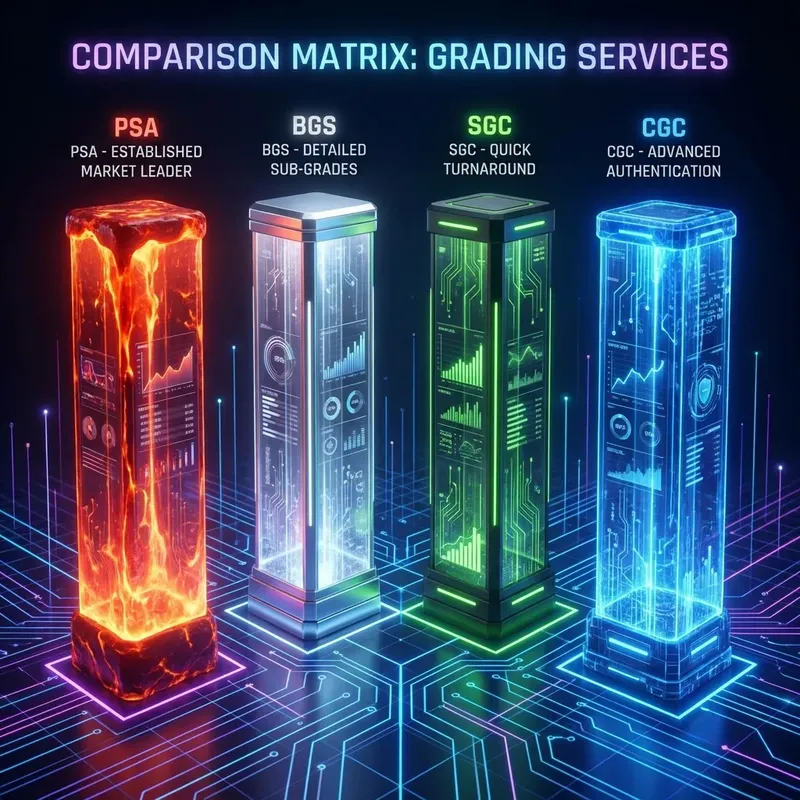
The Short Answer
- Collectors Holdings now owns PSA, SGC, and BGS — three of the four major graders — controlling 80% of the market. CGC is the only major independent.
- PSA commands the highest resale premium (+65% over raw) but Value tiers are paused, making Regular ($79.99) the cheapest option.
- CGC is the value leader at $15/card Economy and has grown 121% year-over-year, largely from TCG and Pokemon grading.
- BGS is the only major with sub-grades on every label. A BGS 10 Black Label (quad-10) can exceed PSA 10 prices.
- SGC offers the fastest turnaround (20-30 days Economy) and is the preferred grader for vintage pre-1980 cards.
- TAG is the newest entrant, offering photographic sub-grade reports that show exactly why each score was assigned.
- Use AI pre-grading to determine which company is best for each card before spending money on submissions.
Short Answer: Which Card Grader Is Best in 2026?
There is no single best card grader in 2026. The right choice depends on your card type, budget, timeline, and resale goals.
For maximum resale value on modern sports cards, PSA remains the default — its PSA 10 commands the highest premium on eBay, PWCC, and Goldin. But with Value tiers paused at $79.99/card, the cost of PSA grading has never been higher.
For TCG cards (Pokemon, MTG, Yu-Gi-Oh!), CGC is the strongest option — $15/card Economy pricing, fast turnaround, and growing market acceptance. CGC grew 121% year-over-year in 2025.
For vintage cards, SGC offers the fastest turnaround (20-30 days) and their tuxedo slab is preferred by many vintage collectors. SGC grades for vintage approach PSA premium levels.
For sub-grade transparency and the Black Label chase, BGS is the only major that prints all four sub-grades on every label. A BGS 10 Black Label is the rarest grade in the hobby.
For photographic proof of how your grade was determined, TAG is the newest option, providing a photo-based sub-grade report with each card.
2026 Card Grading Company Comparison Table
| Feature | PSA | BGS | CGC | SGC | TAG |
|---|---|---|---|---|---|
| Founded | 1991 | 1999 | 2000 (cards: 2020) | 1998 | 2023 |
| Ownership | Collectors Holdings | Collectors Holdings | Independent | Collectors Holdings | Independent |
| Cheapest Tier | $79.99 (Regular) | $20 (Economy) | $15 (Economy) | $25 (Economy) | $12 (Bulk) |
| Value Tier Status | PAUSED | Active | Active | Active | Active |
| Turnaround (Economy) | 65-120 days | 80-100 days | 30-45 days | 20-30 days | 15-25 days |
| Sub-Grades | No (extra fee) | Yes (standard) | Optional | No | Yes (photographic) |
| Grading Scale | 1-10 (whole) | 1-10 (half-pt) | 1-10 (half-pt) | 1-10 (half-pt) | 1-10 (half-pt) |
| Top Grade | PSA 10 Gem Mint | BGS 10 Black Label | CGC 10 Pristine | SGC 10 Pristine | TAG 10 |
| Resale Premium | +65% (highest) | +35% | +25-30% | +40% | Growing |
| Best For | Modern sports, resale | Sub-grades, Black Label | TCG, value grading | Vintage, speed | Transparency |
| Market Share | ~72% | ~5% | ~20% | ~3% | <1% |
PSA: The Market Standard
Professional Sports Authenticator (PSA), founded in 1991, is the most recognized brand in card grading. PSA has authenticated over 40 million cards with a total declared value surpassing $1 billion. For most modern sports cards, a PSA slab commands the highest premium on the secondary market.
Strengths:
- Highest resale premiums — PSA 10s sell for 50-70% more than BGS 9.5s of the same card
- Most recognized brand among casual collectors and investors
- Comprehensive population reports and price guides via Sports Market Report
- Set Registry for competitive set building
- PSA/DNA division for autograph authentication
Weaknesses:
- Value tiers PAUSED since June 2, 2026 — cheapest option is Regular at $79.99/card
- Longest turnaround times at economy tiers (65-120 business days)
- No sub-grades on label (available for extra fee)
- Two price hikes in 2025-2026
- Owned by Collectors Holdings along with SGC and BGS
Best for: Modern sports cards where resale value is the priority. Any card where you want maximum market liquidity. Vintage high-end cards where PSA brand recognition matters most.
BGS (Beckett): The Sub-Grade Specialist
Beckett Grading Services (BGS), founded in 1999, is defined by its sub-grade system. Every card receives four scores — centering, corners, edges, and surface — displayed on the label. The BGS 10 Black Label (perfect 10 on all four sub-grades) is one of the most coveted designations in the hobby.
Strengths:
- Sub-grades on every label at no extra cost — maximum transparency
- Black Label 10 (quad-10) commands 2-5x PSA 10 prices on key cards
- Half-point grading captures cards between PSA 9 and 10
- Raw Card Review at card shows for in-person feedback
- BVG (Beckett Vintage Grading) for pre-1981 cards
Weaknesses:
- Resale premium below PSA for most modern cards (+35% vs +65%)
- Thicker slab design is less popular with some collectors
- Now owned by Collectors Holdings (same parent as PSA and SGC)
- Losing market share to CGC in TCG
Best for: Cards where sub-grades add real buyer information. Black Label chasing on cards where a perfect quad-10 would jump the value. Premium thick cards (RPAs, patch cards) where sub-grade transparency matters.
CGC: The TCG Insurgent
Certified Guaranty Company (CGC), originally known for comic book grading, has rapidly expanded into trading cards since 2020. CGC is the only major independent grader left after Collectors Holdings acquired PSA, SGC, and BGS. CGC grew 121% year-over-year in 2025, largely from TCG and Pokemon grading.
Strengths:
- Lowest cost among major graders — $15/card Economy, $12/card Bulk (25-card min)
- Fastest standard turnaround among the big four (30-45 business days Economy)
- Optional sub-grades available
- CGC 10 Pristine designation for exceptional cards
- Only major independent grader — not owned by Collectors Holdings
- Dominant in Pokemon TCG and MTG grading
Weaknesses:
- Sports card resale below PSA
- CGC 10 typically sells for 72-85% of PSA 10 price
- Discontinued sub-grades on standard labels in 2025 (now optional)
Best for: TCG cards (Pokemon, MTG, Yu-Gi-Oh!, One Piece, Lorcana). Value grading for cards under $100 raw. Bulk submissions. Collectors who want an independent alternative to the Collectors Holdings monopoly.
SGC: The Vintage Speed King
Sportscard Guaranty Corporation (SGC), founded in 1998, built its name on clean, slim slabs and fast turnaround times. Their distinctive "Tuxedo" slab (black background with gold lettering) is instantly recognizable and has become a status symbol in the vintage community.
Strengths:
- Fastest turnaround among major graders — 20-30 business days Economy, 1-2 days Immediate tier
- Distinctive tuxedo slab preferred by many vintage collectors
- For vintage pre-1980 cards, SGC premiums approach PSA levels
- Competitive pricing at $25/card Economy
- Growing market share since 2020
Weaknesses:
- Resale below PSA for modern cards (+40% vs +65%)
- No sub-grades
- Now owned by Collectors Holdings (same parent as PSA and BGS)
- Smaller market share than PSA and CGC
Best for: Vintage cards (pre-1980). Fast turnaround needs. Collectors who prefer the SGC tuxedo aesthetic. Value-conscious vintage submissions.
TAG: The Transparency Newcomer
TAG (Technical Authentication & Grading), founded in 2023, is the newest entrant in the card grading market. TAG differentiates itself by providing photographic sub-grade reports that show exactly where and why each deduction was made.
Strengths:
- Photographic sub-grade reports — collectors see exactly what affected the grade
- Fast turnaround (15-25 business days)
- Competitive pricing ($12/card Bulk, $25/card Standard)
- Independent company
- Modern, tech-forward approach appealing to newer collectors
Weaknesses:
- Very small market share (<1%)
- Limited resale data — buyers are less familiar with TAG slabs
- Resale premium not yet established on secondary markets
- Brand recognition is minimal compared to PSA/CGC
Best for: Collectors who value transparency and want to understand exactly why their card received its grade. Early adopters. Cards where you want detailed condition documentation for personal records or insurance.
The Collectors Holdings Consolidation
The biggest story in the card grading industry in 2025-2026 is consolidation. Collectors Holdings, which already owned PSA (acquired 2021 for ~$700 million), acquired SGC in February 2024 and announced an agreement to acquire Beckett (BGS) in December 2025.
If the BGS acquisition closes, a single company would control roughly 80% of the grading market by volume, with three of the four major graders under one roof. This has drawn an antitrust lawsuit in California and a request for an FTC investigation.
CGC is the only major grader that remains independent. This has benefited CGC significantly — collectors uncomfortable with the consolidation have migrated to CGC, driving its 121% year-over-year volume growth.
The consolidation has also affected pricing. PSA raised prices twice in 2025-2026, citing submission volume outpacing capacity. When the dominant player controls 72% of the market, price pressure flows one direction: up.
Best Grader for Sports Cards
For modern sports cards (1980-present), PSA is the default choice when resale value is the priority. A PSA 10 sells for 50-70% more than a BGS 9.5 of the same card. The PSA brand is the most recognized among buyers, and PSA slabs have the deepest market liquidity on eBay, PWCC, and Goldin.
However, with PSA Value tiers paused at $79.99/card, CGC is the better ROI choice for cards under $100 raw. At $15/card Economy, CGC costs 81% less than PSA Regular. A CGC 10 typically sells for 72-85% of PSA 10 prices, so for lower-value cards the fee savings outweigh the resale premium difference.
For vintage sports cards (pre-1980), SGC is a strong alternative to PSA. SGC tuxedo slabs are preferred by many vintage collectors, and SGC premiums for vintage approach PSA levels. SGC also has faster turnaround (20-30 days vs 65-120 days for PSA Economy).
Best Grader for TCG Cards
For TCG cards (Pokemon, MTG, Yu-Gi-Oh!, One Piece, Lorcana, etc.), CGC is the strongest option in 2026. CGC dominates TCG grading with $15/card Economy pricing, fast turnaround, and growing market acceptance. CGC grew 121% year-over-year largely from TCG submissions.
PSA still commands the highest resale premium for Pokemon cards specifically. A PSA 10 Pokemon card typically sells for 5-10% more than a CGC 10 of the same card. For high-value Pokemon cards (Charizard alt arts, 1st Edition holos), PSA is worth the premium fee.
BGS is popular for MTG due to the sub-grade system. MTG collectors value the four sub-grades for vintage cards where condition nuance matters. A BGS 10 Black Label on an Alpha Black Lotus is the pinnacle of MTG grading.
For budget TCG grading, CGC Bulk at $12/card (25-card minimum) is the best value. For a 25-card Pokemon submission, CGC Bulk costs $300 total vs $2,000 for PSA Regular.
Best Grader for Vintage Cards
For vintage cards (pre-1980), the grader choice depends on the card value and your timeline.
PSA is the safest choice for high-value vintage cards. A PSA 7 1952 Topps Mickey Mantle is instantly recognized by all buyers. PSA brand recognition matters most in the vintage market, where buyers are often older collectors who have trusted PSA for decades.
SGC is the preferred alternative for vintage. The tuxedo slab is aesthetically suited to vintage cards, and SGC vintage grades approach PSA premium levels. SGC is also significantly faster (20-30 days vs 65-120 days for PSA Economy).
BVG (Beckett Vintage Grading) is a specialized service for pre-1981 cards. BVG uses the same grading standards as BGS but with a vintage-specific label. BVG is less common than PSA and SGC for vintage but offers sub-grades.
For pre-war cards (T206, Goudey, etc.), PSA is the standard. The PSA population report is the most comprehensive for pre-war issues, and PSA slabs are the most liquid in the vintage market.
Resale Premium Data: How Much More Does a PSA 10 Sell For?
Industry data from 2025-2026 market analysis shows clear resale premium differences between grading companies. Here is the data:
| Grader | Avg. Premium Over Raw | vs. PSA 10 Price | Best Category |
|---|---|---|---|
| PSA 10 | +65% | 100% (baseline) | Modern sports, vintage |
| SGC 10 | +40% | ~70-85% of PSA 10 | Vintage sports |
| BGS 9.5 | +35% | ~60-75% of PSA 10 | Sub-grade cards |
| CGC 10 | +25-30% | ~72-85% of PSA 10 | TCG, value grading |
| BGS 10 Black Label | +200-500% | 2-5x PSA 10 | Perfect condition chase |
| TAG 10 | Growing | Data insufficient | Transparency-focused |
The data shows that PSA 10 is the resale king for standard grades, but BGS 10 Black Label is the absolute ceiling when you can hit it. The Black Label premium exists because all four sub-grades must be perfect 10s — an extraordinarily rare outcome.
Frequently Asked Questions
Which card grading company is best in 2026?
Why are PSA Value tiers paused?
Is CGC as good as PSA?
Who owns PSA, BGS, and SGC?
What is a BGS Black Label?
Should I use AI pre-grading before choosing a grader?
How much does card grading cost in 2026?
Sources & Further Reading
- PSA Grading Services
- Beckett Grading Services
- CGC Trading Cards
- SGC Card Grading
- PreGradeCards Grading Cost Calculator
The PreGradeCards Research Team combines machine-learning engineers, grading analysts, and collector-education specialists to produce accurate, data-driven guides on AI card grading, professional grading standards, and collecting strategy.
With submission floors rising, pre-screening is no longer optional. Use our AI Pre-Grade Calculator to score a card's PSA 10 odds before you pay, and the Submission Planner to pick the right tier.