The Short Answer
- The 1st Edition Legend of Blue Eyes (LOB) Blue-Eyes White Dragon PSA 10 sold for $85,100 — the benchmark Yu-Gi-Oh! collectible.
- Yu-Gi-Oh! has the most complex edition system of any TCG — 1st Edition, Unlimited, and Limited Edition designations create significant price tiers.
- Tournament prize cards (Judge Prize, VJump promos, championship awards) are the rarest Yu-Gi-Oh! cards — some with fewer than 20 copies known to exist.
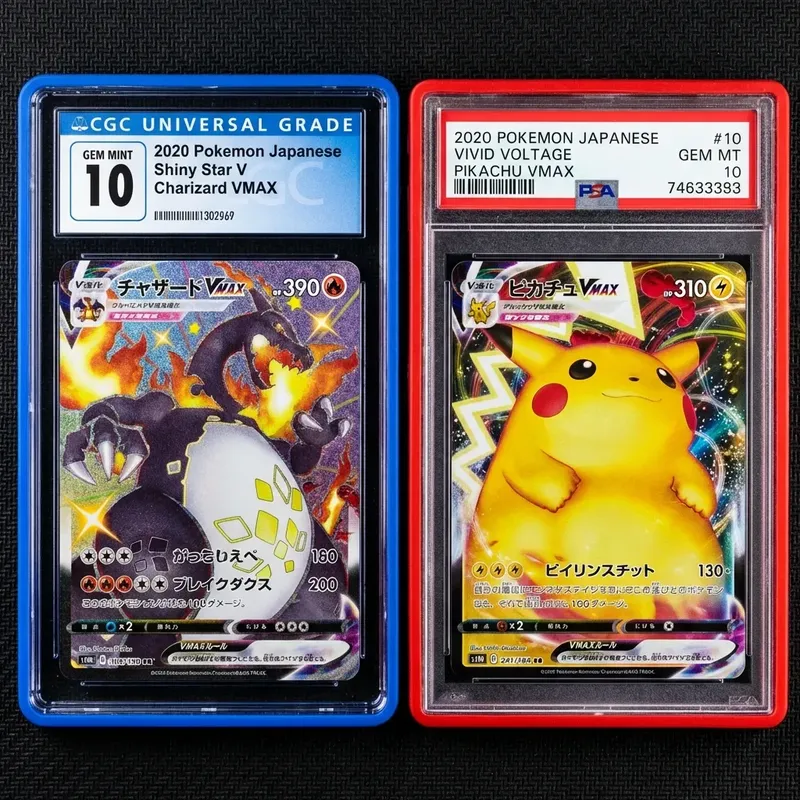
- PSA grades Yu-Gi-Oh! cards but CGC has gained significant market share in the YGO community due to TCG-specific expertise.
- Modern Collector's Rare and Ultimate Rare variants in post-2020 sets are the most collectible modern Yu-Gi-Oh! cards for grading.
Vintage Grails: Legend of Blue Eyes (LOB) Era (2002)
The original English Yu-Gi-Oh! set, Legend of Blue Eyes White Dragon (LOB), was released in March 2002. The cards from this set — especially 1st Edition Ultra Rares and Secret Rares — are the most sought-after graded YGO collectibles:
- LOB 1st Edition Blue-Eyes White Dragon (LOB-001) PSA 10 — The benchmark. Sold for $85,100 in 2021. PSA 10 population is extremely low due to the poor centering rates of early Konami printing. Any PSA 10 example is a genuine rarity.
- LOB 1st Edition Dark Magician PSA 10 — Equally iconic. At $25,000-$45,000 PSA 10. Dark Magician is the most beloved spellcaster character in the franchise.
- LOB 1st Edition Exodia the Forbidden One PSA 10 — The "God card" concept before the actual God cards. PSA 10 at $15,000-$30,000.
- Metal Raiders (MRD) 1st Edition Rainbow Dragon PSA 10 — The follow-up set introduced Black Skull Dragon and Summoned Skull. PSA 10 MRD 1st Edition Ultras at $5,000-$15,000 each.
The Yu-Gi-Oh! Edition System: Price Tiers
Yu-Gi-Oh! has a three-tier edition system that creates significant price differences for identical cards:
| Edition | Indicator | Rarity | Price Multiplier |
|---|---|---|---|
| 1st Edition | "1st Edition" text on card | Lowest print run | 3–10x |
| Limited Edition | "Limited Edition" text | Tin/special promos | 2–4x |
| Unlimited | No edition text | Highest print run | Baseline |
Always verify edition when purchasing vintage Yu-Gi-Oh! cards. A LOB Unlimited Blue-Eyes PSA 10 trades at $4,000-$6,000 — compared to $85,100 for the 1st Edition version. The edition multiplier is more extreme in Yu-Gi-Oh! than any other TCG.
Tournament Prize Cards: The Rarest Yu-Gi-Oh! Collectibles
Yu-Gi-Oh! has produced some of the rarest TCG collectibles ever through its tournament prize system:
- 2002 Tournament Black Luster Soldier — Only 1 known copy exists (the prize from the first Yu-Gi-Oh! tournament ever held). This is the most valuable YGO card ever offered — estimated at $10 million, though no public sale has confirmed a price.
- VJump Promos (Japanese exclusives) — Cards given away with the Japanese V-Jump magazine. Early VJump promos (2000-2005) have PSA populations under 10 and are collecting at $1,000-$10,000 PSA 10.
- Judge Prize/Award Cards — Awarded to judges at sanctioned tournaments. Print runs of 200-1,000. PSA 10 examples at $500-$3,000 depending on card power level and era.
- Regional Championship Prize cards — Mosaic Manticore, Crush Card Virus (trophy version). PSA 10 at $500-$2,000.
Modern Collector's Rare & Ultimate Rare (2020–2026)
Modern Yu-Gi-Oh! introduced new rarity tiers that have become the premium collectibles for non-vintage collectors:
- Collector's Rare — Introduced in 2019-20, these cards feature a rainbow-foil treatment applied to the card name, attribute, and image border simultaneously. Collector's Rare PSA 10 for key competitive cards at $150-$500.
- Quarter Century Secret Rare — Celebrating the 25th anniversary of Yu-Gi-Oh!, these gold-foil numbered parallels are the most premium modern YGO cards. PSA 10 QCR Dark Magician or Blue-Eyes at $300-$800.
- Starlight Rare — The rarest standard pull rarity in modern sets (approximately 1 in 576 packs — same as Pokémon SIR). Staple competitive Starlight Rares at $200-$600 PSA 10.
Grading Yu-Gi-Oh! Cards: Critical Tips
- Centering is the #1 issue: Konami's centering has been historically poor, especially pre-2015. Check centering with a ruler before any vintage submission — off-center cards cap at PSA 7-8 regardless of surface condition.
- CGC is the preferred YGO grader: The Yu-Gi-Oh! community has adopted CGC as the primary grading authority due to their TCG expertise and subgrade detail. CGC 10 YGO cards trade at 80-90% of PSA 10 — near parity for most cards.
- Foil wear on Ultras/Secrets: The ultra rare gold foil and secret rare foil on vintage YGO cards show mechanical wear from deck shuffling. Cards stored unsleeved (common in the early 2000s) will show foil scuffing that immediately caps at PSA 7.
- 1st Edition stamp check: The "1st Edition" stamp can be counterfeited on unlimited cards. Authenticate vintage LOB/MRD 1st Edition cards through comparison with known authentic examples before grading.
Pre-grading with AI tools is essential for vintage YGO — the PSA 10 hit rate on LOB 1st Edition is under 5% for most cards. Spending $79.99 on a PSA 7 prediction is avoidable.
Yu-Gi-Oh! Investment Framework 2026
- LOB 1st Edition is the safest vintage hold: The LOB 1st Edition set is the cornerstone of YGO collecting. PSA 9-10 Ultra Rares appreciate steadily due to nostalgia, fixed supply, and new generation collectors entering the hobby through the anime and games.
- Quarter Century promos are the modern grail chase: The 25th Anniversary period (2023-2025) produced the most collectible modern YGO cards. QCR and 25th Anniversary reprints of iconic cards at limited print runs.
- Competitive staples are volatile: Cards that are "meta" in tournament play spike in price, then crash when reprinted or when the meta shifts. Do not invest in competitive staples unless you have specific reprinting intelligence.
- Anniversary periods drive demand: The 25th Anniversary showed how milestone years spike YGO collecting. Watch for the 30th Anniversary (2028) — another major catalog demand event is coming.
Frequently Asked Questions
What is the most valuable Yu-Gi-Oh! card?
The 2002 Tournament Black Luster Soldier (1 copy known) is estimated at up to $10 million but has no public confirmed sale. Among graded cards with verified auction results, the LOB 1st Edition Blue-Eyes White Dragon PSA 10 at $85,100 is the benchmark. For accessible vintage, LOB 1st Edition Ultra Rares in PSA 9 at $3,000-$8,000 are the most collected high-value YGO cards.
Is CGC or PSA better for Yu-Gi-Oh! cards?
The Yu-Gi-Oh! community has broadly adopted CGC as the preferred grader due to TCG-specific expertise and the detailed subgrade system. CGC 10 YGO cards trade at 80-90% of PSA 10 value — near parity. For the highest-value sales ($5,000+), PSA still commands a premium. For most collectors, CGC is the recommended option.
What is a 1st Edition Yu-Gi-Oh! card and why is it valuable?
A 1st Edition card is printed in the first production run of a set, indicated by "1st Edition" text on the card face. Once this run sells out, subsequent prints are Unlimited Edition (no text). 1st Edition cards are typically 3-10x more valuable than Unlimited versions because of lower print runs and collector demand for "first printing" originals. The LOB 1st Edition Blue-Eyes vs. Unlimited price gap ($85,100 vs. $4,000-$6,000) is the extreme example.
Are Starlight Rares worth grading?
Yes for competitive staples with high demand. Starlight Rares have approximately the same pull rate as Pokémon SIRs (1 in ~576 packs), creating genuine scarcity. PSA 10 Starlight Rare competitive staples at $200-$600 provide positive grading ROI over most fee structures. Check the PSA 10 population before submitting — if pop exceeds 100, the premium narrows significantly.
Sources & Further Reading
Sarah Williams leads PreGradeCards educational content and collector onboarding. She has been a full-time collector and dealer for 12 years, specializing in modern sports cards and Pokémon TCG, and has written grading guides read by over 300,000 collectors.
With submission floors rising, pre-screening is no longer optional. Use our AI Pre-Grade Calculator to score a card's PSA 10 odds before you pay, and the Submission Planner to pick the right tier.