1986 Fleer Michael Jordan #57
The Red Border Under the Microscope
A forensic deep-dive into the most iconic basketball card ever produced. We examine the sub-millimeter evidence that separates a $700,000 Gem Mint from a $50,000 PSA 8.

The 1986 Fleer Michael Jordan #57 under forensic examination — corner softening and edge whitening visible under magnification.
Year: 1986
Set: Fleer Basketball
Card #: 57
Player: Michael Jordan RC
Magnification: 50x – 200x
Primary Target: Green Print Dot & Micro-Whitening
Risk Level: Critical
Why This Card Matters
The 1986 Fleer Michael Jordan #57 is the undisputed king of modern basketball cards. A PSA 10 Gem Mint copy sold for $738,000 in 2021, while even a PSA 9 commands $30,000–$50,000. The difference between these grades often comes down to details invisible to the naked eye — details that forensic analysis reveals with certainty.
The card's bright red border is both its signature and its Achilles' heel. Any edge whitening, corner softening, or centering deviation is immediately apparent against the vivid red background. This makes the card one of the most condition-sensitive issues in the hobby.
Forensic Analysis: The Red Border
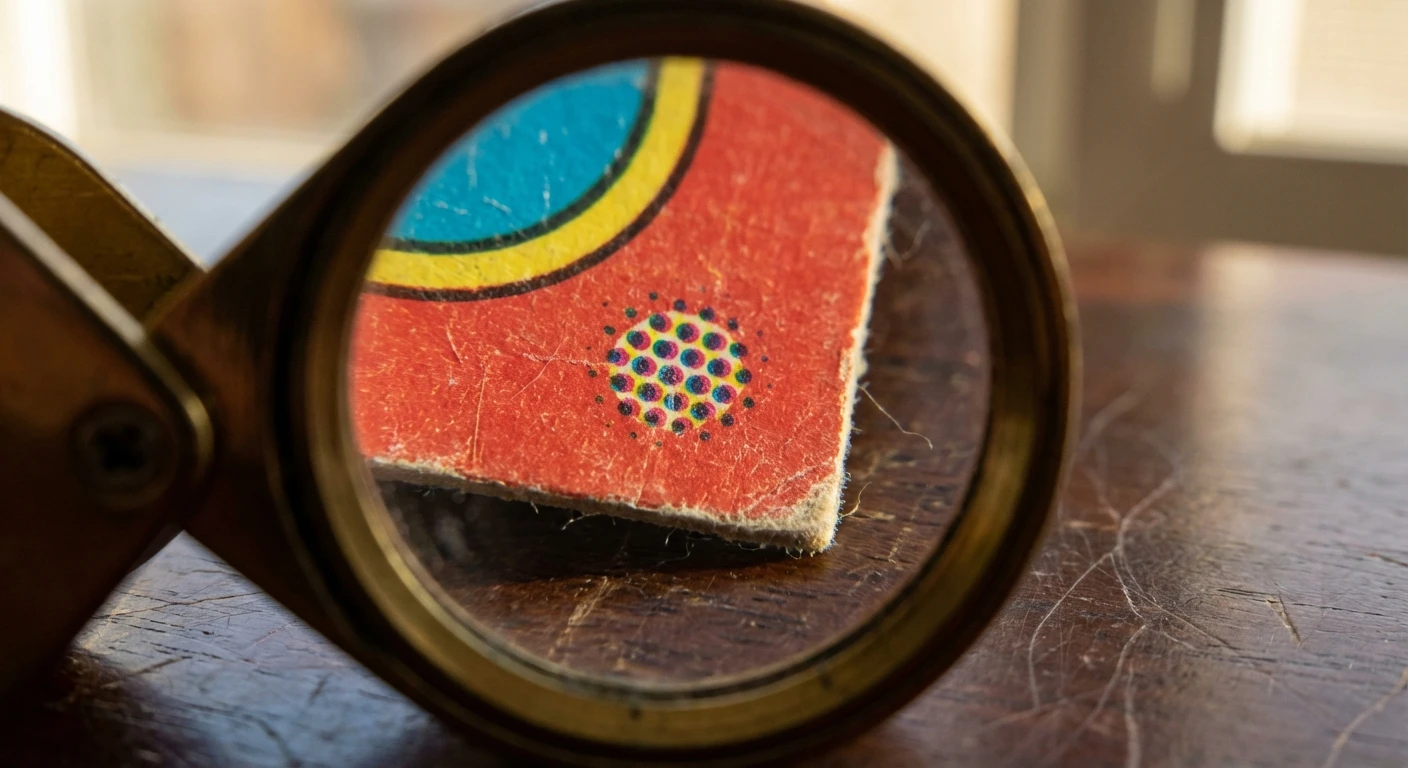
Under 200x magnification, the red border reveals the CMYK rosette print pattern — the fingerprint of authentic 1986 Fleer production.
Under 200x magnification, the red border must show a consistent rosette print pattern — the overlapping dot matrix created by the CMYK printing process. This pattern is the card's fingerprint. Counterfeit reproductions typically show a flat, inkjet-style pattern that lacks the depth and regularity of the original offset lithography.
Key Forensic Indicator: The Green Print Dot
A single green print dot frequently appears in the circular background pattern behind Jordan's image. This is a factory artifact from the printing process — a registration mark that bled through. Authenticators use this dot to verify genuine 1986 Fleer production. Its absence doesn't prove a fake, but its presence confirms authenticity.
Corner & Edge Analysis
The four corners of the 1986 Fleer Jordan are the primary battleground for grade determination. Under 50x magnification, even "sharp" corners often reveal:
Micro-Whitening
The red ink layer separates from the white cardstock at the corner tip, creating a hairline white arc visible only under magnification. This is the most common reason for PSA 9 vs. PSA 10 downgrades.
Corner Softening
The corner radius increases from the factory-sharp ~0.3mm to 0.5mm or more. This rounding is a 1–2 grade deduction depending on severity. The bottom-left corner is statistically the most affected due to how the cards were stacked and cut.
Edge Chipping
Small chips in the red border ink along the edges expose the white cardstock beneath. Even chips smaller than 0.5mm are detectable and will prevent a Gem Mint designation.
Centering Standards
PSA requires 60/40 centering or better for a PSA 10 on the 1986 Fleer Jordan. Due to the hand-cut production process, perfectly centered copies are exceptionally rare. The red border makes centering deviations immediately obvious — a 55/45 split is visible to the trained eye without measurement.
Grade Impact Summary
Counterfeit Detection
Due to the card's extreme value, counterfeits are common. Key authentication markers include:
- Rosette pattern consistency — Genuine cards show the offset lithography dot pattern at 200x. Fakes show inkjet or laser patterns.
- Card stock thickness — Authentic 1986 Fleer stock measures 0.020" ± 0.001". Reprints are typically thinner or thicker.
- UV fluorescence — Under UV light, genuine 1986 Fleer stock fluoresces a specific shade. Modern paper stocks fluoresce differently due to optical brightening agents.
- Back printing registration — The back of the card should show precise alignment of the blue and red ink layers. Misregistration on the back is common in counterfeits.
Pre-Grade Your Jordan Before Submission
Our AI forensic scan detects the same micro-defects shown in this case study. Know your grade before spending $150+ on professional grading.
Start Forensic Scan