The Short Answer
- Bowman Chrome releases September 9, 2026 — the deepest rookie autograph checklist in baseball with Misiorowski, Anthony, Caglianone, McGonigle, and Murakami.
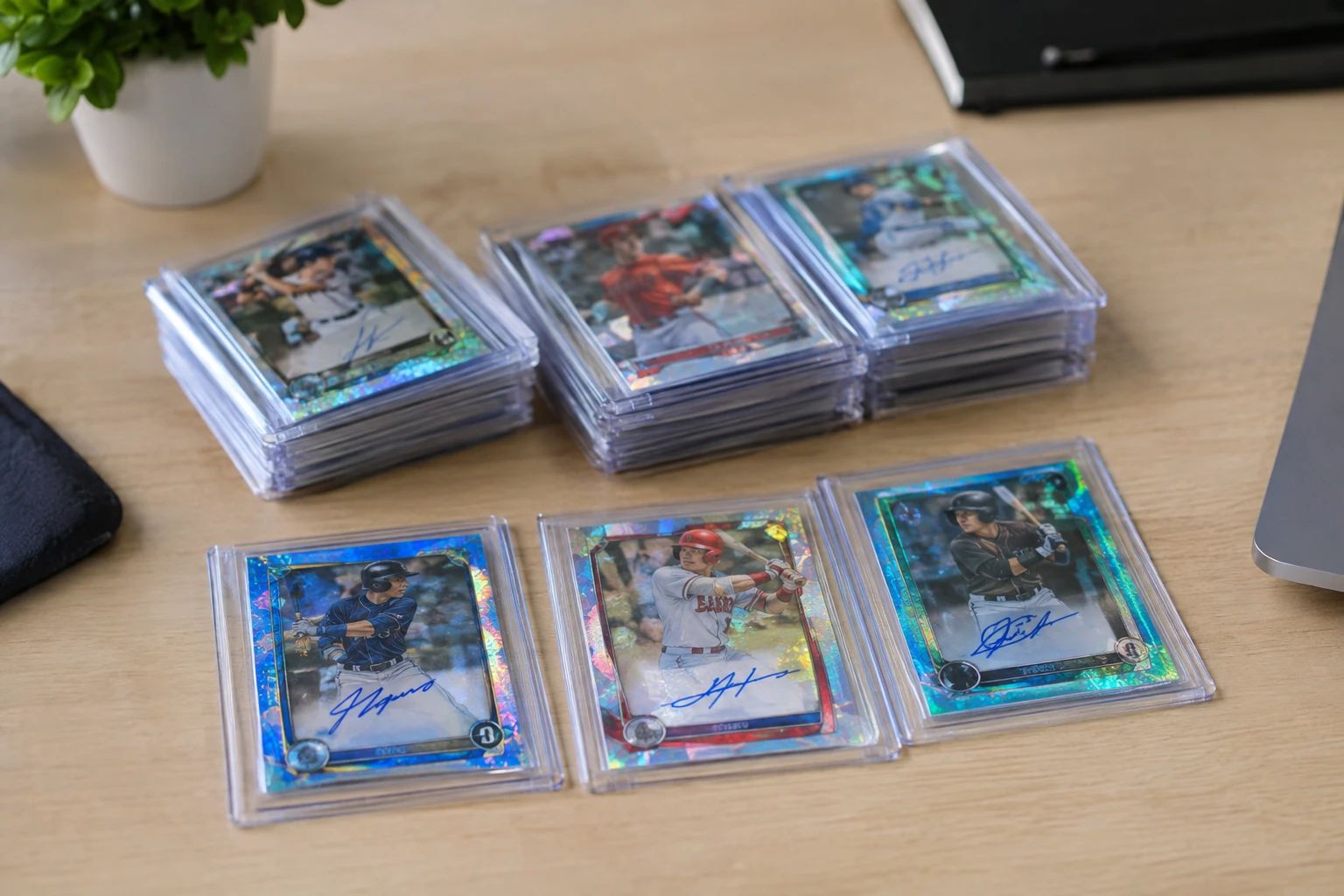
- Rookie Autographs are the headline chase — on-card signatures on Chrome design with full refractor rainbow up to 1/1 Superfractor.
- Refractor surface requires diffuse lighting — pack scratches and print lines are the #1 grade killer on Chrome cards. AI pre-grading with refractor calibration is essential.
- 1st Bowman cards are the most valuable prospect cards — a player's first Bowman Chrome card is always their most valuable pre-major-league card.
- Early-pop premium is real — PSA 10 slabs submitted in the first 2–4 weeks after release command 30–100% premiums over stabilized prices.
- AI pre-grading costs $0.15–$0.25/card and filters out 60–80% of Chrome cards that would waste $80+ in PSA fees on surface or centering failures.
2026 Bowman Chrome Baseball: Product Overview
2026 Bowman Chrome Baseball releases September 9, 2026, and it is the most important prospect product of the year for card graders. Bowman Chrome is where the hobby's future stars get their first chromium rookie cards with autographs — and for grading flippers, it is the single best product for capturing early-pop premiums on PSA 10 slabs.
Bowman Chrome is distinct from Topps Chrome (which released July 22, 2026 and features MLB veterans and current rookies). Bowman Chrome focuses on prospects — players who are either in the minor leagues, just called up, or in their first MLB season. The "1st Bowman" designation (a player's first Bowman Chrome card) is the most valuable label in prospect card collecting.
What Makes 2026 Bowman Chrome Special
- Elite rookie autograph class — Jacob Misiorowski, Roman Anthony, Jac Caglianone, Kevin McGonigle, JJ Wetherholt, Munetaka Murakami, Chase Burns, Cam Schlittler
- Topps 30th anniversary Chrome celebration — 2026 is the 30th anniversary of Topps Chrome, and Bowman Chrome carries commemorative design elements
- Panini MLB exclusive ending — Panini's MLB exclusive license is ending, making 2026 the last fully Panini-era Bowman product before Topps/Fanatics takes over
- International rookie class — Munetaka Murakami (Japanese star now with the White Sox) brings international collector demand to Bowman Chrome
- Deep refractor rainbow — full parallel set from Base Refractor through Superfractor 1/1, with color parallels at /499, /250, /150, /99, /50, /25, /10, /5
Product Configuration
| Format | Packs/Box | Boxes/Case | Key Hits |
|---|---|---|---|
| Hobby Box | 20 packs / 4 cards | 12 | 2 autographs, 2 refractors |
| Jumbo Hobby Box | 12 packs / 11 cards | 8 | 3 autographs, multiple refractors |
| Mega Box | 6 packs / 7 cards | 20 | 1 autograph, exclusive parallels |
Top Rookies to Grade in 2026 Bowman Chrome
Jacob Misiorowski, SP — Milwaukee Brewers
Misiorowski is the headline pitching prospect in 2026 Bowman Chrome. His 2026 stats through August: 4.4 WAR, 1.57 ERA, 173 strikeouts, 269 ERA+. He is doing things that put perennial Cy Young contention on the table. Topps used his Superfractor as the marketing image for 2026 Topps Chrome, and his Bowman Chrome rookie auto is the most anticipated pitching prospect card of the year.
Cards to grade: Rookie Autograph Refractor (all parallels), 1st Bowman Chrome base/refractor. His autograph cards will have the deepest market and highest PSA 10 premium. Target Green Refractor /99 or Orange /25 autos for the best balance of scarcity and affordability.
Roman Anthony, OF — Boston Red Sox
Anthony is the potential face of the Red Sox franchise — and when that franchise is Boston, that is a big deal. His 2026 stats: 0.8 WAR, .229 AVG, 1 HR in limited action (currently on IL). Do not let the small sample fool you — his prospect pedigree and Boston market size make his Bowman Chrome cards premium grading targets. Boston market cards always command a premium.
Cards to grade: 1st Bowman Chrome autograph, all refractor parallels. Boston market premium means PSA 10 Anthony slabs will outprice comparable small-market players by 30–50%.
Jac Caglianone, 1B — Kansas City Royals
Caglianone brings elite power to the Royals. His 2026 Bowman Chrome rookie auto is one of the most sought-after in the product. Power hitters with high exit velocities are the best long-term grading holds because home run milestones create price catalysts throughout their careers.
Cards to grade: Rookie Autograph, 1st Bowman Chrome. Power hitter rookie autos in PSA 10 appreciate well with milestone catalysts (50 HR season, Rookie of the Year).
Kevin McGonigle, SS — Detroit Tigers
McGonigle has shown he can hit — .281 AVG, 9 HR, 35 RBI, 127 OPS+ in 2026. If the power develops next, he is a superstar. Shortstop is the most valuable defensive position for card values, and Detroit's rebuilding timeline means McGonigle will be the face of the franchise.
Cards to grade: 1st Bowman Chrome autograph and refractor parallels. Shortstop prospects with hit tools are premium long-term holds.
Munetaka Murakami, 3B — Chicago White Sox
Murakami is the Japanese superstar who signed with the White Sox. His Bowman Chrome rookie auto brings international collector demand — Japanese collectors actively grade and collect MLB cards of Japanese stars. The Shohei Ohtani effect has proven that Japanese players generate enormous card market demand.
Cards to grade: Rookie Autograph (all parallels). International demand creates a secondary market beyond US eBay — PSA 10 Murakami slabs will have demand from Japanese collectors on Yahoo Auctions Japan and other platforms.
JJ Wetherholt, 2B — St. Louis Cardinals
Wetherholt: 4.0 WAR, .260 AVG, 14 HR, 38 RBI, 115 OPS+. He comes up in the clutch. Second basemen do not get much hobby love, which is a real obstacle — but he looks like a key piece in a new era of Cardinals baseball. The Cardinals market is historically strong.
Cards to grade: 1st Bowman Chrome autograph. Lower market ceiling due to position bias, but Cardinals market premium and clutch performance narrative provide upside.
Rookie Autograph Grading Strategy
Rookie Autographs are the headline chase in 2026 Bowman Chrome. On-card signatures on the base Chrome design, with the full refractor rainbow running up to a one-of-one Superfractor. These are the cards that hold value longest and have the highest PSA 10 premiums.
Autograph Grading Challenges
Autograph cards are graded on the same four pillars (centering, corners, edges, surface) plus the autograph itself. The auto is not given a separate sub-grade by PSA (unlike BGS), but a smeared or incomplete autograph can affect the overall grade through surface assessment. Key issues:
- Ink smearing — the most common auto grade killer. Happens when the card is handled before the ink dries. Look for ink transfer or streaking.
- Incomplete signatures — the signer started but did not finish. PSA does not penalize this explicitly, but it affects eye appeal and resale value.
- Auto placement — if the signature runs off the designated auto area or crosses into the card design, it can affect the surface grade.
- Sticker vs on-card — 2026 Bowman Chrome uses on-card autos (better). Sticker autos have a separate surface element that can peel or bubble.
Pre-Grading Autograph Cards
When AI pre-grading autograph cards, photograph the card with the autograph clearly visible. The AI will assess:
- Card centering, corners, edges, and surface (same as non-auto cards)
- Autograph ink quality (smears, skipping, incomplete strokes)
- Auto placement relative to the designated signature area
Only submit autograph cards where both the card condition AND the autograph quality are PSA 10 worthy. A perfectly centered, flawless card with a smeared autograph will not grade PSA 10.
Which Auto Parallels to Grade
| Parallel | Print Run | Raw Price Est. | PSA 10 Premium |
|---|---|---|---|
| Base Auto Refractor | Unnumbered | $50–150 | 2–4x |
| Blue Refractor Auto | /150 | $100–300 | 3–5x |
| Green Refractor Auto | /99 | $150–500 | 4–7x |
| Orange Refractor Auto | /25 | $300–1,000 | 5–10x |
| Red Refractor Auto | /5 | $500–2,500 | 8–15x |
| Superfractor Auto | 1/1 | $1,000–10,000+ | 10–50x+ |
Estimated raw prices for top-5 prospects (Misiorowski, Anthony, Caglianone). Lower-tier prospects will be 30–60% cheaper.
Refractor Parallel Grading Guide
Bowman Chrome refractor parallels are the bread and butter of baseball card grading. Each parallel has different scarcity, surface characteristics, and PSA 10 premium. Understanding the parallel rainbow is essential for maximizing grading ROI.
The Refractor Rainbow
| Parallel | Print Run | Hobby Odds | Grading Difficulty |
|---|---|---|---|
| Base Refractor | Unnumbered | 1:3 packs | Moderate — standard refractor surface |
| Purple Refractor | /250 | 1:6 packs | Moderate — tinted refractor |
| Aqua Refractor | /199 | 1:8 packs | Moderate — lighter tint |
| Blue Refractor | /150 | 1:11 packs | Moderate — blue tint changes reflection |
| Green Refractor | /99 | 1:17 packs | Hard — green tint shows scratches more |
| Gold Refractor | /50 | 1:33 packs | Hard — gold tint is very reflective |
| Orange Refractor | /25 | 1:66 packs | Hard — low pop means high stakes |
| Red Refractor | /5 | 1:330 packs | Very Hard — every flaw matters at /5 |
| Superfractor | 1/1 | 1:1,640 packs | Variable — unique card, grade regardless |
Which Parallels to Grade
Best ROI: Green /99 and Orange /25. These parallels have low enough print runs to maintain strong PSA 10 premiums (4–10x raw) but high enough availability that you can actually find them. A PSA 10 Green Refractor /99 of Misiorowski could sell for $800–1,500, while the raw card costs $150–300. That is a 3–5x multiplier after grading fees.
Volume play: Base Refractor and Purple /250. These are the most common parallels and have the highest submission volume. PSA 10 premiums are lower (2–4x) but the cards are cheaper to acquire. Good for batch grading through CGC Bulk at $17/card.
Premium play: Gold /50 and Red /5. Low pop, high stakes. Only grade if AI pre-grading shows 9.5+ with high confidence. A PSA 10 Red Refractor /5 of a top prospect can sell for $2,000–5,000+.
Superfractor 1/1 Valuation and Grading
The Superfractor is the holy grail of Bowman Chrome — a 1/1 card with a unique refractor pattern. If you pull a Superfractor, grade it. There is no ROI calculation needed for a 1/1 — the grading fee is a tiny fraction of the card's value, and a PSA 10 Superfractor commands a massive premium over a raw Superfractor.
Superfractor Valuation by Player Tier
| Player Tier | Example Players | Raw Superfractor Est. | PSA 10 Superfractor Est. |
|---|---|---|---|
| Tier 1 (Ace/Cy Young candidate) | Misiorowski | $5,000–15,000 | $8,000–25,000 |
| Tier 2 (Boston/LA market) | Anthony | $3,000–10,000 | $5,000–15,000 |
| Tier 3 (Power hitter) | Caglianone | $2,000–7,000 | $3,500–12,000 |
| Tier 4 (International star) | Murakami | $2,000–8,000 | $3,000–12,000 |
| Tier 5 (Mid-tier prospect) | Wetherholt | $1,000–4,000 | $2,000–6,000 |
Estimates based on comparable 2025 Bowman Chrome Superfractor sales and 2026 prospect hype levels. Actual prices depend on player performance, market timing, and auction platform.
Superfractor Auto vs Base Superfractor
Superfractor Autographs (1/1 with on-card auto) are worth 3–10x more than base Superfractors (1/1 without auto). A Misiorowski Superfractor Auto PSA 10 could sell for $25,000–50,000+, while his base Superfractor PSA 10 might sell for $8,000–15,000.
Grading a Superfractor
Even though you should grade every Superfractor regardless of condition (the 1/1 scarcity overrides condition concerns), AI pre-grading is still valuable:
- It sets expectations for the final grade
- It identifies any issues you might want to disclose when selling
- It documents the card condition before submission (insurance purposes)
- If the AI predicts 9.5+, use PSA Walk-Through ($599, 5–7 day turnaround) to get the slab back fast for auction
Chrome Surface Grading Challenges
Chrome and refractor surfaces are the most challenging to grade in the entire sports card hobby. The reflective chromium finish shows every defect — scratches, print lines, dimples, and residue are all magnified by the refractor pattern. This is why AI pre-grading with refractor calibration is essential for Bowman Chrome.
Common Chrome Surface Defects
- Pack scratches — the most common Chrome defect. The pack foil can introduce micro-scratches during opening. Even careful slow-open technique sometimes scratches the refractor surface. These are typically visible only under angled lighting.
- Print lines — manufacturing defects where a line of ink is missing or doubled. Print lines run parallel to the card edge and are distinct from scratches. They are the most debated PSA 10 disqualifier — some graders allow "minor" print lines, others do not.
- Surface dimples — small circular pressure marks from packing. Dimples are distinct from scratches — they are indentations, not surface-level damage. AI detects them separately.
- Refractor pattern anomalies — the refractor pattern itself can have manufacturing inconsistencies. These are not "damage" but can affect the surface grade if they are visible enough.
- Fingerprint oils — handling Chrome cards without gloves can transfer skin oils that show up as smudges under refractor lighting. Always handle Chrome cards by the edges with clean, dry hands or nitrile gloves.
Photographing Chrome Cards for AI Pre-Grading
The #1 reason AI pre-grading fails on Chrome cards is poor photography. The refractor surface creates glare that confuses the AI if not properly diffused. The correct setup:
- Two softbox lights at 45-degree angles — this creates even, diffuse lighting that eliminates glare.
- Never use direct flash or single overhead light — this creates a hot spot on the refractor surface that the AI interprets as surface damage.
- Dark matte background — place the card on a black or dark gray matte surface to prevent background reflection.
- Camera directly overhead — shoot straight down, not at an angle. Angled shots distort centering measurements.
- Check for glare before uploading — if you can see a light reflection on the card surface in your photo, retake it. The AI needs to see the actual surface, not your light reflection.
PSA vs CGC for Bowman Chrome Cards
| Card Type | Best Grader | Cost | Reasoning |
|---|---|---|---|
| Rookie Autograph (top-5 prospect) | PSA Regular | $79.99 | PSA 10 auto premium is highest; max resale liquidity |
| Refractor /99 or /25 (top prospect) | PSA Regular | $79.99 | Low-pop parallel — PSA 10 commands 20–50% over CGC 10 |
| Base Refractor (mid-tier prospect) | CGC Economy | $20 | Lower fee preserves margin on lower-premium cards |
| Bulk base/prospect cards (25+) | CGC Bulk | $17 | Cheapest professional grading for volume |
| Superfractor 1/1 | PSA Walk-Through | $599 | Fast turnaround for auction; PSA 10 premium on 1/1 is enormous |
| Vintage Bowman Chrome (2000s) | PSA or SGC | $79.99 / $25 | PSA for max resale; SGC for vintage aesthetic |
The PSA 10 Premium on Bowman Chrome
PSA 10 Bowman Chrome slabs sell for 20–50% more than CGC 10 equivalents. For a Misiorowski Rookie Auto Refractor PSA 10 selling at $1,000, the CGC 10 equivalent might sell at $600–800. The $200–400 difference easily justifies the $79.99 PSA fee vs $20 CGC fee on high-value cards. For base refractors of mid-tier prospects where the PSA 10 sells at $80–120, CGC Economy at $20 produces better net profit.
AI Pre-Grading Workflow for Bowman Chrome
The Bowman Chrome pre-grading workflow is identical to Topps Chrome with one addition: autograph assessment.
- Sort by card type. Separate autograph cards, base refractors, color parallels, and prospects by tier. Each requires different attention.
- Set up diffuse two-light photography station. Two softbox lights at 45 degrees, dark matte surface, camera overhead. This is non-negotiable for Chrome cards.
- Photograph front and back of every card. The AI needs both sides for full centering and surface analysis.
- For autograph cards, ensure the auto is clearly visible. Position the card so the autograph is in even light — no glare on the signature.
- Upload to PreGradeCards AI grading. Specify card year (2026), product (Bowman Chrome), and player name for accurate calibration.
- Filter by predicted grade. Only submit cards predicted 9.5+ to PSA. Cards predicted 8.5–9.0 can go to CGC Economy if the multiplier works. Cards below 8.5 should be sold raw.
- Check centering specifically. Chrome cards are notorious for centering issues. If AI shows worse than 55/45 front, do not submit to PSA regardless of other sub-grades.
- For batch submissions, use batch grading. Upload 25–100 cards at once, sort by predicted grade, submit the top 30–40%.
Submission Timing: The Early-Pop Premium
The single most important timing principle in Bowman Chrome grading: submit early. The early-pop premium on PSA 10 Bowman Chrome slabs is real and significant.
Why Early Submission Matters
When Bowman Chrome releases on September 9, the PSA population for every card is zero. Every PSA 10 submitted in the first 2–4 weeks is among the first in the pop report. Collectors and investors who search PSA's population report for "2026 Bowman Chrome Misiorowski Rookie Auto" and see only 5 PSA 10s will pay a premium. Six months later, when the pop is 200+, the same PSA 10 sells for 30–50% less.
The Early-Pop Timeline
- Week 1–2 (September 9–23): Cards are pulled, AI pre-graded, and submitted to PSA. PSA 10 pop is under 10 for most cards. Maximum premium.
- Week 3–6 (September 23 – mid-October): More collectors submit. Pop reaches 20–50 for top prospects. Premium is still 30–60% above stabilized price.
- Month 2–3 (November–December): Pop stabilizes at 100–300 for base refractors, 20–50 for color parallels. Premium compresses to 10–20% above stabilized.
- Month 4+ (January 2027+): Pop is mature. Premium is minimal unless the player has a breakout MLB performance.
The Workflow for Early Submission
- Buy or open Bowman Chrome on release day (September 9).
- AI pre-grade every hit the same day. Upload to PreGradeCards within hours of pulling.
- Submit PSA 10 candidates to PSA Regular the next day. Do not wait — every day of delay is a day closer to pop stabilization.
- Use PSA Express ($149) for top-tier prospect autos if you want the slab back in 20–30 days instead of 65. The faster turnaround means you can sell during the early-pop window.
- List PSA 10 slabs immediately upon return. Do not hold — the early-pop premium decays every week.
The AI Advantage
Collectors who pre-grade with AI have a 2–3 week head start over collectors who submit without pre-screening. The AI pre-grading takes minutes. Manual inspection of 50+ Chrome cards with a loupe takes hours. In the early-pop window, that time difference is the difference between selling a PSA 10 at maximum premium and selling it after the pop has already built.
Frequently Asked Questions
When does 2026 Bowman Chrome Baseball release?
Who are the top rookies to grade in 2026 Bowman Chrome?
Should I grade Bowman Chrome autograph cards?
What is the best refractor parallel to grade in Bowman Chrome?
How soon should I submit Bowman Chrome cards to PSA?
Is PSA or CGC better for Bowman Chrome cards?
What is a Superfractor and should I grade it?
Sources & Further Reading
- 2026 Bowman Chrome Baseball Release Date — Beckett
- 2026 Topps Chrome Baseball Checklist and Analysis — The Athletic
- AI Baseball Card Grading: Rookies, Vintage, Chrome 2026 — PreGradeCards
- 2026 Topps Chrome Baseball 30th Anniversary Pre-Grade Guide — PreGradeCards
- Grading Chrome Cards: Topps, Prizm, Select Guide — PreGradeCards
JT Thompson has focused on vintage sports cards (pre-1980) for more than 20 years. He is a regular contributor to vintage collector forums, has consulted on authentication issues for high-value pre-war cards, and teaches collectors how to spot trimming, recoloring, and restoration on classic cardboard.
Create a free account and get 1 free credit — enough for 1 complete AI grading with market pricing. No credit card required.
Sign Up Free →