The Short Answer
- Vintage baseball cards are graded with era-appropriate standards for centering, corner wear, and surface.
- Modern cards require 55/45 front centering and flawless corners for PSA 10.
- Chrome and refractor cards are prone to surface print lines and scratches.
- Rookie cards and Hall of Famers carry the highest grading premiums.
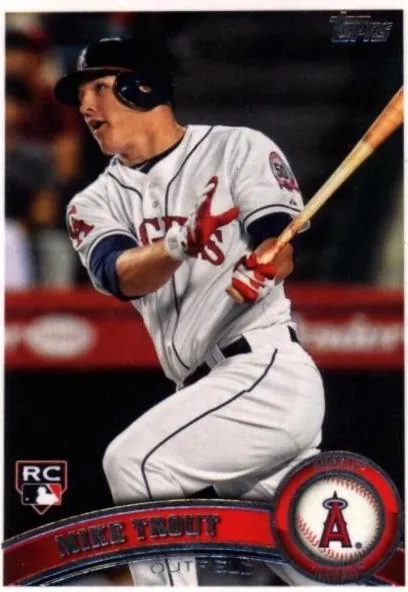
- The 1952 Topps Mickey Mantle, 1986 Topps Jerry Rice, and 2011 Topps Update Mike Trout are the most important baseball cards.
- AI pre-screening can detect wax stains, surface defects, and centering issues before you pay grading fees.
Baseball Card Grading Market in 2026
Baseball cards are the foundation of the modern sports card hobby. The market spans more than a century of production, from tobacco cards in the early 1900s to the ultra-modern chrome and refractor rookies of today. PSA alone has graded more than 50 million baseball cards, making it the largest single category in the grading industry. The baseball card market is driven by Hall of Fame rookies, current superstars, and the deep nostalgia of American collectors.
The market has two distinct segments: vintage and modern. Vintage cards are defined as cards from the pre-1980 era, when production was lower and cards were often included with tobacco, gum, or candy. Modern cards are from 1980 to the present, with the chrome and refractor era beginning in the 1990s. The grading standards for these two segments are very different. A vintage card can be valuable with moderate wear, while a modern card needs to be near-perfect to justify the cost of grading.
In 2025, PSA graded approximately 2.5 million baseball cards. The most submitted modern products were Topps Series 1, Topps Chrome, and Bowman Chrome. The most submitted vintage sets were 1952 Topps, 1954 Topps, and 1955 Topps. The 1986 Topps set remained one of the most submitted vintage-modern sets due to the Jerry Rice and Bo Jackson rookies. The 2011 Topps Update set is the most submitted modern set due to the Mike Trout rookie.
Vintage vs Modern Baseball Card Grading Standards
Vintage baseball cards are graded with era-appropriate standards. A 1952 Topps Mickey Mantle can earn a PSA 6 with moderate corner wear, surface wear, and centering that is well off modern standards. The same card in modern production would never earn a 6. This is because vintage cards were not produced with the same quality control, were not preserved carefully, and were often handled roughly by children.
The key factors that make vintage cards valuable are scarcity, player importance, and historical significance. A 1952 Topps Mickey Mantle is valuable because it is the most important post-war baseball card, and high-grade copies are rare. A 1971 Topps Steve Garvey rookie is valuable to a much smaller audience because the player is not a Hall of Famer and the set is not historically iconic. When deciding whether to grade a vintage card, the first question is whether the card is valuable enough in any grade to justify the grading cost.
Modern baseball cards are graded with much tighter standards. A PSA 10 card must have 55/45 front centering, 75/25 back centering, and no visible flaws under 10x magnification. The standards are so tight that many collectors cannot distinguish between a PSA 9 and a PSA 10 with the naked eye. This is why professional grading is essential for modern cards. The difference between a 9 and a 10 can be thousands of dollars on a star rookie.
The chart above illustrates the fundamental difference between vintage and modern baseball card grading. Vintage cards are rare in high grade, so lower grades are acceptable and valuable. Modern cards are produced with high quality control and preserved carefully, so only the highest grades are worth slabbing.
Most Valuable Baseball Cards to Grade
The value of a graded baseball card depends on the player, the year, the set, and the grade. The table below shows the most important baseball cards to grade, with estimated 2026 market ranges. These are the cards that have the strongest demand, the deepest liquidity, and the highest PSA 10 premiums.
| Card | Set | PSA 10 Range | PSA 9 Range | Premium |
|---|---|---|---|---|
| Mike Trout | 2011 Topps Update | $3,000 - $6,000 | $600 - $1,200 | ~5x |
| Juan Soto | 2018 Topps Update | $600 - $1,500 | $120 - $300 | ~5x |
| Aaron Judge | 2017 Topps Update | $400 - $900 | $80 - $180 | ~5x |
| Ronald Acuna Jr. | 2018 Topps Update | $300 - $700 | $60 - $150 | ~5x |
| Julio Rodriguez | 2022 Topps Update | $200 - $500 | $40 - $100 | ~5x |
| Gunnar Henderson | 2023 Topps Update | $150 - $400 | $30 - $80 | ~5x |
The 2011 Topps Update Mike Trout is the most important modern baseball card. It is the flagship rookie card of the best player of the generation and has a relatively small PSA 10 population compared to the demand. The PSA 10 premium is consistently around 5x the PSA 9 price. For vintage cards, the 1952 Topps Mickey Mantle is the grail, with PSA 8 copies trading for $1,000,000+ and PSA 9 copies reaching several million dollars when they appear at auction.
PSA, BGS, SGC, and CGC Baseball Grading Standards
Each major grading company applies the same four criteria to baseball cards: centering, corners, edges, and surface. PSA is the dominant brand for both vintage and modern baseball cards. BGS is popular for modern cards because of sub-grades and the 9.5 designation. SGC is popular for vintage cards because of its classic tuxedo label and strong reputation with pre-war collectors. CGC is the newest entrant and tends to be the strictest on modern centering.
For vintage baseball cards, the order of resale premium is usually: PSA > SGC > BGS > CGC. PSA is the gold standard for vintage because of its long track record and deep auction data. SGC is a strong second choice and often sells at a small discount to PSA. BGS is less common for vintage but acceptable for high-grade cards. For modern baseball cards, the order is: PSA 10 > BGS 10 Black Label > BGS 9.5 > SGC 10 > PSA 9 > CGC 9.5 > raw.
BGS 9.5 is often considered equivalent to PSA 10 for modern cards, but the market usually prices BGS 9.5 below PSA 10. BGS 10 Black Label is the only BGS grade that consistently commands a premium over PSA 10, and it is extremely rare. For most collectors, PSA is the safest choice for both vintage and modern baseball cards.
Centering Analysis for Baseball Cards
Centering is the most common reason modern baseball cards miss PSA 10. Topps has historically struggled with centering, especially on flagship sets from the 1980s and 1990s. The 1986 Topps set is notorious for poor centering, which is why PSA 10 copies of Jerry Rice and Bo Jackson are so rare. Modern Topps sets have improved quality control, but centering issues still occur regularly.
PSA 10 requires 55/45 front centering and 75/25 back centering. For vintage cards, the standard is more lenient. A 1960s Topps card with 60/40 centering can still earn a high grade if the corners and surface are strong. A 1980s Topps card with 60/40 centering is more likely to be a PSA 8 or 9 because the era is more modern and collectors expect better quality control.
How to Check Centering on a Baseball Card
Use a clear centering tool or a digital caliper. Measure the left and right borders, then the top and bottom borders. For PSA 10, the larger border should not exceed 55% of the total border width. For example, if the left border is 3.0mm and the right border is 2.5mm, the left border is 54.5% of the total, which should pass. If the left border is 3.2mm and the right border is 2.2mm, the left border is 59.3%, which will fail. Back centering is allowed to be 75/25.
Centering is also important on vintage cards, but it is graded more leniently. A 1952 Topps Mickey Mantle with poor centering can still be extremely valuable if the corners and surface are strong. The iconic status of the card and the player can overcome centering issues that would sink a modern card.
Corner and Edge Wear on Baseball Cards
Baseball cards with white borders show corner wear very easily. This is why the 1952 Topps set, which has white borders, is so difficult in high grade. Even a small touch of whitening on a corner can drop a modern card from PSA 10 to PSA 9. The 1986 Topps set has colored borders, but the corners are still prone to whitening because the cards were printed on thin stock and often handled roughly.
Edge wear is also a major issue. Cards with dark borders, like the 1971 Topps set, are notorious for edge chipping. The black borders show every imperfection, and edge chipping is common on cards that were stored in boxes or binders. Edge wear is less visible than corner wear but is equally damaging to the grade. Always inspect the entire perimeter of the card before submitting.
For vintage cards, corner wear is expected and graded accordingly. A 1952 Topps card with soft corners can still earn a PSA 5 or 6 if the rest of the card is strong. A 2011 Topps Update Mike Trout with soft corners will be a PSA 8 or lower, because modern collectors expect near-perfect corners. The era of the card determines how much corner wear is acceptable.
Surface Issues, Wax Stains, and Print Lines
Surface defects are the hardest issues to see on baseball cards without proper lighting. Common problems include print lines, surface scratches, wax stains, gum stains, and water damage. Vintage cards often have wax stains from the gum that was included in packs. The 1952 Topps set is particularly known for wax stains because the cards were packaged with gum directly against the card surface. Wax stains lower the grade but do not destroy the value of important vintage cards.
Modern cards can also have surface issues. Chrome and refractor cards are prone to print lines, which are factory defects that appear as thin lines on the reflective surface. Print lines are most common on Topps Chrome, Bowman Chrome, and Topps Finest cards. A single print line crossing the player face can drop a PSA 10 to a PSA 9. Surface scratches from handling are also common on chrome cards and appear as fine hairline marks under direct light.
AI pre-screening is especially valuable for surface detection because it can analyze the card under consistent lighting and at multiple angles. This is important for both vintage and modern cards. For vintage cards, the AI can detect wax stains, gum residue, and surface wear. For modern cards, the AI can detect print lines, scratches, and surface residue. The human eye often misses these issues under normal room lighting.
Modern Chrome, Refractor, and Parallel Baseball Cards
The modern baseball card market is dominated by chrome and refractor cards. Topps Chrome, Bowman Chrome, and Topps Finest produce the most important modern rookie cards. These cards have a reflective surface that is beautiful but extremely condition-sensitive. The PSA 10 premium is highest on star rookies from these sets because the chrome surface makes high grades difficult to achieve.
Bowman Chrome is particularly important because it is the first chrome card of many players. The 1st Bowman designation is highly collectible and carries a premium over regular Topps Chrome rookies. The 2011 Bowman Chrome Mike Trout is one of the most valuable modern baseball cards, trading for more than the 2011 Topps Update Trout in many market conditions. The 1st Bowman cards of current prospects like Jackson Holliday, Dylan Crews, and Paul Skenes are the current speculative targets.
Parallels are also important in modern baseball. Topps Chrome has refractor, prism, blue, purple, gold, orange, red, and superfractor parallels. Bowman Chrome has similar parallels. Numbered parallels /499, /250, /99, /50, /25, /10, /5, and 1/1 are worth grading if the player is a star or prospect. The PSA 10 premium is magnified by scarcity on numbered parallels.
ROI and Investment Outlook for Graded Baseball Cards
Baseball card grading is an investment decision. The cost of grading ranges from $15 to $300 per card depending on the service level and grader. A card should only be graded if the expected value in the target grade exceeds the grading cost by a meaningful margin. For modern baseball cards, the rule of thumb is that the PSA 10 value should be at least 3x the PSA 9 value before the grading cost is justified. For vintage cards, the math is different because the card value may be high even in lower grades.
The baseball card market has shown long-term growth driven by nostalgia, institutional investment, and the rise of online marketplaces. The 2011 Topps Update Mike Trout is a case study: raw copies were $10 in 2011, PSA 9 copies reached $500 by 2018, and PSA 10 copies exceeded $4,000 at peak. Vintage cards have performed even better, with the 1952 Topps Mickey Mantle setting auction records every few years.
However, not every baseball card is a good investment. The majority of modern rookie cards fail to justify the grading cost. The key is to focus on star players, Hall of Famers, and iconic sets. AI pre-screening improves ROI by helping collectors submit only the best candidates. If a collector has 100 raw Trout rookies, the AI can identify the 20 best candidates and the 80 cards that should be sold raw or held ungraded. This reduces grading cost and improves average grade.
What to Submit for Baseball Card Grading
Use this checklist to decide which baseball cards are worth grading in 2026.
- Submit: Rookie cards of star players from Topps flagship, Topps Update, Topps Chrome, and Bowman Chrome.
- Submit: Vintage rookie cards of Hall of Famers from Topps, Bowman, and pre-war sets.
- Submit: Numbered parallels and 1/1 cards of star players and top prospects.
- Submit: Autographed cards with clean signatures and minimal surface issues.
- Do not submit: Base cards of common players, even in good condition.
- Do not submit: Cards with visible print lines, corner whitening, surface damage, or poor centering.
- Pre-screen first: Always use AI or a magnifier to inspect surface and centering before paying grading fees.
The baseball card market is seasonal. It peaks during the MLB season, especially around the All-Star Game and the World Series. The market is typically softest in the winter. Rookie cards of players who win MVP awards or lead their teams to the World Series can spike dramatically. Timing is less important than condition, but it can add 10-20% to sale prices.
Frequently Asked Questions
What is the most common reason baseball cards get PSA 9 instead of PSA 10?
Are vintage baseball cards graded more leniently?
What baseball cards are worth grading?
Can AI detect wax stains on vintage cards?
How much does it cost to grade a baseball card?
What is the PSA 10 premium for baseball rookies?
Sources & Further Reading
- PSA Baseball Population Reports
- SportsCardsPro Baseball Price Guide
- Topps Collecting
- Beckett Grading
The PreGradeCards Research Team combines machine-learning engineers, grading analysts, and collector-education specialists to produce accurate, data-driven guides on AI card grading, professional grading standards, and collecting strategy.
With submission floors rising, pre-screening is no longer optional. Use our AI Pre-Grade Calculator to score a card's PSA 10 odds before you pay, and the Submission Planner to pick the right tier.