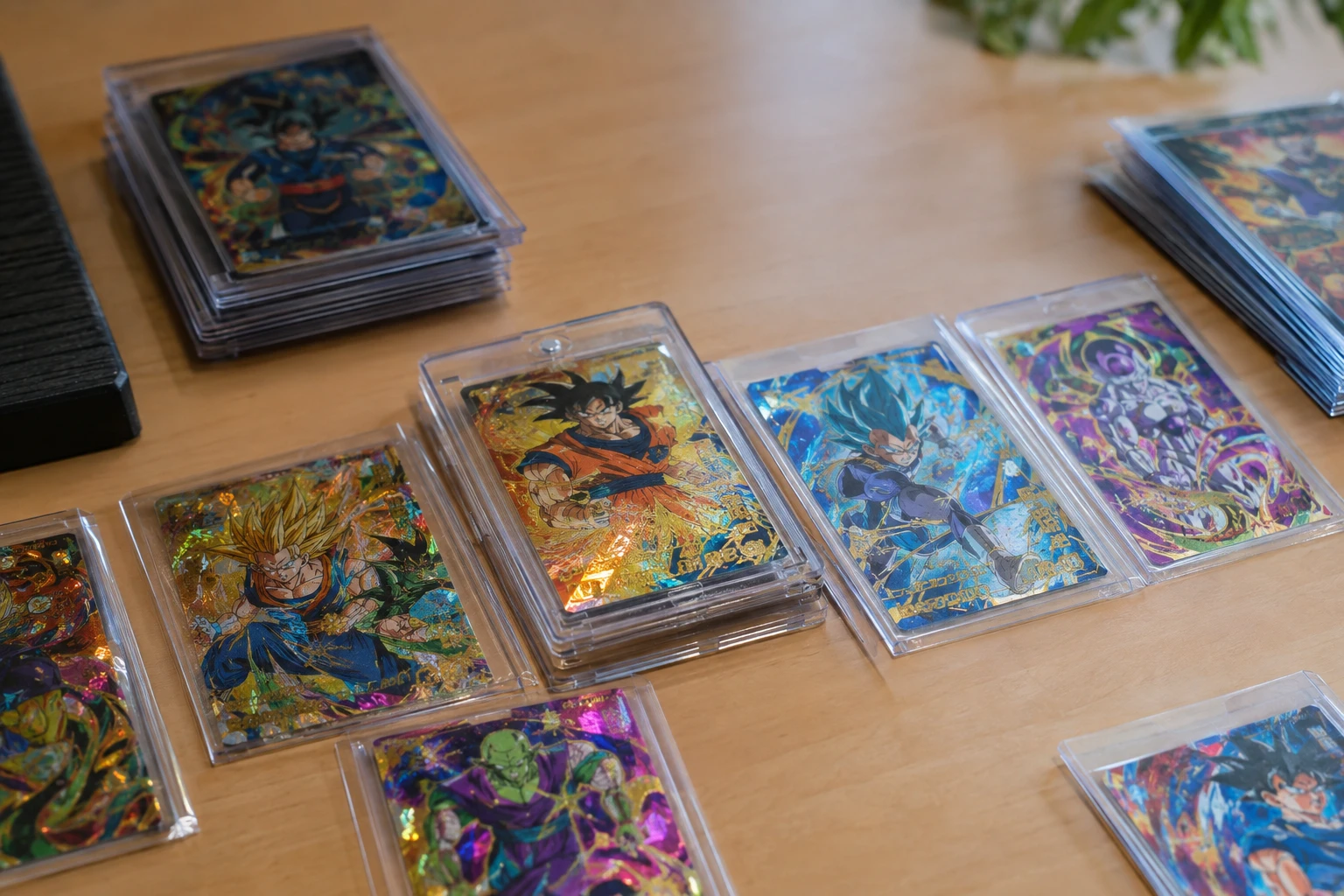
The Short Answer
- Son Goku SCR Tournament of Power sold for $12,100 in BGS 10 — DBS grading has blue-chip potential.
- God Rares (GDR) are DBS Masters' highest rarity — foil stamp integrity is the #1 AI check.
- Fusion World SCRs use different print specifications than Masters — AI calibration is set-specific.
- DBS Championship 2026 prize cards are limited-run grading targets with low PSA populations.
- High factory print quality on DBS makes grading competitive — PSA 10 rates are higher than Pokémon average.
Dragon Ball Super Card Grading in 2026
Dragon Ball Super's card game has two distinct product lines that collectors and graders treat differently: Dragon Ball Super Card Game Masters (the premium physical product sold in card shops worldwide) and Dragon Ball Super Card Game Fusion World (the newer product line targeted at casual and competitive players). Both have grading markets, but with different dynamics.
The DBS grading market sits at an interesting intersection: Dragon Ball Z has one of the most recognizable IPs in global entertainment, the card game features some of the highest-quality print production in the TCG industry, and the fanbase spans adults who grew up with the original DBZ anime and now have disposable income to invest in collectibles. The result is a grading market that's smaller than Pokémon but features high per-card values on premium pulls.
The key 2026 development: the Dragon Ball Super Fusion World 2026 Championship season has concluded its Grand Finals and Battle Hour events, creating a class of limited-distribution prize cards with naturally low PSA populations. These prize cards — distributed only to top tournament finishers — are among the most coveted DBS grading targets of 2026.
God Rares (GDR): Dragon Ball Super Masters' Highest Rarity
God Rares are the apex rarity tier in Dragon Ball Super Card Game Masters. Distinguished by their gold-border treatment, full-artwork illustration, and a distinctive foil stamp in the card's energy cost area, God Rares typically feature the most iconic Dragon Ball characters — Son Goku, Vegeta, Beerus, Broly — in their most powerful transformations.
Why God Rares Grade Well
Bandai's production quality on God Rares is notably high compared to most other TCGs. The card stock is thicker and more rigid than Pokémon or standard MTG, the print resolution is higher, and the foil treatments are applied with more consistency than early-run TCG foil cards. Industry observers note that DBS God Rares have higher PSA 10 rates than equivalent-rarity Pokémon cards — a function of better factory quality control.
Most Valuable God Rares in 2026
- Son Goku, The Awakened Power (SCR, Tournament of Power) — BGS 10 sold for $12,100; the benchmark DBS high-grade sale
- Vegeta God Rare variants — consistently strong secondary market
- Beerus GDR variants — deity character appeal drives collector demand
- Super Saiyan God SS Goku GDR (Universe Survival Saga)
God Rare Grading Challenges
Despite high factory quality, God Rares have two specific grading vulnerabilities:
- Gold border chipping — the gold-colored borders on GDR cards can chip or show whitening at the corners. This is the most common grade killer on otherwise pristine God Rares.
- Foil stamp scratching — the energy cost foil stamp area can show fine scratches from pack opening or card-to-card contact in storage. AI foil stamp analysis is specifically trained to detect this.
Secret Rares in Fusion World: New Grading Targets
Dragon Ball Super Card Game Fusion World uses a different rarity system than Masters. In Fusion World, the equivalent of a God Rare is designated SCR (Secret Rare), featuring the same full-artwork treatment and premium foil applications in a product designed for wider distribution.
Fusion World vs Masters Print Differences
Fusion World SCRs use slightly different print specifications than Masters GDRs. The foil treatment has a different reflective profile — more of a rainbow holographic shimmer compared to the more matte-metal finish of Masters God Rares. AI surface analysis distinguishes between these two finish types; uploading a Fusion World SCR as a Masters GDR would produce inaccurate surface readings.
When uploading DBS cards to PreGradeCards, always specify whether the card is from Masters or Fusion World — and provide the specific set name (e.g., "Fusion World FB-02 Blazing Aura"). The AI applies the correct foil calibration for each product line.
Fusion World Leader Cards
Leader cards in Fusion World deserve separate attention. Leaders are the largest cards in a Fusion World deck and feature alternate art treatments similar to Pokémon alt-art cards. Fusion World Leader alt arts for popular characters (Goku, Vegeta, Frieza) have their own grading market independent of SCR pulls. AI centering analysis on Leader cards is especially important — the larger card format means any centering deviation covers a larger physical distance.
Foil Stamp Integrity: The Critical AI Check for DBS God Rares
The energy cost foil stamp is the most condition-sensitive element on a Dragon Ball Super God Rare or Secret Rare card. Located in the upper-left area of the card face, this small circular or diamond-shaped foil element:
- Shows fine scratches from card-to-card contact even in sleeve storage
- Can develop a "worn" or dull appearance if the foil stamp adhesive degrades over time
- Is the first place a professional grader looks on a DBS God Rare
AI foil stamp analysis on PreGradeCards uses a high-magnification crop of the stamp area in the image to detect micro-scratches and surface wear that aren't visible at normal viewing distance. For any DBS God Rare or SCR submission, the AI report's foil stamp section is the first thing to check — a damaged stamp prevents PSA 10 regardless of all other card condition.
Photographing DBS Cards for Foil Stamp Analysis
For the most accurate foil stamp AI analysis, photograph DBS cards at maximum smartphone resolution. The stamp is small relative to the card face — maximum resolution ensures the AI has enough pixels in the stamp region to detect fine scratches accurately. A low-resolution photo produces an inconclusive stamp analysis.
Use two softbox lights at 45-degree angles rather than direct overhead light. Direct light creates a specular highlight on the stamp that obscures surface condition. Angled diffuse light shows the stamp surface at its true condition.
DBS Championship 2026 Prize Cards: Low-Pop Grading Targets
The Dragon Ball Super Fusion World 2026 Championship season — including the Grand Finals and Battle Hour 2026 events — distributed limited prize cards to top finishers. These prize cards have natural scarcity: only players who placed in the top brackets received them, and the total distribution is a fraction of a retail set's print run.
Why Championship Prize Cards Are Grading Targets
Championship prize cards have three characteristics that make them ideal grading targets:
- Artificially low PSA population — very few copies exist. Any PSA 10 that surfaces has a meaningful rarity story.
- Competitive player provenance — prize cards often come from tournament winners who may have handled them less carefully than a dedicated collector. AI pre-grading filters the gem-mint survivors.
- Unique artwork — Championship prize cards frequently feature exclusive artwork not available in retail products, driving collector demand independent of competitive format.
Condition Reality for Prize Cards
Many DBS Championship prize cards were distributed in toploaders or binder pages at tournament events — not in the sealed booster packaging of retail cards. Event handling, travel, and non-collector storage conditions mean a higher percentage of prize cards show condition issues than retail-pulled God Rares. AI pre-grading is essential for filtering the rare gem-mint prize cards before expensive PSA submissions.
DBS Print Quality and What It Means for PSA 10 Rates
Dragon Ball Super's print quality is genuinely among the best in the TCG industry. Several factors contribute:
- Thicker card stock — DBS cards are slightly more rigid than standard TCG cards. This reduces corner fraying and edge chipping from normal handling.
- Higher print resolution — the DBS artwork printing process produces crisp, consistent images with less visible dot-matrix pattern than some competitors.
- Better centering consistency — Bandai's DBS printing facilities have demonstrated better centering consistency than comparable TCG print runs.
- More durable foil adhesion — DBS foil stamps and treatments show less peeling or degradation compared to some older TCG foils.
The practical result: collectors who AI-grade a batch of DBS God Rares and SCRs will typically find a higher percentage of gem-mint candidates than in an equivalent batch of Pokémon SIRs or MTG foils. Industry estimates suggest PSA 10 rates on DBS God Rares run 15–25% — compared to the hobby-wide PSA 10 average of 8.88%. This makes DBS grading ROI math more favorable on average.
Note: "better on average" doesn't mean individual cards can be skipped in AI pre-grading. The foil stamp issue and gold border chipping remain real grade killers that AI catches before expensive submissions.
PSA vs BGS vs CGC for Dragon Ball Super Cards
DBS graders have a genuine three-way choice, and the right answer depends on which product line and value tier:
| Card Type | Best Grader | Reasoning |
|---|---|---|
| High-value God Rares ($200+ raw) | PSA | Maximum resale; PSA 10 commands best prices |
| Benchmark GDRs (SCR Tournament of Power tier) | PSA or BGS | BGS 10 Pristine commands premium on top-tier DBS cards per $12,100 sale |
| Fusion World SCRs | PSA or CGC | PSA for maximum value; CGC for cost efficiency on mid-value SCRs |
| Championship prize cards | PSA | Low pop + PSA = maximum premium capture |
| Bulk modern DBS | CGC Bulk | $17/card vs $79.99 PSA minimum on cards with limited grade-up potential |
Note on BGS: BGS (Beckett) is now owned by Collectors Holdings (same parent as PSA). The BGS 10 Pristine grade — requiring 10s across all four subgrades — remains a meaningful distinction for ultra-premium DBS cards where subgrade transparency adds value.
AI Pre-Grading Workflow for Dragon Ball Super Collections
- Separate Masters from Fusion World. These product lines need different AI calibrations. Never mix them in the same upload batch without specifying set correctly.
- Identify the product type for each card: God Rare (GDR), Secret Rare (SCR), Leader alt art, or Championship prize card.
- Photograph at maximum resolution with diffuse lighting. The foil stamp is small — resolution matters more on DBS than most other TCGs for accurate stamp analysis.
- Upload specifying set and card type. "Masters — Universe Survival Saga GDR" applies different calibration than "Fusion World FB-02 SCR."
- Check foil stamp section of AI report first. Any stamp damage = do not submit to PSA regardless of other condition.
- Check gold border corners second. Border chipping on GDRs is the second most common grade killer.
- Review centering and surface. DBS has better centering consistency than many TCGs — most grade issues will be stamp or corner related.
- Apply the PSA 10 rate advantage. DBS God Rares have 15–25% PSA 10 rates vs the 8.88% hobby average. AI-confirmed gem-mint DBS cards have strong submission ROI.
Frequently Asked Questions
What is the most valuable Dragon Ball Super card to grade?
What is a God Rare in Dragon Ball Super?
Is Dragon Ball Super worth grading in 2026?
What is the difference between Dragon Ball Super Masters and Fusion World?
How do I photograph Dragon Ball Super cards for AI grading?
Should I use PSA or BGS for Dragon Ball Super God Rares?
Sources & Further Reading
- Dragon Ball Z Cards Value Guide 2026 — Eneba
- AI Dragon Ball Card Grading — TCGAI.PRO
- Dragon Ball Super Fusion World 2026 Championship Grade Guide
Marcus Chen has evaluated over 50,000 sports cards and TCG cards across PSA, BGS, SGC, and CGC standards. Before joining PreGradeCards, he worked as a submission specialist for a major grading company and trained collectors and dealers on condition assessment.
Create a free account and get 1 free credit — enough for 1 complete AI grading with market pricing. No credit card required.
Sign Up Free →