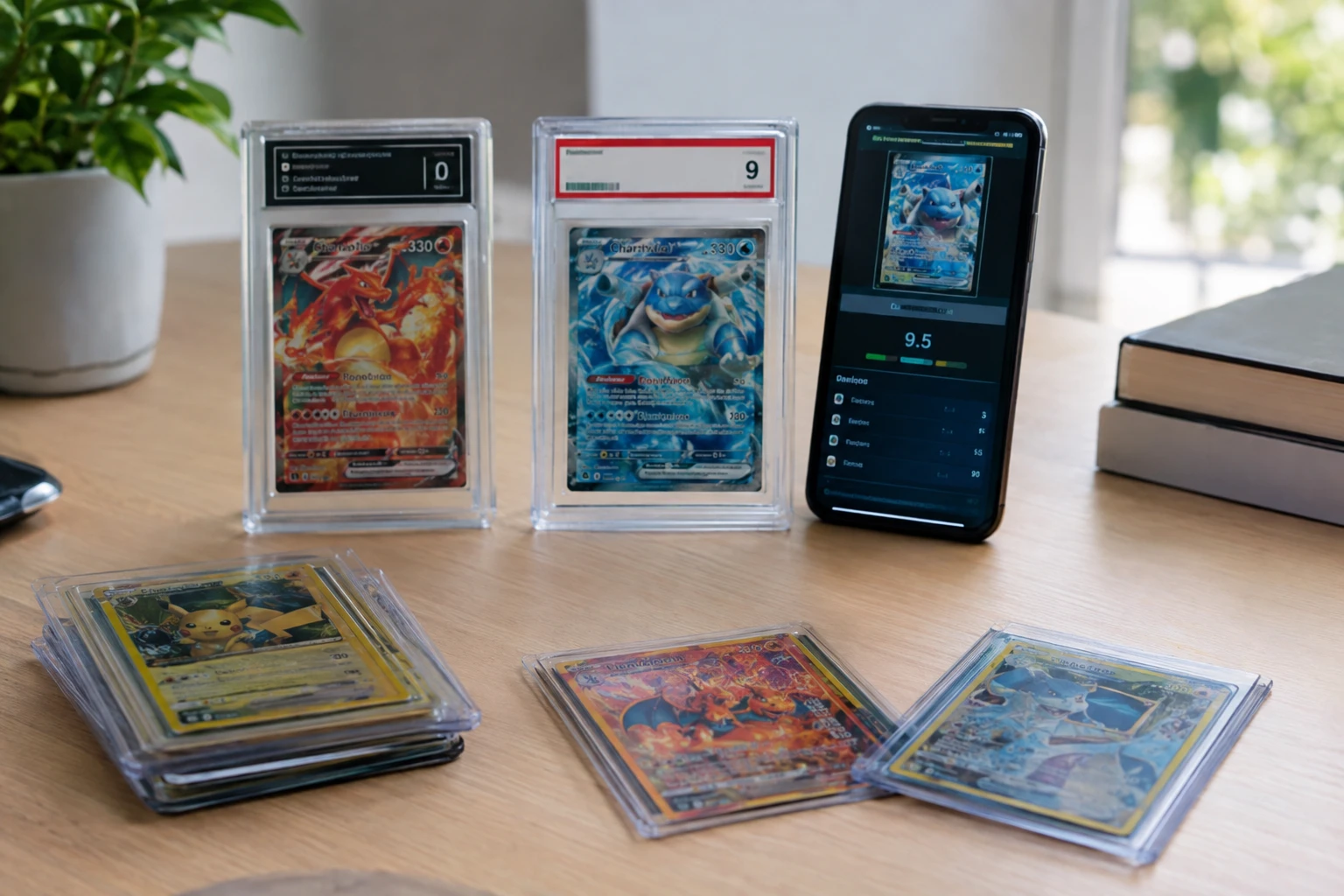
The Short Answer
- TAG Grading uses computer vision + human verification and scored 40% YoY growth in May 2026.
- PSA still commands the highest resale premiums but costs $79.99 minimum (Value tiers paused).
- AI pre-grading (PreGradeCards) should precede all TAG, PSA, or CGC submissions to filter losers.
- TAG Priority tier is $149/card; Walkthrough is $299/card — basic/standard/express tiers are sold out.
- CGC is open but running 120 working days on Bulk — best for non-urgent TCG bulk submissions.
What Is TAG Grading and How Does Its AI Work?
TAG — Technology Assisted Grading — entered the card grading market as the most technologically differentiated option available to collectors. While PSA, CGC, BGS, and SGC rely primarily on trained human graders making judgment calls under magnification, TAG's process leads with machine vision.
TAG's AI system uses computer vision and photometric stereo imaging to analyze a card across centering, corners, edges, and surface simultaneously. The system scores on a granular 1,000-point scale rather than the standard 1–10, providing a more precise reading of card condition. A PSA 10 maps roughly to the 900–1000 range; PSA 9 maps to 800–900. Every TAG slab ships with a DIG (Digital Imaging and Grading) report accessible via QR code — a full photographic record of the card and all detected condition data.
The DIG+ tier adds eight sub-scores for collectors who want granular breakdowns of each grading factor. This level of data is unprecedented in traditional grading and makes TAG slabs extremely informative for condition-focused collectors who care about understanding why a card received its grade.
Human verification remains part of TAG's process — the AI surfaces the data, a trained grader makes the final call. TAG describes itself as "technology-led, not human-free." This hybrid approach has driven rapid adoption among collectors who want both data transparency and physical authentication.
TAG vs PSA Resale Value: The Honest Numbers
The most important data point any collector should understand before choosing TAG over PSA is resale value. TAG slabs typically sell 35–60% below the equivalent PSA grade on the secondary market. A card that would sell for $200 as PSA 10 might sell for $80–$130 as TAG 10.
This gap exists for a simple reason: PSA has 30+ years of market adoption. eBay buyers, COMC sellers, and auction houses price PSA as the default liquidity standard. TAG's market is growing but smaller — fewer buyers means less competitive bidding, which means lower realized prices.
The gap is narrower on:
- Modern cards ($20–$100 raw range) where the absolute dollar difference is smaller
- Cards where the TAG DIG report adds perceived value — condition-focused collectors who want sub-grade data
- Personal collection builds where resale is not the goal
The gap is wider on:
- Vintage cards where PSA dominates collector culture
- High-value singles ($500+ raw) where PSA's liquidity premium is most pronounced
- Crossover submissions — TAG does not reholder other companies' slabs, and cracking a PSA slab to submit raw to TAG destroys known liquidity to chase an illiquid grade
TAG's 2026 Capacity Situation
TAG has been a victim of its own success in 2026. After reporting ~52,000 cards graded in May — a 40% year-over-year increase — the company's affordable submission tiers filled beyond capacity:
- Basic tier — sold out at capacity
- Standard tier — sold out at capacity
- Express tier — sold out at capacity
- Priority tier — limited availability, $149 per card, ~5 business day turnaround
- Walkthrough tier — limited availability, $299 per card
This mirrors PSA's Value tier pause and CGC's extended backlogs — the entire grading industry hit capacity in May–June 2026. The hobby-wide demand surge (driven by PSA's $200M investment announcement, the Pokémon release cycle, and MTG's serialized card programs) overwhelmed every grader simultaneously.
For TAG, the practical implication is that affordable submissions are not currently possible. Priority at $149 is the cheapest accessible tier, and only for collectors who confirm a card's grading potential first. This makes AI pre-grading even more essential before committing to a $149 TAG Priority submission than it was before the tier closures.
AI Pre-Grading vs TAG vs PSA vs CGC: What Each Does
These are not competing options — they serve different roles in a smart submission strategy. Here's exactly what each does:
| Method | Purpose | Cost | Output | Speed |
|---|---|---|---|---|
| PreGradeCards AI | Pre-submission filter | Free – $0.19/card | Predicted grade + condition flags | 60 seconds |
| TAG Priority | Physical slab + DIG report | $149/card | 1–10 grade + 1000-pt score + DIG | ~5 business days |
| PSA Regular | Physical slab (highest liquidity) | $79.99/card | 1–10 grade + authenticated slab | 50 business days |
| CGC Bulk | Physical slab (cheapest per-card) | ~$17/card | 1–10 grade + authenticated slab | ~120 working days |
| SGC Regular | Physical slab (vintage strength) | ~$25–40/card | 1–10 grade + authenticated slab | 30–45 business days |
The right strategy: always start with AI pre-grading (PreGradeCards, free). Then apply the grader that matches your card type, value, and timeline. No professional submission should happen without an AI pre-grade first at current fee levels.
Pokémon Cards: TAG vs PSA vs AI — Which to Choose
Pokémon is the biggest single category in card grading. Here's the optimal choice matrix for Pokémon:
High-Value Modern Pokémon ($200+ raw PSA 10 target)
Use PSA Regular ($79.99). PSA 10 premiums on high-value alt art cards, Special Illustration Rares, and chase holos remain highest with PSA slabs. The $79.99 fee is proportionally small against a card worth $200–$2,000+ in PSA 10. AI pre-grade first to confirm gem-mint potential.
Mid-Value Modern Pokémon ($50–200 raw)
Consider CGC Standard (30 working days) or TAG Priority ($149) for urgent needs. At mid-values, the resale premium gap between PSA and CGC/TAG narrows. CGC Standard at ~$30/card with 30 working days is an efficient choice. TAG Priority at $149 only makes sense if the card's PSA 10 equivalent would clear $500+.
Bulk Modern Pokémon ($5–50 raw)
CGC Bulk (~$17/card) or hold raw. PSA at $79.99 doesn't make financial sense on cards worth $30 raw. CGC Bulk at $17 with a 120-day turnaround can work if the PSA 10 value clears the fee. AI pre-grade the entire batch first — only the AI 9–10 cards go into the CGC submission.
Vintage Pokémon (Base Set era)
PSA for all high-value vintage. PSA dominates vintage Pokémon liquidity. A Base Set Charizard PSA 10 commands premium pricing that CGC or TAG cannot match. AI pre-grade first given the $79.99 floor.
MTG Cards: TAG vs PSA vs AI — Which to Choose
MTG grading has more nuance than Pokémon due to the wide range of card types and values:
Vintage MTG (Pre-2000, Reserved List)
PSA. The Reserved List market is built on PSA liquidity. Alpha/Beta Power Nine PSA 10 sales set records PSA can't be matched by TAG or CGC on vintage.
Serialized Modern MTG (Hobbit, Marvel, Star Trek)
PSA for highest-value serials; CGC Standard for mid-value serials. Serialized cards numbered /1 to /25 command enough value that PSA's premium is worth the wait and fee. Serials numbered /100–/500 may be better suited to CGC Standard where faster turnaround allows capitalizing on market timing.
Modern MTG Foils (Competitive Format Staples)
TAG Priority for speed + data; PSA for long-term hold. If a competitive format staple just spiked due to a ban or format shift, TAG Priority's 5-business-day turnaround lets you capitalize on the price spike. PSA's 50-day turnaround may miss the window. AI pre-grade first to confirm the card merits $149.
Yu-Gi-Oh! Cards: TAG vs PSA vs AI — Which to Choose
Yu-Gi-Oh has unique considerations. Note that TAG does not currently grade Yu-Gi-Oh cards — they're outside TAG's eligible card dimensions (59×86mm vs standard 63×88mm). This makes the choice simpler:
High-Value Yu-Gi-Oh (LOB 1st Edition, Ghost Rares, Starlight Rares)
PSA Regular ($79.99). PSA commands the strongest market for high-grade Yu-Gi-Oh slabs. A Legend of Blue-Eyes 1st Edition Blue-Eyes White Dragon PSA 10 is a blue-chip collectible. AI pre-grade first given the high fee floor.
Modern Yu-Gi-Oh (Chaos Origins Starlight 2.0, recent sets)
CGC Standard or PSA Regular depending on value. Modern Starlight Rares and high-value modern singles have a growing CGC market. The lower CGC fee makes sense on cards where PSA 10 vs CGC 10 premium gap is smaller in the modern era.
Bulk Yu-Gi-Oh Submission
CGC Bulk at ~$17/card. Bulk Yu-Gi-Oh submissions go to CGC for the lowest per-card cost. AI pre-grade the entire batch first; only submit AI 9–10 cards.
Complete Decision Matrix: TAG vs PSA vs CGC vs AI by Scenario
| Scenario | Best Choice | AI Pre-Grade First? |
|---|---|---|
| High-value Pokémon alt art (PSA 10 > $300) | PSA Regular | Yes — essential |
| Bulk modern Pokémon (raw $5–50) | CGC Bulk | Yes — batch filter |
| Vintage MTG Reserved List | PSA Regular | Yes |
| Serialized MTG (numbered /1–25) | PSA Regular or Express | Yes |
| MTG format staple (price spike, need speed) | TAG Priority | Yes — justify the $149 |
| Yu-Gi-Oh LOB 1st Ed | PSA Regular | Yes |
| Modern Yu-Gi-Oh bulk | CGC Bulk | Yes — batch filter |
| Personal collection (data matters more than resale) | TAG Priority | Yes |
| Unknown card, just want to know the grade | AI Pre-Grade Only | N/A — AI is the answer |
Frequently Asked Questions
Is TAG Grading better than PSA?
Does TAG Grading use AI?
Can I submit Yu-Gi-Oh cards to TAG Grading?
Why are TAG's cheap tiers sold out in 2026?
Should I use AI pre-grading before submitting to TAG?
How does the TAG 1000-point scale convert to PSA grades?
Sources & Further Reading
- TAG vs PSA vs CGC: 2026 Grading Shake-Up — The Card Shop Finder
- TAG Grading Guide 2026 — CardGrade.io
- Card Grading Backlog 2026 — CardGrade.io
- TAG Grading Paused Tiers: What Collectors Do Now
Marcus Chen has evaluated over 50,000 sports cards and TCG cards across PSA, BGS, SGC, and CGC standards. Before joining PreGradeCards, he worked as a submission specialist for a major grading company and trained collectors and dealers on condition assessment.
Create a free account and get 1 free credit — enough for 1 complete AI grading with market pricing. No credit card required.
Sign Up Free →