The Short Answer
- MTG Reserved List cards see value spikes after each B&R update — AI pre-grading maximizes ROI before submission.
- Foil MTG cards require diffuse lighting for accurate AI surface analysis due to foil refraction.
- Alpha/Beta rounded corners require AI tools calibrated for vintage MTG cardstock.
- Serialized MTG cards (The Hobbit, Marvel, Star Trek) are 2026's hottest new grading targets.
- PSA Regular is now $79.99 minimum — AI pre-grading is non-negotiable ROI protection.
MTG Grading Landscape in 2026
Magic: The Gathering has become one of the fastest-growing segments of the card grading market. GemRate data shows MTG cards are a significant portion of PSA's 71% TCG share in its June 2026 record month of 2.5 million graded cards. The combination of Reserved List speculation, serialized card programs, and competitive format upheaval has created sustained demand for MTG slabs across all eras of the game.
The grading economics have shifted dramatically in 2026. PSA paused its Value tiers on June 2, leaving $79.99 Regular as the cheapest submission path. For a stack of 50 MTG cards, that's $3,999.50 in fees before a single grade comes back. The BGS cheapest tier starts at $14.95 per card but carries similar backlog pressure. CGC's Bulk tier is $17 per card with a 120 working-day turnaround.
AI pre-grading is how serious MTG collectors protect themselves from submitting cards that won't grade well. With the PSA 10 rate across all submissions at just 8.88%, having an AI-based pre-screen is essential capital management.
Reserved List Cards: AI Grading Guide
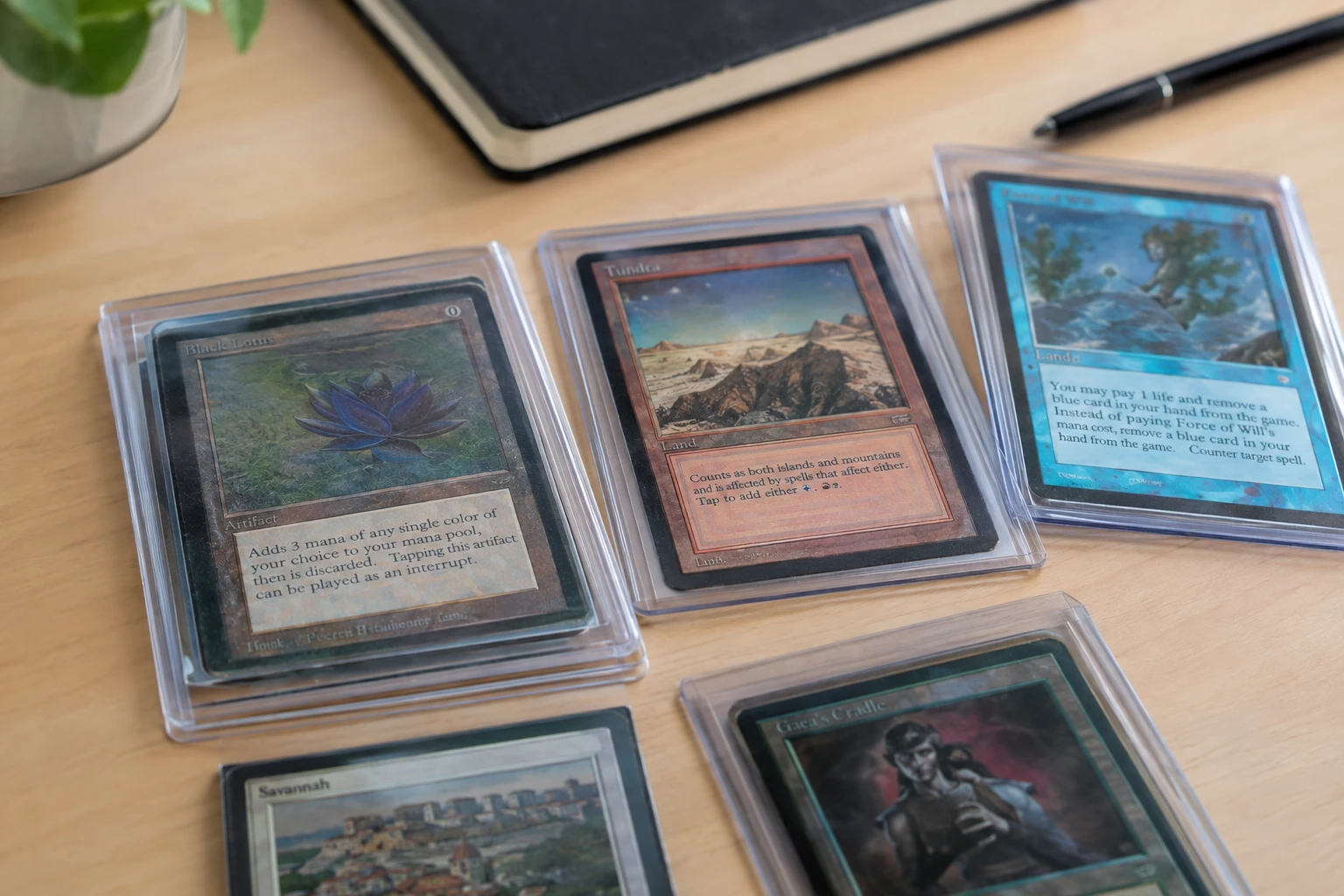
The Magic: The Gathering Reserved List comprises approximately 572 cards that Wizards of the Coast has committed never to reprint. These cards — including Power Nine, dual lands, and other vintage staples — have become blue-chip collectibles in the hobby, with high-grade slabs commanding prices that dwarf original purchase prices.
Why Reserved List Cards Deserve AI Pre-Grading
The stakes on Reserved List cards are high enough that a one-grade difference can mean thousands of dollars. A Underground Sea in PSA 8 might sell for $800; the same card in PSA 9 reaches $1,500; PSA 10 can exceed $8,000. The fee on a PSA Regular submission ($79.99) is trivial relative to these values — but knowing which grade to expect before submission is still critical for batch decisions and tier selection.
Key Grading Concerns for Reserved List Cards
Most Reserved List cards are from the early 1990s. The cardstock from this era has specific aging characteristics:
- Corner fraying — early MTG cardstock uses softer paper than modern cards. Corner wear is the #1 grade killer on vintage Reserved List cards. AI corner analysis identifies fraying even in subtle amounts.
- Edge whitening — the black-bordered cards of the early MTG sets show edge whitening clearly. AI edge detection flags this before submission.
- Surface scratching — played Reserved List cards (even sleeved for years) accumulate micro-scratches on their non-foil glossy surface. AI surface analysis catches this.
- Centering variance — early print runs had significant centering variability. AI centering tools provide exact pixel measurements.
For high-value Reserved List cards ($500+ raw), AI pre-grading provides a crucial quality filter. For ultra-high-value cards ($5,000+), use AI as a first screen and consider a professional card dealer evaluation before committing to PSA submission.
Black Lotus, Alpha, and Beta Cards: AI Grading Nuances
The Power Nine — Black Lotus, Ancestral Recall, Time Walk, Mox Sapphire, Mox Jet, Mox Pearl, Mox Ruby, Mox Emerald, and Timetwister — are the most valuable Magic cards in existence. A PSA 10 Black Lotus sold for $540,000 in 2021. Any collector holding raw Power Nine should understand the grading nuances before submitting.
Alpha vs Beta Rounded Corners
Alpha and Beta cards have a distinctive characteristic: their corners are slightly more rounded than Unlimited and later printings due to a different die-cut process. This creates a unique challenge for AI corner analysis — tools must be calibrated for the expected corner profile of these editions to avoid falsely flagging normal Alpha/Beta corners as damaged.
PreGradeCards AI is calibrated for Alpha and Beta corner profiles. When submitting vintage MTG photos, note the set in the submission form so the algorithm applies the correct corner baseline.
Black Border vs White Border
Alpha, Beta, and early expansion cards have black borders. Unlimited and most later prints have white borders. AI centering tools measure centering against actual card image content rather than border color, so the same algorithm applies to both. However, black-bordered cards show edge whitening much more clearly — AI edge detection is especially critical for these cards.
Condition Reality Check
The honest reality for most collectors with Alpha/Beta cards: cards that were played in the 1990s before the grading hobby existed are likely in the LP to MP condition range (PSA 4–6). AI pre-grading on these cards helps set realistic expectations before spending $79.99+ per card on submissions that may return grades that don't justify the fee. For true near-mint vintage Power Nine, AI pre-grading confirms that gem-mint potential before expensive submission choices.
Modern Foil MTG Cards: AI Grading Challenges and Solutions
Modern MTG foils — from the rainbow foiling of 7th Edition through the etched foils of recent sets — present unique AI grading challenges due to their light-reflective surfaces.
The Foil Photography Problem
Foil cards reflect light differently at different angles. A foil card photographed under direct overhead light shows glare that AI surface detection can misread as scratches. The solution is diffuse lighting: softbox lights placed at 45-degree angles, or diffuse natural light through a window with no direct sun. This eliminates the reflective glare and allows AI surface analysis to see the actual card condition.
Foil Curling
MTG foil cards are notorious for curling — a warping of the card caused by the difference in moisture absorption between the foil layer and the card back. Curled foils cannot receive PSA 10 grades. AI tools detect curvature in the card image from the photo and flag potential curling before submission. A card showing moderate curl in the photo should be considered unsubmittable until the curl can be safely reversed (using controlled humidity techniques that are outside the scope of this article).
Etched Foil and Galaxy Foil Cards
Recent MTG sets introduced etched foil and galaxy foil treatments. These surfaces have a matte-foil texture that AI tools handle differently from traditional foil. Etched foils should be photographed in the same diffuse lighting as standard foils. Galaxy foil cards (Commander Masters, etc.) have a sparkle pattern that can create visual noise in AI surface analysis — a slight reduction in AI confidence is normal on these cards. When in doubt, photograph twice from slightly different angles and use the cleaner photo.
Serialized MTG Cards: Hobbit, Marvel, and Star Trek Grading Guide
Wizards of the Coast's 2025–2026 serialized card programs have created some of the most valuable modern MTG grading targets. Serialized cards are numbered out of a limited print run (e.g., /500 or /001) with the serial number stamped on the card. They combine the scarcity of a limited print with the collectibility of a numbered series — a powerful combination for the grading market.
The Hobbit Serialized Cards (2025)
The Lord of the Rings: Tales of Middle-earth set introduced serialized versions of key cards including The One Ring (serialized /1, only one copy exists). The broader serialized inserts from this set are grading targets with significant PSA 10 premiums. Hobbit serialized cards use a gold-foil serial stamp that can be scratched — AI surface analysis must check the stamp area specifically.
Marvel Serialized Cards (2025–2026)
The Marvel Universe Beyond set brought Marvel IP to MTG with serialized versions of Spider-Man, Iron Man, Captain America, and other iconic characters. These are among the hottest modern MTG grading targets in 2026. The serialized stamp on Marvel cards is in the bottom-right corner; AI analysis of this area is critical as handling marks on the stamp area significantly impact grade.
Star Trek Serialized Cards (2026)
The Star Trek: Away Team set follows the serialized card model with iconic Star Trek characters. Initial reports from early submission data show higher PSA 10 rates on Star Trek serialized cards compared to some earlier serialized programs, suggesting better factory quality control.
AI Pre-Grading for Serialized Cards
The rule for all serialized MTG cards: photograph both faces at maximum resolution and specifically check the AI report for any flags in the serial number stamp region. A damaged or scratched serial number stamp is a significant grade penalty that AI tools catch before an expensive submission.
June 2026 B&R Update: Which MTG Cards to Grade Right Now
MTG's June 29, 2026 Banned and Restricted announcement shook the format landscape. The banning of Force of Will from Legacy, Time Warp from Vintage, and Candelabra of Tawnos from Legacy created immediate market effects on the affected cards and their replacements.
Banned Cards: Grade Before Values Drop
Cards banned from competitive formats typically see short-term value drops as competitive players sell or trade out. However, for grading purposes, banned Reserved List cards retain significant collector value as historical artifacts. Force of Will in particular has a massive collector base — high-grade PSA copies remain highly liquid regardless of format legality.
Replacement Cards: Grade Now While Demand Peaks
When a ban removes a key card from a format, the cards that replace it in competitive builds often see rapid value increases. These are short-window grading opportunities — AI pre-grading these cards quickly and identifying gem-mint candidates for fast submission maximizes capture of the price spike.
The Hobbit and Marvel Sets Unaffected
The serialized card programs from The Hobbit and Marvel sets are in silver-bordered or commander-legal formats unaffected by the June 2026 B&R changes. These remain straightforward grading targets based on collector demand rather than competitive playability.
CGC vs PSA for MTG Cards: Which Grader Should You Choose?
MTG collectors have a genuine choice between PSA and CGC in 2026, with different tradeoffs for different card types:
| Factor | PSA | CGC |
|---|---|---|
| Resale premium | Higher — PSA 10 commands best prices | Lower but growing, esp. on Pokémon crossover |
| Cheapest tier (July 2026) | $79.99 (Regular) — Value tiers paused | ~$17 (Bulk, ~120 working days) |
| Turnaround | 50 business days (Regular) | 120 days (Bulk), 30 days (Standard) |
| Vintage MTG | Better — PSA dominates vintage market | Acceptable but lower secondary liquidity |
| Modern foils | Strong — good market for recent sets | Good — consistent grading on foils |
Rule of thumb: PSA for anything vintage or high-value modern where resale liquidity matters. CGC for bulk modern submissions where cost matters more than maximum resale premium. Always AI pre-grade before either.
AI Pre-Grading Workflow for MTG Collections
Here is the optimized workflow for AI-grading a MTG collection before professional submission:
- Triage by value. Sort cards into three piles: $100+ raw (individual AI scans, top-tier submission consideration), $20–$100 raw (AI scan, CGC Bulk or hold), under $20 raw (no grading makes economic sense at current fee floors).
- Set up diffuse lighting. MTG foils demand diffuse lighting. Use a window with indirect light or two softbox lights at 45 degrees. Never use direct flash or overhead single-point light.
- Photograph both sides at high resolution. MTG card backs are standardized — the back often shows surface wear before the front does. Upload both.
- Flag foils as foils in PreGradeCards. The tool's foil-aware surface analysis mode applies the correct algorithm for reflective surfaces.
- Check centering against PSA standards. PSA requires 60/40 or better left-to-right and 75/25 top-to-bottom. AI centering returns exact percentages.
- Review serial number stamp areas on serialized cards. Check the AI report's close-up of the serial stamp area specifically.
- Submit only AI 9–10 cards to PSA. Run ROI math: card value at PSA 10 minus $79.99 fee minus shipping minus platform fees. Positive? Submit. Marginal? Hold raw.
Frequently Asked Questions
Can AI grade Magic: The Gathering cards accurately?
What is the cheapest way to grade MTG cards in 2026?
Are Reserved List MTG cards worth grading?
How do I photograph MTG foil cards for AI grading?
What are the most valuable MTG cards to grade in 2026?
Sources & Further Reading
- PSA Backlog Falls to 12M — SI Collectibles
- TAG vs PSA vs CGC: 2026 Grading Shake-Up
- MTG Banned & Restricted July 2026
Marcus Chen has evaluated over 50,000 sports cards and TCG cards across PSA, BGS, SGC, and CGC standards. Before joining PreGradeCards, he worked as a submission specialist for a major grading company and trained collectors and dealers on condition assessment.
Create a free account and get 1 free credit — enough for 1 complete AI grading with market pricing. No credit card required.
Sign Up Free →