The Short Answer
- LOB 1st Edition Blue-Eyes White Dragon PSA 10 sells for $60,000+ — AI pre-grading is essential before submission.
- Ghost Rares and Starlight Rares have complex holographic surfaces that AI surface detection analyzes precisely.
- Yu-Gi-Oh cards are non-standard size (59×86mm) — AI tools must account for correct centering ratios.
- TAG Grading does not accept Yu-Gi-Oh cards — PSA and CGC are the primary professional options.
- Chaos Origins Starlight 2.0 (July 2, 2026) created the hottest new grading targets in the format.
Yu-Gi-Oh Grading Market in 2026
Yu-Gi-Oh! has experienced a sustained grading boom across 2025–2026, driven by a combination of nostalgic buying from 1990s–2000s collectors reaching peak disposable income, new competitive sets creating valuable high-rarity cards, and general card hobby growth. PSA grading volume for Yu-Gi-Oh sits at a significant share of the TCG category that represented 71% of PSA's record 2.5 million monthly grades in June 2026.
The Yu-Gi-Oh grading market is split between two distinct collector groups:
- Vintage collectors — targeting early sets from the Yugi/Kaiba/Joey Starter Decks and the original LOB through IOC print runs. These collectors chase PSA 10 grades on 1st Edition cards that were printed in low quantities and rarely survived in gem-mint condition.
- Modern collectors — targeting the current Starlight Rare and Ghost Rare premium cards from competitive sets. Chaos Origins (July 2, 2026) introduced new Starlight 2.0 designations that have already created a wave of PSA submissions.
Both groups face the same 2026 challenge: PSA's cheapest available tier is $79.99 Regular. With Yu-Gi-Oh cards distributed across both gem-mint-worthy and damaged populations, AI pre-grading is the only smart filter before committing professional submission fees.
Legend of Blue-Eyes White Dragon (LOB) 1st Edition: What to Know Before Grading
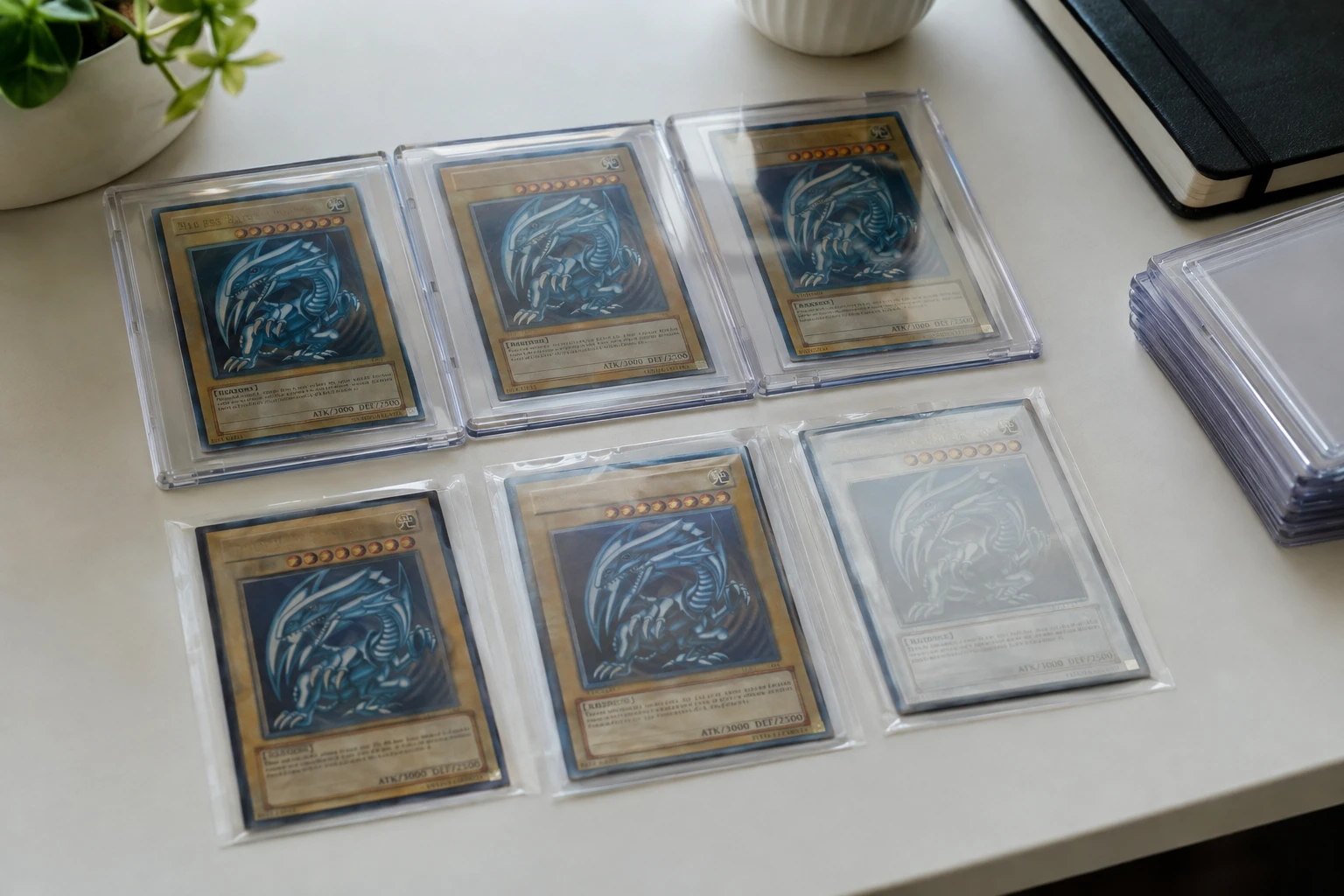
Legend of Blue-Eyes White Dragon — the first Yu-Gi-Oh set released in English by Upper Deck Entertainment — remains the definitive vintage Yu-Gi-Oh grading target. 1st Edition copies identified by the "1st Edition" stamp on the card's left side carry significant premiums over Unlimited copies.
Key Cards to Grade from LOB 1st Edition
- Blue-Eyes White Dragon (LOB-001) — the most valuable Yu-Gi-Oh card in PSA 10. PSA 10 copies sell for $60,000–$100,000+. The low PSA 10 population (fewer than 150 copies known) makes every gem-mint candidate extraordinarily valuable.
- Dark Magician (LOB-005) — PSA 10 values in the $5,000–$15,000 range depending on current market conditions.
- Exodia pieces (LOB-118 through LOB-122) — the full Exodia set in PSA 10 is a major collector target.
- Summoned Skull, Man-Eater Bug, Celtic Guardian — supporting cards with solid PSA 10 premiums.
LOB 1st Edition Grading Challenges
Cards from the original LOB print run (2002) face specific condition issues:
- Surface scratching — early Yu-Gi-Oh cards used a surface coating that shows fine scratches from card-to-card contact. Even unplayed cards stored in original binders for 20+ years often have micro-scratches from binder sleeve friction.
- Edge wear — the thin cardstock of early Yu-Gi-Oh cards chips easily at edges. AI edge detection catches even subtle chipping that manual inspection misses.
- 1st Edition stamp condition — the stamp itself can show ink wear or printing defects. AI analysis of the stamp area is critical for LOB submissions.
- Print quality variations — LOB has documented print quality inconsistencies. Some cards from certain print batches show printing artifacts that affect surface grades.
For LOB 1st Edition, given the potential values involved, AI pre-grading serves as a quality confirmation before a $79.99 or higher submission decision. For Blue-Eyes White Dragon specifically, professional hands-on evaluation from an experienced Yu-Gi-Oh dealer should complement the AI analysis before submission.
Ghost Rares: AI Grading Challenges for Yu-Gi-Oh's Most Unique Finish
Ghost Rares are among the most visually distinctive cards in the Yu-Gi-Oh! card game. Introduced in Strike of Neos (2006), Ghost Rares feature a white holographic foil on the main artwork area that creates a three-dimensional, ghost-like appearance. They are also among the most condition-sensitive cards in the entire hobby.
What Makes Ghost Rares Hard to Grade
The Ghost Rare finish is extremely susceptible to surface wear. The white holographic foil:
- Shows fingerprints more readily than any other finish in the hobby. Even a brief touch with clean dry hands can leave an oil smudge visible under grading loupe.
- Scratches at ultra-low thresholds — the holofoil surface can be micro-scratched by a soft cloth cleaning attempt, by card-to-card contact in a toploader, or by the inside of a premium sleeve.
- Reflects light in a way that amplifies surface defects — what looks like a minor scratch on a regular card appears dramatically more severe on Ghost Rare foil.
Most Valuable Ghost Rares to Grade
The highest-value Ghost Rares in 2026 include Stardust Dragon (TDGS-EN040), Five-Headed Dragon (FET-EN000), Dark Magician (various printings), Shooting Star Dragon (TSHD-EN040), and newer Ghost Rare printings from competitive sets. PSA 10 Ghost Rares trade at significant premiums due to the extremely low survival rate of gem-mint copies.
AI Surface Analysis for Ghost Rares
AI surface detection on Ghost Rares requires the most careful photography of any Yu-Gi-Oh card type. Use two softbox lights at 45-degree angles — one on each side — and photograph at multiple angles to capture how the foil looks under different lighting conditions. The AI surface algorithm applied to Ghost Rares should be treated as a minimum condition threshold, not a ceiling. A card the AI grades 9 on Ghost Rare surface may be a 8 in PSA's hands due to how human graders assess the foil condition.
Starlight Rares: Chaos Origins Starlight 2.0 Grading Guide
Starlight Rares were introduced to Yu-Gi-Oh! in 2019 and have become the modern equivalent of Secret Rares as the premium pull of each set. Each booster set contains a small number of Starlight Rare variants of key cards, distinguished by a distinctive diagonal foiling pattern across the entire card face.
Chaos Origins Starlight 2.0 (July 2, 2026)
The July 2, 2026 release of Chaos Origins introduced what collectors are calling "Starlight 2.0" — an updated holographic treatment that increases the depth and shimmer of the traditional Starlight pattern. Early submitted copies have returned strong PSA 10 rates from reports at the 300th YCS in Dortmund, suggesting good factory quality control on the Chaos Origins print run.
Key Chaos Origins Starlight 2.0 targets for grading:
- Chaos Emperor Dragon — Envoy of the End (Starlight 2.0)
- Chaos Sorcerer (Starlight 2.0)
- Black Luster Soldier — Envoy of the Beginning (Starlight 2.0)
AI Grading for Starlight Rares
Starlight Rares have a diagonal foil pattern that creates visual complexity for AI surface analysis. The key is ensuring the AI distinguishes between the intentional foil pattern (which should not be flagged) and actual surface defects (scratches perpendicular to the foil pattern lines, surface scuffs at the card margins). When uploading a Starlight Rare to PreGradeCards, the tool's Starlight-aware surface mode applies the correct algorithm for this finish.
Centering is the most critical factor for modern Starlight Rares. The diagonal foil pattern makes off-centering visually obvious in a way that standard cards don't — a 65/35 center on a Starlight Rare is significantly more noticeable than on a common. AI centering analysis provides the exact pixel ratio before submission.
Yu-Gi-Oh Card Size and Centering: What AI Tools Must Account For
Yu-Gi-Oh! cards are a non-standard size: 59mm × 86mm versus the standard 63mm × 88mm used by Pokémon, MTG, sports cards, and most other TCGs. This size difference creates important considerations for AI grading tools and human graders alike.
Centering Ratio Recalculation
PSA's centering standard — 60/40 left-to-right and 75/25 top-to-bottom — applies to the card's actual dimensions. On a 59mm-wide card, a 60/40 split equals approximately 35.4mm/23.6mm of margin. AI centering tools that are not calibrated specifically for Yu-Gi-Oh dimensions will apply incorrect pixel ratios, producing centering estimates that don't align with PSA's actual standards.
PreGradeCards AI is calibrated for Yu-Gi-Oh card dimensions. When uploading Yu-Gi-Oh cards, the algorithm applies the correct border measurement ratios for the 59×86mm format.
Art Box Positioning
Yu-Gi-Oh! cards have a distinct layout: the artwork box sits in the upper-center of the card, bounded by the card name above and a thick border below. The card text and effects box sits below. AI centering analysis measures both the outer border centering and the inner artwork box positioning — for Yu-Gi-Oh, the artwork box positioning is a secondary signal that experienced graders use to assess overall print quality.
The TAG Eligibility Issue
TAG Grading's current eligibility criteria require standard 2.5×3.5 inch cards. Yu-Gi-Oh cards at 59×86mm (~2.32×3.39 inches) fall outside this specification. TAG does not currently grade Yu-Gi-Oh cards. Collectors with Yu-Gi-Oh submissions should use PSA, CGC, or SGC — not TAG.
PSA vs CGC for Yu-Gi-Oh Cards in 2026: Which to Choose
The PSA vs CGC decision for Yu-Gi-Oh depends heavily on the era and value of the card:
Vintage Yu-Gi-Oh (LOB through early 2000s)
PSA dominates vintage Yu-Gi-Oh. The secondary market for high-grade vintage Yu-Gi-Oh is built primarily on PSA slabs. LOB 1st Edition Blue-Eyes White Dragon PSA 10 sets the price benchmark; CGC 10 versions of the same card sell for 30–50% less. For vintage grading, PSA is the clear choice despite the $79.99 minimum fee.
Modern Yu-Gi-Oh (Ghost Rares, Starlight Rares, recent sets)
CGC is gaining market share. CGC's lower pricing ($15–$30 per card depending on tier) and growing TCG market presence make it a compelling choice for modern Yu-Gi-Oh. CGC 10 premiums on modern Ghost Rares and Starlight Rares are narrower relative to PSA than on vintage, making the cost savings more significant.
Cost-Benefit Summary
| Card Type | Recommended Grader | Rationale |
|---|---|---|
| LOB/MRD/PSV 1st Edition | PSA | Maximum secondary market liquidity |
| Ghost Rares (all eras) | PSA (high-value); CGC (mid-value) | PSA 10 Ghost Rares command premium; CGC acceptable for lower-value copies |
| Starlight Rares | PSA (launch-period); CGC (bulk) | PSA wins on resale for first-print Starlights; CGC for cost efficiency |
| Modern bulk (Secret Rares, Ultra Rares) | CGC Bulk | $17/card cost vs $79.99 PSA minimum; acceptable for non-premium cards |
AI Pre-Grading Workflow for Yu-Gi-Oh Collections
Here is the complete AI pre-grading workflow optimized for Yu-Gi-Oh collectors:
- Identify your submission candidates. Separate 1st Edition copies from Unlimited. Pull all Ghost Rares and Starlight Rares regardless of era — these are the highest-value AI pre-grade candidates.
- Handle Ghost Rares with cotton gloves. Ghost Rare foil registers fingerprints under AI surface analysis. Use lint-free cotton gloves when handling these cards before photography.
- Set up lighting for foil cards. Two softbox lights at 45-degree angles — one from each side — produces even lighting that shows Ghost Rare and Starlight Rare surfaces accurately without glare.
- Photograph at maximum phone resolution. For older cards, ensure lighting catches the 1st Edition stamp clearly — AI analysis of stamp condition on LOB cards is an important quality signal.
- Upload to PreGradeCards with card type noted. The AI applies Yu-Gi-Oh-specific centering ratios when the card type is identified correctly.
- Review centering results carefully. Yu-Gi-Oh centering variance is high across many print runs. Cards that appear centered to the eye often show measurable off-centering in AI pixel analysis.
- Apply the submission filter: AI 9–10 → submit to PSA or CGC. AI 8–9 → consider CGC Bulk if the card value justifies fees. Below 8 → sell raw.
PSA Value Pause Impact on Yu-Gi-Oh Collectors
The PSA Value tier pause has hit Yu-Gi-Oh collectors differently depending on which part of the market they operate in:
High-Value Vintage Collectors — Minimal Impact
Collectors submitting LOB 1st Edition Blue-Eyes, high-grade Stardust Dragons, and premium Ghost Rares were already using PSA Regular or above before the pause. These cards justify the $79.99 fee on their own merits. The Value pause doesn't meaningfully change the economics of high-value Yu-Gi-Oh grading.
Mid-Value Modern Collectors — Significant Impact
Collectors who relied on PSA Value tiers to grade modern Starlight Rares at affordable prices (previously ~$20–$30/card) now face the choice between PSA Regular at $79.99 or CGC at lower tiers. For Starlight Rares with PSA 10 values of $50–$100, the $79.99 fee floor makes the ROI marginal. CGC is the rational alternative here.
The CGC Opportunity
The PSA Value pause has accelerated CGC market adoption in the Yu-Gi-Oh space. Collectors who previously defaulted to PSA for everything are now building CGC-graded collections of modern Yu-Gi-Oh cards. As CGC's pop reports on Yu-Gi-Oh cards build, the CGC 10 resale values for popular modern cards are increasing, narrowing the premium gap with PSA.
The long-term opportunity: collectors who submit early in a set's lifecycle to CGC — before the CGC pop report builds — capture the best CGC 10 premiums. AI pre-grading identifies the gem-mint candidates in the batch; early submission timing captures the market premium.
Frequently Asked Questions
Can AI grade Yu-Gi-Oh cards accurately?
What is the most valuable Yu-Gi-Oh card to grade?
Does TAG Grading grade Yu-Gi-Oh cards?
What are Starlight Rares in Yu-Gi-Oh?
How do I photograph Ghost Rare cards for AI grading?
Is CGC a good option for Yu-Gi-Oh grading in 2026?
Sources & Further Reading
- PSA Record June 2026 Grading Month — SI Collectibles
- TAG Grading Guide 2026 (Yu-Gi-Oh eligibility) — CardGrade.io
- Yu-Gi-Oh Chaos Origins Starlight 2.0 Grading Guide
Marcus Chen has evaluated over 50,000 sports cards and TCG cards across PSA, BGS, SGC, and CGC standards. Before joining PreGradeCards, he worked as a submission specialist for a major grading company and trained collectors and dealers on condition assessment.
Create a free account and get 1 free credit — enough for 1 complete AI grading with market pricing. No credit card required.
Sign Up Free →