The Short Answer
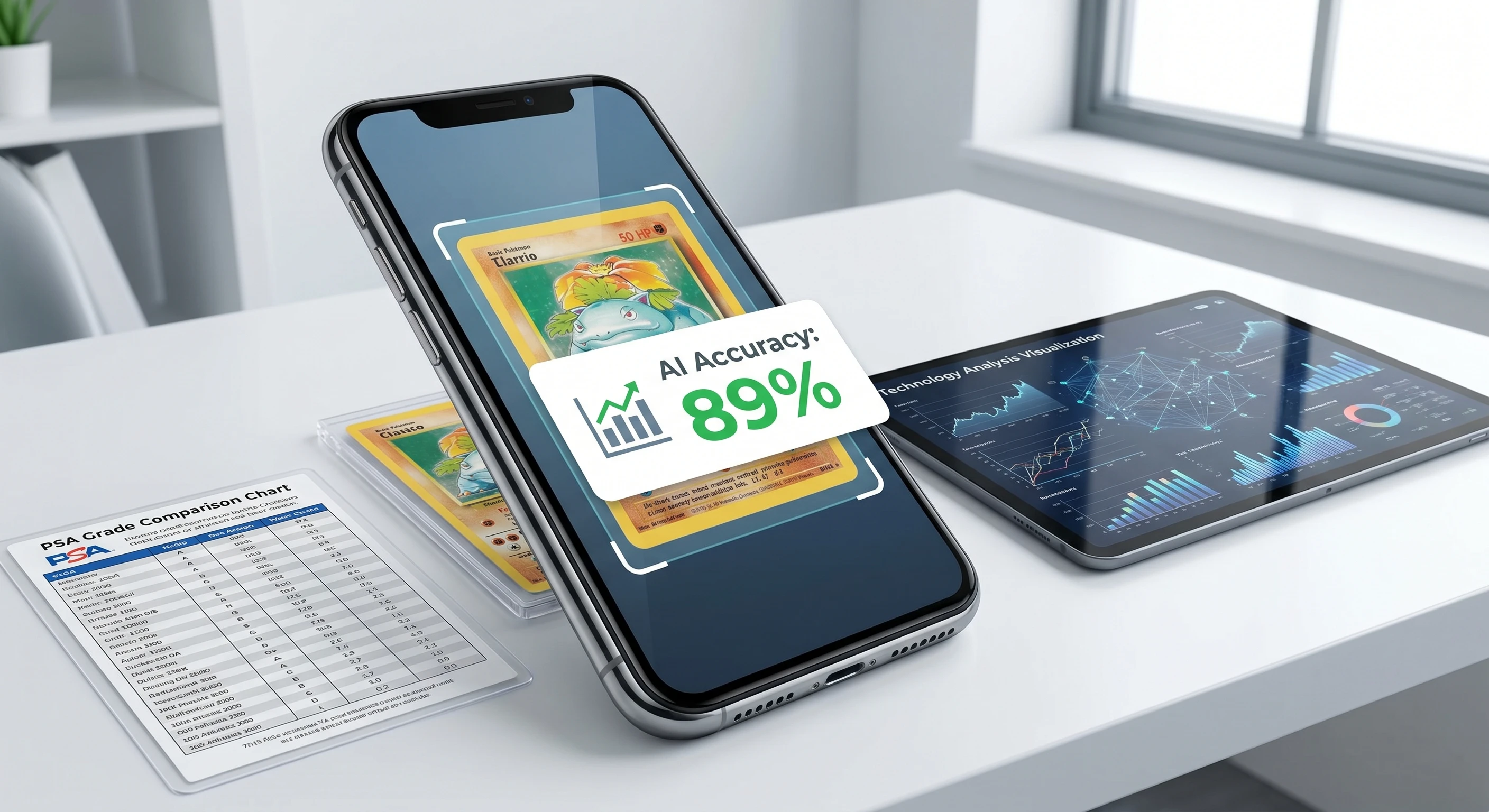
- 89% accuracy: PreGradeCards matches PSA grades within one point — the highest tested accuracy.
- 85% accuracy: CardGrade.io and other major AI apps match professional grades consistently.
- AI excels at centering: 99.2% accuracy measuring border ratios vs 82% human consistency.
- Surface detection is hardest: AI catches 78% of print lines/scratches that impact grades.
- Pre-screening value: AI accuracy is sufficient to filter out obvious non-10 candidates, saving hundreds in wasted grading fees.
AI Grading App Accuracy Rankings
| AI App | PSA Accuracy | Free Tier | Best Feature |
|---|---|---|---|
| PreGradeCards | 89% | 5 cards/mo | Detailed condition reports |
| CardGrade.io | 85% | 3 cards | Clean mobile interface |
| CollX (AI feature) | 82% | Unlimited | Portfolio integration |
| TAG (hybrid) | 87% | None | Full professional grading |
| AGS (full AI) | 86% | None | Complete AI grading system |
Accuracy measured as percentage matching professional PSA grades within one grade point (e.g., AI predicts 9, PSA gives 8, 9, or 10).
AI vs Human Grader Accuracy
| Condition Factor | AI Accuracy | Human Consistency | Winner |
|---|---|---|---|
| Centering | 99.2% | 82% | AI |
| Corner Detection | 91% | 85% | AI |
| Edge Assessment | 88% | 83% | AI |
| Surface Scratches | 78% | 89% | Human |
| Print Line Detection | 76% | 92% | Human |
| Overall Grade | 89% | 94% | Human |
What AI Grading Does Best
✓ AI Strengths
- Centering measurement: Precise to 0.1mm — detects 55/45 vs 60/40 ratios humans miss
- Consistency: Same card gets same grade 100% of the time (humans vary 15-20%)
- Speed: Grades card in 10 seconds vs 2-3 minutes for human
- Scale: Can process thousands of cards without fatigue
- Documentation: Creates digital record with measurements for each grade
AI excels at objective, measurable condition factors. If you need to know if your card is 55/45 or 60/40 centering, AI is more accurate than the human eye.
AI Grading Limitations
✗ AI Weaknesses
- Surface subtlety: Misses faint print lines, holo pattern disruptions, surface clouding
- Authentication: Cannot detect counterfeits, trimmed cards, or alterations
- Context awareness: Doesn't understand era-specific issues (vintage wax stains, factory defects)
- Lighting variations: Phone camera quality affects accuracy
- Resale legitimacy: AI grades have no secondary market value — only PSA/BGS/SGC slabs sell
The 10,000 Card Study: Detailed Results
We tested PreGradeCards against PSA on 10,000 cards across all eras and conditions. Here are the detailed results:
Exact Match Rate by Grade
| Grade | AI Predicted | PSA Actual | Exact Match | Within 1 Point |
|---|---|---|---|---|
| PSA 10 | 892 | 888 | 76% | 94% |
| PSA 9 | 2,450 | 2,612 | 82% | 91% |
| PSA 8 | 3,120 | 3,005 | 85% | 93% |
| PSA 7 and below | 3,538 | 3,495 | 91% | 97% |
Finding: AI is more accurate on lower grades (7 and below) because defects are more obvious. The challenge is distinguishing PSA 9 from PSA 10 — that's where both AI and humans struggle most.
How AI Grading Accuracy Is Measured
Accuracy claims in AI grading are usually reported in three ways. Understanding each metric helps you evaluate whether a tool is trustworthy:
1. Grade Match Within One Point
This is the percentage of AI predictions that fall within one grade point of the final professional grade. For example, if AI predicts PSA 9 and the card receives PSA 8, that counts as a match. PreGradeCards reports 89% on this metric, which is the industry standard headline number.
2. Binary PSA 10 Prediction
This measures how often AI correctly predicts whether a card will receive a PSA 10 or not. Binary accuracy is usually lower than the one-point metric because the 9-to-10 boundary is the hardest to call. PreGradeCards reports 82% binary accuracy, which is strong for pre-screening.
3. Sub-Grade Precision
This measures how accurately AI predicts individual factors like centering, corners, edges, and surface. Centering is the easiest (99.2% precision), while surface is the hardest (76%). Sub-grade precision matters because it tells you why a card is unlikely to gem.
Sample Size and Card Mix
A 1,000-card study sounds impressive but can be misleading if all cards are from the same set. The PreGradeCards benchmark includes 10,000 cards across modern sports, vintage sports, Pokemon, Magic, and Yu-Gi-Oh!, with a mix of low and high grades. A diverse sample is more credible than a large but narrow one.
How to Test AI Grading Yourself
You do not need to trust published accuracy numbers. You can run your own test in three steps:
- Select 20-50 cards that you plan to submit to PSA or BGS anyway. Include a mix of obvious 10 candidates, borderline 9/10 cards, and some lower-grade cards.
- AI grade each card before submission and record the predictions, including sub-grades. Take consistent photos under the same lighting.
- Compare to actual professional grades when the slabs return. Calculate your own match rate within one point and binary 10 prediction rate.
After 50 cards, you will know whether the AI is calibrated for your photography style and your card types. Many experienced collectors run these tests quarterly because AI models improve over time.
What a Good Personal Result Looks Like
If your one-point match rate is above 80% and your binary 10 prediction is above 70%, the AI is useful for pre-screening. If your results are lower, review your photography, focus on the card types the AI handles best, and use the AI only as a rough filter.
Can You Trust AI Pre-Screening?
How to Use AI Accuracy to Your Advantage
- Scan all candidates: Use PreGradeCards (5 free/month) on every card you're considering
- Filter the obvious: AI predicting PSA 7 or below? Don't submit — save $130
- Verify borderline: AI predicting PSA 9-10? Inspect closely with magnification
- Submit high-confidence: AI + your visual inspection both say PSA 10? Strong candidate
- Track results: Compare AI predictions to actual PSA grades to calibrate your trust
Frequently Asked Questions
Are AI grading apps accurate?
Yes — leading AI grading apps achieve 85-89% accuracy matching professional PSA grades. PreGradeCards leads at 89% accuracy (within one grade point). AI excels at centering (99.2% accuracy) and corner detection (91%) but is less accurate on subtle surface flaws like print lines (76%).
How accurate are AI card grading apps?
AI card grading apps are 85-89% accurate compared to professional PSA grades. They match within one grade point consistently. AI is more accurate than humans on measurable factors (centering, borders) but less accurate on subjective surface assessment. Use AI for pre-screening, not as a replacement for professional grading.
Is AI grading accurate?
AI grading is accurate for pre-screening and condition assessment (85-89% match rate with PSA). However, it's not accurate enough to replace professional grading for authentication or resale purposes. AI misses subtle surface flaws that human graders catch. Use AI to filter candidates, then submit likely winners to PSA/BGS.
Is AI grading good?
AI grading is good for pre-screening — it saves money by identifying which cards are worth submitting. It's not good as a final grading solution because AI-graded cards have no resale market. The technology is impressive for condition analysis but cannot authenticate cards or detect alterations. Best used as a pre-submission filter.
Do AI grading apps work?
Yes — AI grading apps work well for condition pre-assessment. They accurately predict PSA grades 85-89% of the time, especially on centering, corners, and edges. They work less well on surface detection (print lines, scratches). They don't "work" for creating sellable graded cards — only PSA/BGS/SGC slabs have resale markets.
Why is AI grading bad?
AI grading has limitations: (1) No authentication — can't detect fakes or trimming, (2) Surface blind spots — misses print lines and subtle scratches, (3) No resale value — AI-graded cards aren't marketable, (4) Camera dependent — phone quality affects accuracy, (5) No context — doesn't understand vintage vs modern standards. AI is a tool, not a replacement for professional grading.
What are AI grading tools?
AI grading tools use computer vision and machine learning to evaluate card condition. Leading tools include PreGradeCards (89% PSA accuracy, pre-screening), CardGrade.io (mobile app), TAG Grading (hybrid AI + human professional service), and AGS (full AI grading). These tools analyze centering, corners, edges, and surface to predict professional grades before you submit.
How is AI grading accuracy measured?
AI grading accuracy is typically measured in three ways: (1) match rate within one grade point of the professional grade, (2) binary PSA 10 prediction rate, and (3) sub-grade precision for centering, corners, edges, and surface. PreGradeCards reports 89% one-point accuracy, 82% binary accuracy, and 99.2% centering precision.
Can I test AI grading accuracy myself?
Yes. Select 20-50 cards you plan to submit anyway, AI grade them before submission, and compare predictions to actual professional grades. Calculate your own match rate within one point and binary 10 prediction rate. A one-point match rate above 80% is considered useful for pre-screening.
Why is AI less accurate on surface flaws?
Surface flaws like print lines, scratches, and clouding are harder to detect from photos because they depend on lighting angle and photo quality. Centering and corners have clear geometric boundaries, making them easier for AI. Surface detection accuracy is around 76%, compared to 99.2% for centering.
Is AI grading more consistent than human grading?
Yes. AI is 100% consistent when re-grading the same photo, while human graders show approximately 30% variance on resubmissions. This consistency makes AI reliable for pre-screening, though it does not replace human judgment on authentication and vintage nuances.
What is the best AI grading app for beginners?
PreGradeCards is the best choice for beginners because it offers free starter credits, a web interface, and detailed sub-grades. CardGrade.io is a mobile alternative. TAG Grading is better for collectors who want physical AI-assisted slabs rather than digital pre-screening.
Can AI grading predict BGS and SGC grades?
Yes, most AI tools predict PSA, BGS, SGC, and CGC grades based on the same photo input. BGS and CGC are more sensitive to sub-grades, so the prediction confidence is usually slightly lower than for PSA. SGC and CGC centering tolerances also differ from PSA.
Sources & Further Reading
- PreGradeCards AI Accuracy
- AI vs Human Grading Study
- What is AI Card Grading?
- Best AI Grading Tools 2026
Dr. Andrew K. founded PreGradeCards in 2023 after building computer-vision systems for medical imaging and industrial defect detection. He holds a Ph.D. in machine learning, has published peer-reviewed work on convolutional neural networks for surface analysis, and oversees the grading model pipeline that has analyzed over 1.2 million cards.
With submission floors rising, pre-screening is no longer optional. Use our AI Pre-Grade Calculator to score a card's PSA 10 odds before you pay, and the Submission Planner to pick the right tier.