The Short Answer
- Quarterback rookie cards account for the majority of high-value football card grading submissions.
- PSA 10 Panini Prizm QB rookies routinely command 4-10x premiums over PSA 9 copies.
- Centering and print lines are the two biggest reasons modern football cards miss PSA 10.
- Vintage Topps football cards are graded with era-appropriate standards; wax stains and gum residue are common.
- AI pre-screening can identify surface defects, corner whitening, and centering issues before you pay grading fees.
Football Card Grading Market in 2026
The football card market is one of the most grading-intensive segments of the hobby. Panini America produces the only NFL-licensed trading cards, and the annual Prizm, Select, and Mosaic releases drive millions of submissions to PSA, BGS, SGC, and CGC every year. In 2025, PSA graded more than 1.2 million football cards, with Panini Prizm and Select accounting for over 40% of that volume.
The market is quarterback-driven. Rookie cards of starting quarterbacks carry the highest grading premiums, followed by elite wide receivers and running backs. Defensive players and linemen rarely justify the cost of grading unless they are generational Hall of Fame talents. The grading boom has created a clear tier system: PSA 10 gem mint cards trade at significant premiums, while PSA 9 and lower grades often struggle to cover the grading cost on common players.
PreGradeCards AI grading analysis of 2024-2025 football submissions shows that the average PSA 10 hit rate across all Panini Prizm base cards is approximately 38%, but that number drops to 28% for quarterback rookies and rises to 52% for veteran base cards. The lower PSA 10 rate for rookies is driven by massive submission volume, higher centering variance, and more aggressive handling of chase cards out of packs.
Top Football Card Brands to Grade
Not every football card brand is worth grading. The market has consolidated around Panini since the company acquired the exclusive NFL license in 2016. Before that, Topps, Bowman, and Fleer produced the most important vintage and early modern football cards. Here is the current grading hierarchy for modern football cards.
| Brand / Set | Target Cards | PSA 10 Hit Rate | Grading Priority |
|---|---|---|---|
| Panini Prizm | QB rookies, silver prizms, color parallels | ~38% | Highest |
| Panini Select | Field Level, Club Level, die-cut parallels | ~35% | High |
| Panini Mosaic | Rookie variations, genesis, stained glass | ~40% | Medium-High |
| Panini Contenders | Rookie Ticket autos, playoff tickets | ~32% | High for autos |
| Topps Chrome (vintage) | 1950s-2000s Topps rookies | ~25% | High for vintage |
| Panini Donruss | Rated Rookies, base rookies | ~42% | Medium |
Panini Prizm is the flagship brand for football card grading. It has the deepest liquidity, the largest collector base, and the strongest resale premiums. Select is the second-most submitted brand, with Field Level parallels trading at higher prices than base Prizm in many cases. Mosaic is visually distinctive but generally trades below Prizm and Select. Contenders is essential for autographed rookie cards, but the sticker autos and ticket-style designs are notoriously condition-sensitive.
Most Valuable Modern Football Cards to Grade
The value of a graded football card depends on player, set, parallel, and grade. The chart below shows typical 2026 PSA 10 vs PSA 9 values for the most important modern football rookie cards. These are estimated market ranges based on recent auction sales and population scarcity.
| Card | Set | PSA 10 Range | PSA 9 Range | 10x Premium |
|---|---|---|---|---|
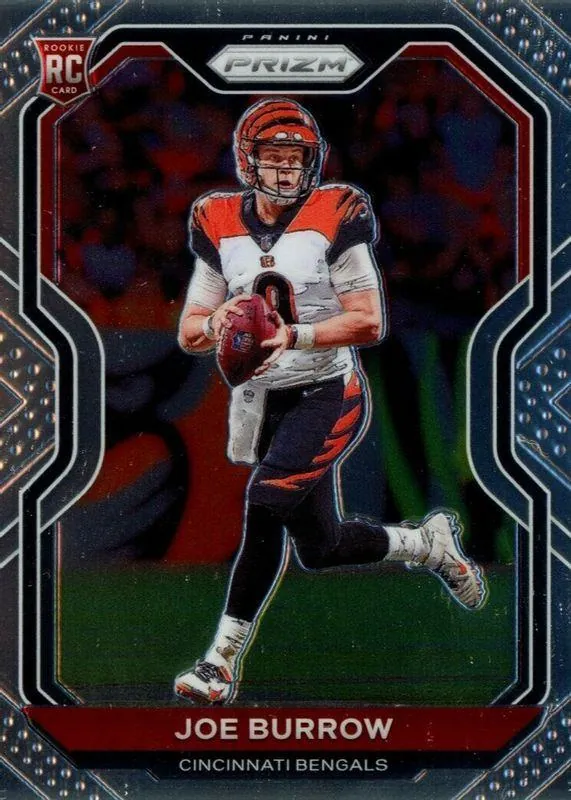
| Joe Burrow Prizm #321 | 2020 Panini Prizm | $1,800 - $3,500 | $300 - $550 | ~6x |
| Justin Herbert Prizm #325 | 2020 Panini Prizm | $1,200 - $2,400 | $200 - $400 | ~6x |
| Trevor Lawrence Prizm #301 | 2021 Panini Prizm | $400 - $800 | $80 - $150 | ~5x |
| Brock Purdy Prizm #353 | 2022 Panini Prizm | $1,500 - $3,000 | $250 - $450 | ~6x |
| C.J. Stroud Prizm #339 | 2023 Panini Prizm | $800 - $1,600 | $150 - $300 | ~5x |
| Jayden Daniels Prizm #340 | 2024 Panini Prizm | $600 - $1,200 | $120 - $220 | ~5x |
These ranges fluctuate based on player performance, playoff success, and market momentum. The PSA 10 premium is highest when the player is actively winning and the population of PSA 10s remains relatively low. Once a player has a very large PSA 10 population, the premium compresses. For example, Joe Burrow has a higher PSA 10 population than Brock Purdy, but Purdy has traded at comparable or higher PSA 10 prices due to his Super Bowl run and lower relative supply.
PSA, BGS, SGC, and CGC Grading Standards
Each major grading company applies the same four pillars to football cards: centering, corners, edges, and surface. However, the interpretation of those standards and the label that results from them differs significantly between graders. PSA is the dominant resale brand for football cards. BGS remains relevant because of sub-grades and the 9.5 designation. SGC has gained market share with faster turnaround and lower prices. CGC is the newest entrant and tends to be the strictest on modern centering.
PSA 10 requires 55/45 centering or better on the front, 75/25 or better on the back, and no visible flaws under 10x magnification. BGS 9.5 is roughly equivalent to a PSA 9 or weak PSA 10 in the market, but BGS 10 Black Label commands a higher premium than PSA 10 when it appears. SGC 10 is often considered comparable to PSA 10 for vintage and modern cards, and SGC has been aggressive about winning football market share with $15-25 grading tiers. CGC is generally the strictest on centering and is popular with collectors who want the tightest standard at a lower price point.
For football cards specifically, the order of resale premium is usually: PSA 10 > BGS 10 Black Label > SGC 10 > BGS 9.5 > PSA 9 > CGC 9.5 > SGC 9.5 > raw. The exact ranking changes by player and set, but PSA 10 is the gold standard for modern football rookies.
Centering and Corner Analysis
Centering is the single most common reason a football card misses PSA 10. Panini prints millions of Prizm and Select cards each year, and the cutting process produces significant variance. A card that looks centered to the naked eye may fail the 55/45 standard when measured. The front centering is more important than the back centering for PSA 10, but both are evaluated.
Corners are the second-most common deduction. Panini cards often leave the factory with slightly soft corners, and the cards are handled aggressively during the pack-out process. A tiny touch of whitening on a corner can drop a modern card from PSA 10 to PSA 9. This is especially true on cards with white borders, where whitening is highly visible.
How to Check Centering at Home
Use a clear centering tool or a digital caliper. Measure the left and right borders, then the top and bottom borders. For PSA 10, the larger border should not exceed 55% of the total border width. For example, if the left border is 2.5mm and the right border is 2.0mm, the left border is 55.5% of the total, which may fail. Back centering is allowed to be 75/25, but tighter is better for maximum value.
Edge wear is also a problem on football cards. The die-cut designs in Select and the thick stock in Contenders make edges prone to chipping. Edge chipping is less visible than corner whitening but is equally damaging to the grade. Always inspect the entire perimeter of the card before submitting.
Surface Defects and Print Lines
Surface defects are the most deceptive grade killers on modern football cards. Panini Prizm cards have a chrome finish that acts like a mirror. Print lines, holo scratches, and surface residue are often invisible under normal lighting but become glaring under a bright LED or at an angle. The most common surface issues are factory print lines, which appear as thin vertical or horizontal lines on the chrome surface. These are present out of the pack and are not the collector fault, but they still reduce the grade.
Print lines are particularly common on Prizm silver cards and Select holo parallels. They are most visible on the jersey area and the background of the card. A print line that crosses the player face is usually more damaging than one on the border. A single prominent print line almost always prevents PSA 10. Two or more print lines typically result in a PSA 8 or lower.
Holo scratches are different from print lines. They are caused by handling and are usually curved or scattered. They appear as fine hairline scratches on the reflective surface. Surface residue from fingers or storage can sometimes be removed with a microfiber cloth, but scratches and print lines are permanent. AI pre-screening is especially useful for detecting surface defects because it can analyze the card under consistent lighting and flag issues that the human eye misses.
The chart above shows the approximate distribution of PSA 10 deductions on submitted Panini Prizm football cards. Centering is the most common issue, followed by corners and surface. This is why pre-screening is so valuable. Most collectors overestimate the condition of their raw cards because they do not inspect them under the lighting and magnification that graders use.
Autographed Football Cards
Autographed football cards are graded on two criteria: the condition of the card itself and the quality of the autograph. Panini Contenders and National Treasures produce the most important signed football rookie cards. The autograph must be complete, bold, and not faded. Streaking, smudging, or incomplete signatures lower the grade. The card surface around the autograph cannot have damage from the signing process.
Sticker autographs are common in Panini products. The sticker is placed on the card after the player signs it. Sticker autos can have bubbles, peeling, or surface damage around the sticker edge. On-card autographs are generally preferred by collectors and command higher prices, but they are more expensive to produce and therefore more common in high-end products. For investment purposes, on-card rookie autographs typically outperform sticker autos by 20-40% at the same grade.
When grading autographed football cards, the autograph is usually the first thing graders look at. A card with a perfect surface but a streaked auto will not receive a 10. If you are considering buying a raw autograph for grading, ask the seller for close-up photos of the signature and the area immediately around it.
Vintage Topps Football Card Grading
Before Panini held the exclusive NFL license, Topps was the dominant football card manufacturer. Vintage Topps football cards from the 1950s through the early 2000s are graded with era-appropriate standards. A 1957 Topps Johnny Unitas rookie can earn a PSA 6 with moderate corner wear, while a 1986 Topps Jerry Rice rookie needs to be much cleaner to earn a PSA 9 or 10.
Vintage football cards often have wax stains, gum residue, and creasing from being stored in packs. These defects are noted on the label but are more forgivable than on modern cards. Centering was also much looser on vintage cards, so a 60/40 front centering can still earn a high grade if the corners and surface are strong. The most valuable vintage football cards to grade are rookie cards of Hall of Fame quarterbacks, running backs, and wide receivers, particularly from the 1950s, 1960s, and 1980s.
The 1986 Topps Jerry Rice rookie, the 1981 Topps Joe Montana rookie, and the 1957 Topps Johnny Unitas rookie are the three most important vintage football cards. A PSA 8 copy of the Montana rookie typically trades for $1,000-$2,000, while a PSA 10 can reach $10,000+. The Jerry Rice rookie is similarly valuable, with PSA 10 copies being extremely rare due to the poor centering and soft corners common in the 1986 Topps set.
ROI and Investment Outlook for Graded Football Cards
Grading football cards is an investment decision. The cost of grading ranges from $15 to $300 per card depending on the service level and grader. A card should only be graded if the expected value in the target grade exceeds the grading cost by a meaningful margin. For modern football cards, the rule of thumb is that the PSA 10 value should be at least 3x the PSA 9 value before the grading cost is justified. For vintage cards, the math is different because the grading cost is fixed while the card value may be high.
The football card market has shown long-term growth driven by sports betting, daily fantasy sports, and increased media coverage of the NFL draft. Rookie cards of quarterbacks who become franchise players have historically delivered the best returns. The 2017 Panini Prizm Patrick Mahomes rookie is a case study: raw copies were $50 in 2017, PSA 9 copies reached $1,000 by 2020, and PSA 10 copies exceeded $10,000 at peak. However, not every rookie performs this way. The majority of quarterback rookies fail to justify the grading cost.
AI pre-screening changes the ROI equation by reducing the number of cards sent for grading. If a collector has 100 raw Prizm rookies, the AI can identify the 20 best candidates and the 80 cards that should be sold raw or held ungraded. This reduces the total grading cost by 80% and increases the average grade of the submitted cards. Over a full season, this can improve the collector net return by 30-50%.
What to Submit for Grading
Here is a practical checklist for deciding which football cards to grade in 2026. The answer depends on player, set, condition, and market timing.
- Submit: Rookie cards of starting quarterbacks, especially from Panini Prizm, Select, and Contenders.
- Submit: Color parallels and numbered cards of star players, including /99, /49, /25, /10, and 1/1.
- Submit: Vintage rookie cards of Hall of Famers from Topps sets.
- Submit: Autographed rookie cards with clean signatures and minimal surface issues.
- Do not submit: Base cards of common players, even in good condition, unless they are extremely rare.
- Do not submit: Cards with visible print lines, corner whitening, or centering that fails the 55/45 standard.
- Pre-screen first: Always use AI or a magnifier to inspect surface and centering before paying grading fees.
Timing also matters. The football card market peaks during the NFL season and playoffs, especially around the Super Bowl. Rookie cards of players who make the playoffs often spike in January and February. The market is typically softest in the late spring and summer. If you have a choice, sell graded cards during the season and buy raw cards during the offseason.
Frequently Asked Questions
What is the best football card brand to grade in 2026?
Why do so many Panini Prizm football cards get PSA 9?
Are vintage Topps football cards worth grading?
Can AI help me pick football cards to grade?
How much does it cost to grade a football card?
What is the PSA 10 premium for football rookies?
Sources & Further Reading
- PSA Football Population Reports
- SportsCardsPro Football Price Guide
- Panini America
- GemRate Grading Trends
The PreGradeCards Research Team combines machine-learning engineers, grading analysts, and collector-education specialists to produce accurate, data-driven guides on AI card grading, professional grading standards, and collecting strategy.
With submission floors rising, pre-screening is no longer optional. Use our AI Pre-Grade Calculator to score a card's PSA 10 odds before you pay, and the Submission Planner to pick the right tier.