The Short Answer
- Cards AI is the best overall tracker — scans individual cards into a synced binder with real eBay sold prices and AI condition grading.
- Collectr is best for clean cataloging — polished interface across sports and TCG with portfolio value tracking.
- CollX offers the largest free database — 20M+ cards identified with a built-in marketplace and no cost entry.
- Card Ladder is the investor's choice — historical price charts, index analytics, and portfolio-level tracking.
- Scanning is the #1 feature — manual entry kills motivation; apps that scan cards keep collections updated.
- Real sold prices matter more than listed prices — the best trackers pull from eBay sold comps, not asking prices.
- Most apps cover Pokemon and sports — MTG and niche TCG coverage varies; check game support before committing.
Why Use a Card Collection Tracker?
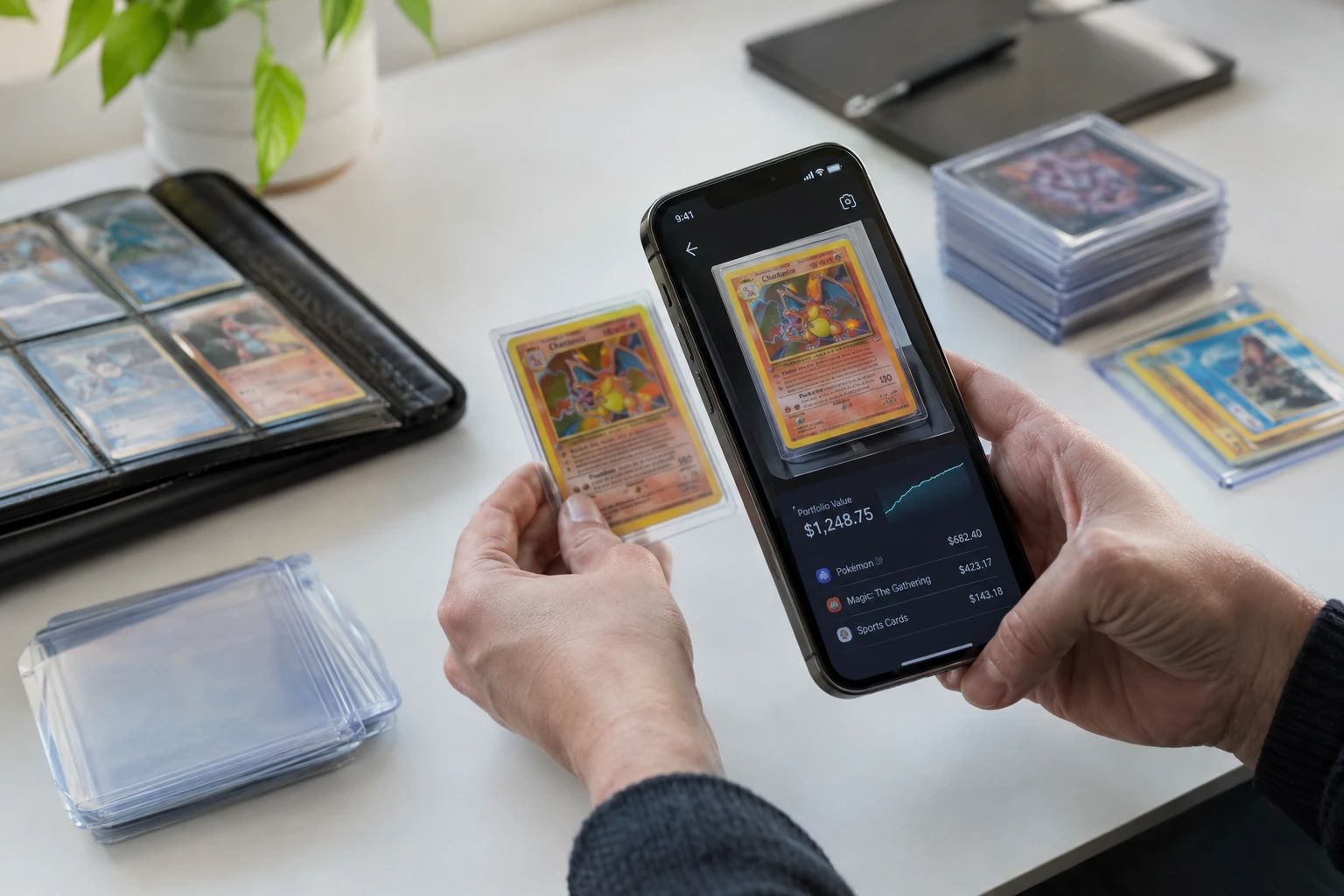
If you have more than 50 cards, you need a tracker. The days of spreadsheets and binder notes are over. Modern card collection tracker apps use AI-powered image recognition to identify cards from a single photo, pull real-time market prices from eBay and TCGPlayer, and give you a running portfolio total that updates as the market moves.
The biggest reason collectors quit tracking is manual entry. Typing in hundreds of card names, set numbers, and conditions by hand is tedious enough that most people give up before finishing a single set. The apps that solve this problem — by letting you scan cards with your phone camera — are the ones that actually keep collections updated.
A good tracker does three things: it gets cards into your collection fast (scanning, not typing), it organizes them so you can find and filter what you have, and it keeps a running value so you know what your collection is worth. The best trackers also offer set completion percentages, price alerts, export options, and integration with grading tools like PreGradeCards for pre-screening before submission.
How We Tested and Ranked
We tested each app against five criteria that matter to collectors:
- Scanning speed and accuracy: How fast does it identify a card from a photo? How often does it get the right card on the first try?
- Pricing data quality: Does it pull real sold prices or just listed prices? How current is the data?
- Game coverage: Does it support Pokemon, MTG, Yu-Gi-Oh!, One Piece, Lorcana, and sports cards?
- Portfolio features: Set completion, value charts, export, price alerts, collection insights.
- Cost and privacy: Is there a free tier? Are there scan limits? Does it require an account? Where is your data stored?
We scanned 50 cards across Pokemon, MTG, Yu-Gi-Oh!, and sports cards on each app. We checked pricing accuracy against eBay sold listings. We evaluated the user interface for ease of use and the depth of features for serious collectors.
1. Cards AI — Best Overall
Cards AI lets you scan individual cards straight into a digital binder that syncs across your devices. This matters more than it sounds — many trackers only scan sealed product barcodes and make you search a database by name to add singles, which is slow enough that people give up. Scanning the actual card is what keeps a big collection updated.
Each card is priced from real recent eBay sold listings for that exact card, with outliers trimmed. You also get an AI condition grade across centering, corners, edges, and surface — the same four pillars that PSA, BGS, and CGC evaluate. This makes Cards AI particularly useful for collectors who want to pre-screen cards before grading submissions.
Key Features
- Scans front and back of individual cards
- Real eBay sold prices with outlier trimming
- AI condition grading (centering, corners, edges, surface)
- Covers sports cards and Pokemon
- iPhone and Android support
- Digital binder with sync across devices
Pricing
Free to try for 7 days. Paid plans start at $4.99/month for unlimited scanning and full condition reports.
Best For
Collectors who want scanning, pricing, and AI grading in one app. The condition grading feature makes it especially valuable if you are considering professional grading — scan first, then decide which cards to submit.
2. Collectr — Best for Clean Cataloging
Collectr offers a polished, easy-to-use interface for cataloging both sports cards and trading card games. It is popular with collectors who want an organized, good-looking collection view without the complexity of investor-grade analytics.
The app supports scanning for quick entry, though its identification accuracy is slightly below Cards AI on niche and vintage cards. Where Collectr shines is organization — the interface makes it easy to browse your collection by set, player, team, or card type, and the portfolio value tracking is clear and straightforward.
Key Features
- Clean, intuitive collection interface
- Supports sports cards and TCG
- Portfolio value tracking
- Barcode scanning for sealed products
- Set completion tracking
- Available on iOS and Android
Pricing
Free with optional premium features. The free tier is generous enough for most casual collectors.
Best For
Collectors who prioritize a clean, organized view of their collection and want something that works well across both sports cards and TCG without a steep learning curve.
3. CollX — Best Free Database
CollX identifies cards against a database of more than 20 million entries and returns an average market value. It has a free tier with a built-in marketplace, making it the strongest no-cost option for getting a big collection catalogued quickly.
The scanning feature works well for modern cards but can struggle with vintage and obscure issues. Pricing is based on average market data rather than individual sold comps, which means it is less precise than Cards AI or Card Ladder but good enough for bulk collection valuation.
Key Features
- 20M+ card database
- Free tier with no scan limits on basic features
- Built-in marketplace for buying and selling
- Batch scanning mode
- Average market value pricing
- iOS and Android
Pricing
Free with ads. Premium subscription available for ad-free experience and advanced analytics.
Best For
Collectors who want to catalog a large collection at no cost. The 20M+ database means most cards will be identified, and the built-in marketplace is a nice bonus for casual buying and selling.
4. Card Ladder — Best for Investors
Card Ladder is built for serious portfolio and market tracking. It offers historical price data, index-style analytics, and the kind of charting tools that investors expect from financial software. If you treat your collection as an investment and want to watch its value move over time, Card Ladder is the most powerful option.
The platform tracks graded card prices across PSA, BGS, CGC, and SGC, with historical charts going back years. It also publishes market indices — the Card Ladder Pokemon index is up 145% year-over-year as of mid-2026, and their sports card indices track the overall market direction.
Key Features
- Historical price charts for graded cards
- Market indices (Pokemon, sports, vintage)
- Portfolio tracking with gain/loss reporting
- PSA, BGS, CGC, SGC price tracking
- Web-based and mobile app
- Price alerts and watchlists
Pricing
Subscription-based. A free PSA Collectors Club membership includes a Card Ladder subscription, which is the best value entry point. Standalone subscriptions start at $14.99/month.
Best For
Investors and serious collectors who want professional-grade portfolio analytics. If you track your collection's performance like a stock portfolio, Card Ladder is the tool. Pair it with our grading ROI guide to calculate which cards are worth submitting.
5. Dex — Best for Pokemon Set Completion
Dex is a long-standing favorite for Pokemon collectors built around sets and completion. If your goal is to complete every set in the Pokedex or finish a specific expansion, Dex gives you clear Have/Need lists, completion percentages, and set checklists.
The app does not offer the broad market analytics of Card Ladder or the AI grading of Cards AI, but for pure Pokemon set building, it is hard to beat. The interface is clean, the set data is comprehensive, and the community features let you trade with other collectors to fill gaps.
Key Features
- Complete Pokemon set checklists
- Have/Need lists with completion percentages
- Community trading features
- Card scanning for quick entry
- iOS and Android
Pricing
Free with premium features available via in-app purchase.
Best For
Pokemon collectors focused on set completion. If you are working through the 30th Celebration expansion or building a Mega Evolution master set, Dex keeps you organized.
6. ManaBox — Best for MTG Players
ManaBox pairs collection tracking with deck building, so the cards you own shape what you can build. This makes it uniquely useful for Magic: The Gathering players who want their collection to inform their gameplay decisions, not just sit in a database.
The app supports MTG-specific features like format legality checking, mana curve visualization, and deck stats. Collection tracking includes scanning, pricing from TCGPlayer, and trade list management. For MTG collectors who also play, ManaBox is the natural choice.
Key Features
- MTG-focused collection tracking
- Deck builder with format legality
- TCGPlayer price integration
- Trade list management
- Set completion tracking
- iOS and Android
Pricing
Free with premium subscription for advanced deck analytics and unlimited collection size.
Best For
MTG players who want collection tracking and deck building in one app. If you play Commander, Standard, or Modern and want your collection to inform your decks, ManaBox is the answer.
7. Shiny — Best Multi-Game Tracker
Shiny is a strong multi-game pick, spanning Pokemon, Magic: The Gathering, Lorcana, One Piece, and Yu-Gi-Oh!. It includes price alerts and a centering tool for grading prep — a feature most trackers do not offer.
The centering tool is particularly noteworthy. It lets you measure your card's centering ratio directly in the app, which is the single most common reason cards do not grade PSA 10. If you are pre-screening cards for grading, having a centering tool built into your tracker saves you from switching between apps.
Key Features
- Multi-game: Pokemon, MTG, Lorcana, One Piece, Yu-Gi-Oh!
- Price alerts
- Built-in centering tool for grading prep
- Collection tracking with set completion
- iOS and Android
Pricing
Free with premium features for unlimited tracking and advanced analytics.
Best For
Collectors who collect across multiple TCGs and want a single app that handles all of them. The centering tool makes it especially useful if you are pre-screening for card grading submissions.
8. TCGPlayer App — Best Marketplace Integration
TCGPlayer's mobile app includes scanner functionality optimized for their marketplace. It is strong on Pokemon, Magic, and Yu-Gi-Oh! but weaker on sports cards. The key advantage is direct integration with TCGPlayer's listing system — scan a card, see its market price, and list it for sale in one flow.
The pricing data comes from TCGPlayer's own marketplace, which is the standard for TCG card pricing in the US. The scanner works well for modern cards but can struggle with vintage and foreign-language cards.
Key Features
- TCGPlayer marketplace integration
- Scan-to-list functionality
- Strong Pokemon, MTG, Yu-Gi-Oh! support
- Market price data from TCGPlayer
- Collection tracking and store integration
- iOS and Android
Pricing
Free. TCGPlayer makes money through marketplace fees when you buy or sell.
Best For
Collectors who buy and sell on TCGPlayer. If you are actively selling TCG singles, the scan-to-list workflow is the fastest path from card to listing.
9. Ludex — Best for Sports Card Scanning
Ludex is a sports-card-focused scanner with deep price history charts and accurate recognition of vintage sports cards, which competitors sometimes struggle with. If your collection is primarily sports cards — baseball, football, basketball, hockey — Ludex offers the best scanning experience for that category.
The app also supports TCG cards but its strength is sports. Ludex integrates with eBay for pricing comps and offers one-tap listing creation, which is useful for active sellers.
Key Features
- Strong sports card recognition (vintage and modern)
- Deep price history charts
- eBay integration for comps and listings
- Batch scanning mode
- iOS and Android
Pricing
Free basic scanning. Premium subscription at $9.99/month for unlimited scans and full price history.
Best For
Sports card collectors, especially those with vintage cards. If you have a stack of 1970s-1990s baseball, football, or basketball cards, Ludex will identify them more reliably than TCG-focused apps.
10. Cardstash — Best Privacy-First Option
Cardstash is the free, no-account, fully offline way to scan, track, and value your trading card collection. It covers Pokemon, Magic: The Gathering, Yu-Gi-Oh!, and Disney Lorcana, with a 180,000+ card database. Everything stays on your device — no account, no cloud, no tracking, no ads.
The app uses an honest confirm-first OCR scanner: it reads the card name and collector number, presents ranked candidates, and lets you confirm the match. This prevents the silent misidentifications that plague one-tap black-box scanners. Prices are estimates from a dated snapshot rather than live data, so you should verify high-value cards independently.
Key Features
- Free forever, no account, no subscription
- Fully offline — data never leaves your device
- 180,000+ card database
- Multi-language support (English, Japanese, French, German, Spanish, Italian, Portuguese, Korean, Chinese)
- Continuous scanning mode
- Free CSV/JSON export and backup
- Set completion tracking
- Value-over-time chart
Pricing
Free. All features included from day one — no subscription, no in-app purchases, no paid tiers.
Best For
Privacy-conscious collectors who want a completely free, offline tracker. If you do not want your card data in the cloud and you do not want to pay a subscription, Cardstash is the best option. The CSV export means you can move your data anytime.
Full Comparison Table
| App | Games | Scanning | Pricing Data | Free Tier | Best For |
|---|---|---|---|---|---|
| Cards AI | Sports, Pokemon | Yes (front/back) | eBay sold | 7-day trial | Overall |
| Collectr | Sports, TCG | Barcode | Market avg | Yes | Cataloging |
| CollX | Sports, TCG | Yes | Market avg | Yes (ads) | Free database |
| Card Ladder | Sports, TCG | No | Historical | With PSA membership | Investors |
| Dex | Pokemon | Yes | TCGPlayer | Yes | Set completion |
| ManaBox | MTG | Yes | TCGPlayer | Yes | MTG players |
| Shiny | 5 TCGs | Yes | Market avg | Yes | Multi-game |
| TCGPlayer | Pokemon, MTG, YGO | Yes | TCGPlayer | Yes | Selling |
| Ludex | Sports, TCG | Yes | eBay | Limited | Sports cards |
| Cardstash | 4 TCGs | Yes (OCR) | Snapshot | Yes (all) | Privacy |
How to Choose the Right Tracker
The right tracker depends on what you collect and what you want to do with your collection. Here is a quick decision framework:
If you collect Pokemon only
Dex for set completion, Cards AI for scanning + grading prep, or Cardstash for a free offline option.
If you collect sports cards only
Ludex for scanning and price history, Card Ladder for investor analytics, or CollX for a free option.
If you collect across multiple games
Shiny for multi-TCG tracking with a centering tool, Collectr for clean cataloging, or Cardstash for free offline tracking.
If you are pre-screening for grading
Cards AI for AI condition grading, Shiny for the centering tool, or pair any tracker with PreGradeCards for full pre-grading analysis before PSA, BGS, or CGC submission.
If you are on a budget
CollX and Cardstash are both free with no scan limits. Collectr has a generous free tier. Most apps offer enough in their free tier to get started — upgrade only when you hit real limitations.
Whatever tracker you choose, the most important thing is to actually use it. A tracker that scans cards and stays updated is worth more than the most powerful analytics tool that you abandon after a week because manual entry is too tedious. Start free, scan your first 50 cards, and see which app fits your workflow.
Frequently Asked Questions
What is the best free card collection tracker app?
Can I scan cards with my phone to add them to my collection?
Which card tracker app has the best pricing data?
Do card collection tracker apps work for both sports cards and TCG?
Can I use a card tracker app to help with grading decisions?
Is there a card collection tracker that works offline?
Sources & Further Reading
Marcus Chen has evaluated over 50,000 sports cards and TCG cards across PSA, BGS, SGC, and CGC standards. Before joining PreGradeCards, he worked as a submission specialist for a major grading company and trained collectors and dealers on condition assessment.
Create a free account and get 2 free credits — enough for 2 complete AI gradings with market pricing. No credit card required.
Sign Up Free →